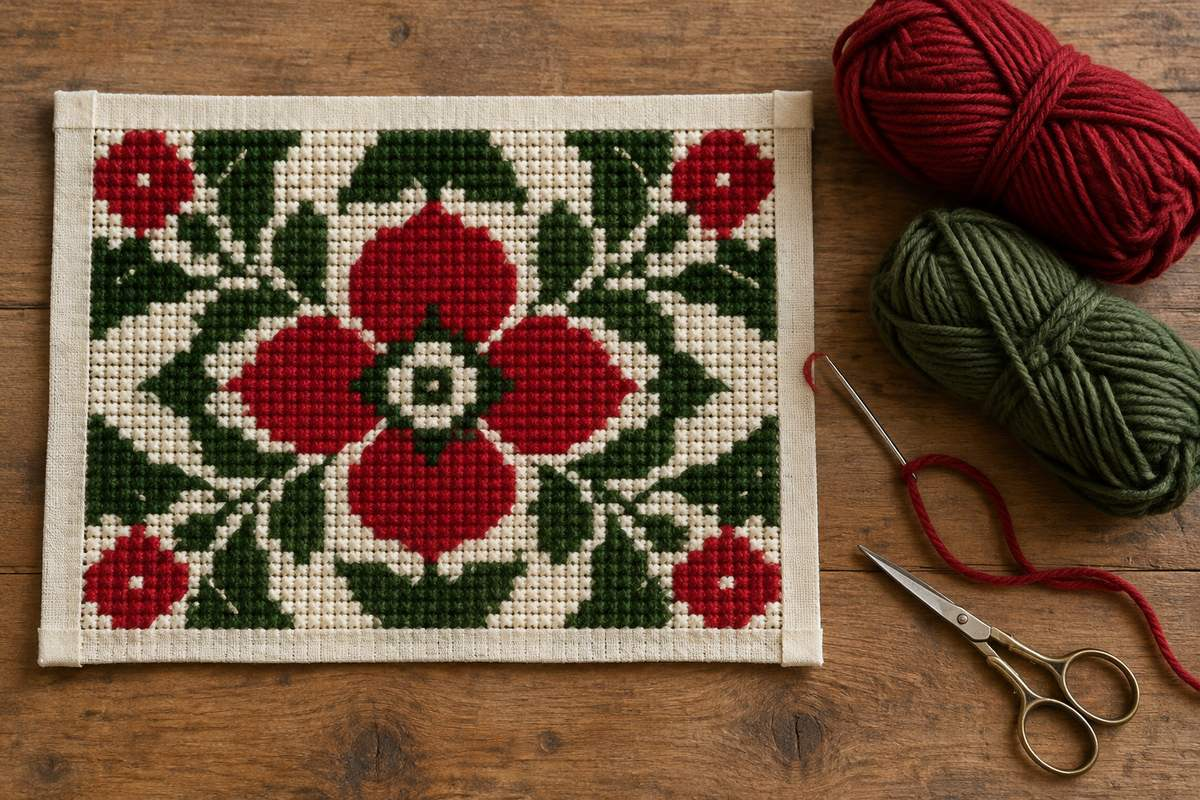
Many cross stitch charts can be worked as needlepoint, because both crafts read a grid in which each square is one stitch. The conversion is easy for some charts and frustrating for others, and the difference comes down to partial stitches, backstitch, color changes, canvas choice and thread thickness. This guide covers how to pick a chart, how to size the canvas, which canvas and stitch to use, how many strands to use per mesh size, and what to do about gaps. Last updated November 13, 2026.
Start here: Choose a chart with whole stitches only, large blocks of color and little backstitching. Work out the finished size with the canvas mesh count, not the Aida count. Use a thicker thread than the chart suggests, and tint or choose a neutral canvas so any bare canvas does not show.
Why the conversion works
Janet Perry of Nuts about Needlepoint, a needlepoint teacher's site, explains the idea: cross stitch and needlepoint charts use the same convention, where each square on the graph is one stitch. In cross stitch the stitch goes over one thread of the fabric, and in needlepoint a tent stitch goes over one intersection of canvas threads. A stitch is still a stitch. It is just that the threads are thinner and the holes bigger in cross stitch.
Ruth Cartwright of Craft with Cartwright, a pattern designer, gives the same rule in plain terms: each cross stitch X corresponds to one tent stitch, so you follow the chart and work a tent stitch where each X is. Tent stitch is a small diagonal stitch over one intersection of canvas threads. Our guides on needlepoint versus cross stitch and reading a needlepoint chart give background.
Choose a chart that converts well
Herrschners, a needlework retailer, warns about the problems people run into: charts with many color changes that make basketweave almost impossible to work, canvas showing through the stitches, and partial stitches that leave you asking how to work half a basketweave stitch. It suggests checking what size fabric the chart uses, how many colors it has, how many half or quarter stitches it has and how intricate the color changes are.
Easy designs, in Herrschners' words, are charted on a fabric size similar to common canvas sizes (12, 14 or 18 mesh), have large blocks of color and depend almost entirely on full stitches. Those are good first charted needlepoint projects.
Perry gives the same filter. Look for charts with whole stitches only and minimal backstitching. Because of how canvas is built, you cannot make precise partial stitches on needlepoint canvas, so quarter, half and three-quarter stitches cause trouble. Cartwright agrees that you should choose designs with full stitches only and, if possible, full coverage, meaning the design fills all of the fabric. Our fractional stitches guide explains what those stitches are.
About backstitch: Perry says backstitching is hard to do on needlepoint and that you can ignore it when it only outlines. When it provides detail, such as lines in a gingerbread house, she stitches it over the finished tent stitch base to keep the fine details.
Work out the size
A chart's finished size depends on the canvas, not on the fabric the chart was written for. Cartwright gives an example: a chart 76 stitches wide by 28 high is 5.29 by 1.86 inches on 14-count Aida and 4.22 by 1.55 inches on 18-count canvas. Divide the stitch count by the mesh count in each direction.
Because canvas mesh counts differ from Aida counts, a design stitched on 18-mesh comes out smaller than the same chart on 14-count. Cartwright also notes that if you reverse the process and convert needlepoint to cross stitch, you have to remember the count for sizing in the same way. Our mesh size chart and 13 versus 18 mesh guide help you choose.
Choose the canvas
The canvas decides how much bare mesh shows. Herrschners offers these options.
- Penelope (double mesh) canvas. If the chart has many half and quarter stitches, use Penelope canvas. It comes in the same mesh counts as mono canvas, but the threads are in pairs that are normally covered by one stitch. The pairs can be separated so you can make half and quarter stitches as in cross stitch, and the stitches cover this canvas more easily. Our canvas types guide compares the types.
- Colored canvas. On mono or double mesh, use a neutral color such as ecru rather than white, because it is less obvious if it peeks through.
- Painted canvas. Tint areas with diluted acrylic paint, such as soft blue for sky, green for a field and red for a house, so any exposed canvas blends in. Painting the major shapes also makes basketweave easier to follow. Our paint your own canvas guide covers painting a canvas.
Before you start, prepare the canvas and tape the edges.
Choose the stitch
The stitch you choose affects coverage and how easily you can follow a chart. Herrschners says that for an intricate chart, or if you do not paint the canvas, half cross stitch is much easier to work from a chart, since it is worked in horizontal rows instead of diagonal rows. The trade-off is that it covers the canvas less well than basketweave. It suggests three ways to compensate: tint at least the largest color areas, work on a higher mesh such as 14 or 18 rather than 12 or 13, and add one or more plies of fiber.
Basketweave covers better but is harder to follow from an intricate chart. Our guides to basketweave and continental versus half cross go through the options.
Choose the thread
Perry points out that cross stitch uses thinner thread than needlepoint, because in cross stitch you embellish a fabric while in needlepoint you make a fabric. A cross stitch has two layers in it, while a tent stitch has one, so needlepoint calls for thicker thread. If the chart gives strand recommendations, she says not to use them. Her starting table for strands of silk or floss:
- 24 mesh (Congress cloth): 2 to 3 strands
- 18 mesh: 4 strands
- 14 mesh: 6 strands
- 12 mesh: 8 strands
She says to always strip, ply and recombine threads before using them. Cartwright adds that needlepoint allows a wider range of materials than cotton floss, including wool, silk and novelty fibers, and invites you to experiment with texture. Our thread by mesh count guide and thread quantity guide cover amounts.
Perry also notes the economic angle: the method lets you use charts from your stash and less expensive floss. Remember to fill in the background if the chart is not full coverage, as Cartwright points out.
Stitch and finish
Follow the chart and work a tent stitch for each square. If the design does not cover the whole canvas, fill in the background. Cartwright suggests finishing as a pillow, wall hanging or bookmark. Our guides on finishing a pillow, framing and blocking cover the next steps.
If you would rather start from a photo or an image than from a bought chart, our photo to needlepoint pattern guide covers that route.
Where sources disagree
Which tent stitch. Herrschners suggests half cross stitch for intricate charts because it is easier to follow, accepting weaker coverage that it offsets with tinting, a finer mesh or extra plies. Perry and Cartwright describe the conversion as one tent stitch per square without recommending a specific form. Choose by how much coverage you need and how much detail the chart has.
Partial stitches. Perry says you cannot make precise partial stitches on needlepoint canvas, so avoid them. Herrschners says Penelope canvas lets you separate the paired threads and make half and quarter stitches as in cross stitch. Both can be right: mono canvas does not support them, and double mesh does.
Backstitch. Perry says to ignore outline backstitching and stitch detail backstitching over the tent stitch base. Cartwright does not discuss it, and Herrschners lists partial stitches rather than backstitch as the main problem.
FAQ
Can I convert any cross stitch pattern to needlepoint? Technically any chart can be read, but whole-stitch charts with large color blocks and little backstitch convert most easily, per Perry and Herrschners.
Does each X become one tent stitch? Yes, according to Cartwright and Perry.
How many strands should I use? Perry's starting point is 4 strands on 18 mesh, 6 on 14 mesh and 8 on 12 mesh, with 2 to 3 strands on 24 mesh, ignoring the chart's strand recommendation.
Why does canvas show through? Tent stitch has one layer, so coverage is thinner. Herrschners suggests neutral or tinted canvas, a higher mesh and added plies.
Will the finished size change? Yes. Divide the stitch count by the canvas mesh count. Cartwright's example is 5.29 by 1.86 inches on 14-count Aida and 4.22 by 1.55 inches on 18-count canvas.
Can I go the other way? Cartwright says reversing the process works, with attention to the count for sizing.
Sources
This guide draws on the following sources. Where their advice differs, it says so above rather than blending them.
- Craft with Cartwright, pattern designer: How to convert cross stitch into needlepoint, craftwithcartwright.co.uk, June 2026. Source for the one-X-one-tent-stitch rule, the size example and the thread and finishing notes. The site sells patterns.
- Herrschners, needlework retailer: Converting Cross-Stitch to Needlepoint, herrschners.com. Source for the chart checklist, canvas options and half cross stitch trade-offs. Herrschners sells canvas and supplies.
- Nuts about Needlepoint, needlepoint teacher's site by Janet M Perry: Cross Stitch Charts for Needlepoint?, nuts-about-needlepoint.com, 2019. Source for the chart filter, backstitch advice and the strand table.