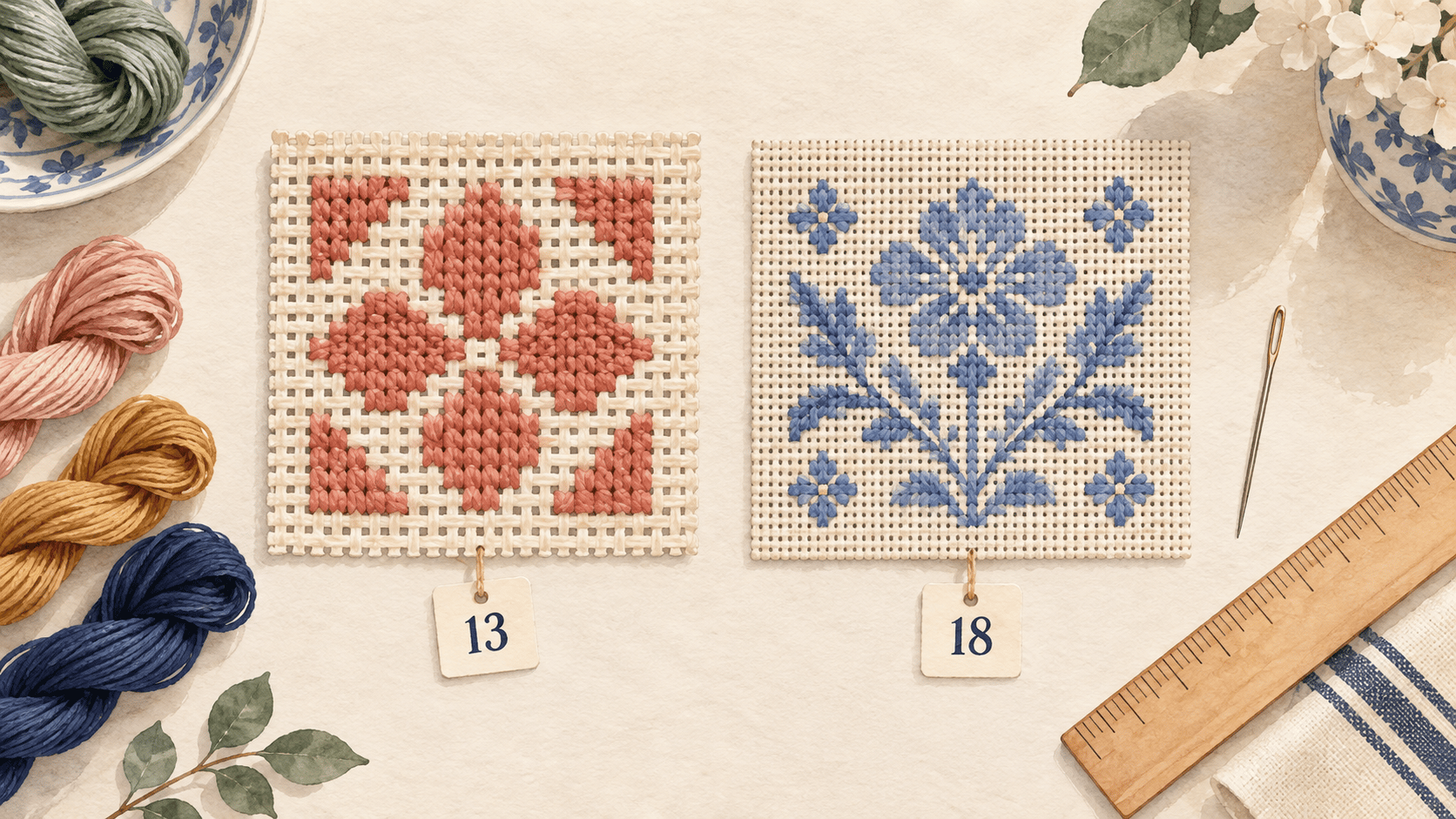
Choosing between 13-mesh and 18-mesh canvas changes much more than the size of each hole. It changes the finished size, the detail a pattern can hold, which threads cover cleanly, and roughly how long the project takes.
Choose 13 mesh for larger, faster, more forgiving projects. Choose 18 mesh when fine detail matters enough to justify smaller stitches and more time.
What does mesh count mean?
Mesh count is the number of canvas holes per inch. A 13-mesh canvas has 13 holes per inch in each direction. An 18-mesh canvas has 18.
Higher mesh count means smaller stitches. It also means many more stitches fit into the same physical area:
- 13 mesh: 13 × 13 = 169 stitches per square inch
- 18 mesh: 18 × 18 = 324 stitches per square inch
That is the main tradeoff. Eighteen mesh can draw finer curves, faces, lettering, and color changes, but a same-size piece contains about 1.9 times as many stitches.
13 mesh vs 18 mesh at a glance
| Factor | 13 mesh | 18 mesh |
|---|---|---|
| Holes per inch | 13 | 18 |
| Stitches per square inch | 169 | 324 |
| Best for | Pillows, wall pieces, bold designs, first projects | Ornaments, belts, portraits, lettering, fine detail |
| Stitching pace | Faster | Slower |
| Visibility | Easier to see | Smaller holes; strong light may help |
| Pattern look | Bold and graphic | Finer and smoother |
| Common threads | Silk-wool blends, tapestry wool, thicker cotton | Stranded cotton, fine silk, perle cotton #8 |
How mesh count changes the finished size
The same chart becomes smaller on a finer mesh. Use this formula:
pattern stitches ÷ mesh count = finished inches
A chart that is 130 stitches wide becomes 10 inches wide on 13 mesh, but about 7.2 inches wide on 18 mesh. To keep it 10 inches wide on 18 mesh, the pattern needs to be 180 stitches wide.
A complete example
Suppose your Threaded chart is 130 × 104 stitches:
| Canvas | Finished design | Total stitches |
|---|---|---|
| 13 mesh | 10 × 8 inches | 13,520 |
| 18 mesh | 7.2 × 5.8 inches | 13,520 |
The total stitch count does not change when you move the unchanged chart to another mesh. Only its physical size changes. If you resize the 18-mesh pattern to keep the same 10 × 8-inch result, it becomes 180 × 144 stitches, or 25,920 stitches.
Which mesh shows more detail?
Eighteen mesh has more points available to describe the same inch. It handles eyes and small facial expressions, narrow lettering, curved outlines, small ornaments and belt motifs, and gentle color gradients.
Thirteen mesh is better when the design depends on large shapes, strong outlines, or blocks of color. It is usually enough for florals, simple house portraits, graphic pets, monograms, and most pillows.
Do not choose 18 mesh automatically because it sounds more refined. If the photo has a simple silhouette and no tiny detail, the extra stitches may add work without improving the result.
How much longer does 18 mesh take?
For the same finished square inch, 18 mesh holds 324 stitches and 13 mesh holds 169. That makes 18 mesh about 1.9 times denser.
If you stitch 200 to 300 tent stitches per hour, one square inch on 13 mesh takes about 34 to 51 minutes. The same area on 18 mesh takes about 65 to 97 minutes.
Your real pace depends on thread changes, stitch type, lighting, experience, and how often you check the chart. A pattern with many isolated color changes takes longer than one with large solid areas, even when the total stitch count is the same.
Which threads work on each mesh?
Coverage matters. Thread that is too thin leaves bare canvas showing. Thread that is too thick crowds the holes, wears quickly, and can distort the canvas.
Common choices for 13 mesh
- Silk & Ivory
- Planet Earth Pepperpot
- DMC Soft Cotton
- Tapestry or Persian wool at the right ply
- Perle cotton #5
Common choices for 18 mesh
- Two strands of DMC or Anchor stranded cotton for tent stitch
- Vineyard Silk
- Fine silk lines
- Perle cotton #8
- One ply of some crewel or Persian wools
Threaded supports 49 real thread libraries, so you can match the chart to the line you plan to buy. DMC and Anchor matching are included on the free plan; Pro unlocks the other 47.
Stitch a small patch at the edge of the canvas. Dye, stitch tension, and individual thread lines can change coverage even when the label says they suit the same mesh.
Best mesh for common needlepoint projects
Pillows and larger wall pieces: usually 13 mesh
Large physical areas become very slow on 18 mesh. Thirteen mesh keeps a pillow manageable and works with plush wool and silk-wool blends.
Ornaments: often 18 mesh
An ornament needs detail inside a small finished area. Eighteen mesh gives names, faces, and narrow outlines more room. A simple, bold ornament can still work well on 13 mesh.
Belts: usually 18 mesh
Belts have limited height. The finer grid helps fit initials, small icons, or repeating scenes into the narrow strip.
Photo portraits: choose based on crop and size
Use 18 mesh for a small portrait where eyes and expression need to survive. Use 13 mesh for a larger, graphic portrait with a close crop and simplified background.
First project: usually 13 mesh
The holes are easier to see, more thread lines provide clean coverage, and progress appears faster. That makes 13 mesh a good balance between a polished result and a manageable first finish.
Do not forget the canvas margin
The finished design size is not the canvas size you buy. Leave at least 2 to 3 inches of blank canvas around every side for stretcher bars, blocking, and finishing. A 10 × 8-inch design with a 3-inch margin on every side needs a canvas at least 16 × 14 inches.
Set the pattern dimensions before converting a photo
Work backward from the physical result you want:
- Choose the finished width and height in inches.
- Choose 13 or 18 mesh.
- Multiply each finished dimension by the mesh count.
- Use those stitch dimensions when you make the pattern.
For an 8 × 8-inch design, 13 mesh needs about 104 × 104 stitches, while 18 mesh needs 144 × 144 stitches. This keeps a good chart from finishing at the wrong size.
Make the pattern at the size you intend to stitch
Turn your photo into a chart, choose the stitch dimensions, compare the palette, and clean the grid before buying materials. You can start without an account.
Make your pattern in ThreadedFrequently asked questions
Is 13 mesh or 18 mesh better for beginners?
Thirteen mesh is usually easier. The holes are larger, stitching progresses faster, and a wider range of thicker threads covers it cleanly.
Can I put the same pattern on 13 and 18 mesh?
Yes. The stitch chart stays the same, but the finished piece is smaller on 18 mesh. Resize the chart if you want the physical dimensions to stay the same.
How do I calculate needlepoint size?
Divide the pattern width and height in stitches by the mesh count. Then add 2 to 3 inches of blank canvas to every side before buying the canvas.
Is 18 mesh almost twice as slow as 13 mesh?
For the same physical area, it contains about 1.9 times as many stitches. Actual time also depends on color changes, stitch choice, and your pace.
Can I use DMC floss on 13 mesh?
You can, but standard stranded cotton often needs more strands to cover 13 mesh and may become bulky. DMC Soft Cotton or a thicker wool or silk blend is usually simpler. Standard stranded cotton is a more natural fit on 18 mesh.