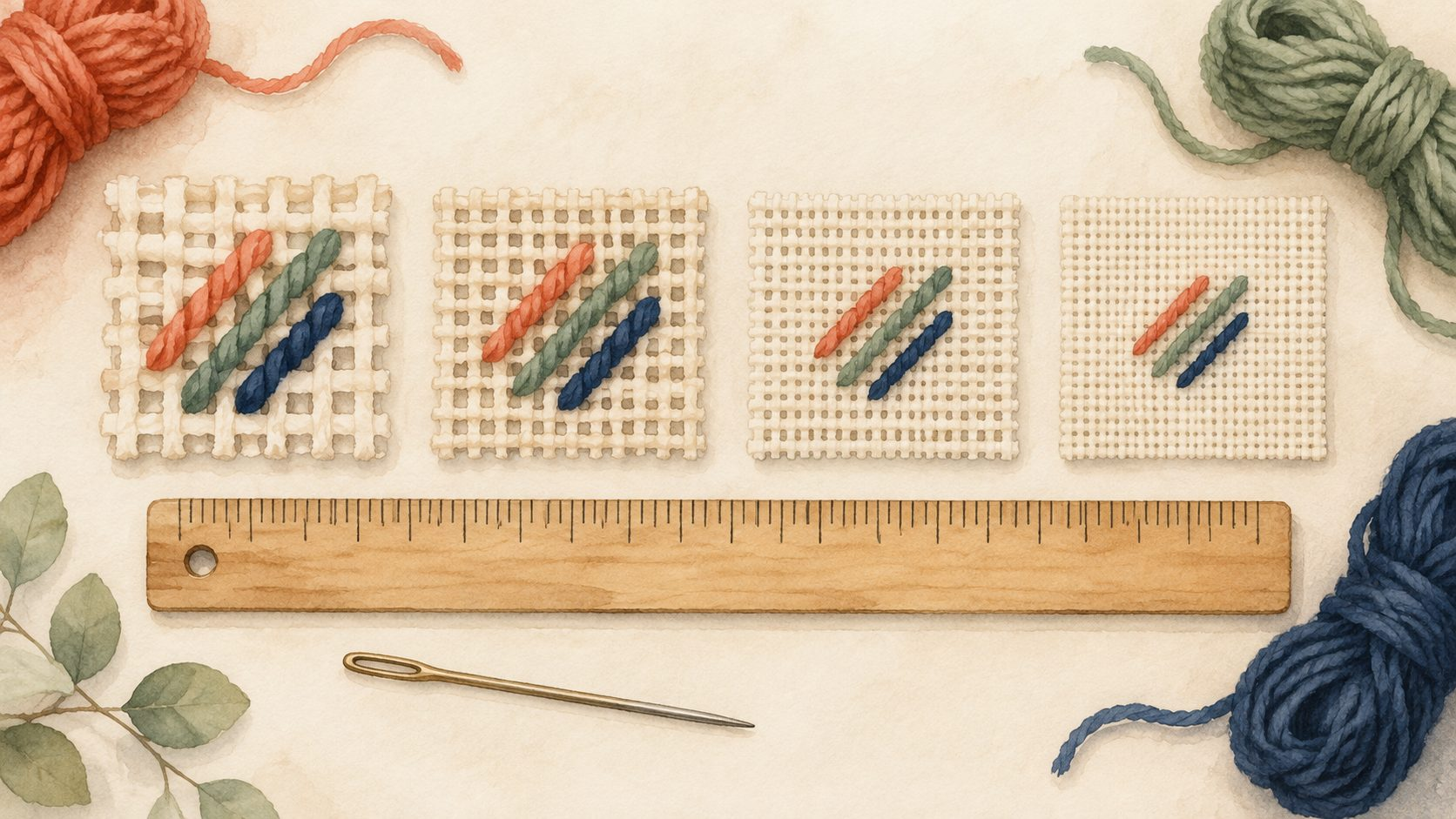
A needlepoint chart has a fixed number of stitches, and the canvas mesh decides how big that chart is. Divide the stitch count by the mesh count and you have inches. This page puts that math in one chart, adds stitches per square inch, needle and thread notes by mesh, and what the sources say about how much extra canvas to buy.
Finished inches = stitches / mesh. A 100-stitch-wide design is 10.0 inches on 10 mesh, 7.7 on 13 mesh, and 5.6 on 18 mesh. Then add bare canvas on every side for blocking and finishing, with sources suggesting 2 to 4 inches. To run your own numbers, use the needlepoint canvas size calculator.
The one formula
Knytstudio says mesh count is how many holes fit in one inch, so 13 mesh gives 13 tent stitches per inch, and that finished size in inches is the stitches in the chart divided by the mesh count. Stitchmate gives the same formula and adds that Aida count works the same way, so a chart sized for 14-count Aida lands closest to its original size on 13 or 14 mesh. Golden Hour Needlepoint notes that charts work on any mesh and only the finished size changes. Mesh does not mean bigger holes at a higher number. Needlepoint Maker says a higher number packs more stitches into each inch.
Worked example from Needlepoint Maker: 72 stitches divided by 18 is 4 inches, while 72 divided by 13 is about 5.5 inches, so the same chart is about 38 percent larger in each direction on 13 mesh.
Finished size chart
Each cell is the design width in inches for that many stitches on that mesh, rounded to one decimal. It is the same division as above, so it works for height too.
| Stitches | 10 mesh | 12 mesh | 13 mesh | 14 mesh | 18 mesh | 22 mesh | 24 mesh |
|---|---|---|---|---|---|---|---|
| 50 | 5.0 in | 4.2 in | 3.8 in | 3.6 in | 2.8 in | 2.3 in | 2.1 in |
| 100 | 10.0 in | 8.3 in | 7.7 in | 7.1 in | 5.6 in | 4.5 in | 4.2 in |
| 150 | 15.0 in | 12.5 in | 11.5 in | 10.7 in | 8.3 in | 6.8 in | 6.3 in |
| 200 | 20.0 in | 16.7 in | 15.4 in | 14.3 in | 11.1 in | 9.1 in | 8.3 in |
To convert to centimeters, multiply inches by 2.54. For a chart with unusual dimensions, divide each side by the mesh separately. If you want to move a chart to another mesh and keep its size, see how to resize a needlepoint pattern.
Stitches per square inch
Mesh squared gives the tent stitches in a square inch, which is a quick way to see how much more work finer canvas is. Cozy Stitchery lists these.
| Mesh | Stitches per square inch |
|---|---|
| 5 | 25 |
| 7 | 49 |
| 10 | 100 |
| 12 | 144 |
| 13 | 169 |
| 14 | 196 |
| 18 | 324 |
| 22 | 484 |
| 24 | 576 |
The local shops guide at Local Needlepoint Shops puts it as 18 mesh having nearly twice as many stitches as 13 mesh over the same area, which matches 324 against 169.
Thread and needle by mesh
| Mesh | Typical thread (Cozy Stitchery) | Tapestry needle size |
|---|---|---|
| 10 | Tapestry wool full strand, Persian yarn 3-ply | 18 |
| 12 | Persian 3-ply, tapestry wool, pearl cotton #3 | 18 or 20 |
| 13 | Persian 2-ply, tapestry wool, pearl cotton #3 | 20 |
| 14 | Persian 2 to 3-ply, tapestry wool, pearl cotton #5 | 20 |
| 18 | Persian 1-ply, pearl cotton #5 or #8, stranded cotton, silk | 22 |
| 22 | Stranded cotton, silk, pearl cotton #8 | 24 |
| 24 | Stranded cotton, silk | 24 or 26 |
For deeper thread detail see needlepoint thread by mesh count and how to choose a needlepoint needle. Local Needlepoint Shops, citing Needlepoint Joint, gives size 20 for 13 mesh and size 22 or 24 for 18 mesh.
How much canvas to buy
Add bare canvas on every side of the design. Knytstudio says 2 to 3 inches larger on every side for blocking and finishing. Local Needlepoint Shops says Needlepoint Joint allows at least 2 inches of bare canvas on each side, and gives an example of a 120-stitch chart that is 12 inches wide on 10 mesh. The Craft Mat suggests 3 to 4 inches for needlepoint, more for professional framing or a pillow, and its calculator example turns a design of 10.8 by 10.8 inches with a 3 inch margin into a canvas of at least 17 by 17 inches. Our guide to preparing canvas before stitching covers taping and marking the margin.
Picking a mesh
- 10 mesh: Knytstudio says big holes, fast progress, and a bold look, good with thicker tapestry wools.
- 13 mesh: Knytstudio calls it the workhorse and says most painted canvases and most mono canvas sold today are 13 mesh. Local Needlepoint Shops says to choose 13 mesh for a first project.
- 14 mesh: slightly finer than 13, and Knytstudio notes charts for 14-count Aida keep their physical size.
- 18 mesh: Knytstudio says it suits fine detail, faces, and small ornaments, and is slower and happier with thinner thread. See 13 mesh vs 18 mesh.
- 7 mesh: Cozy Stitchery says it is the standard plastic canvas count. See plastic canvas needlepoint.
Canvas construction is a separate choice from mesh. See mono, interlock, and Penelope canvas.
Test before you buy
Cozy Stitchery says published yarn-per-square-inch estimates spread widely by mesh, yarn, and stitch, which is why a one inch test square beats any chart. The same habit helps with canvas. Stitch a small square of your planned thread on scrap canvas at the mesh you are considering, hold it at the distance the finished piece will be seen from, and check that the canvas is fully covered and the detail still reads. Knytstudio makes a similar point about where a piece will live: a cushion front wants 10 to 13 mesh and sturdy wool, a framed portrait wants 13 or 14 so detail reads at arm length, and an ornament earns 18 mesh.
Where sources disagree
- Margin: Knytstudio says 2 to 3 inches per side, Needlepoint Joint (via Local Needlepoint Shops) says at least 2, and The Craft Mat says 3 to 4 for needlepoint. Use the larger number if you plan to frame or make a pillow.
- How common 14 mesh is: Cozy Stitchery calls 14 mesh common for kits and Knytstudio treats it as a near twin of 13. Local Needlepoint Shops counted far fewer 14 mesh canvases than 13 mesh in the shop catalogs it read, under two thousand against about eighty-six thousand.
- Needle size at 12 mesh: Cozy Stitchery gives 18 or 20, so the sources leave a choice. Test thread and needle on a scrap, as Cozy Stitchery also advises for yarn amounts, since its published estimates spread widely.
- Starting mesh: Knytstudio and Local Needlepoint Shops say 13 for beginners, while Cozy Stitchery says 13 or 14 and calls 10 mesh common for pillows, kits, and beginners.
Questions
How big is a 200 by 200 stitch design?
Divide by the mesh: 15.4 inches on 13 mesh, 11.1 inches on 18 mesh, and 20 inches on 10 mesh.
Does a higher mesh number mean a larger design?
No. A higher number means smaller stitches, so the same chart comes out smaller.
Can I use a cross stitch chart?
Yes. Knytstudio says any counted chart works, with each square becoming one tent stitch. Size it with the same formula.
Which mesh should I choose if the pattern does not say?
Local Needlepoint Shops says 13 mesh unless the design has fine detail that would be lost at that size.
Can I try it without math?
Print the mesh size cheat sheet (PDF) for a one-page version of the chart. Use the needlepoint canvas size calculator, or make a chart from a photo in the needlepoint chart maker.
Sources
- Knytstudio: Needlepoint Mesh Counts Explained
- Cozy Stitchery: Needlepoint Canvas Mesh Size Chart
- Local Needlepoint Shops: Needlepoint Mesh Count Explained
- Needlepoint Maker: 13 vs 18 Mesh Needlepoint Canvas
- The Craft Mat: Needlepoint Canvas Size Calculator
- Golden Hour Needlepoint: Mesh Size Calculator
- Stitchmate: Needlepoint Canvas Calculator