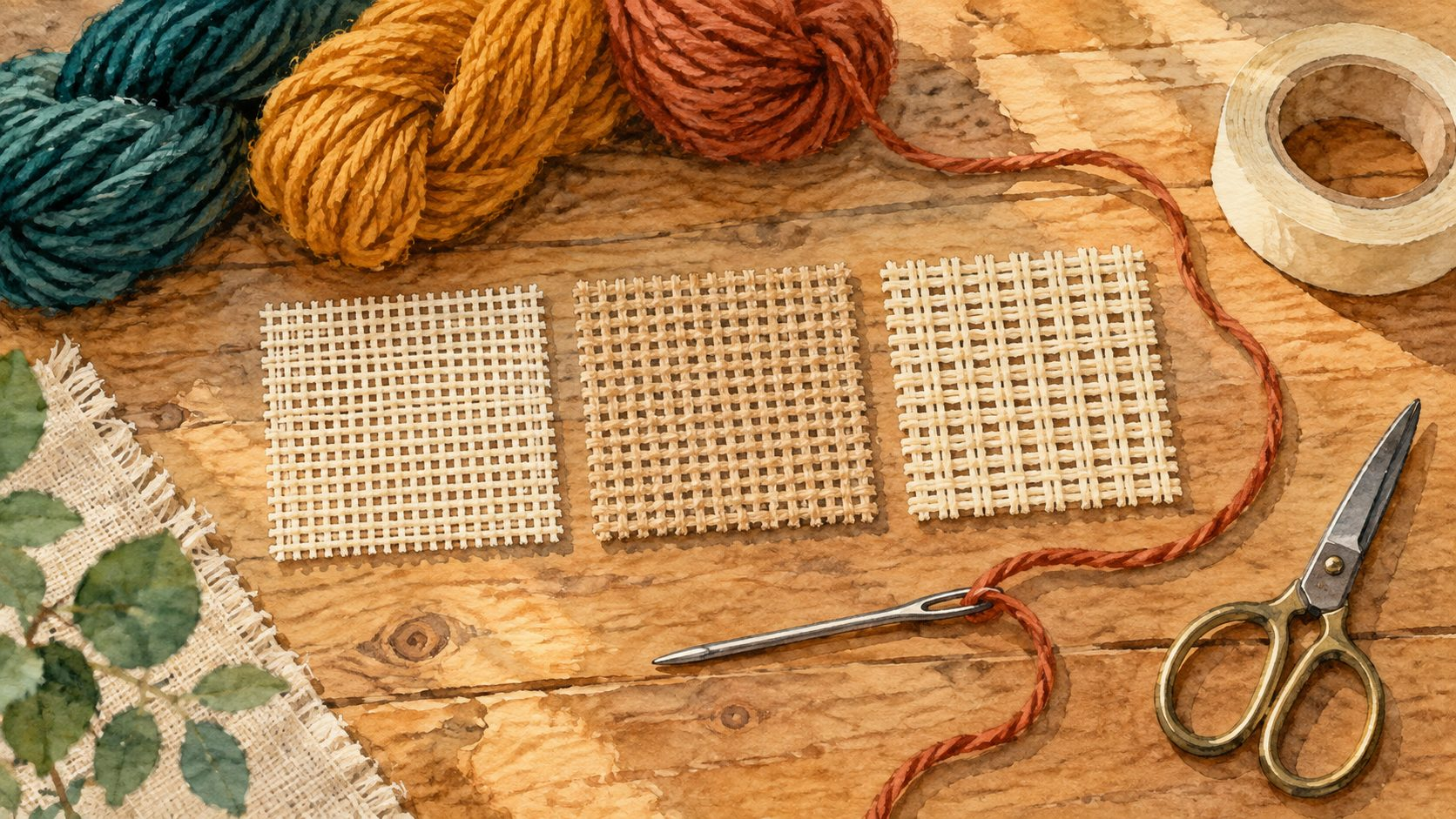
Blank needlepoint canvas looks like one product until you shop for it and find mono, interlock, and Penelope sitting side by side. They are all open-weave grids, and they behave differently under the needle. The weave decides how stable the canvas is, which stitches it suits, and whether you can stitch fine detail on it. This guide explains the three main types, how to match one to your project, and where the sources we read do not agree.
If you are buying a kit or a hand-painted canvas, the canvas type was chosen for you, so you only need to pick a mesh count. If you are buying blank canvas for a design you made, interlock is the safest first choice for a beginner doing plain tent stitch, per Needlework Tips and Techniques. Choose mono if you want to use many different stitches. Choose Penelope if you want fine detail in part of the design.
Mesh count first
Every canvas type is sold by count, which is the number of threads or holes per inch. World of Needlepoint says the lower the count, the larger the holes and the thicker the yarn the canvas can take. It lists all-purpose canvas from 5 to 24, and says stitching on canvas under 16 is called gros point while 16 and above is petit point.
Needlepoint For Fun adds the practical rule: the thread should glide through the mesh. If the mesh is too small it shreds the thread, and if it is too large the canvas shows through. It also says a beginner will find 10 or 12 mono easier to stitch than a finer count. Our guides to 13 mesh versus 18 mesh and to thread by mesh count cover that choice in more detail.
Mono canvas
DMC describes mono canvas as single threads woven together, consistent in thickness and evenly spaced. World of Needlepoint calls it a plain over-and-under weave available in a wide range of gauges and colors.
The weave has some give. DMC says that makes it work for things like cushions that will be sat on, and that you need a frame to stabilize it while you stitch. Needlepoint For Fun says stitchers who like to use a variety of stitches prefer mono, because the intersections can move to fit different stitch directions and thicknesses. Needlepoint Teacher says the threads distort easily, which makes mono a good candidate for techniques such as pulled thread work.
Mono is also what most painted canvases are made on. Serendipity Needleworks says almost all hand-painted canvases available today are painted on mono. It lists 10, 12, 13, 14, and 18 as the most common sizes.
Interlock canvas
Interlock is also a single-mesh canvas, but the construction is tighter. DMC says two vertical threads trap the single horizontal thread, locking it in place at each intersection, which makes the canvas more stable. World of Needlepoint calls it stiffer and more stable than mono.
Needlework Tips and Techniques gives practical reasons to like it. It is less prone to distortion while you stitch, and you can trim it close to the edge of a project without fraying, which suits coasters and similar small pieces. Serendipity Needleworks says screen-printed designs are often printed on interlock, and that kits often use it. DMC says it is very popular in needlepoint kits and is usually available in white or brown.
The trade-off, per Needlepoint Teacher, is that you cannot split the intersections to make petit point. Needlepoint For Fun says the same rigidity makes interlock harder to use for a variety of stitches, though fine for tent stitch.
Penelope canvas
Penelope is also called duo or double-mesh canvas. DMC says it is made of double threads woven together, which makes it very durable. World of Needlepoint explains the useful part: the weave leaves one larger and one smaller opening at each intersection, so you can separate the double threads and stitch smaller stitches in the smaller openings.
That is why the count is written as two numbers. World of Needlepoint gives 5/10 or 14/28 as examples, and DMC gives 5/10. The first number is the openings per inch if the pairs stay together, and the second is the number if you separate them. Serendipity Needleworks says 10/20 is the most common size, and that you can mix gros point and petit point on one piece, which suits designs with a small area of fine detail such as a face.
Side by side
| Mono | Interlock | Penelope | |
|---|---|---|---|
| Structure | Single threads, over and under | Single mesh, locked at each intersection | Paired threads, double mesh |
| Stability | Some give, use a frame | Most stable of the three | Durable |
| Frays when trimmed | Yes, tape the edges | Can be trimmed close | Tape the edges |
| Split into smaller stitches | No | No | Yes |
| Usually found in | Hand-painted canvases | Kits and screen-printed designs | Pre-worked designs |
| Typical use | Varied stitches, cushions | Plain tent stitch, beginners | Mixed stitch sizes, detail |
The rows draw on DMC, World of Needlepoint, Needlework Tips and Techniques, Needlepoint Teacher, and Serendipity Needleworks. The fraying row follows Needlework Tips and Techniques on interlock and DMC's advice to tape canvas edges.
Which one to pick
- First project, plain tent stitch. Needlework Tips and Techniques calls interlock the safest all-round choice for most needlepoint, stable and beginner-friendly. Pair it with a 10 or 12 count, per Needlepoint For Fun.
- Lots of different stitches. Mono, because the intersections can shift to suit them, per Needlepoint For Fun.
- A design with one small detailed area. Penelope, so you can split the threads only where you need them.
- A hand-painted canvas. It will almost always be mono, per Serendipity Needleworks. You choose the thread and count, and the canvas type is already decided.
- A design you made yourself. Pick the count first, then the type. The canvas size calculator shows how big the finished piece is on each count, and the needlepoint pattern maker sizes a design for the mesh you set.
Before you stitch
DMC recommends binding the edges with masking tape before you begin, applying each strip half on the front and half on the back. It stops the canvas from unraveling and from catching the thread, and if you use a frame you mount the prepared canvas on it.
Check the canvas before you commit. World of Needlepoint says to inspect it for knots or cuts and make sure the grid is even rather than warped. Needlework Tips and Techniques agrees that you get what you pay for, since cheaper canvas can have knots or unevenly twisted threads.
Color matters a little. Needlework Tips and Techniques says to pick white canvas for a design in mainly pale shades and brown canvas for a dark design, so any canvas that shows through blends in.
DMC also gives a starting needle size for each range of counts: size 16 for 8 to 10 count, size 18 for 10 to 12, size 20 for 12 to 14, and size 22 for 16 to 18. For stitch choices once the canvas is taped, see our guides to needlepoint stitches for beginners and needlepoint kits for beginners.
Other canvas types
- Rug canvas. Very heavy, 3 to 5 holes per inch, for thick rug yarns, per World of Needlepoint. World of Needlepoint says its threads cannot be separated.
- Plastic canvas. Molded rather than woven, stiff, and it will not fray. World of Needlepoint and Needlework Tips and Techniques both suggest it for 3D projects and for children learning to stitch.
- Waste canvas. Removed after stitching, so you can work a grid design on fabric that is not an even weave, such as a t-shirt or tote bag, per World of Needlepoint.
- Silk gauze. Very fine. World of Needlepoint lists gauges from 20 to 60 for ultra-fine work such as miniatures, and Needlepoint Teacher says silk gauze starts at 24 count.
Where sources disagree
| Question | What the sources say |
|---|---|
| Half cross stitch | World of Needlepoint says half cross does not work well on mono and is better on interlock. Needlepoint Teacher says mono is not recommended for half cross and that Penelope is best for projects using it. Needlework Tips and Techniques says mono keeps its shape as long as you do not have sizeable areas of half cross. |
| Interlock for beginners | Needlework Tips and Techniques calls interlock beginner-friendly and the safest all-round choice. Needlepoint For Fun says its rigidity makes a variety of stitches harder and keeps it to tent stitch. |
| How interlock is built | World of Needlepoint says two vertical threads twist around each other and around the horizontal threads. Needlepoint Teacher says one vertical thread and paired cross threads. Both describe the same stable result. |
| Beginner mesh count | Needlepoint For Fun suggests 10 or 12 for a first project. Serendipity Needleworks lists 10, 12, 13, 14, and 18 as the common mono sizes and names 18 as its favorite, because artists can add more detail on it. |
Questions
What is the difference between mono and interlock canvas?
Both are single mesh. Mono is a plain over-and-under weave with some give, and interlock locks the threads at each intersection, so it is more stable, per DMC and World of Needlepoint.
What canvas is best for beginners?
Needlework Tips and Techniques recommends interlock for plain tent stitch, and Needlepoint For Fun suggests a 10 or 12 count for a first project.
What does 10/20 mean on Penelope canvas?
It means 10 double-thread openings per inch, or 20 stitches per inch if you separate the pairs, per World of Needlepoint and Serendipity Needleworks.
Can I use mono canvas for half cross stitch?
World of Needlepoint says half cross does not work well on mono, and Needlepoint Teacher does not recommend it. World of Needlepoint points to interlock instead, and Needlepoint Teacher says Penelope is best.
Does the canvas have to be white?
No. It also comes in ecru, yellow, and brown. Needlework Tips and Techniques suggests white for pale designs and brown for dark ones.
Do I need a frame?
DMC says mono needs a frame to stabilize it while you stitch. Our finishing basics guide covers what happens after the stitching is done.
Sources
- DMC: the three canvas types, taping edges, and needle sizes by count.
- World of Needlepoint: gauges, weave structure, Penelope counts, and other canvases.
- Needlepoint For Fun: mono, interlock, and Penelope, with thread-to-mesh guidance.
- Needlework Tips and Techniques: choosing by project, canvas color, and quality.
- Needlepoint Teacher: canvas definitions, sizes, and stitch suitability.
- Serendipity Needleworks: where each type is used and common sizes.