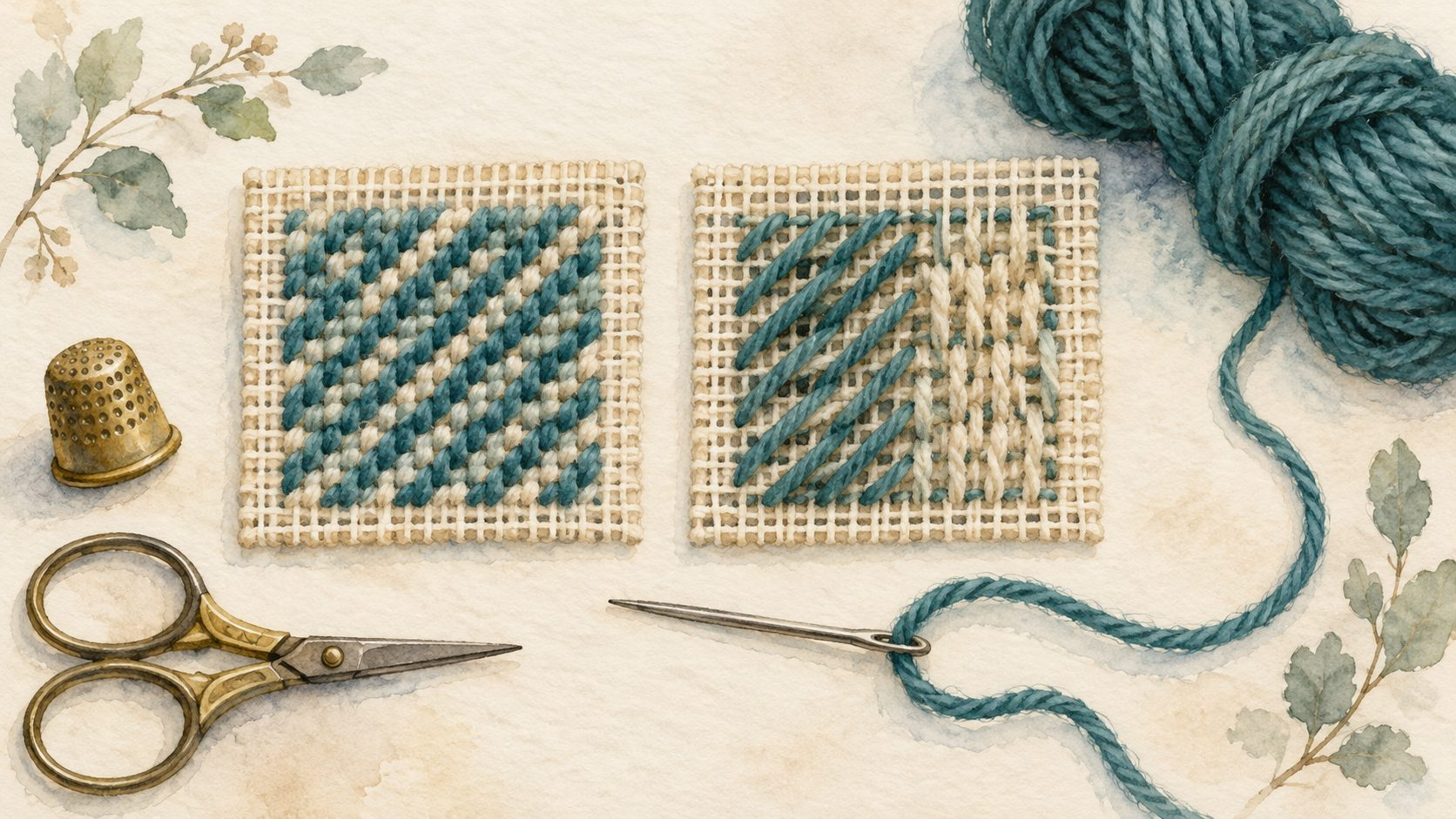
Continental and half cross are both tent stitches: one small diagonal over one canvas intersection. From the front they look the same. The difference is on the back, and that decides how well a piece wears and how much thread it eats.
Use continental for single lines, letters, details, and small or odd-shaped areas. Use half cross only where wear does not matter or when thread is tight. Use basketweave for large areas and anything that will be handled. Whatever you pick, keep it consistent within an area, because rows that mix the two can look uneven.
The three tent stitches side by side
Unwind Studio rates the three on coverage, canvas distortion, and thread use. Its table is the clearest single summary among the sources.
| Stitch | Coverage on the back | Canvas distortion | Thread use |
|---|---|---|---|
| Basketweave | Strongest | Very low | High |
| Continental | Medium | Medium | Medium |
| Half cross | Weakest | Low | Low |
Source: Unwind Studio. Other sources rank the three the same way on coverage, with some disagreement on distortion, covered below.
Same front, different back
Threadneedle Street says all three look the same on the top in theory but very different on the reverse. Worked in horizontal rows, half cross leaves lots of small, straight up and down stitches on the back, so some canvas threads still show. Continental covers the back with long slanted stitches. Le Point Studio explains why that matters: a pillow that gets sat on and thrown around needs a solid structure, and even a keepsake benefits from good coverage for longevity.
Continental stitch
Continental is worked in horizontal or vertical rows. Grant Point Designs says the trick is that when you start a new row and change direction, you also change the direction the needle comes up and goes down. It calls continental great for letters, details, and odd shapes. Unwind Studio recommends it for people learning, and gives a mnemonic: when you work left to right along the row, the actual stitch is worked from right to left, and the other way around. It says the oblique lines on the back give a strong stitch with good coverage, and that it distorts the canvas more than basketweave, which blocking can fix. Chilly Hollow calls it the workhorse for single lines or small areas, and says it will distort the canvas if used all over. See our blocking guide for the fix.
Half cross stitch
Unwind Studio says half cross looks almost identical to continental on the front, but has only small upright threads on the back instead of a dense covering. It says it is not a strong stitch and not recommended for anything that must wear well, such as a purse or stool top, but it does not distort the canvas the way continental does and it uses less thread. Chilly Hollow adds a practical use: half cross uses the least thread, so use it when you are playing thread chicken and hope not to run out. NeedlePaint says it provides no backing, is not recommended for backgrounds, and should only be used on printed canvases where the thread color matches the print. It has used it for a final row that gets turned under when the backing fabric is sewn on. Threadneedle Street notes it is the least used in the United States but much more common in Europe.
Changing direction without mixing stitches
Threadneedle Street warns about a common mistake: stitching one row right to left and the next left to right with the same bottom-left to top-right motion, which quietly makes alternate rows continental and half cross. It says this often gives an uneven look on the front, so stitch every row in continental. Its fix is to turn the stitch upside down at the end of a row, bringing the needle up at the top right of the intersection and down at the bottom left. The downside it names is that you now come up in an already used hole and go down in a new one. As a general rule it prefers coming up in a clean hole and going down in a used one, which disturbs the previous stitches less. Le Point Studio puts the two stitches as opposites: half cross moves bottom to top going left to right, continental moves top to bottom.
Habits that apply to all three
Grant Point Designs says to end a thread by running the needle through at least five stitches on the back, horizontally or vertically and not diagonally, because diagonal tails can show as raised lines on the front. Start the next thread the same way. If you need to skip an area, it says to try not to skip more than three stitches. If you miss a stitch and are nearby, pop over and add it. If you are already far away, restart a piece of thread and end it after the repair. Our needlepoint mistakes guide covers repairs in more depth.
Thread weight matters as much as stitch choice. NeedlePaint says thread and canvas need to match: too fine a thread will not cover, and too heavy a thread is hard to work and usually makes uneven stitches. Its chart for its own canvases:
| Canvas mesh | DMC cotton floss | Waverly wool |
|---|---|---|
| 10 | Not recommended | 3 strands |
| 12 | Not recommended | 3 strands for rugs and heavy use, 2 strands for soft pillows and purses |
| 14 | 6 strands | 2 strands, or 1 strand on printed canvas only where the thread matches the color |
| 18 | 6 strands | 1 strand |
Which one to use
- Small details, letters, single lines: continental (Grant Point Designs, Chilly Hollow, Unwind Studio).
- Large background areas: basketweave. Penny Linn says it can only be done in diagonal formations, which is why it suits large backgrounds. See our basketweave guide and beginner basketweave guide.
- Items that get handled or worn: basketweave, per NeedlePaint, which names chair seats, upholstery, and other pieces that take wear.
- Saving thread on a low-wear piece: half cross.
- Mixed canvases: Le Point Studio recommends half cross and continental for small to medium areas and basketweave for larger ones, and says it often mixes all three on one canvas.
Thread use changes with your choice, so check quantities with our needlepoint thread yardage calculator, and match thread to canvas with the thread by mesh count guide. For a wider tour of stitches, see needlepoint stitches for beginners.
Where sources disagree
Which stitch distorts the canvas. Unwind Studio rates continental medium and half cross low. Chilly Hollow says continental will distort the canvas out of shape if used all over, and Threadneedle Street says continental tends to pull the canvas, and that working on a frame helps. NeedlePaint says basketweave warps less than half cross or continental, which does not match Unwind's low rating for half cross.
A hybrid stitch. Penny Linn describes a "continental half cross" that keeps the same diagonal motion every row, alternating the two stitches, and suggests it to beginners because it is the easiest. Threadneedle Street warns that this kind of mixing often gives an uneven look. Penny Linn also says the front always looks the same whichever stitch you use. The sources do not settle this, so test on a scrap if the front matters to you.
How good continental is. NeedlePaint calls it a good backing stitch that lacks the durability of basketweave and suits small areas, while Penny Linn uses it as her main stitch and calls it versatile on any direction. Penny Linn also says half cross is no easier than continental.
Thread use. Penny Linn says continental uses a medium amount of thread. Grant Point Designs says basketweave is the fastest in stitch speed. Chilly Hollow says basketweave eats thread. Those claims do not conflict, but speed and thread use are different things, so do not read one as the other.
Questions
Do continental and half cross look different on the front?
The sources say they look the same, or almost the same, from the front. Mixing them in alternate rows is the exception, which Threadneedle Street says can look uneven.
Is half cross bad?
Not for the right job. It saves thread and does not distort as much, but it gives the weakest coverage, so avoid it for pieces that get wear.
Which is easier for a beginner?
Unwind Studio recommends continental for people learning. Penny Linn suggests her hybrid, and Le Point Studio says you can pick one stitch for the whole canvas or mix. Choose one and be consistent.
Can Threaded make a pattern for any of these?
Threaded makes the pattern chart. The stitch you work over it is your choice. See the needlepoint chart maker.
Sources
- Threadneedle Street: Tent stitch, continental and half cross
- Penny Linn: The basic needlepoint stitches to know
- NeedlePaint: The tent stitch, when, where, and why
- Unwind Studio: Tent stitch
- Chilly Hollow: Half cross versus continental versus basketweave
- Grant Point Designs: Tent stitches
- Le Point Studio: Learn the basic stitches