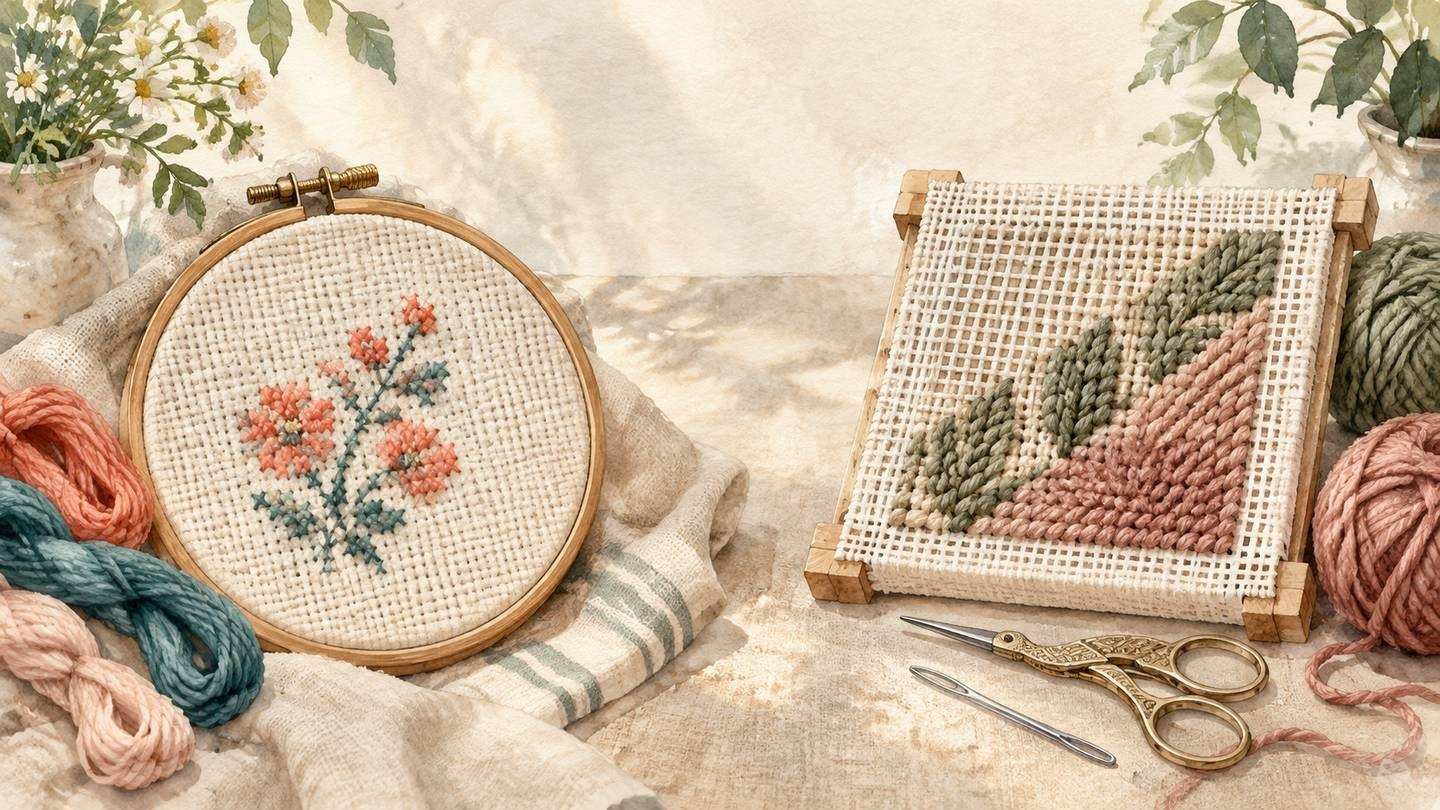
Cross stitch is worked in X-shaped stitches on soft woven fabric, usually Aida, and the background fabric stays visible in the finished piece. Needlepoint is worked in slanted tent stitches on stiff open canvas and covers every hole, producing a dense textile suited to pillows, belts, and ornaments. If you want the cheapest, fastest start, choose cross stitch. If you want a plush, durable object and a wider stitch vocabulary, choose needlepoint.
Both crafts stitch on a grid, so the skills transfer. A first cross stitch kit costs $10 to $20 and teaches counting, tension, and reading a chart. Those same skills carry straight into needlepoint, where you add canvas handling, thread coverage, and decorative stitches. Many stitchers learn cross stitch first and drift into needlepoint once they want texture and functional pieces.
Needlepoint vs cross stitch, side by side
| Cross stitch | Needlepoint | |
|---|---|---|
| Core stitch | X-shaped cross, two diagonals per square | Tent stitch, one diagonal per intersection |
| Base material | Soft woven fabric: Aida, evenweave, linen | Stiff open canvas: mono, interlock, Penelope |
| Sizing unit | Count, stitches per inch (14-count Aida is standard) | Mesh, holes per inch (13 and 18 are most common) |
| Coverage | Partial, fabric shows between stitches | Full, every hole is filled |
| Thread | Six-strand cotton floss, usually 2 strands | Wool, silk, cotton, blends sized to the mesh |
| Design source | Counted chart, a grid of symbols | Painted canvas or counted chart |
| Frame | Hand or small hoop | Often stretcher bars or a frame |
| Typical finish | Framed art, cards, bookmarks, ornaments | Pillows, belts, bags, chair seats, ornaments |
| Starter cost | $10 to $20 for a kit | $30 to $50 for a small kit |
The fastest way to tell finished pieces apart: hold them to the light. Cross stitch shows fabric between the stitches. Needlepoint shows none, because the entire canvas is covered.
The stitch itself
Cross stitch is built from a single stitch. You bring the needle up at one corner of a square and down at the opposite corner, then repeat in the other direction to complete the X. Most patterns use only this stitch plus backstitch for outlines and occasional fractional stitches for curves. The technique takes about five minutes to learn; the craft is in consistency and counting.
Needlepoint's foundation is the tent stitch, one diagonal that covers a single canvas intersection. Three methods produce the same surface look but differ in how you travel across the canvas:
- Continental works across a row and leaves long diagonal floats on the back. It is fast but can distort the canvas.
- Basketweave alternates direction along diagonal rows and creates a woven back. It is the most stable method and the standard for filling large areas.
- Half cross uses less thread but covers more thinly, and it only works on interlock canvas.
Past tent stitch, needlepoint opens into dozens of decorative stitches: Scotch, Byzantine, Cashmere, Rhodes, and many more. A single project might use ten stitch types chosen for how they catch light and build texture. Cross stitch deliberately stays simple; its design power comes from color placement rather than stitch variety.
Fabric vs canvas
Cross stitch fabric is soft and woven with evenly spaced holes. Aida is the beginner standard, woven in visible blocks that make counting easy. The count tells you stitches per inch: 14-count Aida is the most popular, with 11, 16, and 18 also common. Evenweave and linen are smoother and usually stitched over two threads, so 28-count evenweave gives the same design size as 14-count Aida. The fabric drapes, fits a small hoop, and travels well.
Needlepoint canvas is stiff and open, measured in mesh count, the number of holes per inch. Common sizes are 10, 13, 14, and 18 mesh, and the choice changes the finished detail and the thread you need. Our 13 mesh vs 18 mesh comparison walks through that tradeoff in detail. The three canvas weaves:
- Mono has single-thread intersections and is the most versatile, flexible enough to finish into pillows and upholstery.
- Interlock locks its threads at each intersection, so it resists distortion and suits diagonal stitches.
- Penelope is a double-thread mesh you can split for finer detail in selected areas.
The practical difference: cross stitch fabric works in your hand or a hoop, while needlepoint canvas often mounts on stretcher bars or a frame to stay taut, especially at finer mesh counts. That makes needlepoint a little less portable.
Thread and yarn
Cross stitch runs on six-strand cotton embroidery floss. You separate the strands and stitch with the number your fabric count calls for, usually two strands on 14-count Aida. DMC and Anchor dominate, with standardized color numbers that patterns reference directly; our DMC vs Anchor guide compares the two palettes and the specialty lines beyond them.
Needlepoint thread has one job above all: cover the canvas completely. Too thin and canvas peeks through; too thick and it will not pull through cleanly. That is why thread weight is matched to mesh count, a coupling that matters less in cross stitch where fabric is meant to show. Tapestry wool is the traditional choice, with silk, cotton, silk-wool blends, and novelty fibers like metallics and velvet used for texture and sheen. Our needlepoint thread by mesh count guide pairs specific lines with 13 and 18 mesh canvas.
Counted charts vs painted canvas
Most cross stitch is worked from a counted chart: a grid of symbols, each standing for a color, that you transfer onto blank fabric one stitch at a time. Charts are cheap to distribute, so the internet is full of them, and a PDF pattern usually costs a few dollars.
Needlepoint is famous for painted canvases, where the design is printed or hand-painted directly on the mesh and you stitch the colors you see. Counted needlepoint from charts exists too, but the painted canvas is the industry standard and a big part of the price gap: a hand-painted canvas from a designer can run from $30 into the hundreds before you buy any thread. The tradeoff is real. Painted canvases remove counting entirely and feel relaxing to follow, while counted charts give cross stitchers endless inexpensive variety.
Photo conversion narrows the gap. Turning a picture into a grid pattern works for both crafts; only the output settings change, fabric count versus mesh count and floss versus wool. You can convert a photo into a needlepoint pattern or a cross stitch chart from the same source image.
Coverage and finishing
Because cross stitch leaves fabric visible, designs float on the cloth and are usually framed, finished as hoop art, or mounted into cards and bookmarks. Small pieces also become ornaments and accessories.
Needlepoint's full coverage creates a dense, durable textile, so it becomes functional objects: pillows, belts, bags, eyeglass cases, chair seats, and ornaments. Blocking, reshaping the stitched canvas back to square, is a skill of its own, and professional finishing that turns a stitched canvas into a pillow or ornament typically costs $50 to $150. That finishing step is why needlepoint projects take longer to truly complete, and also why they hold up to daily use.
What each craft costs
| Cross stitch | Needlepoint | |
|---|---|---|
| Starter kit | $10 to $20 | $30 to $50 |
| Thread | Skeins of floss under a dollar each | Roughly $2 to $8 per skein or card |
| Design | Charts from free to a few dollars | Painted canvas $30 to $200 or more |
| Mid-size project total | $15 to $30 | $80 to $250 |
| Finishing | Usually self-framed | Often professional, $50 to $150 |
Cross stitch is the more affordable craft at every step, which makes it ideal for testing whether grid stitching suits you. Needlepoint's higher cost buys thicker materials and objects built for use, and many stitchers consider the durability worth it.
Which should you start with?
- Start with cross stitch if you want the gentlest on-ramp. Buy a small kit on 14-count Aida, learn the X and backstitch, and finish something in a weekend. Mistakes undo easily, and kits include everything.
- Start with needlepoint if you are drawn to texture and functional pieces. Pick a small painted canvas at 13 mesh with wool or a wool-silk blend, learn continental and basketweave tent stitch, and accept that the first project or two teaches coverage and tension.
- Move from cross stitch to needlepoint when you want more stitch variety. Your counting, color, and tension skills transfer directly; the new learning is tent stitch mechanics, canvas handling, and matching thread to mesh.
- Stay with cross stitch when you want low cost, huge pattern selection, and portable projects you can stitch anywhere.
There is no wrong answer, and most serious stitchers eventually keep both crafts in rotation: cross stitch for quick graphic pieces, needlepoint for heirloom objects.
Threaded turns any photo into a stitchable pattern for cross stitch or needlepoint. Upload a picture, choose your fabric count or mesh count, and get a chart matched to real thread colors from 49 libraries, with DMC and Anchor presets free. Start with our photo to needlepoint pattern guide or learn how many colors a photo pattern needs.
Common questions
Is needlepoint just cross stitch on canvas?
No. The stitch is different: needlepoint uses a single diagonal tent stitch while cross stitch uses two diagonals forming an X. The base material, coverage, thread, and finishing all differ too. They share the idea of stitching on a grid and little else.
Which is easier for a complete beginner?
Cross stitch, by a clear margin. The X takes minutes to learn, 14-count Aida has obvious holes, and kits are cheap. Needlepoint asks you to manage canvas tension, complete coverage, and thread-to-mesh matching, so the first polished result usually takes a few projects.
Can you use the same pattern for both?
Often yes, with adjustments. A counted cross stitch chart can be worked in tent stitch on canvas at the matching mesh, and a charted needlepoint design can be stitched as cross stitch with floss substituted for wool. Painted canvases do not translate, since the design lives on the canvas itself.
Can you do needlepoint on Aida fabric?
No. Aida is too soft and its weave is wrong for tent stitch. Needlepoint needs stiff open canvas where the threads do not shift, such as mono or interlock.
What is petit point?
Petit point is needlepoint worked on very fine canvas, typically 18 mesh or higher. The tiny stitches allow detailed designs, the needlepoint equivalent of stitching cross stitch on high-count fabric.
Which craft is more relaxing?
Both are meditative in different ways. Cross stitch is rhythmic and automatic once you find the X motion. Needlepoint offers more textural decision-making through decorative stitches, which keeps some stitchers more engaged.