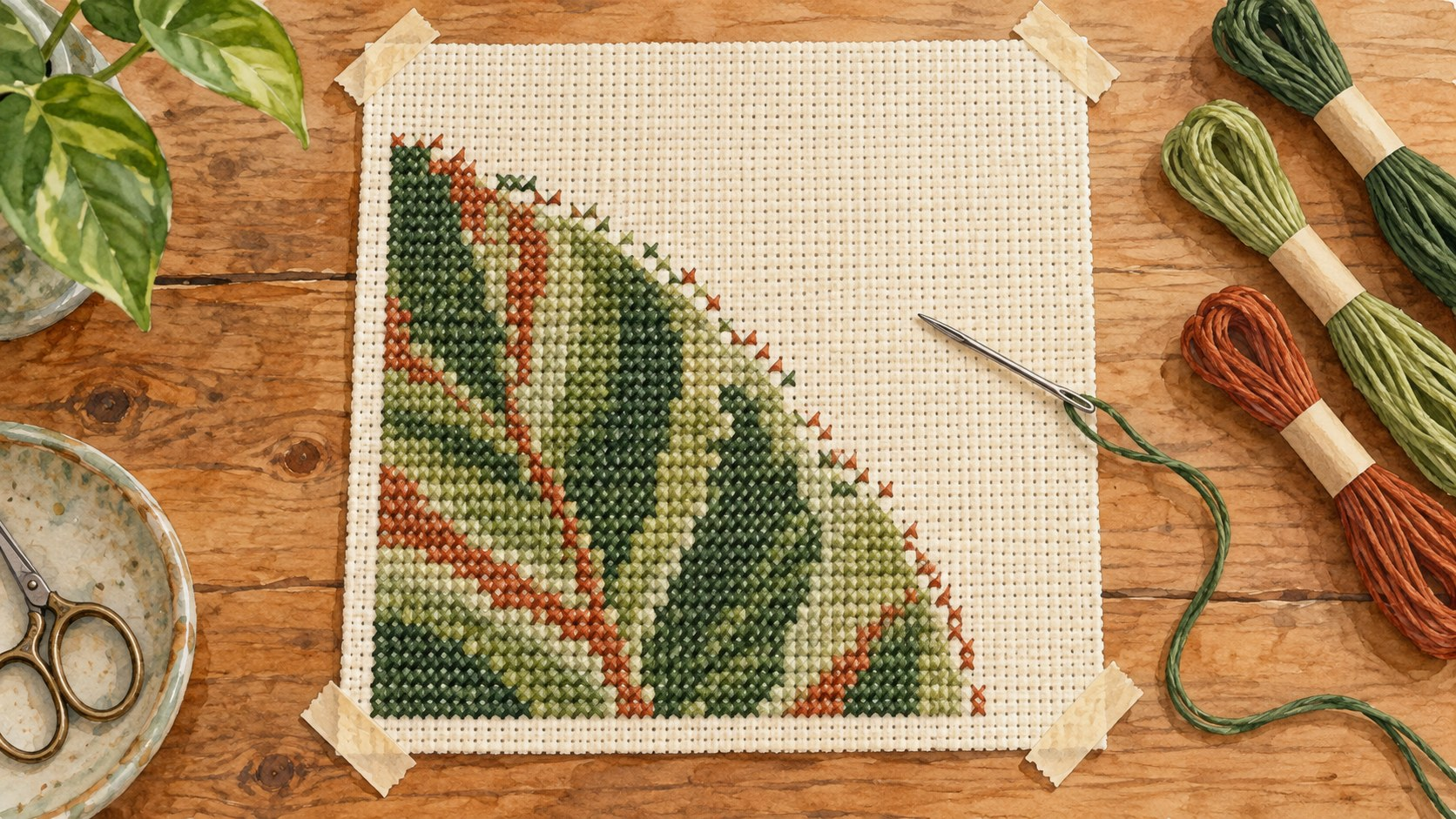
Fractional stitches are partial cross stitches: the half stitch, the quarter stitch and the three-quarter stitch. They fill only part of a square, which lets a chart smooth the staircase edges that full crosses leave on curves and add small details like eyes and beaks. The three-quarter stitch is the one you will meet most (All Things Cross Stitch). The stitches themselves are simple; the confusing part is that charts do not all mark them the same way.
Find the chart key first, because a quarter stitch and a three-quarter stitch can look alike on paper (Floss Field). A half stitch is one slanting leg from corner to corner. A quarter stitch runs from a corner to the middle of the square. A three-quarter stitch is a quarter stitch with one whole diagonal leg laid across it (Floss Field). On Aida the quarter leg ends in the middle of a woven block, so push the needle through the fabric itself; a sharp needle makes this much easier (Floss Field, Needlework Tips and Techniques). Stitch fractionals as you reach them, together with the full crosses of the same color (All Things Cross Stitch).
What fractional stitches are
A full cross stitch fills its whole square, so a curve stitched only in full crosses comes out as a staircase (Floss Field, All Things Cross Stitch). Quarter and three-quarter stitches fill part of a square and take the corners off those steps (Floss Field). DMC describes fractionals as partial cross stitches that help create curves in a design. Peacock and Fig adds that they let a pattern carry fine detail in one area without forcing the whole design onto very high thread count fabric.
The half stitch does a slightly different job. It covers the cloth more thinly than a cross, so an area worked in half stitches looks lighter and softer than the crosses beside it (Floss Field). Needlework Tips and Techniques uses it for sky, water and semi-transparent effects such as smoke rings.
| Stitch | What it is | Used for |
|---|---|---|
| Half stitch | One diagonal leg, corner to corner (Floss Field) | Soft shading, skies, light backgrounds (All Things Cross Stitch, Needlework Tips and Techniques) |
| Quarter stitch | A short leg from one corner to the center (Floss Field) | Tiny details, and the second color in a shared square (All Things Cross Stitch) |
| Three-quarter stitch | A quarter stitch plus one long diagonal leg (Floss Field) | Smooth curves and edges; the most common fractional (All Things Cross Stitch) |
Designers place these stitches where a full cross would be too blunt. Yarn Tree points to quarter stitches adding detail to the eyes and nose of a cat design, and Creative Poppy shows a single three-quarter stitch forming the sharp tip of a seagull's beak. Both are sellers of patterns, so read their examples as demonstrations from designers who chart these stitches for a living.
How to work each one
Half stitch. Bring the needle up at one corner of the square and down at the opposite corner: the first leg of a cross, left uncrossed (Floss Field, DMC). A row of half stitches is worked like the first pass of a row of crosses (Floss Field). Which way the leg slants is up to the chart's key; if the key says nothing, choose one direction and keep to it for the whole area (Floss Field). Half stitches that lean the same way as your top legs blend in with the crosses around them (Floss Field). Because a half stitch covers less fabric, some patterns ask for an extra strand to fill it out (All Things Cross Stitch).
Quarter stitch. Come up through the corner hole the chart points to and go down in the middle of the square (Floss Field, DMC). On evenweave or linen worked over two threads, the middle of the stitch is already a hole. On Aida there is no middle hole, so the needle has to pierce the woven block (Floss Field). DMC describes wiggling the needle between the fibers, and Needlework Tips and Techniques recommends a sharp pointed crewel needle for this. Many stitchers swap to a sharp needle just for these stitches, because a blunt tapestry needle is made to find holes, not to pierce (Floss Field). Our cross stitch needle guide covers the difference.
Three-quarter stitch. Work a quarter stitch first, from the outer corner to the center, then make one whole diagonal leg across it from corner to corner (Floss Field, All Things Cross Stitch, Creative Poppy). Three corners of the square are now covered and the fourth is left bare (Floss Field). Most stitchers make the short arm first, but some lay the whole leg first and pin it down with the quarter stitch (Floss Field). All Things Cross Stitch says either order is fine: pick one and use it every time, so all your three-quarter stitches look alike.
Reading the chart
Fractional stitches appear as small marks inside a chart square, and every publisher draws them a little differently. A small symbol tucked into one corner of a square usually means a quarter stitch (Needlework Tips and Techniques, All Things Cross Stitch). A square with only one triangle filled is a three-quarter stitch, with the filled triangle showing which half of the square to cover (All Things Cross Stitch). A square split by a slanted line with a different symbol in each half holds two colors: a three-quarter stitch in one and a quarter stitch in the other (Floss Field, All Things Cross Stitch).
Here is the catch: a quarter stitch and a three-quarter stitch can be drawn the same way on paper, so the key is the only reliable guide (Floss Field). Yarn Tree, a pattern distributor, goes further and says quarter, half and three-quarter stitches are all shown with the same smaller-than-normal symbol on many charts, leaving the stitcher to decide which one to work. Peacock and Fig notes that every charting software draws fractionals slightly differently, so check the legend on each new pattern. Our guide to reading a cross stitch pattern explains keys and symbols in general.
Aida vs evenweave
The fabric decides how pleasant quarter and three-quarter stitches feel. On evenweave or linen stitched over two threads, each cross spans two fabric threads, which leaves a hole in the center of the stitch exactly where the quarter leg needs to end (Needlework Tips and Techniques, Floss Field). On Aida the quarter leg has to pierce the middle of a woven block (Floss Field). Needlework Tips and Techniques calls evenweave the easier option for fractionals, and All Things Cross Stitch suggests switching projects to evenweave if a pattern is full of fractionals and Aida feels like a fight. The trade-offs sit in our evenweave vs aida guide.
Sirithre adds two practical notes. Piercing the center is actually easier on Aida than on high-count evenweave stitched over one, where there is no middle hole either and the weave is tight. If you stitch over one on a high count and a quarter stitch will not work, you can usually replace it with a full stitch of the same color, or leave it out where backstitch will cover the area.
Two colors in one square
When a slanted line splits a chart square and each half has its own symbol, two colors share that square (Floss Field). The standard rule is to give the three-quarter stitch to the color of whatever stands in front in the picture, and the quarter stitch to the color behind it (Floss Field, All Things Cross Stitch). Using the foreground color for the larger stitch pushes the tiny quarter into the background and makes the front object look more in focus (Needlework Tips and Techniques). Before stitching, study the chart to see which section should dominate (Needlework Tips and Techniques).
If neither shape is clearly in front, you can work two three-quarter stitches sharing the square (Needlework Tips and Techniques). Peacock and Fig gives the same answer for two colors in opposite corners: the long arms lie parallel and make a clean line. Needlework Tips and Techniques suggests working the second three-quarter in the opposite order, half leg first and quarter leg as a tie-down, and adding a backstitch line between the two to keep the areas distinct. Our backstitch guide covers that finishing line.
Sirithre shows why this decision is genuinely subjective: the same split square can be stitched at least four ways (a three-quarter plus a quarter, two three-quarters, two quarters, or a three-quarter and quarter combined differently), and the right choice depends on context. Her working rules: where backstitch outlines the area, a lone quarter stitch is often enough because the backstitch finishes the shape; where one color is clearly the subject, that color takes the three-quarter; where neither dominates, a double three-quarter works.
Where sources disagree
- What the small symbol means. Yarn Tree says many charts show quarter, half and three-quarter stitches with the same small symbol and the stitcher decides which to work. Floss Field says quarter and three-quarter marks can look alike on paper and the key must be checked. Peacock and Fig says every charting software draws them differently. All agree on one thing: read the key before you stitch.
- Which leg goes down first in a three-quarter stitch. Most stitchers work the short quarter leg first, then the long leg (Floss Field, All Things Cross Stitch, Creative Poppy). Some lay the long leg first and pin it with the quarter (Floss Field). All Things Cross Stitch calls both orders fine as long as you are consistent.
- Top-leg direction. DMC says to keep the diagonal of a three-quarter stitch consistent so top stitches lean the same way across the piece. Floss Field says the long leg of a three-quarter may slant either way, whichever the shape needs, and calls that an accepted exception to the top-leg rule.
- Which color takes the three-quarter stitch. Floss Field, Needlework Tips and Techniques and All Things Cross Stitch say the foreground color. Sirithre notes that sometimes neither color is in front, and admits to having chosen arbitrarily in places; two three-quarter stitches is the fallback (Needlework Tips and Techniques, Peacock and Fig, Sirithre).
- Whether you can skip them. Sirithre says a full stitch usually substitutes fine, and quarter stitches can sometimes be left out where backstitch covers the area. All Things Cross Stitch says you can convert a few to full stitches where they hardly show, but keep them where they shape a face, an eye or a visible edge.
- Sellers. Creative Poppy sells patterns and Yarn Tree distributes them; treat their chart-reading advice as a designer's and distributor's view.
Tips for neat fractionals
- Stitch fractionals as you reach them, together with the full crosses of that color, instead of saving them for the end (All Things Cross Stitch).
- Keep the same tension as your full stitches; a tight quarter leg can sink into the center and disappear (All Things Cross Stitch).
- On Aida, poke the center hole from the front with the needle tip first, then bring the thread through (All Things Cross Stitch). A sharp needle parts the block where a blunt one will not (Floss Field).
- Test an unfamiliar chart's fractionals on a scrap of fabric before committing (Peacock and Fig).
- Draw complex sections out on graph paper, marking where each quarter and three-quarter stitch goes and which way it faces (Peacock and Fig).
- Take breaks: fractionals take more concentration than full crosses (Peacock and Fig).
Questions
What is a three-quarter stitch in cross stitch?
A quarter stitch from one corner into the center of the square, plus one long diagonal leg across it. Together they fill half the square as a triangle (All Things Cross Stitch, Floss Field).
Can you do quarter stitches on Aida?
Yes. The needle goes down through the middle of the woven block instead of a hole, and a sharp needle makes that much easier (Floss Field). On evenweave worked over two threads, the middle is already a hole.
Is a half cross stitch the same as a tent stitch?
From the front, yes: both are one slanting stitch. Tent stitch is the needlepoint name, and half cross is one of three ways of working it; continental and basketweave are the others, and they differ on the back (Floss Field). We compare them in continental vs half cross stitch.
Do I have to stitch the fractional stitches in a pattern?
For your own projects you can turn a few into full stitches where they hardly show, but keep them where they shape a face, an eye or a visible edge (All Things Cross Stitch). Sirithre says a full stitch substitute usually works, and backstitch can cover small omissions.
Why do my curves look blocky?
Full crosses fill whole squares, so any curve built from them alone comes out as a staircase. Quarter and three-quarter stitches fill part of a square and take the corners off the steps (Floss Field).
Sources
- Floss Field, Half stitch, quarter stitch and three-quarter stitch
- All Things Cross Stitch, Three-Quarter Stitch in Cross Stitch (Plus Half and Quarter)
- Needlework Tips and Techniques, How to Work Fractional Stitches in Cross Stitch
- Sirious Stitches, Quarter Stitch: Working with Partial Cross Stitches
- DMC, Step by Step Cross Stitch Guide
- Peacock and Fig, Fractional Stitches for Cross Stitch
- Yarn Tree, Mini Cross Stitch Lesson: Fractional Stitches
- Creative Poppy, How to Make a Three-Quarter Stitch (PDF)