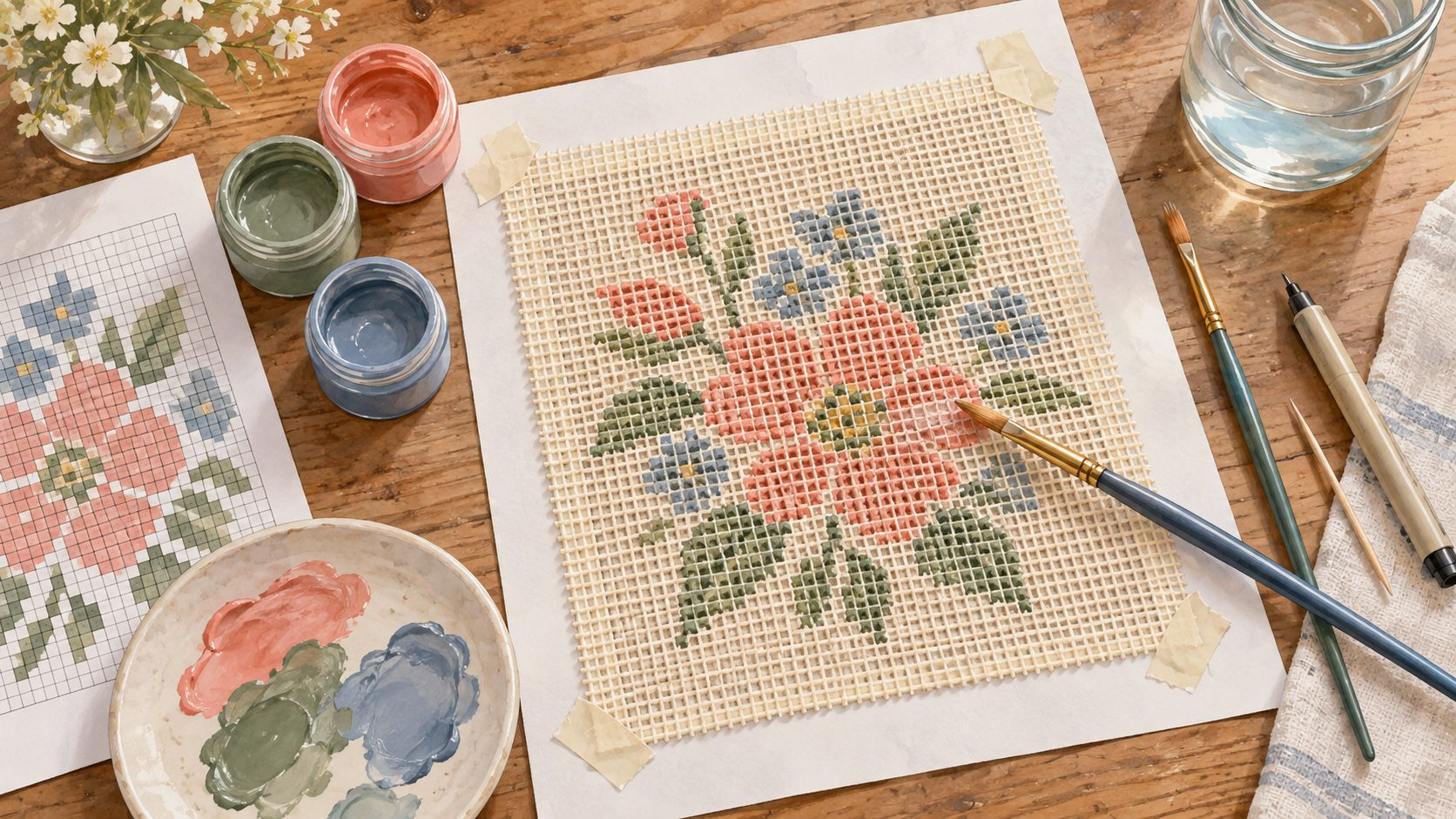
Painting your own needlepoint canvas takes acrylic paint thinned to the consistency of cream, a permanent marker that survives water, and one rule above all: every intersection of canvas threads gets exactly one color, because each intersection is one stitch. With a chart, a drawing, or a photo as your design, you can produce a canvas that stitches just like a professional hand-painted one.
Three habits make or break a painted canvas. Test every paint and pen on a scrap of the same canvas by wetting it before you start (Floss Field's method below). Thin acrylic paint to roughly the consistency of cream and use an almost-dry brush so the holes stay open (Nuts about Needlepoint). And paint one clear color on each thread crossing, since a crossing with two colors leaves the stitcher guessing (The Spruce Crafts). Cut the canvas with a two-inch margin on every side.
What the paint has to do
A painted canvas is a color map. Each intersection, the crossing of two canvas threads that one tent stitch covers, should carry one clear color that tells the stitcher which thread to use. Floss Field calls a canvas painted that way stitch-painted, and notes the looser alternative: a canvas painted more freely leaves some intersections for the stitcher to decide, which is exactly the frustration The Spruce Crafts says drives people to paint their own after struggling with ambiguous bought canvases.
Painting is also optional. Floss Field points out that any chart can be stitched by counting directly onto bare canvas, as long as you use a full-coverage stitch like basketweave so no blank canvas shows. Painting simply moves the counting work from stitching time to painting time.
Supplies
| Item | What to get | Source |
|---|---|---|
| Canvas | Blank mono canvas; Zweigart is the standard, with an orange thread in the selvedge. 13 mesh for a first project (bigger holes, fewer intersections to paint) | Serendipity Needleworks, Floss Field |
| Paint | Acrylic only. Artist-grade fluid acrylics (Liquitex soft body, Golden fluid) cover best; craft acrylics can work if they pass the water test | Serendipity, Floss Field, Nuts |
| Brushes | Cheap synthetic: rounds in 3/0, 2/0, 0 for detail, flat brights in 6 and 8 for filling. Canvas destroys brushes, so never use expensive or natural-fiber ones | Serendipity, The Spruce, Abigail Cecile |
| Pen | Extra-fine permanent marker for fabric: Pigma Micron or Pilot SC-UF | Nuts about Needlepoint |
| Misc | Toothpicks (wet clogs), a tapestry needle (dry clogs), two water jars, foam plates as palettes, masking tape, white paper to work over | Nuts, Floss Field, Needlepoint For Fun |
Needlepoint For Fun adds a firm acrylic brush rather than a soft feathery one, and white paper under the canvas so the mesh is easier to see. Our supplies guide and canvas types guide cover the canvas itself.
Cut and bind the canvas
Cut the canvas at least two inches larger than the design on every side, for blocking and finishing; NeedlepointTeacher gives the same two-inch rule. Mind the grain: the selvage runs along the lengthwise threads, and those should run up and down the design, so keep the selvage at the left or right when you cut (Floss Field). Fold masking tape over each cut edge, half front and half back, so the edge cannot fray or catch thread, and mark the top on the tape.
Which paint
Every source agrees on acrylic: oil paint takes far too long to dry (Nuts about Needlepoint). Serendipity Needleworks uses Liquitex soft body or Golden fluid straight from the bottle and warns against craft acrylics like Delta Ceramcoat and FolkArt, which carry more filler, cover poorly, and can fade or turn milky. Floss Field is milder: craft acrylics will do if they pass the water test, but artist-grade fluid acrylics cover better and mix to any color. The Spruce Crafts asks for opaque rather than transparent paint.
Match each paint to the thread that will cover it, since paint can show between stitches. Floss Field notes acrylic usually dries a little darker than it looks wet, so mix slightly paler than your target and judge a dried dab, not the wet puddle. Whichever paint you choose, thin it: all sources land near the consistency of cream. Thin with a few drops of water or the maker's thinning medium, which keeps the color stronger than water (Floss Field, Serendipity). Do not over-thin: canvas that gets very wet loses the sizing that keeps it stiff.
Which pens
The pen is for outlines only; the stitches will cover it. Nuts about Needlepoint recommends extra-fine fabric markers, Pigma Micron or Pilot SC-UF. Keep the line thin: a thick dark line is hard to hide under thread, so use black only where dark thread will cover it and a thread-colored marker under pale areas (Floss Field). NeedlepointTeacher's warnings: never a ballpoint pen, the ink runs; pencil smudges; and even a marker sold as permanent can bleed, so wet-test it first. Water-soluble options like Mark-B-Gone exist but are for short-term marking.
The water test
This is the step beginners skip and regret. Finished needlepoint gets dampened for blocking and may one day need cleaning, and any color that comes off then lands on your thread. Floss Field's procedure: on a scrap of the same canvas, paint a solid patch of each thinned paint and scribble firmly with each pen. Let ink dry 10 to 15 minutes and paint for a few days, since a thin coat can feel dry in seconds while staying wet inside. Then wet the scrap thoroughly under cold running water and blot it hard between white paper towels. Any color on the towels fails. The test only holds for canvas from that same piece, because canvases differ in sizing.
Getting the design on the canvas
From a chart. On a tent-stitch chart, each square is one intersection, not one hole. Measure your margin in from two edges to find the chart's corner intersection, then dot the intersections with a round brush, working one color at a time from an already-painted crossing, and fill inside the dotted outline with the flat brush (Floss Field). The mesh arithmetic: divide the chart's squares by the mesh, so a 72-square design is 4 inches on 18 mesh (Floss Field's example); our mesh size chart helps, and resizing a pattern covers changing the scale. Cross off squares on the paper as you paint, and keep the chart to settle doubts later.
From a drawing or print-out. Draw or print the design at stitching size in lines dark enough to see through the canvas. Tape the paper down, tape the canvas over it with threads running straight, and trace in the thinnest line your tested pen makes; use a bright window or light box if the lines are hard to see (Floss Field). The Spruce Crafts tapes the canvas on one side only, a hinge, so you can lift it to clear holes and check placement. Then paint up to the lines: the line itself is the boundary between colors, and where it crosses an intersection, give that intersection one color or the other. For lettering, Needlepoint For Fun's shortcut is typing the words in a word processor, enlarging, printing, and tracing; our letters guide covers stitching them.
From a photo. Turn the photo into a chart first, then paint square by square. Our photo to needlepoint pattern tool does the conversion. Floss Field advises choosing a clear, simple picture and allowing few colors, since each color is another paint to match and test.
Painting
Dab the loaded brush on newspaper until it is almost dry: use as little paint as possible (Nuts about Needlepoint). Paint one color at a time, light to dark, cleaning the brush thoroughly between colors or switching brushes, and keep two water jars, one for diluting and one for rinsing. Let one color dry to the touch before painting the color beside it so they do not run together (Floss Field). Where a thinned color looks patchy, let it dry and add a second thin coat rather than one thick one. To shade, work in steps: every intersection gets one whole thread color, never a blend across a crossing. Painting on dark canvas? Nuts about Needlepoint's tip is a white undercoat for the design area first, so colors pop.
Mistakes and clogged holes
Paint in the wrong place: let it dry, cover it with white acrylic or paint matched to the canvas, let that dry, and repaint (Nuts, Floss Field). Serendipity uses gesso thinned to cream consistency for the same job, in multiple coats for dark colors. For a fresh drip, rubbing alcohol on a clean rag lifts most of it if you work fast (Serendipity). Every source that mentions it bans correction fluid: it discolors and flakes off.
Clogged holes are routine. While the paint is wet, clear them with a toothpick (Needlepoint For Fun, Floss Field). Once dry, open them by wiggling a tapestry needle in the hole (The Spruce Crafts, Floss Field). Nuts about Needlepoint adds blowing through wet holes, or a blow dryer on low.
Drying and stitching
Leave the finished canvas flat at room temperature until the paint is dry all the way through: a few days, the same as your test patch. Do not hurry it with heat, which can blister the paint (Floss Field). Nuts about Needlepoint's warning sign while you work: if the canvas buckles as you paint, you are using too much water. Nothing else needs to be done. Once dry, stitch it like any painted canvas, in the hand or on a frame, and block it when you finish.
What not to do
Floss Field's list of shortcuts that backfire: do not put canvas through a home printer, which can jam and whose dye inks can bleed; do not iron on transfer paper, which leaves a stiff plastic film; and skip iron-on transfer pencils, which are made for smooth cloth, not an open grid. Paint it, or have a service print it, and if you buy a printed canvas, wet-test a corner before blocking since you have no scrap.
Where sources disagree
- Craft acrylics: Serendipity Needleworks says avoid them entirely; The Spruce Crafts says skip the little pop-top bottles but names Delta Ceramcoat as a good option; Needlepoint For Fun recommends Apple Barrel and Delta; Nuts about Needlepoint says any acrylic works, with artist grades simply mixing better. Floss Field splits the difference: any acrylic that passes the water test is acceptable, artist fluid acrylics just cover better.
- Thinning: Serendipity prefers an alcohol-based thinning medium to keep opacity and treats water as a fallback; Nuts and Floss Field thin with water as the norm.
- Mistake cover-up: white acrylic (Nuts), canvas-matched paint (Nuts), or thinned gesso (Serendipity). All agree: never correction fluid.
Questions
What paint do I use on needlepoint canvas?
Acrylic, thinned to the consistency of cream. Artist-grade fluid acrylics like Liquitex soft body or Golden fluid cover best per Serendipity Needleworks; Floss Field accepts any acrylic that passes a water test on a scrap of the same canvas.
Can I color a canvas with markers instead of paint?
Yes, if the marker passes the same water test. Floss Field notes acrylic paint pens hold acrylic paint and can be easier for a beginner; labels are no proof, so test first.
How much extra canvas do I need around the design?
At least two inches on every side, for blocking and finishing (Floss Field, NeedlepointTeacher). Bind the cut edges with masking tape.
How do I fix a painting mistake?
Let it dry, cover with white acrylic or thinned gesso, let that dry, and repaint. Never use correction fluid, which discolors and flakes (Serendipity, Floss Field).
How long before I can stitch a painted canvas?
A few days lying flat, until the paint is dry all the way through. A thin coat can feel dry in minutes while still being wet inside (Floss Field). Do not speed it up with heat.
Do I have to stitch-paint every intersection?
Only if you want zero ambiguity. One color per intersection makes the canvas stitch-painted (Floss Field); freer painting leaves decisions to the stitcher, which is the ambiguity The Spruce Crafts says frustrates users of bought canvases.
Sources
- Floss Field, How to paint your own needlepoint canvas
- Nuts about Needlepoint, Painting Needlepoint Canvas
- Serendipity Needleworks, Painting Needlepoint Canvases
- The Spruce Crafts, How to Paint on Needlepoint Canvas
- NeedlepointTeacher.com, Transferring Designs to Canvas
- Needlepoint For Fun, Needlepoint Canvas Painting
- Abigail Cecile, How to Paint a Needlepoint Canvas