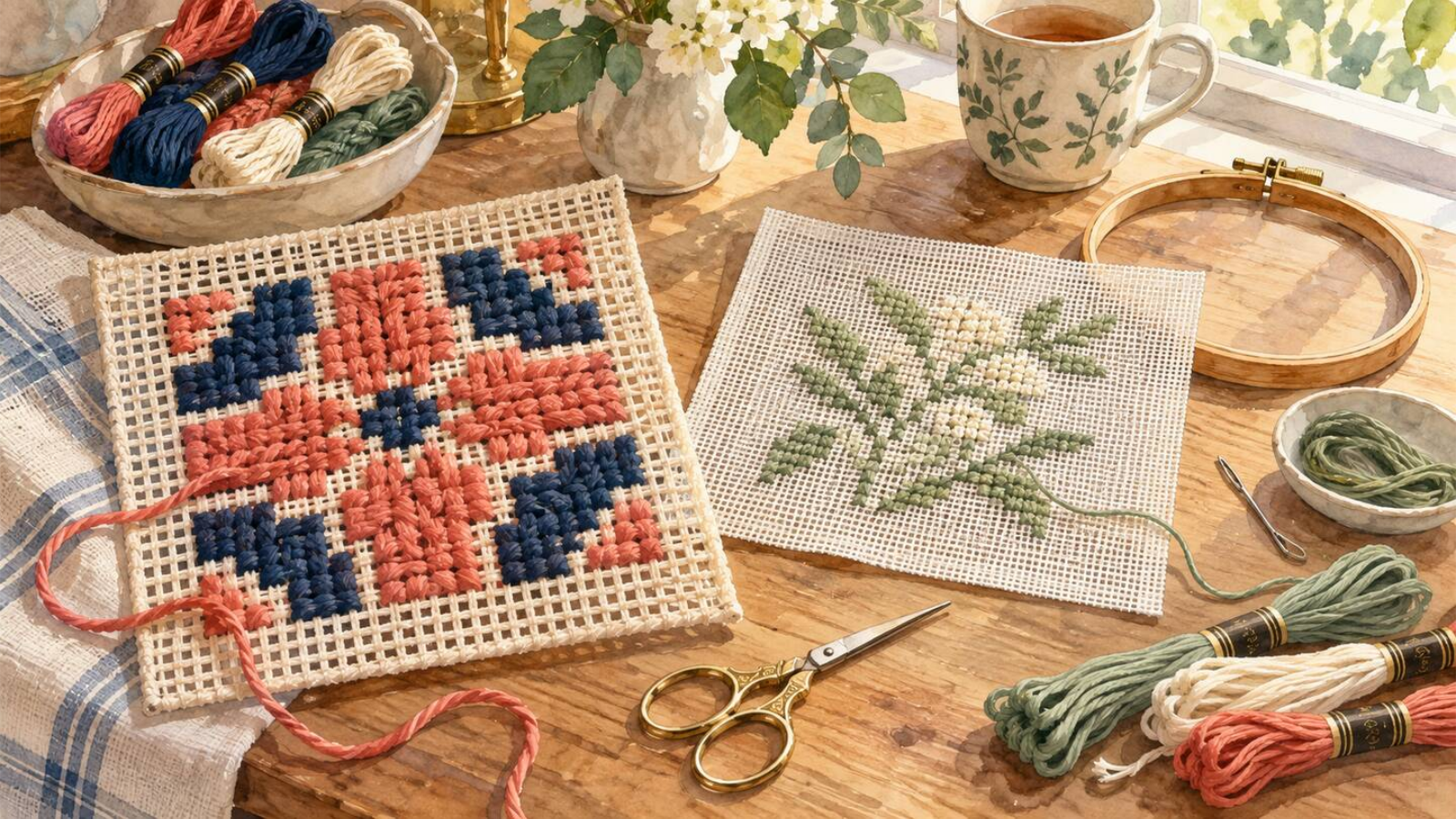
The best needlepoint thread is thick enough to cover the canvas without crowding the holes. On 13 mesh, that usually means fuller wool, silk, silk-wool blends, or size 3 pearl cotton. On 18 mesh, finer silk, blends, size 5 pearl cotton, or stranded cotton are easier to lay neatly.
For 13 mesh, try one strand of a thread sold for that count, such as Silk & Ivory, Planet Earth Silk or Wool, or DMC Pearl Cotton 3. For 18 mesh, start with Vineyard Silk, Pepper Pot Silk, Essentials, DMC Pearl Cotton 5, or about four separated and recombined strands of six-strand cotton. Then stitch a small test block. Paint thickness, stitch choice, tension, and the finish you want can change the answer.
Needlepoint thread by mesh count
| Canvas | Good starting points | Why |
|---|---|---|
| 13 mesh | Silk & Ivory, Planet Earth Silk, Planet Earth Wool, DMC Pearl Cotton 3, fuller specialty fibers | Larger holes generally need a heavier thread for solid coverage |
| 18 mesh | Vineyard Silk, Pepper Pot Silk, Essentials, DMC Pearl Cotton 5, stranded cotton, petite specialty fibers | Smaller holes accept finer thread and preserve more detail |
| Both | Some single-strand silks, metallics, ribbons, and textured fibers | Coverage depends on the exact line, stitch, and painted canvas |
These are starting points, not universal rules. Product lines vary in thickness even when they use the same fiber. Decorative stitches expose more canvas than basketweave or continental stitch, and a dark painted area under a pale thread is less forgiving.
Choose coverage before fiber
Mesh count is the number of canvas holes per inch. Higher mesh counts place the holes closer together, so each stitch is smaller. DMC recommends thicker threads such as tapestry wool, soft cotton, or size 3 pearl cotton for lower-count canvas and finer threads such as size 5 pearl cotton or six-strand embroidery floss for higher counts.
The aim is not always to hide every trace of canvas. A decorative stitch may be meant to show the painted canvas between its legs. A pale background may look clean with lighter coverage, while a light thread over dark paint can look broken. Decide whether the area needs full, medium, or intentionally open coverage before choosing a fiber.
Do not judge only by the unused strand. Pulling thread through canvas compresses it, and repeated stitches build a surface. Work at least a one-inch test block in the same stitch you plan to use.
Best threads for 13-mesh needlepoint
Thirteen-mesh canvas has larger openings and makes a larger finished piece from the same stitch count. It is forgiving for beginners, ornaments, pillows, bold lettering, and graphic designs, but it asks more of the thread. A fiber that looks substantial in the skein can still leave distracting canvas gaps after several rows.
Wool and wool blends
Tapestry wool is a traditional 13-mesh choice because it is durable, resilient, and full. DMC describes its tapestry wool as a gently twisted four-ply thread designed to withstand repeated passes through canvas. It is a sensible choice for cushions, belts, and other pieces that may see wear.
Silk-wool blends such as Silk & Ivory and Milan combine some of wool's body with a softer hand and slight sheen. Needlepoint shops commonly recommend these lines for 13 mesh. They are cut-and-go threads, so use the strand as supplied rather than trying to separate its plies.
Single-strand silk
Planet Earth Silk is a common 13-mesh option because it is fuller than many 18-mesh silks. Pepper Pot or Vineyard Silk may work on 13 mesh in some colors, stitches, or painted areas, but coverage should be tested rather than assumed. Doubling a thread changes the way it lies and can crowd the hole.
Cotton
DMC Pearl Cotton 3 is a practical non-strandable cotton starting point for 13 mesh. Soft cotton offers a matte alternative to wool. Six-strand embroidery floss can also work, but 13 mesh may require seven or eight separated strands combined in the needle, according to one needlepoint shop's strand guide. Because a standard skein contains six strands, that means combining strands from more than one cut length.
Best threads for 18-mesh needlepoint
Eighteen-mesh canvas has smaller openings and supports finer facial features, lettering, and shading. The thread needs to cover without making each hole hard to enter. Forcing a thick thread through 18 mesh increases friction, fraying, and distortion.
Silk and silk-wool blends
Vineyard Silk and Pepper Pot Silk are widely used as single-strand 18-mesh threads. Essentials is a silk-wool blend commonly recommended for 18 mesh. These lines remove the strand-count decision: cut a manageable length and stitch with one strand.
Pearl cotton and stranded cotton
DMC Pearl Cotton 5 is a useful cotton starting point for 18 mesh. It is finer than size 3 and should be used as supplied, not separated. For six-strand embroidery cotton, four separated and recombined strands are a common starting point on 18 mesh. Separating first helps the strands lie beside one another instead of twisting into a rope.
Petite and specialty fibers
Manufacturers often make a petite version of a textured thread for finer canvas. Rainbow Gallery, for example, lists Petite Very Velvet for needlepoint on 14 through 18 count, while regular Very Velvet is the fuller companion. Product names are not enough. Check the manufacturer's canvas range for the exact version.
Cotton, wool, silk, metallic, or specialty fiber?
Cotton: crisp and predictable
Cotton can be matte, like soft cotton, or lustrous, like pearl cotton. It is sturdy, widely available, and helpful when you want clean geometry or an even field of color. Pearl cotton is not strandable. Six-strand floss is strandable, which makes it adaptable but adds the work of stripping and laying strands.
Wool: durable and forgiving
Wool has body, a soft matte surface, and enough resilience to settle into the canvas. It suits hard-wearing pieces and beginners who want dependable coverage. Use tapestry or needlepoint wool rather than substituting knitting yarn, which may stretch or fray differently during repeated passes.
Silk: smooth with richer light
Silk gives saturated color and a gentle sheen. Single-strand needlepoint silks are easy to start, but the correct line depends on mesh. A thicker silk may suit 13 mesh while a finer line sits better on 18. Silk can snag on rough hands or canvas edges, so work with shorter lengths if the surface starts to fuzz.
Silk-wool blends: body plus sheen
Blends split the difference between wool's coverage and silk's light. Silk & Ivory and Milan are fuller 13-mesh examples; Essentials is a finer 18-mesh example. Use the manufacturer's strand as supplied unless it explicitly says the thread can be separated.
Metallics, velvet, ribbon, and fuzzy threads
Specialty fibers work best as deliberate accents. Metallics catch light but can kink and fray. Velvet adds a dense pile but comes in regular and petite weights. Ribbon and fuzzy threads can create leaves, fur, trim, or reflective details that flat cotton cannot. Shorter working lengths reduce wear, and a larger needle may help open the canvas hole without shredding the fiber.
How to test thread before kitting the whole canvas
- Use the real canvas. Test on the edge of the project or a scrap with the same mesh and paint thickness.
- Use the real stitch. Basketweave coverage does not predict an open decorative stitch.
- Stitch a block. One isolated diagonal is not enough. Work at least an inch so the surface settles.
- Check under normal light. Look from stitching distance and from several feet away. Photographing the sample can reveal gaps your eye has stopped noticing.
- Inspect the back and the holes. If the thread is hard to pull, frays quickly, or makes later stitches fight for space, step down in weight.
- Record the choice. Save the brand, color number, number of strands, stitch, and mesh count before separating the sample from the project.
Threaded can map a pattern to 49 thread libraries, including cotton, silk, wool, metallic, and needlepoint-focused lines. Choose a library that offers the weight and finish your canvas needs, then compare the digital match with physical thread. A screen cannot prove coverage, sheen, dye lot, or how a fiber behaves in your stitch.
If the source is a photo, build the chart with the needlepoint pattern maker, choose the canvas mesh and finished size, then use the color-count guide before buying every shade.
Needlepoint thread questions
What thread should I use for 13-mesh needlepoint?
Start with a fuller line designed for 13 mesh: Silk & Ivory, Planet Earth Silk or Wool, tapestry wool, or DMC Pearl Cotton 3. Stitch a test block because painted canvas, stitch choice, and tension affect coverage.
What thread should I use for 18-mesh needlepoint?
Vineyard Silk, Pepper Pot Silk, Essentials, and DMC Pearl Cotton 5 are common starting points. Four separated and recombined strands of six-strand cotton can also work.
Can the same thread work on 13 and 18 mesh?
Sometimes. Pepper Pot, Vineyard Silk, metallics, and specialty threads can cross mesh counts in particular colors or stitches. On 13 mesh the result may be lighter coverage; on 18 mesh it may feel crowded. Test the exact combination.
How many strands of DMC floss should I use?
About four strands is a common starting point on 18 mesh. Thirteen mesh may need seven or eight, which requires combining strands from more than one six-strand length. Separate each strand first, then recombine them so they lie smoothly.
Should the painted canvas show through?
It depends on the design. Full-coverage tent stitches usually look cleaner when gaps disappear. Decorative stitches may intentionally expose paint. Judge from normal viewing distance, not only under a magnifier.