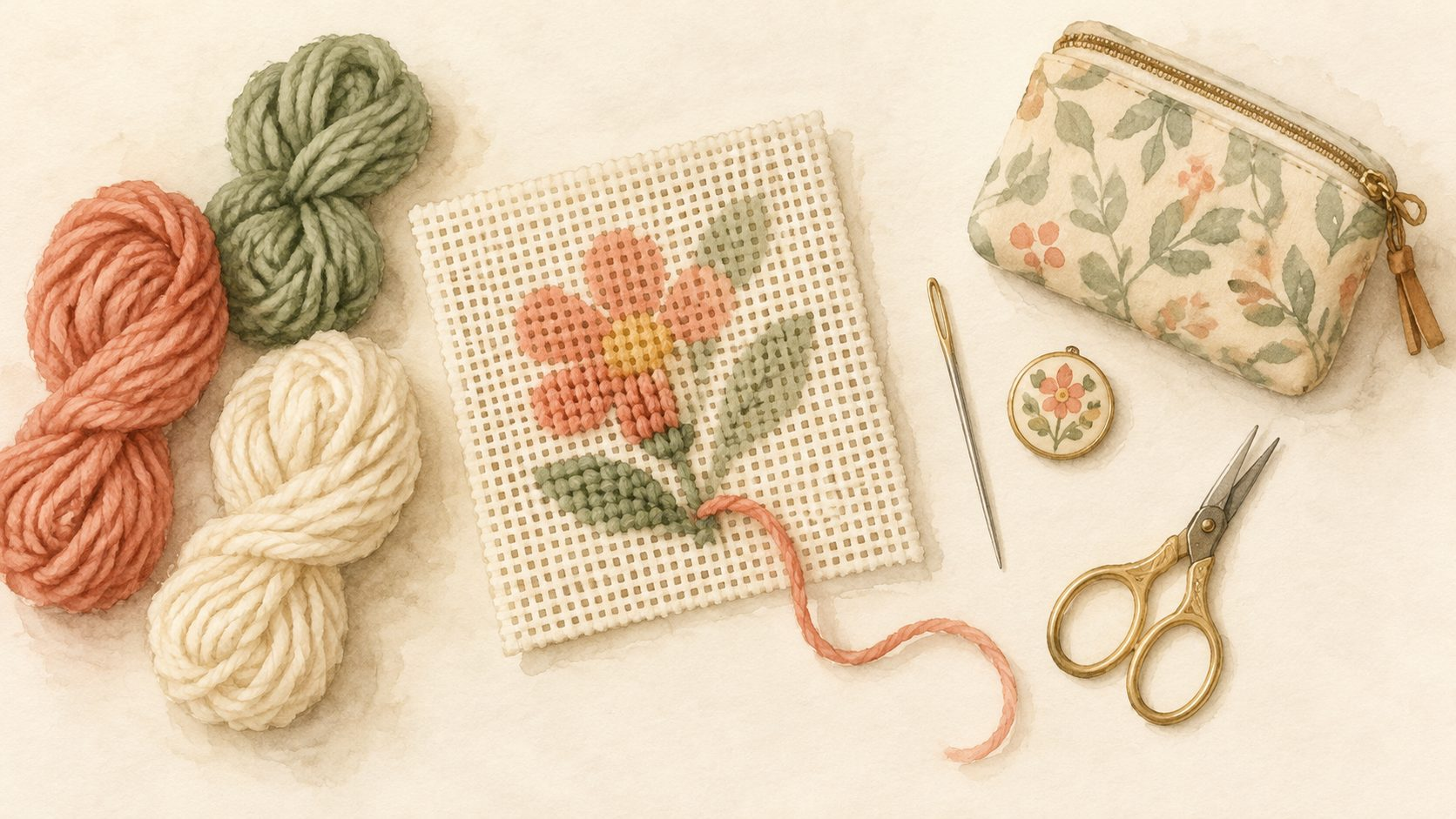
You can start needlepoint with four things: a canvas, matching thread, a tapestry needle, and small scissors. Everything else is a convenience. Where beginner lists differ is on the extras, and on how much a first project costs.
Buy a small kit or canvas at 13 mesh with thread chosen for it, plus a size 20 or 22 tapestry needle and small sharp scissors. Add a needle minder if you tend to lose needles. Skip the frame, stand, and specialty thread until your first piece is done.
The supplies, compared
| Item | Needed on day one? | What sources say |
|---|---|---|
| Canvas | Yes | All sources. Small, few colors, 13 mesh (Anne Scott, Stitch Ladi). |
| Thread | Yes | Must fit the mesh. Wool is forgiving on 13 mesh (Stitch Ladi, Anne Scott). |
| Tapestry needle | Yes | Blunt tip, size by mesh. Many canvases include one (Talking Pretty). |
| Small scissors | Yes | Anne Scott, Stitch Ladi, Talking Pretty. Not listed as essential by Northern Prepster. |
| Needle minder | Disputed | Not optional (Stitch Ladi). Not bare minimum (Anne Scott). |
| Needle threader | Optional | Counted as one of five basics by Talking Pretty. |
| Project bag | Optional | Anne Scott says any pouch works. Northern Prepster likes one for each project. |
| Stretcher bars, frame, stand | No | Anne Scott, Stitch Ladi, Unwind Studio. |
Canvas
Anne Scott Needlepoint says a good beginner canvas has 13 mesh, larger areas of color, clear design lines, not too much tiny lettering, and a design you actually like. The Stitch Ladi says start at 13 mesh because the holes are bigger, the thread is thicker, and it is easier on your eyes, and suggests a small piece under 5 inches such as a coaster or ornament, because a first project's job is to get finished. Lake Shore Needlepoint recommends a simple design with larger shapes and only a handful of colors, and explains that stitch painted or printed canvases show exactly where each stitch goes. Talking Pretty says both 13 and 18 mesh are beginner friendly and personal preference develops. Read our 13 vs 18 mesh guide for the tradeoffs, and canvas types if you are choosing a weave. A beginner kit bundles most of this.
Thread
Thread depends on mesh. Anne Scott says 13 mesh usually takes thicker thread such as wool, pearl cotton, or a wool and silk blend, and 18 mesh takes finer thread such as stranded cotton, silk, or thinner wool. The easiest route, it says, is a kit or a shop that pulls matching thread for you. The Stitch Ladi says wool and wool-silk blends are forgiving, do not fray easily, and cover the canvas well, and says to save velvet, metallics, and silk ribbon for later. Talking Pretty points beginners to DMC soft matte cotton or DMC pearl as budget friendly. The Northern Prepster says DMC is a more affordable option. Our thread by mesh count guide goes further, and the thread yardage calculator helps you buy enough. See DMC vs Anchor for brands.
Needles
Needlepoint uses a blunt tapestry needle, not a sharp sewing needle, so it slides through canvas holes without splitting threads (Anne Scott). Anne Scott suggests size 20 or 22 for 13 mesh and 22 or 24 for 18 mesh. The Stitch Ladi says size 20 for 13 mesh. Local Needlepoint Shops cites a chart of size 20 for 12 to 14 mesh, size 22 for 14 to 18, and size 24 for 18 to 22, and says the ranges overlap. One needle is enough to start, though extras are cheap insurance (Anne Scott). See how to choose a needlepoint needle.
Scissors, needle minder, and bag
Small scissors are on most lists. Anne Scott says any small sharp pair works, and Stitch Ladi says embroidery size with a sharp tip. Northern Prepster says mini scissors make life easier for a few dollars. A needle minder is a small magnet that holds your needle on the canvas. The Stitch Ladi calls it not optional after you lose a needle in a couch cushion, while Anne Scott leaves it off the bare minimum and says you will probably want one eventually. For a bag, Anne Scott says you need somewhere to keep canvas, thread, needle, and scissors together, and a zippered bag or even a plastic bag will do. Northern Prepster keeps each project's canvas and threads in one bag. When you start threads, see how to start and end thread, and read canvas preparation before the first stitch.
Frames and stretcher bars
Unwind Studio says you do not need a frame, but you can use one. Without a frame you roll the canvas up to the part you are working on and hold the rest in your other hand. Its key tip is that handheld stitching is the most portable, while a frame gives straighter canvas tension with less blocking afterwards. Stitch Ladi says stretcher bars help keep bigger pieces taut but are unnecessary for a first small project, and a stand is overkill for ornament number one. Our stretcher bars guide covers sizing.
What it costs
Stitch Ladi estimates a beginner setup of a small canvas, thread, needles, scissors, and one needle minder at $60 to $100, with the canvas as the big variable because hand painted ones cost more. Talking Pretty says beginner kits generally fall between $30 and $80, and that more advanced canvases run $50 to $150 before thread and finishing. It says digital canvas designs typically cost $5 to $10. These are published estimates and will vary by shop and country. You can also make a chart yourself with the needlepoint chart maker.
Your first session
Talking Pretty gives six beginner tips. Begin with continental stitch, which it calls the most foundational stitch and enough for most projects. Stitch in sections or by color, whichever you prefer. Fix mistakes right away, because undoing a stitch immediately is easier than correcting it rows later, and our mistakes guide shows how. Let go of perfectionism, since a first project will have imperfections. Find community, such as a local needlepoint store with stitch nights or online groups. And know that finishing is optional to do yourself: completed canvases can go to a professional finisher, and many needlepoint stores offer that service. The Stitch Ladi agrees on the first point: your first piece will have wonky stitches, everyone's does, the next stitch covers a multitude of sins, and ripping out stitches is a rite of passage and not a failure. When you do finish, see finishing basics. The Northern Prepster adds that if you buy in person, most shops can quickly teach a basic stitch and some host beginner classes, and that many online resources have appeared for learning at home.
Where sources disagree
How many essentials. Northern Prepster says only three things are required: canvas, threads, and needles. Anne Scott says four, adding scissors. Talking Pretty says five, adding a needle threader. Local Needlepoint Shops lists five including something to hold the canvas.
Needle minder. The Stitch Ladi says it is essential. Anne Scott says you do not need it at first. Northern Prepster says some people argue you do not need one but it cannot imagine stitching without it.
Thread. The Stitch Ladi starts beginners on wool. Talking Pretty starts them on DMC cotton or pearl. Anne Scott lists wool, pearl cotton, or blends for 13 mesh. All fit the mesh rule, but the budget and feel differ.
Needle size. For 13 mesh, Stitch Ladi says 20, Anne Scott says 20 or 22, and the chart Local Needlepoint Shops cites says 20 for 12 to 14 mesh. The ranges overlap, so match to the thread and test.
Cost. $30 to $80 for a kit (Talking Pretty) versus $60 to $100 for a custom setup (Stitch Ladi). They describe different things, a kit and a build-your-own.
Questions
Do I need a kit?
No, but sources point beginners to kits or shop-picked threads because they remove the guesswork of matching thread to canvas (Anne Scott, Talking Pretty).
Should I start with a hand painted canvas?
Local Needlepoint Shops suggests a kit first and hand painted canvases after a kit or two. The Stitch Ladi says hand painted canvases cost more because someone painted them by hand.
Can I use sewing needles?
Anne Scott says needlepoint uses a blunt tapestry needle, not a sharp sewing needle.
What should I stitch first?
Anne Scott and Stitch Ladi suggest a small, simple, 13 mesh piece. Talking Pretty suggests starting with continental stitch; see continental vs half cross and stitches for beginners.
Sources
- Anne Scott Needlepoint: The bare minimum supplies
- The Stitch Ladi: What you actually need
- Talking Pretty: How to start needlepoint with 5 basic supplies
- The Northern Prepster: What you need to start needlepointing
- Lake Shore Needlepoint: Free beginner needlepoint guide
- Local Needlepoint Shops: Starter supplies
- Unwind Studio: Needlepoint with or without a frame