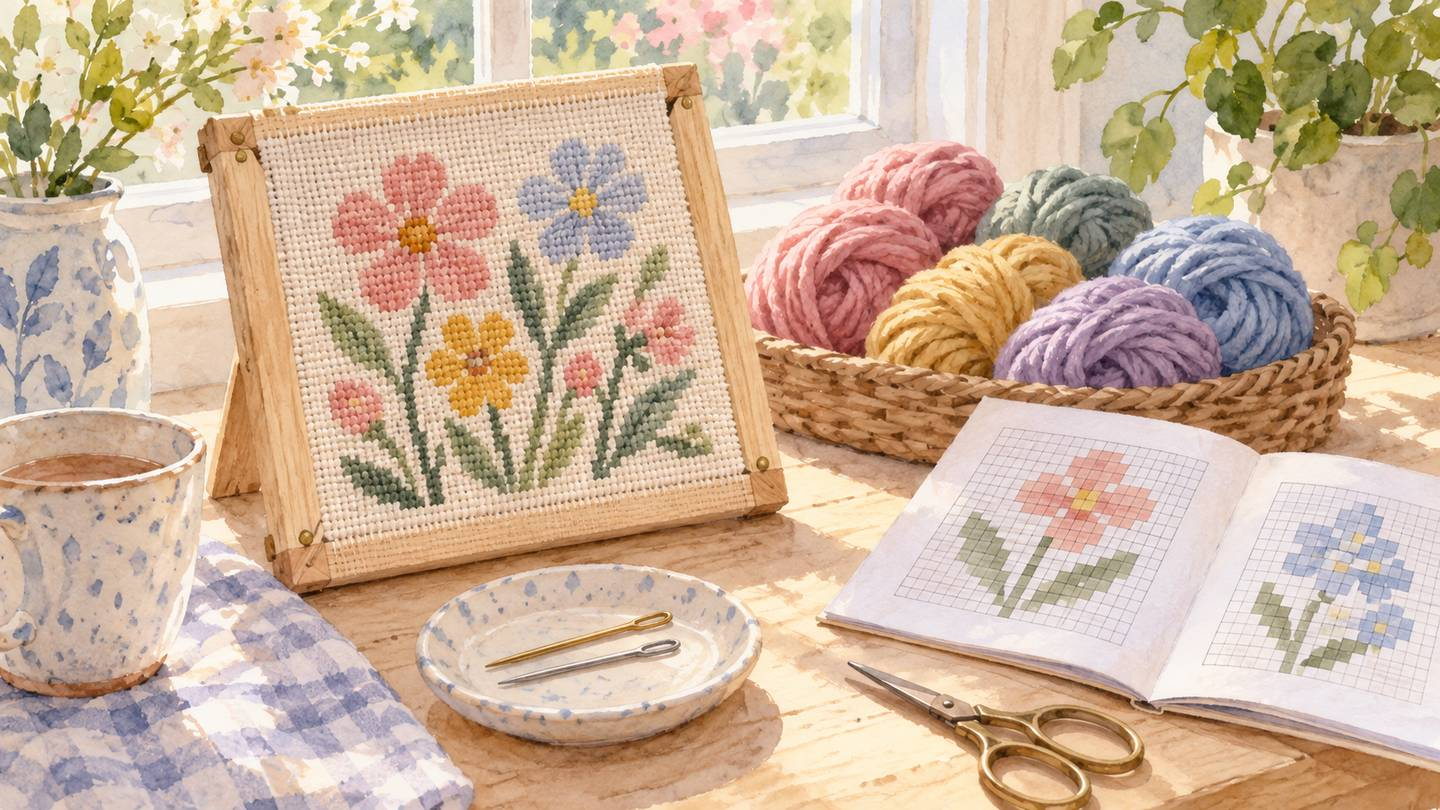
A good beginner needlepoint kit pairs a printed 13 mesh canvas around 5 inches square with everything in the box: color-matched thread with some surplus, at least two tapestry needles, a needle threader, and instructions that teach the one stitch you need. You do not need a specific brand to get this right. You need a short checklist, because everything that predicts whether you finish your first canvas is visible in the listing before you buy.
A beginner kit succeeds or fails on one question: can you finish it without buying, guessing, or searching for anything mid-project? Every criterion below serves that test. Mesh you can see, a design printed on the canvas, complete contents, bold shapes, and a size you can finish in weeks rather than months.
The buyer's checklist
| Criteria | Why it matters | What to look for |
|---|---|---|
| Mesh size | Mesh is holes per inch; finer mesh means more stitches and harder-to-see holes | 13 mesh is the sweet spot; 10 mesh works too; avoid 14 and finer for a first canvas |
| Printed vs charted | A printed canvas shows the design in color on the mesh; a charted kit makes you count from paper | Printed. Counting is a second skill you do not need on project one |
| Canvas type | Interlock locks the thread intersections so edges resist fraying and distortion in your hands | Interlock canvas for a first kit |
| Completeness | Every missing item is a stall point | Canvas, pre-cut thread with surplus, two needles, a threader, real instructions |
| Thread | Tapestry wool covers 13 mesh fully and its slight fuzz hides tension wobbles | Wool or an equivalent full-coverage fiber, pre-sorted by color |
| Design | Tiny details turn muddy when each stitch is 1/13 of an inch wide | Big shapes and clear color boundaries, no delicate lettering |
| Size | Finishing is the entire game on project one | 4 to 6 inches; a 5 inch square at 13 mesh is roughly 4,200 stitches |
Mesh size: 13 is the sweet spot
Mesh count tells you how many holes the canvas has per inch, and it quietly decides how hard your first project feels. At 13 mesh the holes are easy to see without strain, the stitches are big enough to handle confidently, and the finished design still looks crisp rather than blocky. Ten mesh is even more forgiving and shows up in many starter kits. Anything finer than 14 belongs to your second year, not your first week: an 18 mesh canvas at the same 5 inch size roughly doubles the stitch count and halves the hole size. Our 13 mesh vs 18 mesh guide walks through the tradeoff in detail, and a listing that never states its mesh count at all is usually hiding it for a reason.
Printed canvas beats charted for project one
Kits come in two flavors. A printed or hand-painted canvas carries the design in color right on the mesh, so you simply cover each colored area with the matching thread. A charted kit gives you blank canvas plus a paper chart to count from, square by square. Charted work is a wonderful skill, and it is how stitchers turn their own photos into needlepoint, but it adds a counting layer you do not need while you are still learning to thread a needle and keep even tension. For the first kit, printed, full stop. When you are ready to try counted work later, our photo to pattern guide shows how a charted design works.
What belongs in the box
A complete beginner kit contains five things, and the listing should name all of them:
- The canvas, printed, at a stated mesh count, ideally interlock.
- Thread, pre-cut and color-matched to the design, with more than the exact stitch count requires. Beginners rip stitches out; a kit cut to the exact count assumes you never will.
- At least two tapestry needles, blunt-tipped, sized for the mesh (around size 20 to 22 for 13 mesh). Needles bend and vanish; a spare keeps you stitching.
- A needle threader. Small, cheap, and the difference between a relaxing evening and a frustrating one for new stitchers.
- Real beginner instructions that teach threading the needle, starting a thread without a knot, the continental tent stitch, and ending a thread. One diagram on the box flap does not count.
If any item goes unmentioned, ask the seller before buying or move on. The thread by mesh count guide explains why the fiber in the box matters as much as the amount.
The design boldness test
Here is a two-second filter that eliminates most bad beginner kits: zoom the product photo to actual finished size and look at the smallest color areas. If every shape is at least fingernail-sized, the design will stitch cleanly. If you see delicate script lettering, thin outlines, tiny dots, or shading built from many close colors, that kit was designed for the product photo rather than the stitcher. Each stitch on 13 mesh canvas is about 1/13 of an inch wide, so fine detail becomes visual mud at beginner scale. Bold shapes, chunky petals, and clear color boundaries are not a stylistic compromise; they are what makes a first canvas finishable.
What a fair price looks like
Complete beginner kits typically run $30 to $80. Below $30, something on the checklist is usually missing, most often decent thread or real instructions. Above $80, you are generally paying for a hand-painted canvas or a large format, both of which belong in your future rather than your first week. The sweet spot sits around $45 to $75: printed 13 mesh interlock canvas, wool thread, complete contents, and a bold design. Be suspicious in both directions. A $20 kit with thin acrylic thread tests your patience rather than the craft, and if you quit you will not know whether you disliked needlepoint or just that kit.
Kit vs buying a canvas alone
Most needlepoint shops sell the same designs two ways: kitted, with threads and needle included, or as a bare canvas. For a first project the kit wins almost every time, because thread selection is its own skill. Matching fiber type, coverage, and quantities to a mesh count is exactly the kind of guessing a beginner kit exists to remove. Buy the bare canvas when you already have a thread stash, when you want to choose your own colors and textures, or when the shop does not offer a kitted version of a design you love. If you go the canvas-only route, budget for thread on top: full coverage of a 5 inch square in tapestry wool typically takes a dozen or more skeins, and the finishing still comes afterward (our finishing basics guide covers that last step).
Red flags in a listing
- Mesh finer than 14 on a kit marketed to beginners, or no mesh size stated at all.
- Thread described only as yarn with no fiber details, which often means acrylic too thin to cover the canvas.
- No instructions, or a single diagram, instead of step-by-step teaching.
- Exact-length thread with no surplus for mistakes.
- A huge first project. A 12 inch canvas carries four to six times the stitches of a 5 inch one, and the 40-hour runway before your first finish is where hobby momentum dies.
- Fine lettering, thin stems, and tiny details in the design photo.
Once a kit has taught you the stitch, Threaded turns any photo into a custom needlepoint chart with thread matching across 49 libraries and free DMC and Anchor presets. Set the mesh count and finished size, generate the PDF, and stitch something nobody else has. Start with how photo conversion works, or compare crafts in needlepoint vs embroidery if you are still choosing your lane.
Common questions
What mesh size should a beginner needlepoint kit be?
Thirteen mesh, meaning 13 holes per inch. The holes are easy to see without strain, and the finished design still looks crisp. Ten mesh is also beginner-friendly. Avoid anything finer than 14 for a first canvas.
How do I know if a kit includes everything I need?
Check the listing for five things: a printed canvas with a stated mesh count, pre-cut color-matched thread with surplus, at least two tapestry needles, a needle threader, and step-by-step beginner instructions. If any is unmentioned, ask before buying.
Do I need to know any stitches before buying a kit?
No. One stitch, the continental tent stitch, completes an entire beginner canvas, and a good kit teaches it. Most new stitchers are working confidently within the first fifteen minutes.
Is a cheap $20 kit a good way to test whether I like needlepoint?
Be careful what you are testing. A kit with thin thread, no instructions, and a fiddly design tests your patience, not the craft. If you abandon it, you will not know whether you disliked needlepoint or just that kit. A complete kit in the $45 to $75 range is a fairer trial.
What is the difference between interlock and mono canvas?
Interlock canvas has locked intersections that resist fraying and distortion in your hands, which makes it the forgiving choice for a first kit. Mono canvas has single threads that shift more easily and suits advanced decorative stitching. For project one, choose interlock when you have the option.
Should my first kit be a printed canvas or a chart?
Printed. A printed or painted canvas shows the design in color on the mesh, so you match thread to color areas directly. Counting from a paper chart onto blank canvas is a second skill worth learning later, not during your first project.