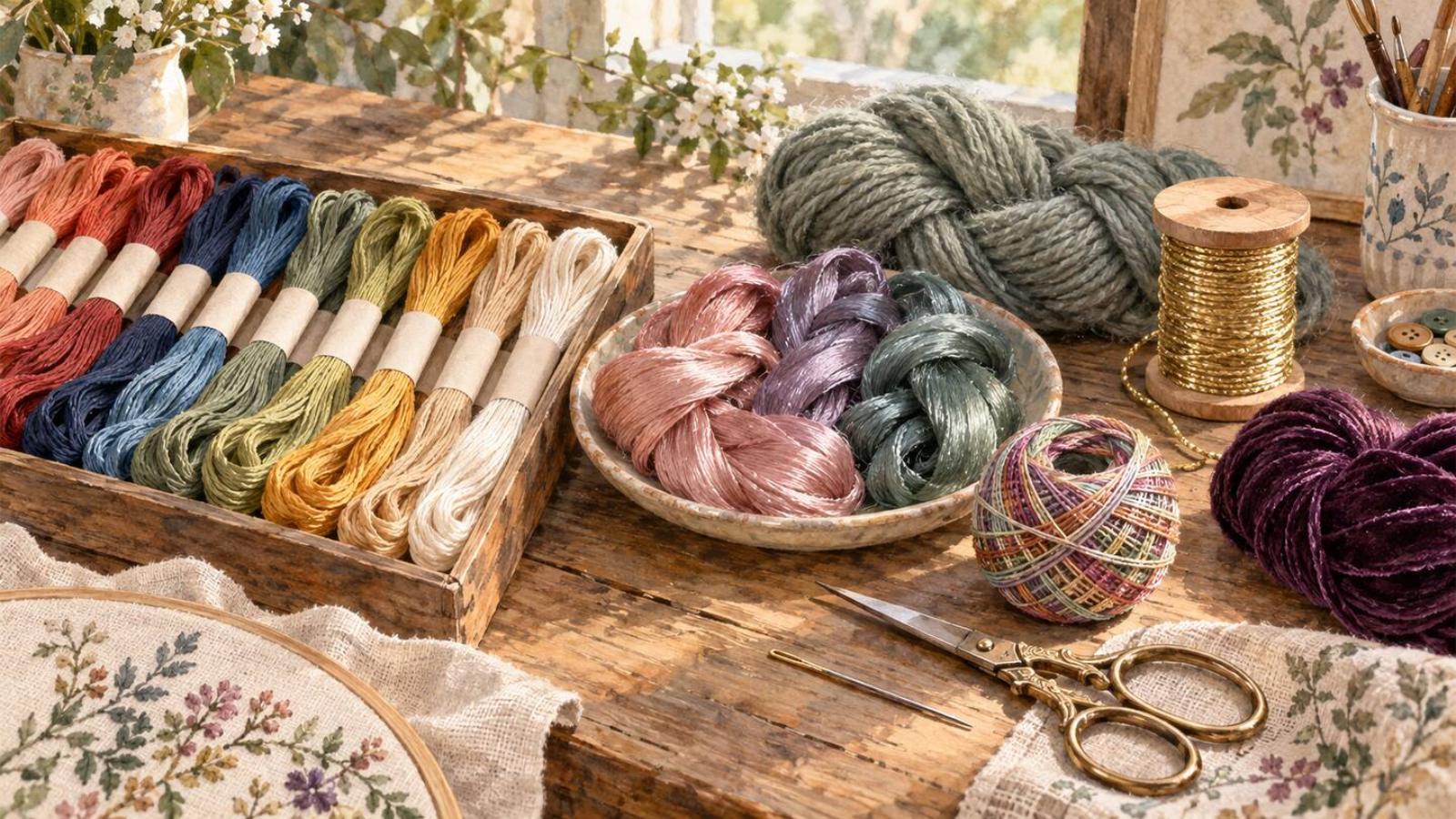
DMC and Anchor are the two mass-market thread brands most stitchers start with, and either one covers a full cross-stitch or needlepoint project. Move to wool, silk, silk-wool blends, hand-dyed cotton, metallics, or velvet when you want a specific texture, sheen, or coverage that stranded cotton cannot give you.
For a first project, pick DMC or Anchor six-strand cotton and match the strand count to your fabric or canvas. For needlepoint on 13 mesh, look at fuller lines such as Silk & Ivory or Planet Earth Wool. For 18 mesh, try Vineyard Silk, Pepper Pot Silk, or Essentials. Add metallics and velvet as accents once the base coverage works.
Thread brands at a glance
| Brand or line | Fiber and form | Known for |
|---|---|---|
| DMC | Six-strand cotton, 500 shades; also pearl cotton and tapestry wool | The default reference palette; easiest to find worldwide |
| Anchor | Six-strand cotton, about 446 colors; also pearl cotton and wool | Closest DMC equivalent, common in Europe and in older patterns |
| Soie d'Alger | Seven-ply stranded spun silk, 632 colors | Strandable silk for canvas work and fine embroidery |
| Silk & Ivory | 50% silk, 50% merino wool, 250 colors | Single-strand coverage on 13 to 18 mesh needlepoint canvas |
| Essentials | 50% merino wool, 50% silk, 276 colors | Single-strand blend sized for 18 mesh |
| Weeks Dye Works, Valdani | Hand-dyed and overdyed cotton | Subtle color variation and primitive or folk texture |
| Kreinik | Metallic braids and cords | Sparkle in graded weights, used straight off the reel |
| Rainbow Gallery | Specialty lines such as Very Velvet | Texture: pile, fuzz, ribbon, and novelty finishes |
Every line above is a real, current product range from the manufacturer or a specialist retailer. Availability of individual colors changes, so confirm a shade exists before designing a whole project around it.
DMC: the default palette
DMC's Mouliné Spécial six-strand embroidery floss is the benchmark stranded cotton. It is 100% cotton, comes in 500 shades, and is sold in 8.7-yard skeins whose six strands separate easily. Because so many patterns list DMC numbers first, it is the path of least resistance: you can kit almost any published chart without converting a single color.
The same line works across crafts. On 14-count cross-stitch fabric, two strands is the common starting point. On needlepoint canvas, you separate and recombine more strands as the mesh gets coarser; the thread-by-mesh guide has starting counts for 13 and 18 mesh.
Beyond stranded floss, DMC sells pearl cotton in graded weights (size 3 is fuller, size 5 finer, and the scale keeps going finer from there), plus tapestry wool for canvas work. Pearl cotton is not strandable: use the weight that matches the canvas instead of trying to split it.
Anchor: the other preset
Anchor's stranded cotton is the closest equivalent to DMC's: six separable strands, comparable thickness, and a range of about 446 colors. In much of Europe, Anchor is the easier brand to find in local shops, and many older or European patterns list Anchor numbers natively.
In day-to-day stitching, the two brands behave nearly the same. Stitchers who compare them side by side tend to describe small differences in hand and sheen rather than a clear quality gap. The practical reason to choose one over the other is usually pattern compatibility or what your local shop actually stocks, not performance.
Anchor also sells pearl cotton and tapestry wool under its own numbering, so a whole project can stay inside one brand if you prefer.
Converting between DMC and Anchor
Conversion charts map each DMC number to the nearest Anchor shade and back, and they are genuinely useful when a pattern lists a brand you cannot buy locally. Treat every mapping as an approximation, not an identity. Two threads can be the nearest available match and still read differently in a large stitched area, especially in reds, greens, and flesh tones.
Three habits keep conversions safe:
- Convert the whole project, not half of it. Mixing brands inside one color family can make the shifted shades visible. If you convert, convert everything in that palette family.
- Compare in daylight before kitting. Hold the converted skein next to the chart or a stitched sample. A screen conversion cannot show dye depth or undertone.
- Buy enough from one dye lot. This matters for every brand, and it matters more when a substitution is already approximate.
When specialty threads are worth it
Stranded cotton is flat, matte, and predictable. That is a strength for charts and lettering, but needlepoint in particular rewards fibers with more body, light, or texture. Specialty lines cost more per skein and are usually sold through needlepoint shops rather than big craft chains, so it helps to know what each category buys you.
Wool: body and durability
Tapestry wool is the traditional needlepoint fiber: resilient, matte, and full enough to cover 13 mesh in a single strand. Planet Earth Wool and the DMC and Anchor tapestry lines are the common options. Wool forgives tension mistakes and holds up on pillows, belts, and other pieces that get handled.
Silk: saturated color and sheen
Single-strand needlepoint silks remove the strand-count decision entirely. Vineyard Silk and Pepper Pot Silk are sized for 18 mesh; Planet Earth Silk is fuller and a common 13-mesh choice. If you want a strandable silk, Au Ver a Soie's Soie d'Alger is a seven-ply spun silk in 632 colors that divides easily for canvas work or fine surface embroidery. Silk rewards shorter working lengths, because it can fuzz if it is repeatedly pulled through canvas.
Silk-wool blends: the middle path
Blends split the difference between wool's coverage and silk's light. Silk & Ivory from Brown Paper Packages is a 50% silk, 50% merino line in 250 colors that the maker rates for 13 through 18 mesh. Essentials from Planet Earth Fibers is the same 50/50 idea in 276 colors, sized for 18 mesh. These are cut-and-stitch threads: use the strand as supplied.
Hand-dyed cotton: gentle variation
Weeks Dye Works built its name on hand over-dyed, colorfast fibers, and Valdani sells hand-dyed pearl cotton in sizes 5, 8, and 12, including more than 170 variegated shades. One skein carries several related tones, so a single thread gives leaves, sky, or backgrounds a mottled, organic look that flat cotton cannot imitate. The flip side is predictability: if you need a perfectly even field of one color, hand-dyed is the wrong tool.
Metallics: controlled sparkle
Kreinik's metallic braids are the standard way to add light to a piece. The braid number tells you the weight: Very Fine #4 is the thinnest, each step up doubles the thickness (Fine #8 is twice #4, Medium #16 twice #8), and they are used straight off the reel as a single strand rather than separated. Pick the weight that covers your mesh, and keep lengths short to limit kinking and fray.
Velvet and novelty textures
Rainbow Gallery's Very Velvet is a 100% nylon pile thread rated for needlepoint on 13 through 18 count, with a petite version for finer canvas. Texture threads like this are accents: a velvet pumpkin, a fuzzy animal, a ribbon-wrapped border. A whole background in pile thread reads heavy, so plan them where the design calls attention.
How to choose a thread brand for your project
- Start from the pattern. If the chart lists DMC or Anchor numbers, buying that brand is simpler than converting. If it lists a specialty line, the designer chose it for a reason.
- Match weight to fabric or mesh. Strand count for floss, size number for pearl cotton, braid number for metallics, or the maker's mesh rating for single-strand lines. The 13 vs 18 mesh guide explains the canvas side of the decision.
- Decide the finish first. Matte and even, soft sheen, visible sparkle, or touchable texture. The finish picks the fiber category before the brand.
- Check availability. Mass-market cotton is everywhere; specialty lines come from needlepoint shops and can go out of stock mid-dye-lot. Buy the full project quantity up front.
- Test before committing. Stitch a small block in the real stitch on the real canvas. Coverage, sheen, and how a fiber behaves in your hands are not visible on a screen.
Threaded maps a pattern to 49 thread libraries, with DMC and Anchor as free presets and the specialty lines available on Pro. You can compare how the same photo converts across libraries before buying a single skein. The digital match gets you to the right shelf; a stitched test block makes the final call.
If you are starting from a photo, build the chart with the needlepoint pattern maker, set the color count to something your chosen library covers well, and then kit the threads.
Thread brand questions
Is DMC or Anchor better for cross-stitch?
Neither has a clear quality edge for everyday work. Choose whichever your pattern lists or your shop stocks; both are six-strand cottons with hundreds of colors and conversion charts between them.
Can I mix thread brands in one project?
Yes, especially across different fiber categories, such as a cotton background with a metallic accent. Inside a single flat color area, stick to one brand and one dye lot so the shade stays consistent.
Are specialty threads worth the price for a beginner?
Not for a first piece. Learn tension with DMC or Anchor cotton, then add a specialty accent on your second or third project. The exception is single-strand needlepoint lines like Silk & Ivory or Essentials, which some beginners find easier because there is no strand counting.
What is the difference between pearl cotton and stranded floss?
Stranded floss separates into six strands so you can tune thickness. Pearl cotton is a twisted, non-strandable thread sold in graded sizes: smaller numbers are thicker. Choose a size that matches your fabric or mesh rather than trying to split it.
Do hand-dyed threads fade?
Reputable hand-dyers such as Weeks Dye Works and Valdani describe their fibers as colorfast. As with any thread, wash finished pieces gently and test first if the piece will be laundered.