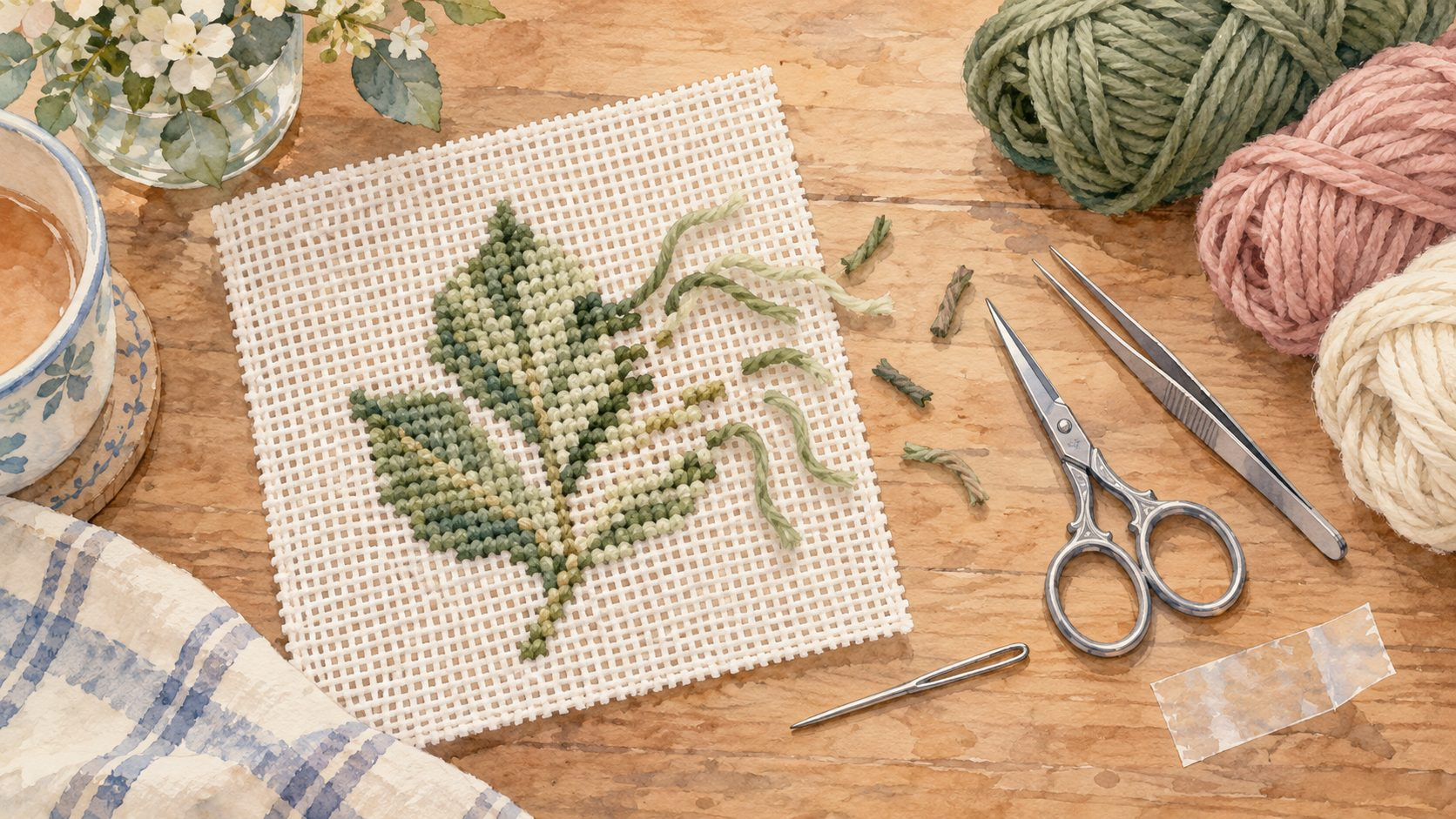
Almost every needlepoint mistake can be fixed without starting over. The trick is choosing the right fix: reverse a few stitches, snip and pull a larger area, tuck in a missed stitch from the back, or mend a cut canvas thread. Some mistakes are best left alone.
Ask whether you can see the mistake from normal viewing distance and whether it affects the structure of the piece. If not, leave it. If you must fix it, work from the front for a few stitches, from the back for larger areas, and keep your scissors away from the canvas threads. Cutting the canvas is the one mistake that needs a repair of its own.
Decide what is worth fixing
Georgie & Lottie Co. open with a rule: do not fix little mistakes. If a mistake does not bother you, is not noticeable from normal viewing distance, and does not affect the structure of the piece, you can leave it. Their reasoning is that over-fixing often causes more frustration than the original problem. They list questions to ask first: does it affect the overall look, will fixing improve your enjoyment, or will it create more frustration?
They treat frogging, the term for taking stitches out, as an informed decision rather than a failure. It is worth it when a stitch choice fights the design or you know the mistake will keep bothering you, and not worth it for tiny inconsistencies you only see when staring closely. Kae Blake lists common reasons stitchers frog: miscounted stitches, the wrong thread color, tension issues, and changes of mind about a design element.
Undo a few stitches
Needlepoint For Fun says that for five or six wrong stitches or fewer, the easiest approach is to reverse the stitching. Put the needle back into the hole the thread came from and unwind the stitches. The author finds it easiest to take the needle off the yarn and use the needle tip to unhook and pull the stitches through, then rethread and carry on.
Georgie & Lottie suggest a gentler first step for loose stitches: turn the canvas over and tug the thread tails to see whether the stitch settles back into place before ripping anything. For a stitch that looks fine from the front, they say to leave it.
Rip out a larger area
For bigger areas, cutting is faster and kinder to the canvas. Needlepoint For Fun gives four steps. Cut the stitches on the front with small sharp scissors, taking care not to cut the canvas. After cutting a few, turn the canvas over and pull out the snipped pieces with tweezers. Repeat until the area is clear, then dab sticky tape over the front and back to lift leftover fibers.
Kae Blake gives similar advice: work slowly, use a blunt-tipped needle or a small seam ripper to lift stitches instead of yanking them, and snip every few stitches when removing a large section to reduce stress on the canvas. She says rushing can break threads or tear the canvas. KC Needlepoint describes a brush tool for large areas: clip the thread from the back, then rub with the long bristles to pull out most cut fiber and the short coarse bristles for what remains. It is a shop product, so treat it as one option among several.
Keep your eyes on the canvas threads while you cut: the stitches go, the canvas stays. If you mount your work, our stretcher bar guide explains how to keep the canvas square.
Reuse the thread or not
Needlepoint For Fun admits that the needlepoint police say you should not reuse yarn that has been unwound or ripped out, and says it does not listen. Inspect it before you stitch with it again. If it is split or messy, tie it off and use a fresh piece. The same page says silks and velvets do not take well to being reused, while sturdy tapestry yarn is usually fine.
Georgie & Lottie say that if a fiber looks tired, cut it and restart with a fresh strand, and suggest lengths of 12 to 15 inches to limit fraying. For how to begin and end a new length without lumps, see our guide on how to start and end a needlepoint thread.
Add a missed stitch
KC Needlepoint has a clear rule of thumb. If you are less than an inch and a half from the missed stitch and still using the same thread, jump back and catch it, then drag the thread back to where you were. If you are farther away, such as when you spot it before finishing, avoid dragging thread across the back because it creates mess.
For a distant missed stitch, find a strand of the right color, thread your needle, and flip the canvas. Run the thread under four or five stitches on the back near the hole, going with the canvas threads so you do not disturb stitches on the front. Bring it up in the missed spot and make the stitch. Then run the needle under four or five canvas threads on the back to lock it, and trim the excess. Georgie & Lottie add a test: if you cannot see the gap without searching for it, it is a mistake no one else will notice.
Mend a cut canvas thread
Cutting the canvas is the one mistake that is not about stitches. NeedlepointTeacher says not to panic and gives two methods. For mono canvas, fill the area around the cut with stitches, leaving about half an inch open. Release the cut thread and poke it to the back, then weave the ends through your stitches. Weave new threads, starting two canvas threads from the edge, through the stitches and the void so the canvas looks as it did before, then stitch the void with correct tension.
For interlock canvas, the method is simpler. Remove the thread from an area about half an inch around the hole, lay a square of canvas on the back, and stitch the area again through both layers. Needlepoint For Fun mentions a quick repair method for cut canvas as well. If you are not sure which canvas you have, our canvas types guide explains how to tell.
Prevent the next mistake
Kae Blake's prevention list is short: double-check the pattern and count often, use a highlighter or marking tool to track progress, work in good light, and take your time. If you work from a chart, how to read a needlepoint chart covers counting squares, centering, and tracking your place. Preparing the canvas properly, as in our canvas preparation guide, also helps, and a well-fitted blunt needle reduces damage to the mesh during corrections. If you also stitch cross stitch, the cross stitch mistakes guide covers the fabric version.
Charting your own design? A clean chart with a reasonable number of colors is easier to follow and cuts counting errors. The needlepoint chart maker produces a chart with a thread legend, but it cannot prevent a miscount at the canvas.
Where sources disagree
Fix or leave. Georgie & Lottie push you to leave small mistakes, while Kae Blake treats frogging as an essential skill that ensures the piece turns out as you envisioned. They are addressing different mistakes: wrong counts and wrong colors versus minor tension differences. The practical test is whether you would notice it at normal viewing distance.
How to remove. Needlepoint For Fun recommends reversing the stitches for small mistakes and cutting for bigger ones. Kae Blake leans toward gentle lifting with a blunt needle or seam ripper and snipping every few stitches. KC Needlepoint sells specialist tools. All of them aim to avoid cutting the canvas, so choose the method you can control best.
Reusing thread. Needlepoint For Fun says reuse is usually fine for sturdy yarn but not silk or velvet. Georgie & Lottie say to replace tired-looking fiber. Both agree you should inspect first.
Thread length. Georgie & Lottie recommend 12 to 15 inches, while Stitchopedia says no longer than 18 inches. Both aim to reduce wear and tangles, so use the shorter end for fibers that fray.
Questions
How do I remove stitches from needlepoint without damaging the canvas?
Cut stitches on the front with small sharp scissors, then pull the snipped pieces out from the back with tweezers. For a few stitches, reverse them with the needle instead.
Can I reuse the thread I pull out?
Often, if it is not split or messy. Silk and velvet usually do not recover, according to Needlepoint For Fun.
How do I fix a missed stitch near the end of a project?
Use a short strand of the right color, anchor it under four or five stitches on the back, make the stitch, and lock it again under four or five canvas threads.
What if I cut a canvas thread?
Mend it before you stitch the area. NeedlepointTeacher gives separate methods for mono and interlock canvas.
Can Threaded fix a mistake in my physical canvas?
No. Threaded helps you plan and chart a design with the needlepoint chart maker and size it with the canvas size calculator, but corrections happen on your canvas.
Sources
- Needlepoint For Fun: How to rip out needlepoint
- Kae Blake: Frogging, embracing the art of undoing
- Georgie & Lottie Co.: How to fix common needlepoint problems without starting over
- KC Needlepoint: What to do when you miss a stitch
- KC Needlepoint: The Boo Boo Brush
- Stitchopedia: The basics, preparation
- NeedlepointTeacher: Mending a hole in the canvas