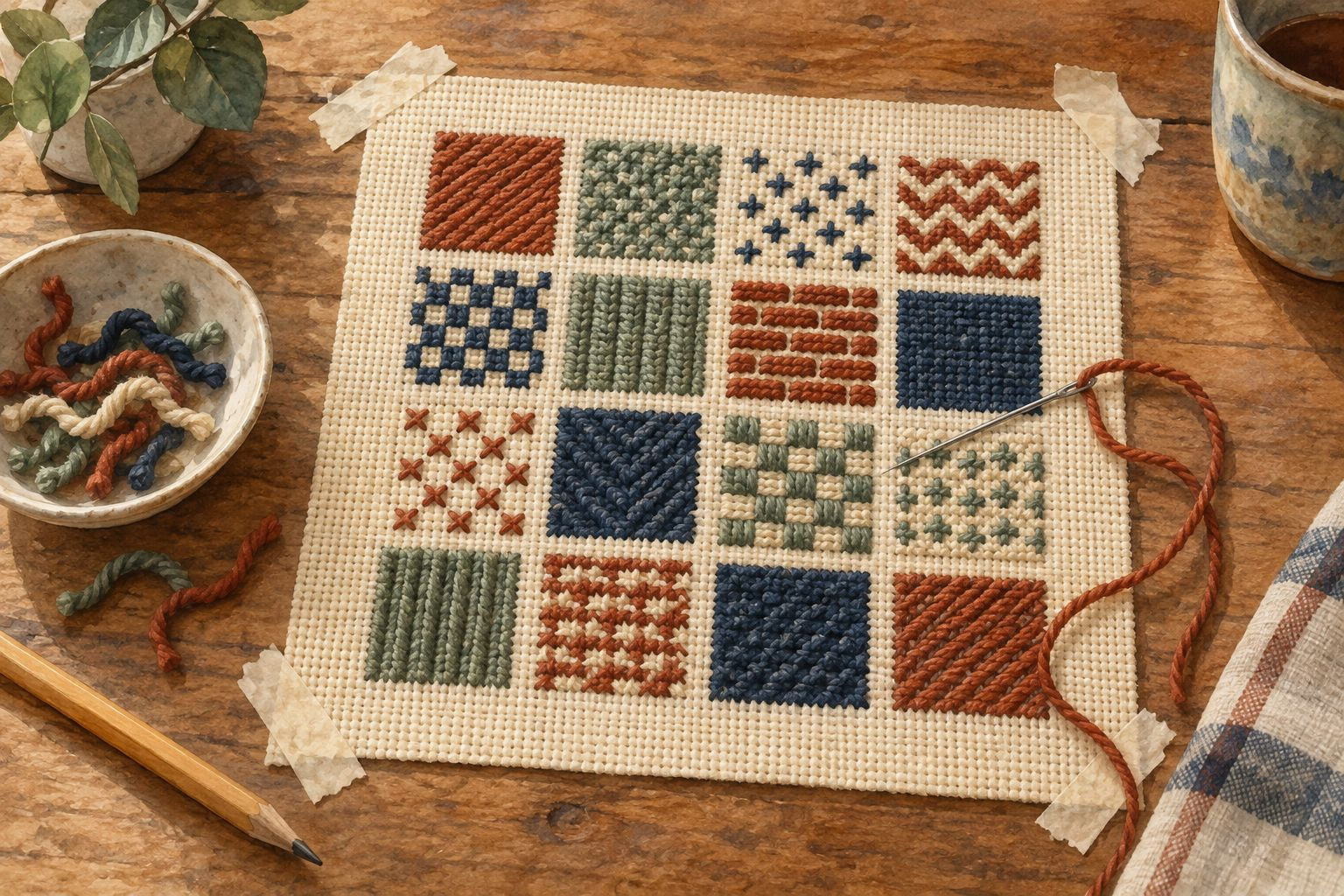
A needlepoint stitch sampler is a small canvas where you try stitches, threads and tension before you commit them to a real project. The sources agree on the idea and differ on size, how many stitches to include and which ones to start with. Here is how to plan one, set it up, choose threads and stitches, and where the advice splits. Last updated October 26, 2026.
Start here: take a small square of canvas, about 4 by 4 or 5 by 5 inches on 13 mesh (Atlantic Blue Canvas), tape the edges, and divide it into squares. Fill each square with a different stitch, starting with ones you know. Nuts about Needlepoint suggests six to fifteen areas, and a few more stitches than areas so you can swap one out.
What a stitch sampler is
Atlantic Blue Canvas, a canvas and kit shop, defines a stitch sampler as a small piece of blank canvas set aside for practice, with no final design to finish. It describes it as a visual library of techniques you can look at when you start a new canvas, and lists what experts use samplers for: testing thread coverage, comparing tension across stitches, checking how silk and wool behave and trying decorative stitches before they go on a precious canvas.
Nuts about Needlepoint, written by needlepoint author Janet Perry, gives a different picture. She says the traditional sampler brings to mind a cross stitch sampler in lines with alphabets and motifs, which she finds limiting for needlepoint stitches. Her own samplers are patchwork-style designs, built from line drawings, ceramic tiles, patchwork quilts and scrapbook layouts, and she has stitched a few as Christmas stockings. She also says she learned from the colorful patchwork samplers in The Needlepoint Book, in its first edition.
If you want a sampler that is a finished object, KC Needlepoint, a shop, describes its 21 stitches in 2021 kit as a modern day sampler. It is a charted gingham magnolia pattern on brown canvas with a stitch guide, so the practice ends in something you can display. A similar idea runs through Serendipity Needleworks, a needlepoint shop, which collected the samplers that readers made in its 2020 Stitch Challenge.
Canvas and setup
Atlantic Blue Canvas says a small square, around 4 by 4 or 5 by 5 inches, is enough for several techniques, and that most beginners learn most comfortably on 13 mesh, which gives room to see how stitches behave and makes mistakes easier to fix. Creativebug's Free-form Needlepoint Sampler class also uses 13 count canvas, which its instructor describes as 13 stitches per inch, and shows masking tape around the edges, a size 22 tapestry needle, wool snips and a pencil. The NeedlepointTeacher free sampler project goes larger: a 13 by 13 inch canvas, 18 mesh.
Atlantic Blue Canvas says to treat the sampler like a real project: tape or bind the edges, mount it on stretcher bars so tension stays consistent, and lightly pencil grid lines if you want clear sections. Our guides cover taping canvas edges and stretcher bar sizing and mounting. The mesh numbers are in the mesh size chart. On needles, Creativebug's instructor says the blunt tip of a tapestry needle helps avoid piercing wool already in a hole, because stitches share holes; see how to choose a needlepoint needle.
If you would rather not draw a layout, Brooke Thorn McGowan, in her Substack post on a tent stitch sampler, says to divide a small canvas into six squares or rectangles, using a micron pen or acrylic paint for the outline if you want help staying organized.
Pick threads
Nuts about Needlepoint describes three ways of choosing: start from a multicolored thread and add threads that coordinate with it, pick several threads in the same or similar colors, or use a color scheme such as red and green. It says to pick threads you like and are comfortable using, because the sampler is a showcase of stitches, and to carry a few more threads than you expect to need, because many samplers never got finished when a thread was not working.
Atlantic Blue Canvas treats the sampler as the place for leftover fibers. It says short pieces of wool, cotton, silk and specialty threads behave differently and testing them on one sampler teaches how fiber choice affects technique: wool is forgiving and gives soft coverage, cotton gives crisp definition, and silk adds sheen but needs careful tension. Brooke Thorn McGowan suggests six different colors, or subtle shifts in shade, to make the differences between the six tent stitch variations show. For more on fibers, see wool, cotton and silk needlepoint threads.
Pick stitches
Nuts about Needlepoint's rule is that the stitches in a sampler should be related, in the same family or of the same type. She says her least successful samplers were the ones where the connection between the stitches was weak. She also says every sampler should include some familiar stitches, which become small rewards after a section that held a new one.
Atlantic Blue Canvas suggests tent stitch, then basketweave, then brick, with mosaic and Scotch as decorative play. Needlepoint.Com, a shop, sells a beginner sampler kit on 13 mesh printed canvas that focuses on the two foundational stitches, tent and basketweave. Serendipity Needleworks lists 15 stitches it thinks every needlepointer should know: diagonal mosaic, woven plait, Hungarian, Byzantine, brick, Hungarian ground, a bargello line pattern, cashmere, Parisian, Scotch, Nobuko, T-stitch, criss-cross Hungarian, Milanese and upright cross. Creativebug's class works through tent stitch variations and then the Byzantine, leaf and wicker stitches.
Brooke Thorn McGowan's sampler is a tent stitch study: vertical and horizontal continental, vertical and horizontal half-cross, and basketweave with a "poll" start and a "step" start. Two blocks of each. She says the front can look the same while the back differs, which changes tension and wear. Our guides cover basketweave and continental versus half cross, and stitch guides for mosaic, Scotch, Byzantine and Nobuko. For a wider starting list, see needlepoint stitches for beginners.
Layouts that work
Atlantic Blue Canvas lists four: a color block sampler, where blocks of coordinating or contrasting colors show how hue and saturation affect texture; a grid sampler, where you divide the canvas into small squares and fill each with a stitch; a mood sampler built around a theme such as calm blues and creams; and a mini motif sampler with small hearts, stars, initials or geometric tiles. It calls the grid a catalog of techniques you will return to for years. Nuts about Needlepoint works from a design instead, with six to fifteen areas. Creativebug's class is free-form, with no printed design.
On direction, tension and coverage, Atlantic Blue Canvas suggests stitching the same stitch in different directions and comparing the results, and working each stitch in wool, cotton and silk to see which combinations give the look you want.
Where sources disagree
How big. Atlantic Blue Canvas says 4 by 4 or 5 by 5 inches on 13 mesh. NeedlepointTeacher's free project is 13 by 13 inches on 18 mesh. KC Needlepoint's kit is a full pattern worked through 21 stitches. A small first sampler finishes faster; the larger ones become display pieces.
How many stitches. Nuts about Needlepoint wants six to fifteen areas and a few spare stitches. Brooke Thorn McGowan's is six blocks. Serendipity Needleworks gives 15 stitches. KC's kit has 21.
Related or varied stitches. Nuts about Needlepoint wants a strong connection between stitches, in one family. Atlantic Blue Canvas says the sampler thrives on variety and gives an open yes to mixing stitches. Pick based on what you want to learn: a family for depth, variety for range.
Half cross. Brooke Thorn McGowan includes half cross in her sampler but does not recommend it for large areas, saying it compromises durability and blocking for finishing. Creativebug's instructor calls half cross a conservative way to use your wool. See the blocking guide for why the back of the stitch matters.
Common mistakes
- Too many unfamiliar stitches. Nuts about Needlepoint says to include some familiar ones and to carry spare stitches in case one will not work that day.
- Skipping the canvas setup. Atlantic Blue Canvas says to tape or bind the edges and mount on bars so tension stays consistent.
- Choosing threads you do not like. Nuts about Needlepoint says it is a showcase of stitches, so pick threads you enjoy.
- Running out of ideas partway. Keep a few spare threads, as Nuts about Needlepoint does, so a failing color can be swapped.
FAQ
What size should a stitch sampler be?
Atlantic Blue Canvas says 4 by 4 or 5 by 5 inches is perfect for beginners. NeedlepointTeacher's project is 13 by 13 inches on 18 mesh.
Which stitches should I start with?
Atlantic Blue Canvas says tent and basketweave first, then brick and mosaic. Brooke Thorn McGowan starts with six tent stitch variations.
Do I need to draw a grid?
Atlantic Blue Canvas says either works: draw grid lines or go freeform, whichever keeps you organized.
Can I use leftover thread?
Atlantic Blue Canvas says a sampler is the perfect place for leftover fibers, and Brooke Thorn McGowan suggests using up stash.
Should a sampler have a finished purpose?
It can. KC Needlepoint's sampler kit ends in a pattern you can display, and Serendipity Needleworks shows readers turning samplers into gifts. Atlantic Blue Canvas describes the sampler as a reference tile and practice piece.
Sources
- Atlantic Blue Canvas - Beginner Stitch Samplers (a canvas and kit shop; size, setup, threads, stitches, layouts)
- Nuts about Needlepoint - How to Make a Needlepoint Stitch Sampler (design, thread and stitch picking)
- Brooke Thorn McGowan - A Mini Sampler of the Six Basic Needlepoint Tent Stitches (six-square tent stitch sampler, half cross caution)
- Serendipity Needleworks - A Scrapbook of Stitch Samplers (a needlepoint shop; reader samplers, list of 15 stitches)
- KC Needlepoint - Learn 21 stitches in 2021 (a needlepoint shop; modern day sampler kit)
- Creativebug - Free-form Needlepoint Sampler (class page; 13 count canvas, materials, stitch list; details from the class transcript)
- Needlepoint.Com - How to Needlepoint Beginner Sampler Kit (a shop; kit on 13 mesh printed canvas, tent and basketweave)
- NeedlepointTeacher - Needlepoint Sampler (free project; 13 by 13 inch 18 mesh canvas, DMC floss list)