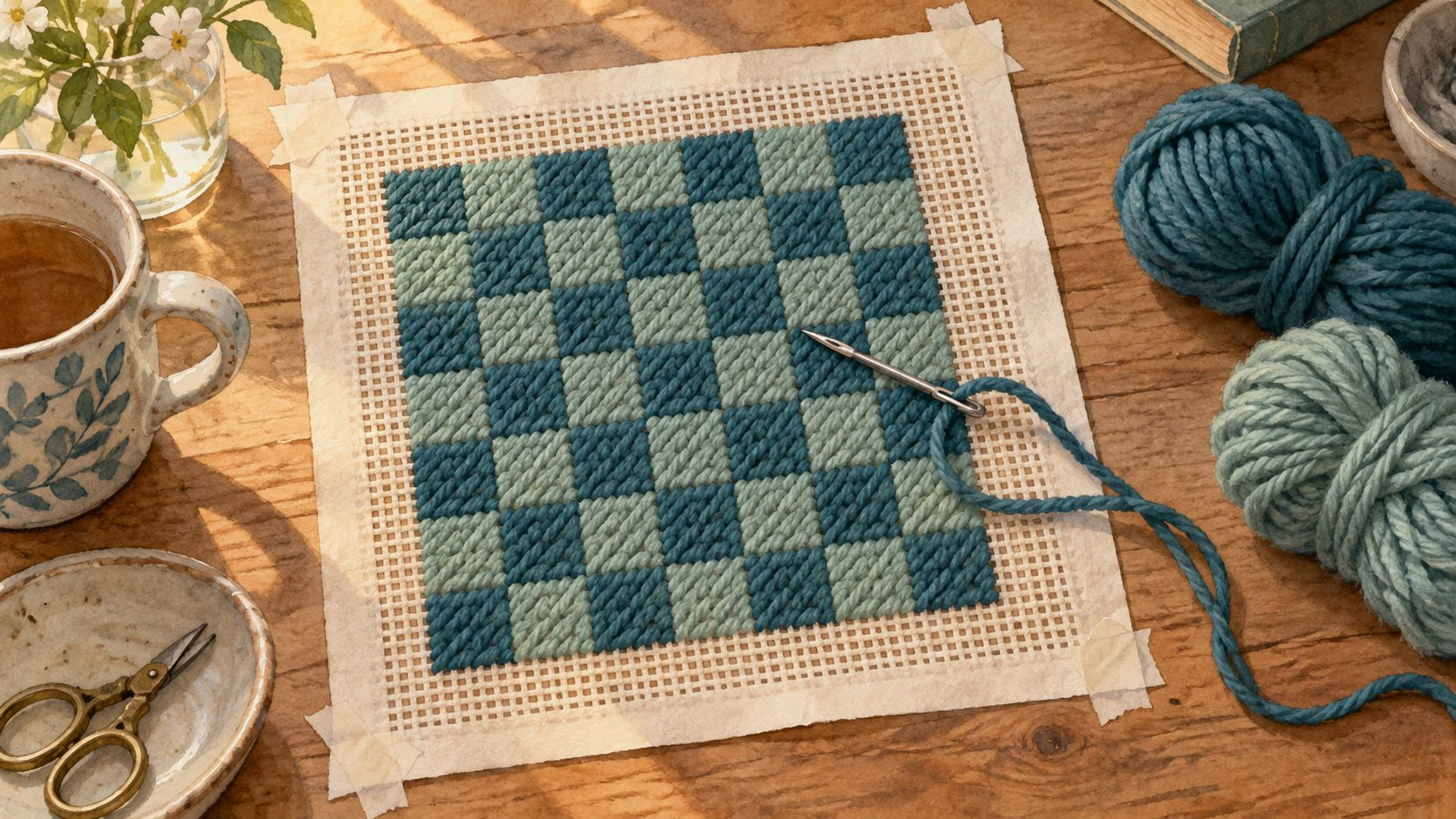
Scotch stitch fills a small square of canvas with five diagonal stitches of growing and shrinking length. It is easy to work, looks tidy in a grid and has many variations. It also pulls canvas out of square more than most stitches. This guide pulls together eight sources on how to work it, which variations exist, and where the advice differs.
Work a tent stitch in the corner of a square three threads by three. Then stitch over two intersections, over three through the middle, over two, and finish with a tent stitch in the opposite corner (Floss Field, KC Needlepoint). Work each square as a unit, then move to the next. Stitch on stretcher bars, because diagonal stitches pull canvas out of shape (Floss Field, Stitchmate).
What Scotch stitch is
Floss Field describes five diagonal stitches of graduated length that fill a square three threads by three. KC Needlepoint gives the same count: over one canvas thread, over two, over three, over two and over one, all slanting to the upper right. Stitchmate says it is the bigger cousin of mosaic stitch, which builds a square from three stitches in a 2 by 2 block.
Names vary. Needlework Tips and Techniques says Scotch is also called Cushion, Chequer or Scottish, and calls it a stitch formation rather than a single stitch. Floss Field says the names in this family are used loosely and that one reference files Scotch as cushion stitch while warning that cushion also names the reversed and framed versions. It advises going by the diagram, not the name. Unwind Studio lists cushion stitch as another name and mosaic and cashmere as related stitches.
| Fact | Source |
|---|---|
| Five stitches over 1, 2, 3, 2, 1 intersections | KC Needlepoint, Floss Field, Stitchmate |
| Fills a 3 by 3 thread square | Floss Field, KC Needlepoint |
| A larger version uses seven stitches over a four-thread square | Floss Field |
| Diagram in one source shows 4 holes per side, reducible to 3 | Needlework Tips and Techniques |
How to work it
- Start with a tent stitch over one intersection in the top left corner of the square (Floss Field, Stitchmate).
- Work the next stitch over two intersections, then the long middle stitch over three (Floss Field).
- Step back down with a stitch over two and a final tent stitch in the opposite corner (Floss Field).
- Work the next square beside it so the two share the holes along the edge between them. The next row lies directly below and shares holes the same way (Floss Field).
Stitchmate adds that you should keep the stitch order the same in every unit, since units worked in different orders lie slightly differently and over a large area it shows. Floss Field relays one teacher's instruction to finish each square before starting the next. Our beginner stitches guide covers tent stitch, which the corners use.
Variations
- Reversed Scotch. Neighboring squares slant in opposite directions (Floss Field, Unwind Studio). Floss Field says the woven look shows best in a shiny thread. Stitchmate says it adds texture and cancels much of the canvas distortion. Unwind Studio says squares on the same diagonal must follow the same direction, and lists it as also known as offset Scotch or Brighton reversed.
- Open Scotch. A gap of bare canvas between squares for an open border (Floss Field).
- Framed Scotch. Each square is surrounded by tent or continental stitch (Needlework Tips and Techniques, Stitchmate). Stitchmate says the frame is often in a second color for a tiled look.
- Alternating with tent squares. Scotch and tent blocks alternate like a checkerboard. Stitchmate says the tent squares calm the pattern and make a good background.
- Chequer. Needlework Tips and Techniques stitches each alternate group in a different color for a checkerboard effect.
- Offset, divided and arrowhead. Nuts about Needlepoint stitched a mini sock with several Scotch variations. Offset Scotch moves each row of units one thread to the left to break up the grid. Divided Scotch splits the long middle stitch of a four-thread unit in half, which makes a dent like a button. Arrowhead Scotch uses a contrasting thread for the corner tent stitches to form an arrow. Half-framed Scotch partly frames the unit in a contrasting thread.
Keeping the canvas square
Floss Field says diagonal stitches can pull canvas out of shape and recommends stretcher bars or a frame. Stitchmate calls Scotch one of the decorative stitches that distort the canvas most, because every stitch slants the same way and the long middle stitch pulls hard, and says a big area can skew into a parallelogram. Its remedies are working on bars or a frame, keeping the tension light, using reversed Scotch or the tent-square variation for large areas, and blocking the piece at the end. See our guides to stretcher bars, even tension and blocking.
Thread and canvas
Needlework Tips and Techniques and Floss Field say to choose a thread that fills the holes so no canvas shows along the long stitches, and suggest tapestry wool on 10 or 12 mesh and a finer thread on 18. Morgan Julia Designs suggests metallic or variegated threads for dimension. Stitchmate says the long stitches show off silk and perle cotton, and AMK Publications says matte wool mutes the geometry while flat-laid silk sharpens the grid. AMK suggests stitching a small square on scrap canvas in the real thread first.
When to use it
Floss Field names backgrounds, borders and buildings. Stitchmate adds framed pieces, checkerboard floors, plaid and tiles. Needlework Tips and Techniques used it for paving slabs in a picture. KC Needlepoint says it works for architecture and borders and fits any area three threads by three. AMK Publications warns that Scotch needs room: in a narrow border you compensate nearly every repeat and the pattern never appears, and it says mosaic is the better choice for broken or narrow areas. Our compensation stitches guide, background stitches guide and borders guide cover those cases.
Where sources disagree
- Is it beginner friendly? Needlework Tips and Techniques calls it beginner friendly and Morgan Julia Designs calls it excellent for beginners. Stitchmate rates its canvas distortion moderate to high and its snag risk moderate. Our read is that it is easy to work but harder to keep square.
- Snagging. Stitchmate says the long middle stitches snag on handled items such as pillows and bags, so use mosaic there. The other sources do not mention snagging.
- Names. Cushion, Chequer and Scottish are all used for Scotch, and Floss Field says cushion is also used for the reversed and framed versions. Unwind Studio lists cushion as another name for plain Scotch.
- Stitch size. Most sources use three threads per side. One diagram shows four holes per side, and Floss Field mentions a seven stitch, four-thread version.
- Mosaic or Scotch. AMK Publications recommends mosaic for narrow or broken areas and Scotch for generous open ones. AMK also sells the stitch charts it recommends, so read that as a seller's view.
Questions
How many stitches are in a Scotch stitch?
Five, over 1, 2, 3, 2 and 1 intersections (KC Needlepoint, Stitchmate).
What is Scotch stitch good for?
Backgrounds, borders and architecture (Floss Field, KC Needlepoint).
Does it distort canvas?
Yes. Work on stretcher bars with light tension, and consider reversed Scotch (Floss Field, Stitchmate).
Is Scotch the same as cushion stitch?
Often, but the names are used loosely. Go by the diagram (Floss Field).
What is the difference between Scotch and mosaic?
Scotch is the larger block. Mosaic builds a 2 by 2 square from three stitches (Stitchmate, AMK Publications).
Sources
- Floss Field, Scotch stitch
- Unwind Studio, Scotch Stitch (plus Reversed Scotch Stitch)
- Needlework Tips and Techniques, Scotch Stitch
- KC Needlepoint, Scotch Stitch
- Stitchmate, Scotch Stitch Needlepoint
- Morgan Julia Designs, Stitch of the Month: Scotch Stitch
- AMK Publications, Mosaic vs Scotch Stitch
- Nuts about Needlepoint, Scotch Stitch Variations