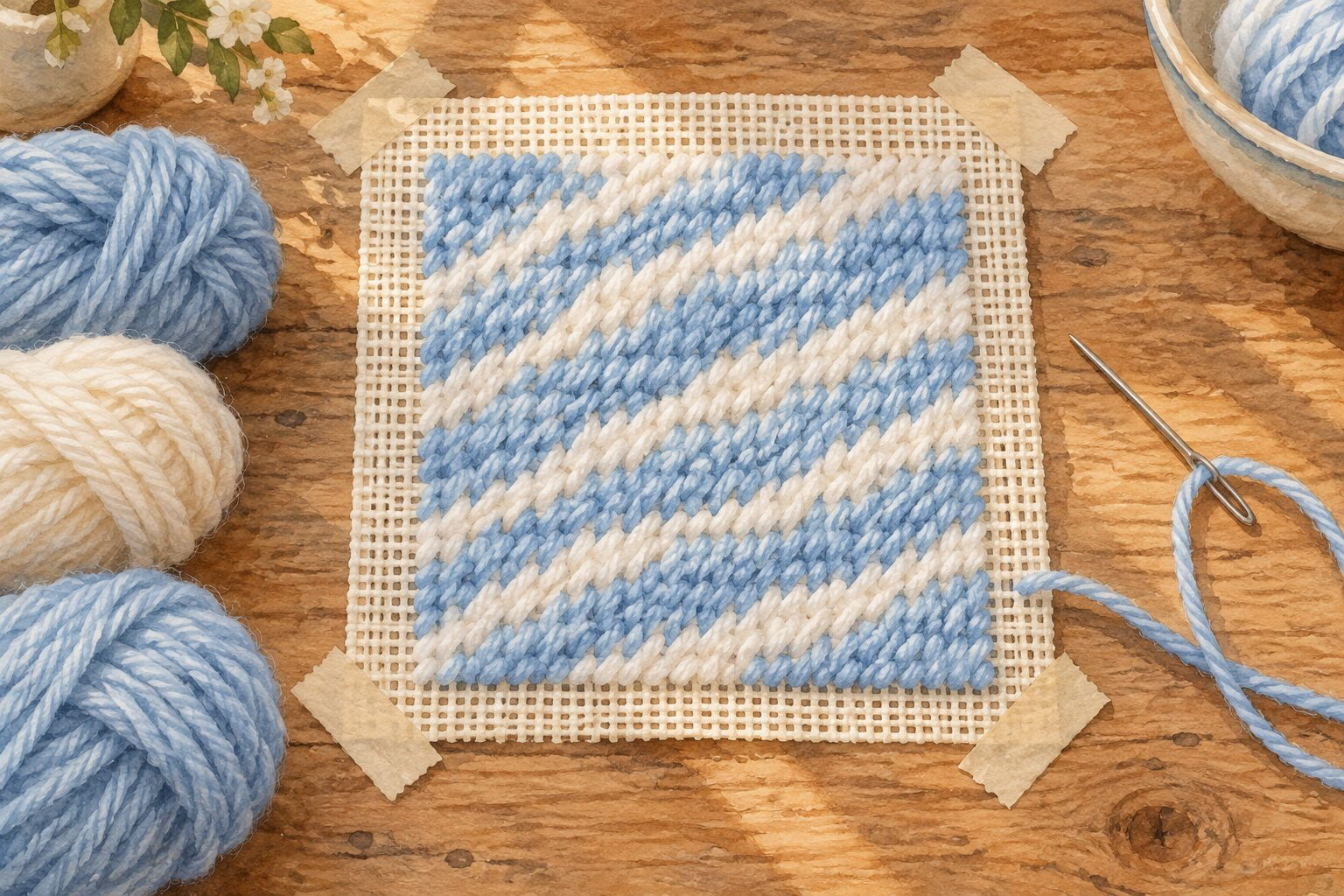
Nobuko is the needlepoint background stitch that moves. Short and long diagonal stitches alternate along each row, and each row nests into the one above, so the surface reads as a soft ripple rather than a pattern. It covers ground fast and suits skies, water and snow. Here is how to work it, how to handle the edges, and the points where the sources genuinely disagree. Last updated October 25, 2026.
Start here: work a tent stitch over one intersection (the short stitch), then come up one hole below its start and go down three threads to the right and three up (the long stitch). Alternate short and long across the row, then work the next row back in the other direction, two threads lower, so the stitches share holes with the row above (Floss Field).
What Nobuko stitch is
The RSN StitchBank, the Royal School of Needlework's stitch reference, defines Nobuko as a diagonal filling stitch that alternates long and short stitches: the long stitches span three canvas threads diagonally and the short stitches span one, usually worked in horizontal rows from left to right and then back again. KC Needlepoint, a shop, describes the stitches as spanning one and three canvas threads on a true diagonal, and adds that although the stitches are diagonal, they should be worked in horizontal rows. Serendipity Needleworks, a shop, explains what a true diagonal means here: the long stitch lies across three vertical and three horizontal canvas threads.
The stitch has a named origin, which is unusual. The RSN StitchBank says it was created by Charlotte "Chottie" Alderson, an early figure in the Embroiderers' Guild of America, and named for her close friend and fellow stitcher, Nobuko; it adds that the stitch continues to be widely used in the United States and cites Jo Ippolito Christensen's The Needlepoint Book (1999). AMK Publications, a needlepoint publisher, calls it a modern stitch by the American stitcher Chottie Alderson.
Floss Field describes the look as a soft diagonal ripple that reads as texture rather than pattern, so it sits back behind a design, and notes that every stitch is made from lower left to upper right, which leaves long stitches on the back. Stitchmate, a stitch-guide site, adds that each long stitch reaches one intersection above and one below the short stitches beside it, and that you can find the same short, long, short, long rhythm along any diagonal of the finished area.
How to stitch it
These steps follow Floss Field and the RSN StitchBank, which agree on the sequence.
1. Work the short stitch. Starting at the left, work a tent stitch over one intersection (Floss Field; RSN StitchBank).
2. Work the long stitch. Come up one hole below the start of the short stitch and go down over three intersections: three threads to the right and three up (Floss Field). The RSN StitchBank gives the same move, angled from bottom left to top right.
3. Alternate across the row. Keep alternating short and long. Each pair starts two threads to the right of the last (Floss Field).
4. Work the row back. Work the next row from right to left, two threads lower (Floss Field; Stitchmate says drop down two holes). Each long stitch ends in the hole where a short stitch of the row above began, and each short stitch ends where a long one began (Floss Field). The RSN StitchBank puts it as long stitches touching the short ones of the previous row and vice versa. Sew Sew Mellow, a needlepoint shop, says to place the first tent stitch of the second row so that it meets the longer middle stitch of the previous row.
Because every stitch runs from bottom left to top right, the needle travels a long way on the back between stitches. The RSN StitchBank and Floss Field both note the long stitches on the reverse, and Stitchmate says the back carries more thread than the front suggests. That is normal for Nobuko. Our laying tool guide covers keeping those long stitches smooth; Serendipity Needleworks recommends a laying tool for the best effect.
Edges and compensation
Because the long stitches cross three intersections, they rarely fit an area exactly. Stitchmate says to shorten any long stitch that would cross the boundary so it covers only the intersections inside, and to work these compensating stitches as you reach them, row by row, so they match the tension of their neighbors. AMK Publications says Nobuko compensates reasonably well because the individual stitches are simple to shorten without the eye noticing, but that a curved painted edge, where you compensate on every row, can make the diagonal look ragged. If most of your boundary is curved, it suggests a smaller-scale stitch. Our compensation stitches guide covers the general method.
Where to use it
Backgrounds are the common thread. The RSN StitchBank recommends it for backgrounds and large areas such as water and sky, and Unwind Studio, a designer and shop, tags it for large areas, backgrounds, water and skies. Floss Field lists backgrounds, sky, water and snow and calls it one of the most used background stitches. Serendipity Needleworks finds it particularly effective for smooth, new-fallen snow, where the stitch implies just enough movement to give gently rolling hills subtle depth, and suggests sand for a summery design. KC Needlepoint and AMK Publications both add animal fur. Poppy Monk, a kit maker, calls it a background stitch with lots of texture that has no strong direction when used as a filler.
For related choices, our sky and water stitches guide, the background stitches guide and the animal fur guide compare it with the alternatives. If you want a knitted texture instead of a ripple, see Kalem stitch.
Threads, mesh and variations
Nobuko is a diagonal stitch, so a thread that covers in tent stitch on your mesh will cover here (Stitchmate). Floss Field says it is full coverage when the thread is thick enough and to add a strand if canvas shows between rows. AMK Publications says thread weight decides whether the ground shows, and that a matte wool fills the gaps and mutes the diagonal while silk or stranded cotton laid flat catches the light and sharpens it. Stitchmate suggests overdyed or variegated thread for skies and water, perle cotton (#3 on 13 mesh, #5 on 18) for crisp definition, and ribbon or sparkle thread for snow. Our thread types guide and variegated thread guide go deeper.
On mesh count, AMK Publications says the same stitch is roughly half the physical size on 18 mesh as on 10, so Nobuko reads as a bold texture on coarse canvas and a subtle, tweedy one on fine canvas, and that finer counts usually want more plies than you expect. See our mesh count guide.
Variations are simple. Stitchmate shows two-color Nobuko, with alternate rows in two shades so each row reads as a band of interlocking short and long stitches, or the long stitches in one thread and the short in another. BeStitched Needlepoint, a shop, likewise says you can change the look with different fibers on the short and long stitches. Serendipity Needleworks worked the long stitch in a shimmering thread and the short in a metallic braid on 18 mesh. AMK Publications describes alternating Nobuko, where the diagonal reverses between rows, and Sew Sew Mellow describes double alternating Nobuko: two tent stitches followed by two longer stitches, with the stitch direction changed on each row for a woven effect.
Where sources disagree
Small areas and handled pieces. Stitchmate and AMK Publications keep Nobuko away from small or narrow areas, because the pattern needs room and you end up compensating most stitches. Stitchmate adds that the long stitches can snag on a pillow or bag, so it suits framed pieces and hanging ornaments better. Serendipity Needleworks takes the opposite view of size, calling it a smallish stitch that works on a variety of canvases from ornaments to pillows.
The first stitches. Floss Field, the RSN StitchBank, Stitchmate and KC Needlepoint describe a true diagonal tent-style short stitch followed by a three-by-three long stitch. Unwind Studio's written steps are worded differently: they begin with a vertical move to the next intersection and then a diagonal stitch that skips three intersections. If written steps do not match your diagram, follow the diagram and count holes.
Row mechanics. Floss Field, Stitchmate and the RSN StitchBank alternate the working direction on each row and drop two threads between rows. Unwind Studio states that all stitches in a row must be made at the same level. Sew Sew Mellow anchors the next row by matching the first tent stitch to the longer middle stitch above. All of these produce the same nested rows; the difference is where each source tells you to look.
Direction. Floss Field and the RSN StitchBank slant every stitch from lower left to upper right. Poppy Monk and Serendipity Needleworks both say you can lean it the other way, and Sew Sew Mellow and AMK Publications change direction row by row in their variations. Pick one and keep it consistent within the area.
Backgrounds only? Most sources push Nobuko toward sky, water and snow. KC Needlepoint and AMK Publications also suggest animal fur, which treats it as a texture stitch rather than a scenery stitch.
Common mistakes
Mixing up long and short positions. If a long stitch lands under a long stitch from the previous row, the two overlap while a gap opens beside them. Check the first few stitches of each row against the row above (Stitchmate).
Pulling too tight. All the stitches slant the same way, so tight tension skews the canvas. Stitchmate recommends stretcher bars, a light even pull, and blocking afterward; see our stretcher bars guide and blocking guide.
Twisted thread. Long diagonal stitches show every twist. Stitchmate says to let the needle hang and untwist every few stitches, or use a laying tool.
Canvas showing between rows. Floss Field says to add a strand if canvas shows; AMK Publications says to add plies on finer mesh.
FAQ
What is Nobuko stitch?
A diagonal needlepoint filling stitch that alternates a short stitch over one intersection with a long stitch over three, worked in horizontal rows that nest together (RSN StitchBank; Floss Field).
Who invented Nobuko stitch?
Charlotte "Chottie" Alderson, who named it for her friend and fellow stitcher Nobuko, according to the RSN StitchBank. AMK Publications also credits her.
What is Nobuko stitch used for?
Skies, water, snow and other large backgrounds (RSN StitchBank; Floss Field; Unwind Studio), and animal fur (KC Needlepoint; AMK Publications).
Does Nobuko stitch distort the canvas?
It can, because every stitch slants the same way. Stitchmate rates the distortion moderate and recommends a frame, light tension and blocking.
Can I work Nobuko the other way?
Yes. Poppy Monk and Serendipity Needleworks both say the slant can be reversed, and alternating variations change direction between rows (AMK Publications; Sew Sew Mellow).
Is Nobuko good for small areas?
Usually not. Stitchmate and AMK Publications say it needs room for several full rows to read as Nobuko.
Sources
- RSN StitchBank - Nobuko stitch (definition, method, origin, uses, reference to The Needlepoint Book)
- Floss Field - Nobuko stitch in needlepoint: how to work it (step sequence, rows, uses, coverage tip)
- Stitchmate - Nobuko Stitch Needlepoint (structure, compensation, threads, two-color version, snag and distortion cautions, common mistakes)
- AMK Publications - The Nobuko Stitch (a needlepoint publisher; uses, mesh behavior, alternating variation, compensation)
- Unwind Studio - Nobuko Stitch (a needlepoint designer and shop; written steps, large-area uses)
- Sew Sew Mellow - Nobuko (a needlepoint shop; step by step, double alternating Nobuko)
- Serendipity Needleworks - Threadventure 2019: Snowy Narvik (a needlepoint shop; true diagonal explanation, snow and sand uses, thread example, laying tool)
- KC Needlepoint - Nobuko Stitch (a needlepoint shop; true diagonal, horizontal rows, skies, water, snow and fur)
- BeStitched Needlepoint - Master the Nobuko Stitch! (a needlepoint shop; full coverage, different fibers on short and long stitches)
- Poppy Monk - Needlepoint Stitch Library (a kit maker; texture, slant direction, filler use)