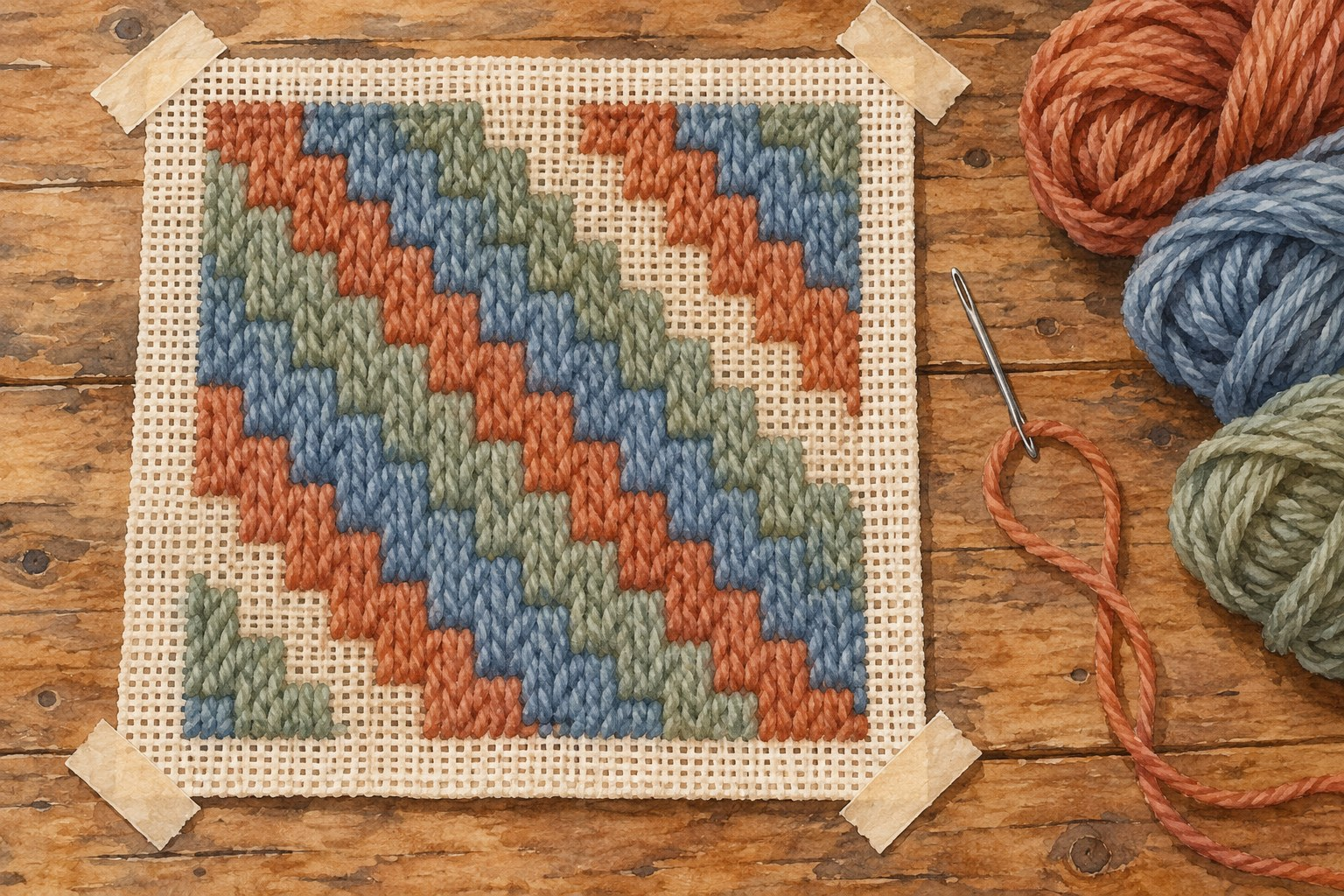
Byzantine stitch is a staircase of diagonal stitches: a run of slanted stitches across, a run stepping down, and the next band nesting against the last until the canvas fills with bold zigzags. It covers big areas fast and gives backgrounds a sense of direction. Here is how to work it, where it earns its keep, and the points where eight sources genuinely disagree. Last updated October 25, 2026.
Start here: work four diagonal stitches side by side, then turn and work down from the last one, counting the corner stitch once because it belongs to both runs (Floss Field). Alternate across and down to build the staircase, fit the next band directly against the first, and fill the gaps at the edges with shorter stitches.
What the Byzantine stitch is
Every stitch in Byzantine slants the same way as a tent stitch, from bottom left to top right, but over more than one intersection (Stitchmate). The pattern comes from where the stitches sit: a horizontal run side by side, then a vertical run stepping down, then horizontal again, with the corner stitch of each step shared by both runs. The next band follows the same staircase directly against the first, so the whole area fills with interlocking diagonal steps. The RSN StitchBank describes it as long diagonal bands of satin zigzags, notes the repeat is quite large, which means it covers the canvas quickly, and calls it a flat stitch that is very good for backgrounds.
In one color the steps show through light catching the stitch direction; in two colors, alternating band by band, they become a strong zigzag (Stitchmate). The stitch reads as a diagonal and the eye follows it, which is why it is suggested for large bodies of water, where the steps suggest waves coming ashore, and why one shop calls it a very busy stitch for places where you want a lot of movement (Floss Field). Needlepoint Teacher calls it a good all purpose stitch and lists backgrounds and clothes among its uses.
Byzantine also goes by another name: one teacher knows it as step stitch (Floss Field, citing Needlepoint Teacher). Its closest relative is jacquard stitch, which the RSN StitchBank calls a development of Byzantine: the same staircase of longer stitches alternating with stepped rows of tent stitch, the tent rows adding a second texture and breaking up the pull on the canvas (Floss Field, Stitchmate).
How to stitch it
Sources chart the stitch at two sizes; the smaller one is the common teaching version and the one shown here (Floss Field, Stitchmate). For the larger version, see the size section below.
1. Work across. Starting at the top left of the area, make four diagonal stitches side by side, each over two intersections: up at the lower left, down at the upper right (Floss Field, Stitchmate).
2. Turn down. Using the last stitch as the corner, work four stitches stepping straight down, each one directly below the last (Stitchmate). Floss Field works the same turn as three more stitches, because the corner stitch belongs to both runs and is counted once.
3. Turn across again. Alternate across and down until you reach the edge of the area, keeping the step length the same throughout; a step that is one stitch short throws off every band after it (Stitchmate).
4. Nest the next band. Work the next band directly against the first, following the same staircase, so its stitches share holes with the band beside it (Stitchmate). The corner stitches of neighboring staircases meet end to end in one hole (Floss Field). The RSN StitchBank notes the second row can be worked above or below the first, fitting into the steps.
5. Fill the edges. Where a full stitch will not fit against an edge, work a shorter one to fill the gap (Floss Field, Stitchmate). Our compensation stitches guide covers those partial stitches in detail.
Where to use it
Byzantine covers ground quickly, so it is a natural choice for large backgrounds (Stitchmate; the RSN StitchBank lists filling and shading among its common uses). Its diagonal direction suggests movement, which suits skies, water and wind-swept fields (Stitchmate), and one teacher suggests it for large bodies of water where the steps read as waves coming ashore (Floss Field). Our stitches for sky and water guide compares it with the other directional options, and the background stitches guide sets it against the other fast coverage stitches.
It is used for clothing too: the slant can be reversed so the steps lean the other way, which lets two sleeves, or the two front panels of a robe, mirror each other (Floss Field). KC Needlepoint, a shop, confirms the stitch can be reversed and charts the reverse version. Needlepoint Teacher lists clothes among its uses, and BeStitched Needlepoint, also a shop, recommends it for things on a diagonal and notes it can be done in various sizes. Unwind Studio, a designer and shop, tags it for small areas, large areas and backgrounds, though see the disagreements section on whether it really suits small spaces. Sunshine Needlepoint, a shop, suggests backgrounds, borders and larger areas where you want texture and diagonal movement.
For framed pieces it is hard to beat; for pillows and bags, the longer stitches can snag, so use the smaller size or a shorter stitch such as mosaic instead (Stitchmate).
Threads, mesh and stitch size
The thread that covers in tent stitch on your mesh will cover here (Stitchmate), so the wool, cotton or silk you would choose for the area still applies; our thread types guide walks through those, and the mesh count guide covers matching thread to canvas. KC Needlepoint stitched its shop example in Planet Earth Silk, a single-strand silk.
On size, sources disagree (details below), but the practical rule holds either way: the bigger the stitch, the faster it covers and the more it can snag in use (Stitchmate). Whichever size you choose, keep the step length constant across the whole area.
Because every stitch slants one way, Byzantine distorts the canvas noticeably; Stitchmate rates the pull moderate to high and recommends working on stretcher bars with a light tension and planning to block the finished piece. Our stretcher bars guide covers mounting, and the blocking guide covers squaring the piece afterward.
Where sources disagree
Stitch length. Floss Field charts each stitch over two intersections, and Stitchmate gives over two as the common size. The RSN StitchBank works each stitch across four intersections, or four threads up and across, and Unwind Studio charts four as well. Both sizes are sold and taught as Byzantine; the RSN itself describes its repeat as quite large.
Stitches per step. Floss Field and Stitchmate build each step from four stitches counting the shared corner, and Floss Field reports that one teacher treats four stitches to a step as the original, the count the Embroiderers' Guild of America accepts for its Master Craftsman program in canvas embroidery. Needlepoint Teacher confirms its charted count is the one the EGA accepts. The RSN StitchBank works five stitches in the first band and four more from the corner, five total per step. Unwind Studio charts four per row including the corner, which is three in each direction not counting the corner.
Small areas. Unwind Studio tags Byzantine for small areas as well as large ones. Floss Field disagrees in practice: the repeat is large, so the pattern needs room, and one teacher's rule is that three repeats of a pattern should fit in the space or the stitch is too large for it. Stitchmate likewise points it at large backgrounds.
Everyday wear. Needlepoint Teacher and Floss Field both put Byzantine on clothing. Stitchmate cautions that the longer stitches snag on pillows and bags and suggests the smaller size or a shorter stitch for anything that gets handled.
Common mistakes
Losing the count at the corners. The stitch at each turn belongs to both runs: the last stitch across is also the first stitch down. Count it once, then check each new staircase against the one before, since the corner stitches of neighboring staircases should meet end to end in one hole (Floss Field).
Changing step length mid-area. A step that is one stitch short throws off every band after it; keep the step length the same throughout (Stitchmate).
The pattern does not show. Byzantine needs room. If three repeats will not fit in the space, the stitch is too large for it; drop to the over-two size or pick a smaller-pattern stitch (Floss Field, citing one teacher's rule).
Pulled-out canvas. Because all the stitches slant one way, the piece can come off the bars skewed; mount before you start and block after you finish rather than trying to force it square later (Stitchmate).
FAQ
What is the Byzantine stitch in needlepoint?
A diagonal stitch laid out as a staircase: runs of slanted stitches across and down, with the corner stitch shared by both runs, band after band nesting together until the canvas fills with zigzags (Stitchmate; RSN StitchBank).
How many stitches go in each step?
Four, counting the shared corner stitch, by one teacher's and one shop's instructions, and five by one stitch reference's (Floss Field, summarizing the disagreement). The Embroiderers' Guild of America accepts the four-to-a-step count for its Master Craftsman program in canvas embroidery (Floss Field; Needlepoint Teacher).
What is the difference between Byzantine and jacquard stitch?
Jacquard stitch alternates staircases of Byzantine with stepped rows of tent stitch, making zigzag stripes that are wide and narrow in turn; the RSN StitchBank calls it a development of Byzantine (Floss Field, RSN StitchBank).
Can Byzantine stitch slant the other way?
Yes. Reverse every stitch and the staircase leans to the left, which is how stitchers mirror two sleeves or the two front panels of a robe (Floss Field; KC Needlepoint charts the reverse).
Is Byzantine stitch the same as step stitch?
One teacher knows Byzantine as step stitch; the two names refer to the same staircase pattern (Floss Field, citing Needlepoint Teacher).
Does Byzantine stitch distort the canvas?
Yes, moderately to heavily, because every stitch slants the same way. Work on stretcher bars and plan to block the finished piece (Stitchmate).
Sources
- RSN StitchBank - Byzantine stitch (over-four method, five-stitch bands, flat stitch for backgrounds, jacquard as a development, uses: filling and shading)
- Floss Field - Byzantine stitch (over-two method, corner counted once, edge fills, step stitch alias, EGA count note, water and clothing uses, three-repeat rule, jacquard pairing, source disagreements)
- Unwind Studio - Byzantine Stitch (a needlepoint designer and shop; over-four chart, three stitches each direction not counting the corner, small and large area tags)
- Needlepoint Teacher - Byzantine and Variations (uses: backgrounds and clothes, all-purpose verdict, EGA Master Craftsman count, charted variations)
- KC Needlepoint - Byzantine Stitch (a needlepoint shop; reversible stitch with reverse diagram, example stitched in Planet Earth Silk)
- Stitchmate - Byzantine Stitch in Needlepoint (over-two common size, corner-sharing structure, distortion rating, stretcher bars and blocking advice, snag caution for pillows and bags)
- BeStitched Needlepoint - Learn the Byzantine Stitch (a needlepoint shop; diagonal uses, various sizes)
- Sunshine Needlepoint - Byzantine Stitch Tutorial (a needlepoint shop; backgrounds, borders and larger areas, texture and diagonal movement)