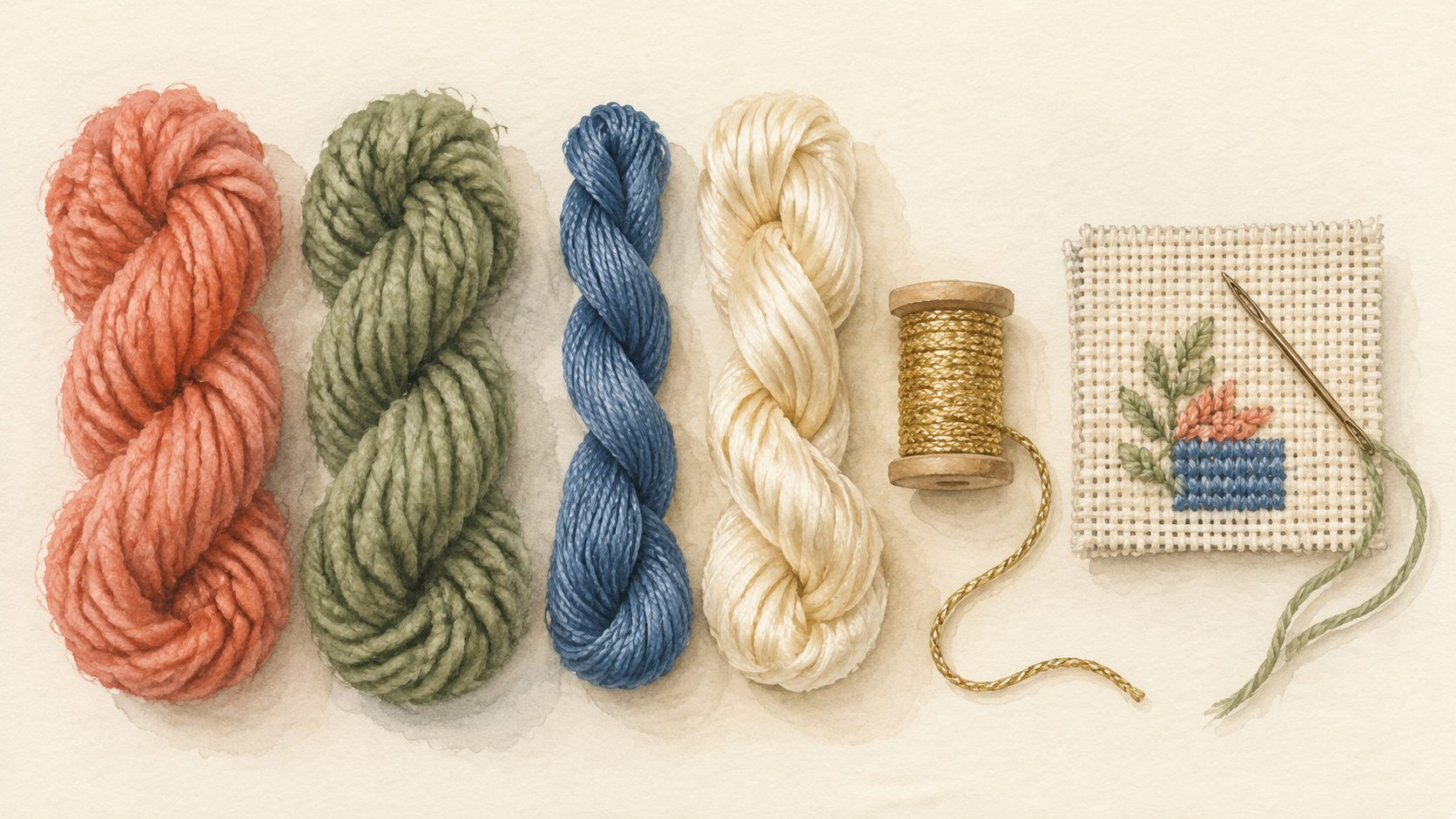
Needlepoint thread falls into a few families: wool, cotton, silk, silk and wool blends, and specialty threads such as metallics. Each one handles differently, wears differently, and suits a different job. This guide compares them using what shops and thread makers say, and flags where they disagree.
If this is your first piece, pick wool or cotton. Sources agree both are forgiving and widely available, and wool is the traditional choice for anything that gets handled. Save silk and metallics for accents or display pieces. Whatever you pick, match it to your canvas mesh. Our thread by mesh count guide covers sizing.
Fibers compared
| Fiber | What sources say it is good for | What sources warn about |
|---|---|---|
| Wool | Durable, forgiving, strong coverage, classic choice (Serendipity Needleworks, Needlepoint.com, Atlantic Blue Canvas, DMC) | Can pill with repeated pulling and can cost more (Atlantic Blue Canvas) |
| Cotton | Good value, sturdy, does not pill, crisp stitches (Needlepoint.com, Atlantic Blue Canvas) | Feels more rigid; six-strand floss is harder to lay flat (Needlepoint.com, Serendipity Needleworks) |
| Silk | Luster and smooth glide (Serendipity Needleworks, Morgan Julia Designs) | Costs more and needs careful handling (Serendipity Needleworks, Atlantic Blue Canvas) |
| Silk and wool blends | Softness and sheen with fullness (Morgan Julia Designs) | Can fuzz if handled too much (Morgan Julia Designs) |
| Metallic and specialty | Highlights, texture, sparkle (Serendipity Needleworks, Unwind Studio) | Frays, creases, wears poorly (Atlantic Blue Canvas, World of Needlepoint, Unwind Studio) |
Wool
Serendipity Needleworks calls wool the traditional needlepoint thread and says it is durable enough for belts, purses, shoes, pillows, and rugs. It names DMC tapestry wool for 10 mesh, and options such as Appleton, Rainbow Persian, and Waverly Wool for 13 or 14 mesh. DMC describes its tapestry wool as a gently twisted 4-ply, 100% wool thread, hard wearing, colorfast, and moth-proofed. World of Needlepoint separates Persian yarn (three strands you can pull apart) from tapestry yarn (a single strand, slightly finer than Persian and hard to split) and from crewel yarn (single strand, much finer). It also warns that knitting yarn is spun with shorter, softer fibers and is less durable than needlepoint wool. Atlantic Blue Canvas calls wool the most forgiving option for beginners because its fluffiness fills gaps and hides small tension problems.
Cotton
Needlepoint.com calls cotton the best value option: sturdy, no pilling, with a slight sheen. It adds that cotton has less stretch than wool or silk. Serendipity Needleworks likes pearl cotton #5, a single strand that covers 18 mesh fully, and says pearl cotton #3 suits 13 or 14 mesh. It says six-strand floss works on 13, 14, and 18 mesh but needs stripping, recombining, and a laying tool. World of Needlepoint lists pearl cotton in three weights (#8, #5, #3) and notes it cannot be split. Unwind Studio rates DMC Soft Cotton for 12 to 14 mesh, non-divisible and beginner friendly. DMC describes Soft Cotton as a 5-ply, matte thread whose colors look more muted than wool, which makes it a good fit for framed decorative pieces. Morgan Julia Designs recommends stitching a first project in cotton and says DMC has no dye lots, so you do not worry about color matching if you run out. See also our DMC vs Anchor guide.
Silk
Serendipity Needleworks splits silk into twisted silk (Pepper Pot, Vineyard Silk Classic, Trebizond, Planet Earth Silk), which behaves like pearl cotton, and divisible silk (Splendor, Soie d'Alger), which needs stranding and a laying tool. It calls Splendor a good first silk because it behaves like DMC six-strand floss. Unwind Studio describes Pepper Pot as one of the most popular needlepoint silks and easy to use, and Splendor as a 12-ply silk for 16 to 18 mesh. Morgan Julia Designs calls silk the cashmere of stitching and advises short lengths because it tangles easily. Atlantic Blue Canvas says silk is slippery at first, needs steady tension, and shows every imperfection.
Silk and wool blends
Morgan Julia Designs is the one source here that gives blends their own category. It calls silk and wool its personal favorite, with the softness and sheen of silk and the texture of wool. It names Essentials for 18 mesh and Silk & Ivory and Milan for 13 mesh, and warns they can fuzz if skeins are handled too much. Serendipity Needleworks also mentions Silk & Ivory as a good option for 13 or 14 mesh in a reader reply.
Metallic and specialty threads
Serendipity Needleworks lists Kreinik metallic braids for sparkle and Rainbow Gallery lines for fuzzy or velvety texture, and says each has its own properties and that Rainbow Gallery thread cards give strand suggestions by mesh. Atlantic Blue Canvas says metallics crease and fray and suggests working lengths of about 12 inches. World of Needlepoint says metallic thread is mainly for highlighting small areas because it does not wear well. Unwind Studio adds that Kreinik is slightly stiff, Fuzzy Stuff can fray, and Neon Rays should be used in short lengths. Morgan Julia Designs suggests choosing specialty threads from the canvas itself, such as Fuzzy Stuff for an animal or a sparkle thread for water.
How to choose
Three questions cover most decisions. First, how will the piece be used? Serendipity Needleworks says fancy threads suit pieces that are purely for show, and sturdier threads such as wool suit items handled often. Second, what is the mesh? World of Needlepoint says the lower the canvas gauge number, the heavier the yarn should be, and the thread must be thin enough to pass through the holes without fraying yet thick enough to cover the canvas. Read our 13 vs 18 mesh guide to pick a mesh first, and use the thread yardage calculator to estimate how much you need. Third, how much handling skill do you want to bring? Prep and finish matter too: see starting and ending thread, choosing a needle, and beginner kits, which usually pick a thread for you.
Where sources disagree
Silk durability. Needlepoint.com says silk is durable enough for belts and other hard-wearing items. Serendipity Needleworks says silk can be less durable than wool or cotton, harder to clean, and prone to snagging. If the piece will be handled, wool is the safer bet.
Wool and pilling. Atlantic Blue Canvas says wool can pill if pulled through the canvas too many times. Needlepoint.com says cotton does not pill. DMC describes its tapestry wool as hard wearing and does not mention pilling.
Which mesh for which silk. Unwind Studio lists both Pepper Pot Silk and Planet Earth Silk for 13 to 18 mesh. Morgan Julia Designs recommends Planet Earth for 13 mesh and Pepper Pot for 18 mesh, and Serendipity Needleworks says Planet Earth is considerably thicker and best on 13 or 14. Check the thread card.
Beginner fiber. Atlantic Blue Canvas says wool is the most forgiving for beginners. Morgan Julia Designs recommends starting in cotton. Cotton and wool are both safe first choices, and the right one depends on the mesh.
Questions
What is the best thread for needlepoint beginners?
Sources lean toward wool (Atlantic Blue Canvas) or cotton (Morgan Julia Designs, Unwind Studio's Soft Cotton). Both are easy to find and forgiving.
Can I use embroidery floss for needlepoint?
Yes. Serendipity Needleworks says six-strand floss works on 13, 14, and 18 mesh, but you strip and recombine the strands and use a laying tool. See stitches for beginners for stitch choices.
Can I use knitting yarn?
World of Needlepoint says knitting yarn is not recommended for items that get heavy use because it is spun with shorter, softer fibers. DMC adds that it is likely to stretch and fray as you stitch.
What does divisible mean?
It means the thread is made of strands you can separate and recombine. Serendipity Needleworks says you use more or fewer strands depending on the thread and the canvas mesh.
Sources
- Serendipity Needleworks: Choosing Needlepoint Threads
- Needlepoint.com: Needlepoint Threads, What's the Difference?
- Atlantic Blue Canvas: Needlepoint Thread Guide
- World of Needlepoint: Guide to Needlepoint Yarns and Threads
- Unwind Studio: Our Favourite Threads
- Morgan Julia Designs: The Stitcher's Guide to Needlepoint Threads
- DMC: Which Thread Is Best for Tapestry and Needlepoint?