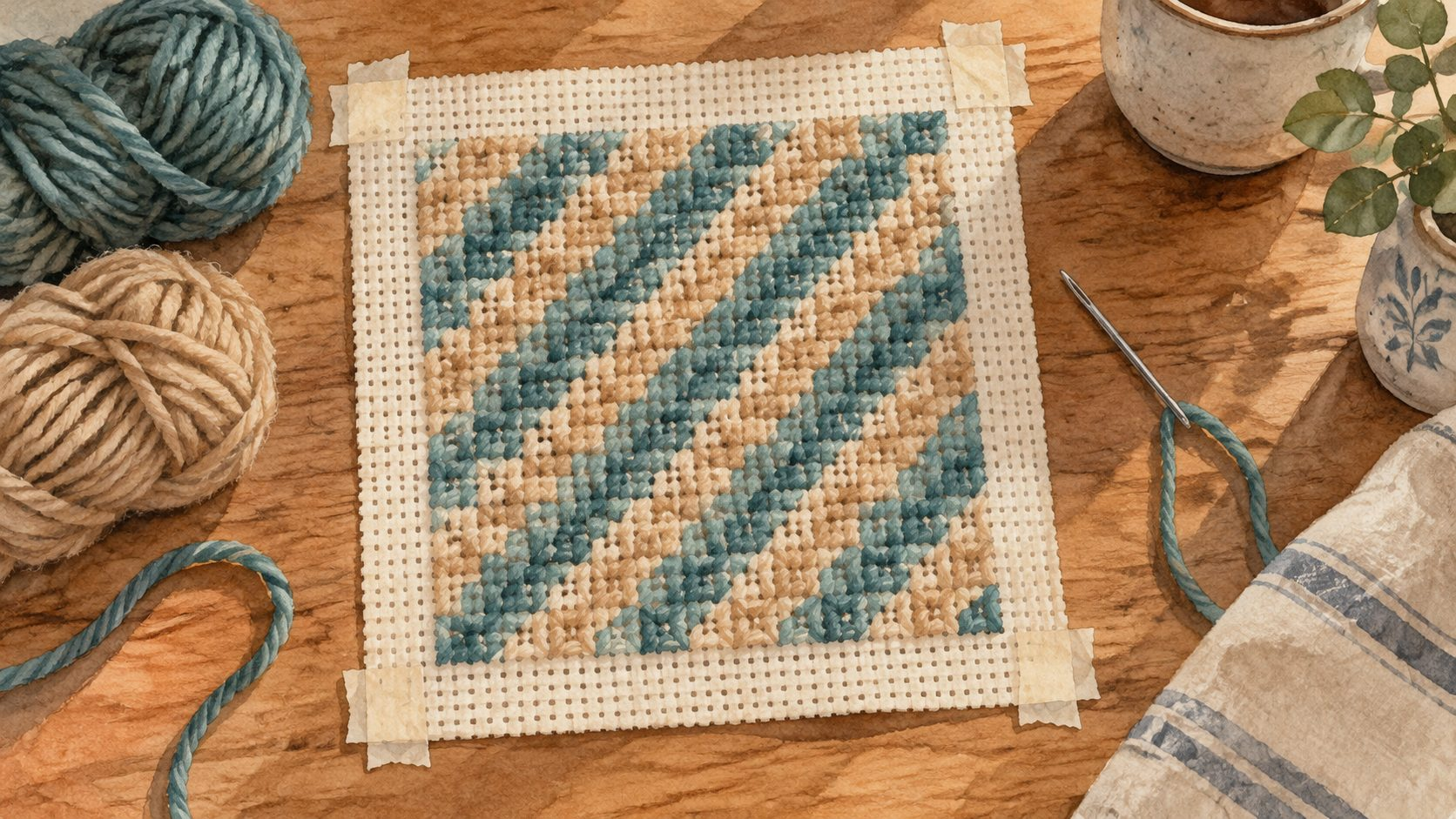
Mosaic stitch is the smallest of the box stitches: three diagonal stitches, short, long, short, that fill a square two threads by two. It is easy to learn, covers fully and fits almost anywhere. It also has a diagonal-row cousin that stitchers often call mosaic too. This guide pulls together eight sources on how to work both, how to use them, and where they disagree.
Work a tent stitch over one intersection in the top left corner of a square two threads by two. Next, a diagonal stitch over two intersections from corner to corner. Finish with a tent stitch in the lower right corner. The next box shares the holes along the edge (Floss Field). One box covers the same canvas as four tent stitches (Floss Field).
What mosaic stitch is
Floss Field calls it the smallest of the box stitches, a neat two-by-two square that is easy to learn and useful for backgrounds, and the slanted cousin of Hungarian stitch. KC Needlepoint describes two tent stitches and one diagonal stitch over two intersections, all slanting toward the upper right, good for any square area two threads by two. Serendipity Needleworks gives the same unit: a tent stitch, a longer 2 by 2 diagonal center stitch and another tent stitch.
| Stitch | Unit | Source |
|---|---|---|
| Mosaic | Three stitches on a 2 by 2 square | Floss Field, KC Needlepoint |
| Cashmere | Four stitches, two long, on a 2 by 3 rectangle | Floss Field |
| Scotch | Five stitches on a 3 by 3 square | Floss Field |
Floss Field notes that a stitch reference lists mosaic among the stitches of Berlin wool work, with double stitch as another name, and that in old books the name may mean something else: a nineteenth-century encyclopedia prints a different arrangement, rows of alternating short and long stitches with rows of short stitches between, as mosaic. See our guides to cashmere stitch and Scotch stitch for the larger relatives.
How to work it
- Work a tent stitch over one intersection in the top left corner of a 2 by 2 square (Floss Field).
- Work a diagonal stitch over two intersections, corner to corner: come up one hole below where the tent stitch began and go down one hole to the right of where it ended (Floss Field).
- Finish with a tent stitch in the lower right corner (Floss Field).
- Work the next box beside it so the two share the holes along the edge. The next row lies directly below and shares holes the same way (Floss Field).
Floss Field says boxes can be worked in straight rows or in diagonal rows and the result is the same, and that when you work them in diagonal rows you should leave one canvas hole between one box and the next, because the boxes of the following row fill those spaces. KC Needlepoint says boxes can be lined up in neat rows or placed anywhere there is a 2 by 2 square. If tent stitch is new to you, start with our beginner stitches guide.
Diagonal mosaic
Diagonal mosaic uses the same short and long stitches in continuous diagonal rows with no break between boxes. Floss Field says the unbroken lines make a subtle stripe, and lists other names: Florence stitch and condensed mosaic stitch. It says the stitch is at least as old as 1842, when an American needlework handbook printed it as German stitch. It suggests it for backgrounds, grass and fields, waves, leaves and the folds of cloth. Unwind Studio calls it a smooth, gently striped texture that works up quickly.
The working order, from Floss Field: work a tent stitch, then beside it a diagonal stitch over two intersections starting one hole below the tent stitch, and continue down the diagonal short, long, short, long. Work the next diagonal row back up beside it, so its short stitches touch the long stitches of the first row. Unwind Studio gives the same rule: always place a long stitch next to a short one from the row before. If two long stitches meet side by side, Floss Field says the rows have slipped.
Floss Field calls it a good first decorative stitch to learn after tent stitch. Janet Perry of Nuts about Needlepoint says it is often one of the first stitches new needlepointers learn.
Variations
- Reversed mosaic. Every other box slants the other way (Floss Field). Serendipity Needleworks prefers to work it in two steps: first the units that slant right, then go back and fill the gaps with units that slant left. It says the stitch needs more room than plain mosaic, enough for 3 rows of at least 3 units.
- Mosaic checker. Mosaic boxes alternate with blocks of four tent stitches, in one color or two (Floss Field).
- Reversed diagonal mosaic and diagonal Scotch. The same diagonal stitch with the slant reversed, or with three stitch lengths instead of two (Floss Field).
- Open and alternating diagonal mosaic. Nuts about Needlepoint shows five variations. Open Diagonal Mosaic lines up rows so only the longest stitches touch. Mayacamas adds a line of reverse stitches between those rows. Alameda alternates rows of diagonal mosaic with rows of reverse diagonal Hungarian motifs. Alternating Diagonal Mosaic crosses bits of diagonal mosaic, and the open intersection can take cross stitches, beads, knots or tent stitches. Star Octagon arranges the bits into a more open stitch.
- Modified diagonal mosaic. Needlepoint For Fun uses a modified diagonal mosaic to teach how to break a complicated chart into its diagonal rows, working all rows in one direction before the other.
When to use it
Floss Field names backgrounds, small squares and checks, and small areas, and says one teacher uses it for the architectural details of a house. Serendipity Needleworks uses reversed mosaic for lawns, brick or cobblestone sidewalks and blankets. For lawns it used a green silk or cotton with 4 strands on 18 mesh or 6 to 7 on 13 mesh for full coverage, and for bricks a rougher over-dyed cotton. Those are one designer's thread choices.
AMK Publications compares it with Scotch. It calls mosaic a small block that fills densely, holds fine detail and sits close in scale to basketweave, so it fits awkward spaces and can run into a curve with the edge compensated. It says to choose mosaic when the area is broken, narrow or bordered by a curved painted edge, and Scotch for a generous open area. It also calls mosaic quiet, giving a background surface interest without competing with the motif. See our background stitches guide for more options.
Edges and mistakes
At the edge of a shape, Floss Field says to fill part boxes with tent stitches at the same angle, and calls a tent stitch the usual way to fill a gap too small for a full unit. For diagonal mosaic it says a tent stitch at the same angle takes the place of a long stitch that will not fit. Our compensation stitches guide covers the method. Floss Field warns that diagonal mosaic can pull the canvas more than a straight stitch does, so work on a frame or stretcher bars. See our stretcher bars guide.
Where sources disagree
- What "mosaic" means. Floss Field notes an old encyclopedia prints a different arrangement as mosaic. Needlepoint sources today use the 2 by 2 box. Unwind Studio and Nuts about Needlepoint use the word for the diagonal-row stitch, which Floss Field lists as diagonal or condensed mosaic. Go by the diagram.
- Other names for diagonal mosaic. Floss Field gives Florence stitch, condensed mosaic, and German stitch in an 1842 handbook. Another encyclopedia used Florentine, a name that now usually means bargello (Floss Field).
- Difficulty. Floss Field counts it among the easiest decorative stitches, and Unwind Studio calls diagonal mosaic beginner friendly. Needlepoint For Fun treats a modified version as complicated enough to need breaking down. That is a variation, not the basic stitch.
- Scale. AMK Publications says mosaic holds fine detail and fits narrow areas. Serendipity Needleworks says the reversed version needs more room than plain mosaic. Both can be true, since they describe different versions.
- Sellers. AMK Publications, KC Needlepoint, Needlepoint For Fun and Unwind Studio sell books, threads or kits. Read their advice with that in mind.
Questions
How many stitches are in a mosaic box?
Three: a tent stitch, a long stitch over two intersections and a tent stitch (Floss Field, KC Needlepoint).
What is the difference between mosaic and Scotch stitch?
Size. Mosaic is three stitches on a 2 by 2 square. Scotch is five stitches on a square of three (Floss Field).
Is diagonal mosaic the same as mosaic?
Both use stitches over one and two intersections. Mosaic groups them into small squares and diagonal mosaic runs them on in lines (Floss Field).
Can I work boxes in diagonal rows?
Yes, leave one hole between boxes so the next row fills the spaces (Floss Field).
What is it good for?
Backgrounds, small areas, checks and fine detail areas (Floss Field, AMK Publications).
Sources
- Floss Field, Mosaic stitch
- Floss Field, Diagonal mosaic stitch
- Nuts about Needlepoint, 5 Diagonal Mosaic Variations
- Serendipity Needleworks, The Reversed Mosaic Stitch
- KC Needlepoint, Mosaic Stitch
- Unwind Studio, Diagonal Mosaic Stitch
- Needlepoint For Fun, How To Work A Complicated Needlepoint Stitch
- AMK Publications, Mosaic vs Scotch Stitch