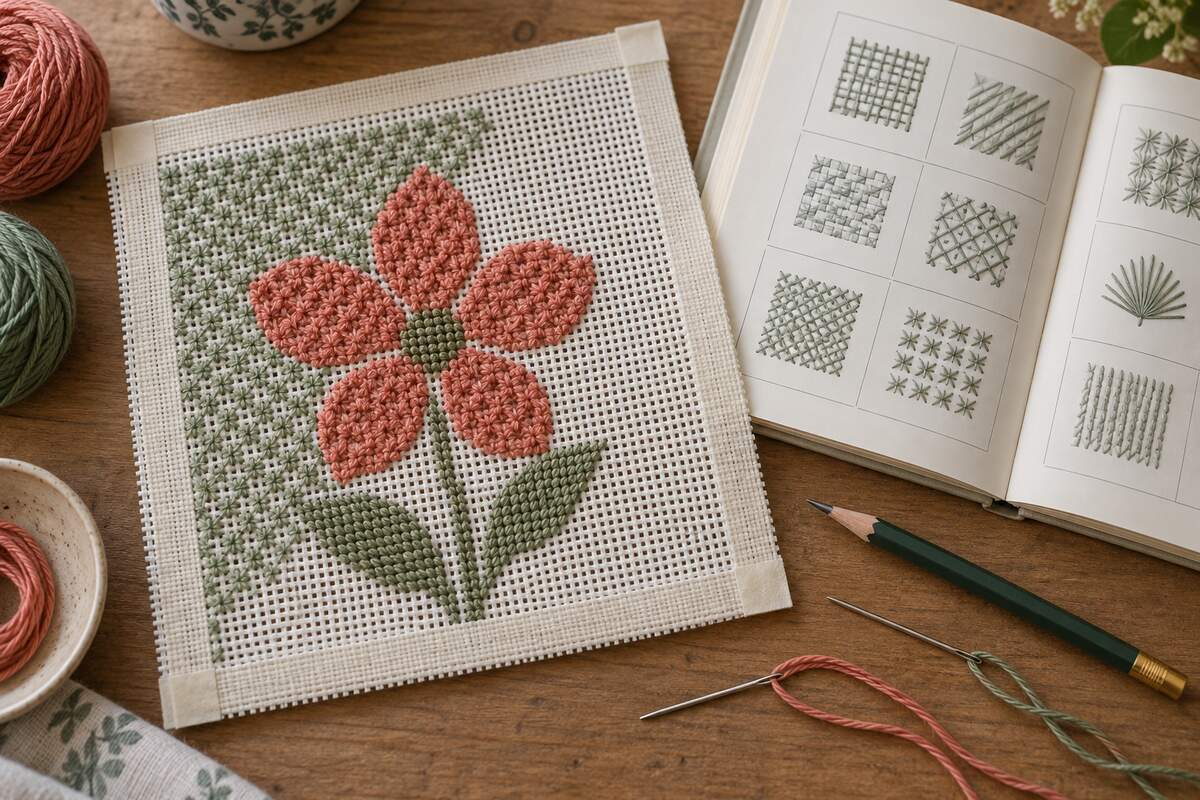
Every painted canvas asks the same question a hundred times: which stitch goes here? Tent stitch always works, but a well-chosen decorative stitch can suggest water, fur, brick or sky without a single extra thread color - and a badly chosen one can flatten a beautiful canvas. Teachers and shops converge on a small set of decision rules, and this guide organizes them: fit the stitch to the space, decide whether it should recede or perform, and let the subject dictate direction and texture. Last updated November 2, 2026.
Start here: For each area, ask three questions. How big is the space - will at least two or three repeats of this stitch fit in its narrowest part? Should the stitch sit back quietly or become part of the design? And does the painted shading need to show through? Then audition: stitch a few repeats on a doodle canvas or in a corner of the margin before committing. There is no single right answer - only stitches that serve the subject and ones that fight it.
Three questions before you choose
Floss Field's stitch-choice guide distills the whole decision into three questions. First, how big is the area: a stitch with a large repeat needs room, so measure the narrowest part of the space - if two or three repeats will not fit there, the stitch is too big, and in a space only a few threads wide, use tent stitch. Second, should it sit back or join in: a small, quiet stitch recedes and lets the subject do the talking, while a larger, more geometric stitch becomes part of the design - which suits a simple subject and can overwhelm a detailed one. Third, is the canvas painted with shading: an open stitch lets the painted ground show through, and on a painted canvas that relationship matters.
Poppy Monk's beginner guide adds the mindset: there is no right or wrong way to stitch, and even seasoned stitchers experiment, rip out, and try again - the goal is a collection of favorite stitches and the instinct to match them to subjects, which only practice builds.
Fit the stitch to the space
Scale is the rule stitchers cite most. Serendipity Needleworks' small-spaces guide notes that small areas need small stitches - compact units that read clearly in a few threads - while larger backgrounds open the door to open stitches, darning patterns and stitches that cross several intersections. Needlepoint For Fun's planning tips make the same point from the other side: a stitch that cannot complete its repeat in the available space will look broken, so check the repeat against the area before you fall in love with a stitch.
For genuinely large fields, Unwind Studio's large-areas guide frames decorative stitches as both an efficiency and a design choice: they cover ground faster than tent stitch and add texture, depth and interest to big color blocks that would otherwise feel repetitive. For ready-made area-specific ideas, see stitches for flowers, stitches for grass, trees and foliage, and stitches for sky and water.
Recede or join in
Serendipity's backgrounds guide explains that a background serves one of two functions: it either fills the space around the focal point quietly, or it actively contributes to the design. A quiet role calls for small, calm stitches with even texture; a contributing role justifies bold geometry. Floss Field's version of the same rule: a small, quiet stitch recedes, a larger geometric stitch becomes part of the design, and that suits a simple subject while risking overwhelm on a detailed one. The subject decides - a naive, graphic canvas can carry an assertive background stitch that a realistic, shaded portrait cannot. For background-specific options, see needlepoint background stitches.
Direction and movement
Serendipity's small-spaces article names direction as a selection criterion in its own right: if you are stitching water or sky, look for a stitch with flow or direction, and note that decorative stitch books are often organized into chapters by directional movement. Horizontal stitches read as calm water or distant sky; diagonals add energy; verticals suggest height or rain. Needlepoint For Fun echoes the idea in its canvas-planning tips: match the stitch's inherent direction to the thing it represents, and be consistent - a stitch that runs one way in one cloud and another way in the next reads as a mistake, not variety.
Texture where it counts
Serendipity's bringing-a-canvas-to-life essay tackles the self-doubt directly - "which stitches will actually make this flower pop?" - and its answer is contrast: areas stitch up flat when everything uses the same texture, so vary stitch height, density and direction between neighboring areas to make the focal point advance and the background retreat. Unwind Studio's background guide adds the physical note: high-coverage stitches like basketweave add durability, decorative and openwork stitches add movement, and the choice changes how the finished piece feels in the hand as well as how it looks.
Working with a painted canvas
On a hand-painted canvas the paint is a design layer, not just a map. Floss Field's third question - is the canvas painted with shading - exists because an open stitch lets the painter's shading show through, while a dense stitch covers it. Choose dense, full-coverage stitches where you want the thread to do the talking and open stitches where the paint should. This is also where thread choice and stitch choice meet: an open stitch in a lustrous thread shows both paint and light. For the difference canvas types make to planning, see hand-painted vs printed vs charted needlepoint.
Planning the whole canvas
Needlepoint For Fun's ten planning tips and Poppy Monk's beginner guide agree on process: decide before you stitch. Walk the canvas area by area, shortlist a stitch for each, check repeats against spaces, and write the plan down. Serendipity's essay adds the emotional payoff: a plan replaces the wave of self-doubt with a sequence of small, answerable questions. And everyone's safety net is the same - audition on a doodle canvas or in the margin, and rip out without ceremony when a stitch fails the subject. The stitch sampler habit pays off here: stitchers who keep a sampler of favorites choose faster and with more confidence.
Where sources disagree
Tent stitch: default or last resort? Floss Field opens with "tent stitch will always do" and steers tiny spaces to it explicitly. Needlepoint For Fun frames its whole guide as moving on from stitching everything in tent - treating it as the stage to graduate from. The positions reconcile: tent stitch is always correct and sometimes best, but a canvas stitched entirely in tent leaves texture and movement on the table.
Bold background on a detailed subject?Serendipity's two-function model allows an assertive background when the design calls for it, while Floss Field warns a larger geometric stitch can overwhelm a detailed subject. Both agree the subject decides; they weight the risk differently, with Floss Field more protective of detailed painting and Serendipity more willing to let the background perform.
Coverage or speed for big areas? Unwind Studio sells decorative stitches for large areas on both coverage speed and added interest, and its background guide separately prizes high-coverage basketweave for durability. On a floor pillow those goals can conflict - the durable choice is not the fast or flashy one - so finish plans break the tie.
FAQ
Is there a wrong stitch choice?
Poppy Monk says no - there is no right or wrong way to stitch, and experimentation is how instinct develops. The practical exception: a stitch whose repeat does not fit the space will look broken, per Floss Field's first question, so "wrong" usually means "wrong scale," not wrong stitch.
How many different stitches should one canvas use?
The sources give no fixed number, but their logic sets bounds: enough variety that neighboring areas differ in texture, height or direction (Serendipity's contrast principle), and few enough that the plan stays coherent and repeatable. Most teachers' examples use a handful of stitches per canvas, not dozens.
Should the background be stitched first or last?
That is its own question with real trade-offs; see should you stitch the background first or last.
What if I choose a stitch and hate it?
Rip it out - Poppy Monk is blunt that even seasoned stitchers experiment, rip out and try again. Auditioning on a doodle canvas first keeps the ripping small, and how to fix mistakes in needlepoint covers the mechanics of backing stitches out cleanly.
Do open stitches work on any canvas?
Open stitches shine where painted shading should show through (Floss Field's third question). On a canvas with little or no painted shading, an open stitch just shows bare canvas, which reads as incomplete coverage rather than intention - choose a fuller-coverage stitch there instead.
Sources
- Floss Field - Which needlepoint stitch to use for sky, water, snow and backgrounds (needlepoint reference site)
- Needlepoint For Fun - How to Choose Needlepoint Stitches and Plan Your Canvas (retailer)
- Poppy Monk - What Needlepoint Stitch To Use: A Beginners Guide (kit maker)
- Serendipity Needleworks - Needlepoint Stitches for Small Spaces (needlepoint teaching blog by Ellen Johnson)
- Serendipity Needleworks - Stunning Needlepoint Backgrounds (needlepoint teaching blog)
- Serendipity Needleworks - Bring Your Needlepoint Canvas To Life (needlepoint teaching blog)
- Unwind Studio - Best Needlepoint Stitches for Large Areas (retailer)
- Unwind Studio - Best Needlepoint Stitches for Background Areas (retailer)