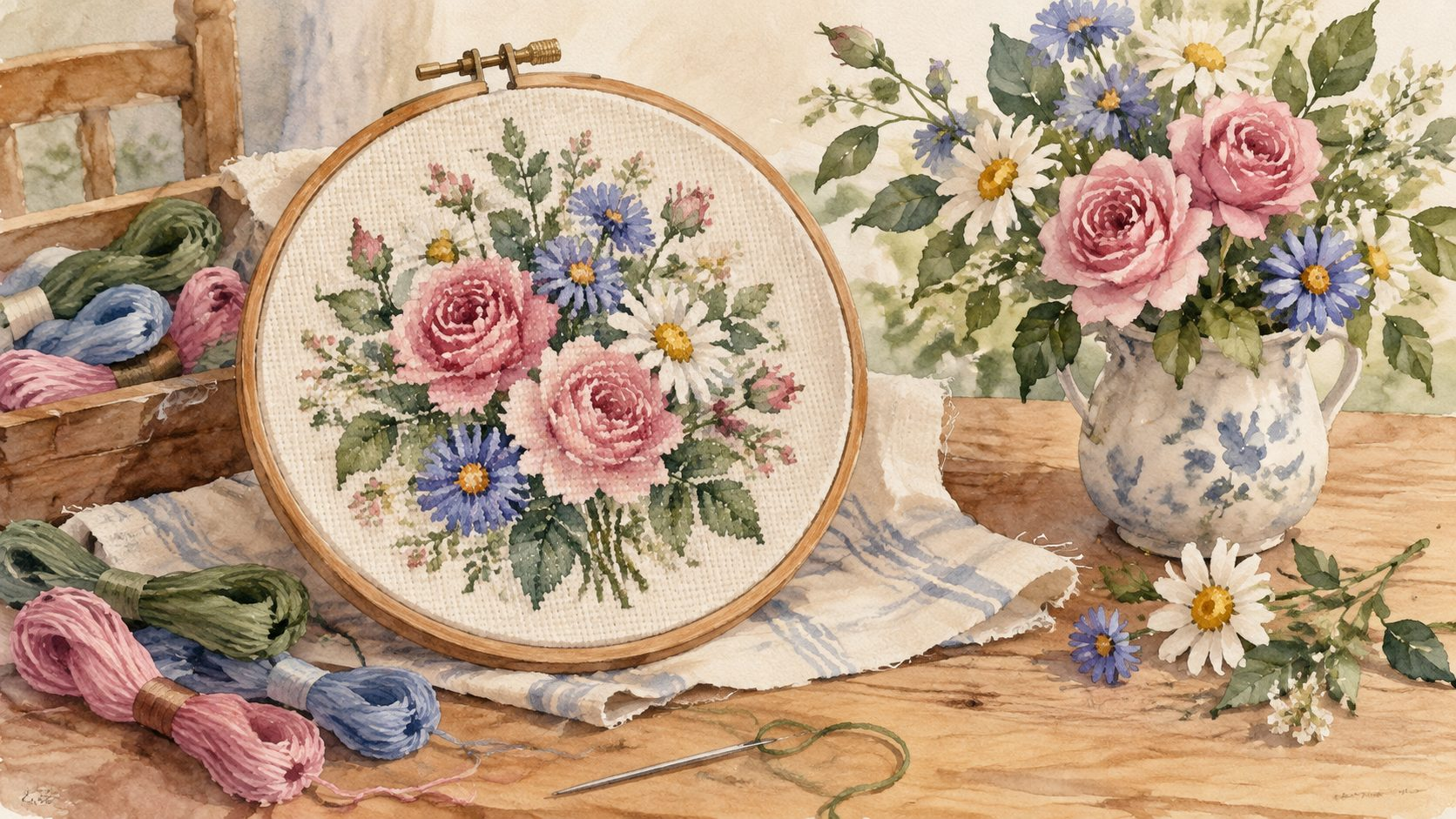
Flowers are curved and needlepoint is a grid, so many stitchers find them hard to make look right. The sources we read pick a small set of stitches: long and short or satin stitches for petals, French knots and wheels for centers, and brick, mosaic or stem stitch for greenery. They differ on which stitch suits which petal.
Atlantic Blue Canvas says long and short stitch suits soft, rounded petals with gradual color change, and encroaching or slanted Gobelin suits crisp, uniform petals like daisies, with French knots for most centers. Nuts about Needlepoint says the curved edges of flowers do not fit the squared-off nature of needlepoint, and suggests satin stitch or long and short stitch for petals. Poppy Monk's stitch guides show a different route: small geometric stitches such as mosaic, brick and Nobuko for petals.
Petals
- Satin stitch, fanned. Nuts about Needlepoint says to fill an entire petal with single satin stitches at different slants. Make one stitch from top center to bottom center, then keep splitting the difference with a new stitch between each pair. It says this gives a smooth petal with rounded top and sides, and that you may need shorter stitches along the sides or fill-in stitches in thin areas. For a layered color effect, it suggests a complete layer in one color overlaid with satin stitches in another.
- Long and short stitch. Nuts about Needlepoint begins at the base of the petal with one center stitch partway up, varies the lengths, then fills in with stitches of similar length at different angles, and says to avoid neighboring stitches with the same length and angle because that creates lines. It says this gives a more textured effect, suited to crepey petals. Atlantic Blue Canvas starts at the outer edge with varied straight stitches and nestles the next row between them, and recommends it for roses, tulips and peonies. Unwind Studio lists a long stitch for smooth, flowing petals and says different thread tones give shading.
- Parallel long stitches. Poppy Monk's camellia guide uses long oblique satin stitches of varying lengths, kept parallel, to fill the space, and tells you to watch tension so each stitch sits evenly.
- Gobelin family. Atlantic Blue Canvas recommends encroaching Gobelin for medium petals like daisies or sunflowers. Each stitch goes over 2 or more canvas threads and the next row starts halfway up the last. It describes slanted Gobelin as a quick workhorse for background petals and uniform sections. Poppy Monk uses interlocking Gobelin for an upper blue flower in its vase guide.
- Mosaic stitches. Unwind Studio recommends mosaic for small petal shapes, and mosaic diagonal for curving petals and multi-color flowers. Poppy Monk's vase guide uses alternating mosaic for smaller petals and mosaic checker for larger petals, with tent stitch in between.
- Others. Poppy Monk uses Nobuko for blue aster petals and horizontal and vertical brick stitch for yellow flowers. Serendipity Needleworks says the double straight cross stitch, one upright cross topped with a small standard cross, works for petals or clusters of flowers. It says that if you cannot work three repeats of the stitch in an area, the stitch is too big for it. NeedlepointTeacher lists the squared daisies stitch as good for foliage, clothes, fields and backgrounds, and says to work the large purple daisies first, then fill in with the yellow ones.
Flower centers
- French knots. Unwind Studio says they suit centers of daisies and roses. Atlantic Blue Canvas gives the method: bring the needle up, wrap the thread around the needle twice, hold the wraps snugly, and go down right next to where it came up. Poppy Monk uses them for yellow flower centers and links to a video.
- Woven wheel. Unwind Studio, which also calls it the spider web stitch, uses it for round flowers like roses or sunflower centers.
- Upright cross. Poppy Monk uses it for camellia centers and gives the reason: it is a heavy coverage stitch with several stitches in the same hole, so it supplies a thinner thread. It can be worked in basketweave direction or back and forth across rows.
- Diagonal mosaic and Rhodes. Poppy Monk uses diagonal mosaic for yellow aster centers and a circle Rhodes stitch for a red center. The needlework-tips site says Rhodes and Smyrna cross stand out from the fabric and suit bold accents and flower centers.
Leaves and stems
- Brick stitch. Atlantic Blue Canvas calls it a zigzag for leaves, with upright stitches staggered like bricks.
- Stem stitch. It says this is the stitch for stems, vines and thin line work, worked left to right with a stitch forward and the needle brought up halfway back along it, keeping the thread on the same side.
- Diagonal mosaic. Atlantic Blue Canvas suggests it for smaller leaves and background foliage. Poppy Monk uses diamond ray for dark green leaves and alternating tent stitch for pale green leaves, and says a tent or skip tent stitch also works.
- Chain stitch. Unwind Studio recommends it for outlining petals, stems or whole floral shapes.
- Leaf stitch. The needlework-tips site groups it with Rhodes as a stitch that breaks away from straight lines, good for floral designs and foliage, though harder to fit into a grid. We also cover grass and trees in our foliage stitches guide.
What stitch guides pick
Poppy Monk publishes stitch guides for its kits. Its camellia and aster guide suggests stitching flowers first and the background last, and using the threads as single strands as they come. Its vase guide uses alternating cashmere for the background. Poppy Monk also says that background cashmere is worked in rows, in portrait then landscape, with the cross stitches and compensating stitches filled in at the end. Our compensation stitches guide covers those fill-in stitches and our background stitches guide covers backgrounds.
Quick comparison
| Part of the flower | Stitches named | Sources |
|---|---|---|
| Soft, rounded petals | Long and short, satin | Atlantic Blue Canvas, Nuts about Needlepoint |
| Crisp, uniform petals | Encroaching or slanted Gobelin | Atlantic Blue Canvas |
| Small or stylized petals | Mosaic, brick, Nobuko, double straight cross | Unwind Studio, Poppy Monk, Serendipity Needleworks |
| Centers | French knots, woven wheel, upright cross, Rhodes | Unwind Studio, Poppy Monk, needlework-tips |
| Stems and leaves | Stem, brick, diagonal mosaic, chain, leaf | Atlantic Blue Canvas, Unwind Studio, needlework-tips |
Working tips
- Atlantic Blue Canvas says to use three or four shades of green for leaves, darkest in shadow, and to layer stitches, for example French knots over filled petals.
- It also says to blend colors gradually in long and short stitch by mixing a few stitches of the new color into the old.
- It says looser tension gives soft petals and tighter tension gives crisp edges, kept consistent within each area, and that you should practice on scrap canvas first.
- Nuts about Needlepoint says that if your canvas is painted the same color as the thread, thin areas will be less noticeable.
- Serendipity Needleworks suggests multi-color or tonal threads for the double straight cross and trying different threads on a doodle canvas. See our thread types guide and variegated thread guide.
- Needle 'n Thread, which teaches surface embroidery on fabric and not needlepoint, fills cornflowers with straight and split stitches that it calls rough needlepainting. We list it as an adjacent technique, not a needlepoint method.
Where sources disagree
- Which stitch for petals: Atlantic Blue Canvas and Nuts about Needlepoint favor long and short or satin stitches. Unwind Studio and Poppy Monk use small geometric stitches such as mosaic and brick. None of the sources tests one against the other.
- What a smooth petal needs: Nuts about Needlepoint says fanned satin stitch gives a smooth petal. It calls long and short more textured and suited to crepey petals. Atlantic Blue Canvas uses long and short for soft, painterly shading.
- Daisies: Atlantic Blue Canvas says encroaching Gobelin for daisy petals, while NeedlepointTeacher lists a squared daisies stitch that makes the flower from the stitch pattern itself.
- Mosaic: Unwind Studio says mosaic gives a slightly raised texture. Poppy Monk uses it for both petals and centers.
- One stitch at a time or one flower at a time: Atlantic Blue Canvas says many stitchers finish a flower at a time, but it is fine to do same-color areas together. Poppy Monk suggests flowers first and background last.
- Kits and prices: Several of these pages sell kits or canvases. We did not check any prices.
Questions
What stitch is best for flower petals?
It depends on the petal, per Atlantic Blue Canvas: long and short for soft rounded petals, Gobelin for crisp ones. Nuts about Needlepoint prefers satin or long and short, fanned to fit the shape.
How do I stitch a flower center?
Several sources use French knots. Unwind Studio also uses a woven wheel, and Poppy Monk uses upright cross, diagonal mosaic or a Rhodes stitch.
Which stitch is for stems?
Atlantic Blue Canvas says stem stitch, and Unwind Studio suggests chain stitch for outlines.
Why do my flowers look flat?
Atlantic Blue Canvas says to layer stitches and vary shades, and to use French knots for height.
Should I stitch flowers or background first?
Poppy Monk's camellia guide says flowers first and background last. Atlantic Blue Canvas says it can be either, one flower at a time or by thread color.
Where can I learn the basics first?
See our beginner stitches guide and basketweave guide.
Sources
- Unwind Studio: Best Needlepoint Stitches for Flowers
- Nuts about Needlepoint: Making Realistic Flower Petals
- Poppy Monk: Stitch Guide for Camellias and Asters
- Poppy Monk: Stitch Guide for Vase of Flowers
- Atlantic Blue Canvas: Best Needlepoint Stitches for Flowers
- Serendipity Needleworks: Stitching Flowers on the Double Straight Cross
- NeedlepointTeacher: Squared Daisies Stitch and Variation
- Needlework Tips and Techniques: Needlepoint Stitches
- Needle 'n Thread: Cornflowers Stitch-Along 4