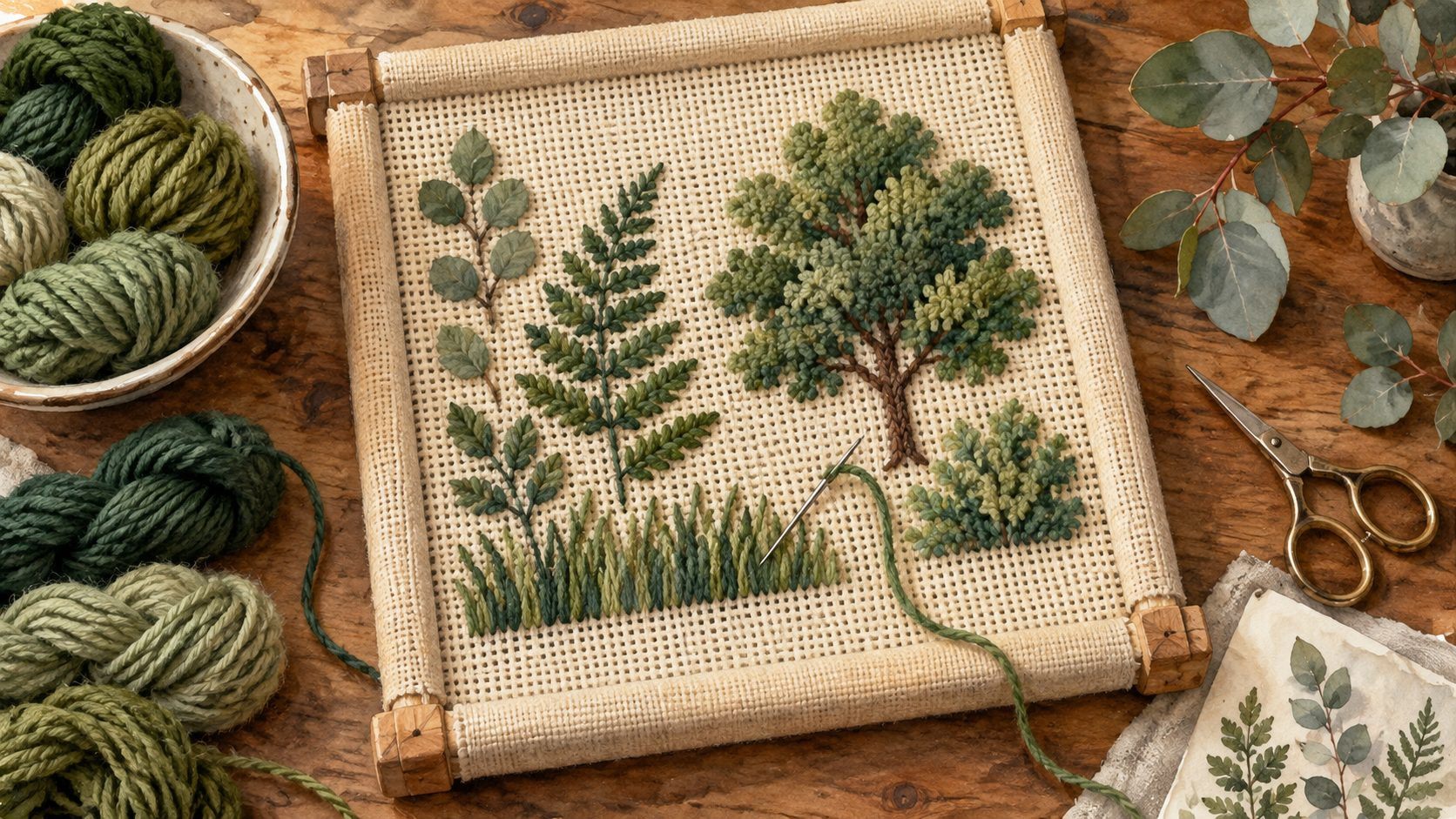
Grass, bushes and trees fill a lot of painted canvases, and writers recommend a handful of decorative stitches for them: straight-stitch patterns for grass, woven or leaf-shaped patterns for foliage, and free-form satin stitches for conifers. They agree that texture and thread choice matter more than color. They differ on how formal the stitch should look.
Floss Field lists French knots, Rhodes and Scotch for trees and bushes, and brick and bargello for fields, hills and mountains. Serendipity Needleworks uses the Bellingrath grass stitch for grass and the woven plait stitch for trees. Poppy Monk likes Diamond Leaves for trees, shrubs and forests. Test the stitch on scrap canvas first, as Floss Field and the leaf stitch tutorial both advise.
Grass and fields
- Bellingrath grass stitch. Serendipity Needleworks says it is a simple, medium-size straight stitch that needs plenty of space to establish the pattern. It says to start at the top right edge: the first vertical row repeats three short stitches and one long stitch, and the return row uses three long stitches and one short stitch, with short stitches sharing holes with long ones. Because it is a straight stitch, it says to use thicker thread or more strands for full coverage, such as a single strand of Silk and Ivory on 18 mesh or 6 to 8 strands of Splendor on 13 mesh, and to use a laying tool with multiple strands.
- Upside down ray and W stitch. KC Needlepoint says upside down ray is a great stitch for grass, and that the W stitch is great for grass and other foliage.
- Brick and bargello. Floss Field says upright stitches in rows and waves suit fields, hills and mountains.
- Double, diagonal knit and others. NeedlepointTeacher's stitch index suggests Double for fields, trees and grassy areas, and Diagonal Knit for meadow and smaller areas. These are short index notes, and the site says they are only suggestions.
Trees and shrubs
- Woven plait stitch. Serendipity Needleworks says it lets the painted shading show through, especially with lightweight thread, and that it is simple, small and fits just about anywhere. It says it works well in multi-color thread. Every stitch is a true diagonal over two intersections, and the second row is offset from the first. It suggests a single strand of Watercolours on 13 mesh, or two strands of Threadworx Overdyed Floss on 18 mesh.
- Diamond Leaves. Poppy Monk says you do not have to angle it to make it look like foliage, since its shape gives a shrub-like effect. It says a central pillar in a contrasting color gives trunks, as on the conifers in one of its kits, and that it suits a variegated thread for less manicured trees. It is worked in two parts: the darker diamonds first, then the inner arrows. It compensates with tent stitch at the tree tops.
- Free-form satin for conifers. Poppy Monk's Acadia stitch guide uses satin stitches for pine branches, with every stitch going to a center line. It says more than two stitches can share a hole, and you can change angle and length as long as stitches stay roughly parallel to their neighbors.
- French knots, Rhodes, Scotch. Floss Field says these give knots and blocks with texture for trees and bushes. Poppy Monk says French knots in tone-on-tone silk make shrubs look three-dimensional.
- Detached chain, diagonal leaf, double Leviathan. NeedlepointTeacher's index suggests these for foliage.
- Hungarian leaf. KC Needlepoint calls it a beautiful foliage stitch, made of two pairs of diagonal stitches over two with a Hungarian stitch centered underneath, and suggests a strandable silk like Splendor.
Leaf stitches
Needlework Tips and Techniques describes the leaf stitch as a group of straight stitches worked as a leaf-shaped motif. It says each motif covers nine canvas intersections high and six wide, motifs fit together into a background, and compensating stitches fill the edges. It says to count the threads first, use a firm even canvas (its go-to is 14 count), keep tension even, and test on scrap. It suggests green for hedgerows, autumn colors for seasonal pieces, and a small Christmas tree built from leaf motifs, and says leaves do not have to be green. See our compensation stitches guide for fitting a repeat into an odd shape.
Threads
Serendipity Needleworks lists these among its favorites for grass: Splendor, Watercolours, Waterlilies, Rainbow Linen, DMC cotton floss, Impressions, Planet Earth Silk, Pepper Pot Silk, Soie Cristale and Threadworx Overdyed Floss. For tree tops it likes Watercolours, Threadworx Overdyed Floss and Weeks Dye Works perle cotton, and it says those lines also have deep browns for trunks. Its solid-color picks for trees include Splendor, DMC floss, Impressions and DMC perle cotton. For how variegated thread behaves on canvas, see our variegated thread guide. Floss Field says upright stitches do not cover as well as slanted ones, so they may need more strands or a thicker thread. See thread by mesh count for strand counts and background stitches for other large areas.
Quick comparison
| Area | Stitches sources suggest | Source |
|---|---|---|
| Grass | Bellingrath, upside down ray, W | Serendipity Needleworks, KC Needlepoint |
| Fields, hills | Brick, bargello, double | Floss Field, NeedlepointTeacher |
| Tree tops | Woven plait, Diamond Leaves | Serendipity Needleworks, Poppy Monk |
| Conifers | Free-form satin to a center line | Poppy Monk |
| Bushes | French knots, Rhodes, Scotch | Floss Field, Poppy Monk |
| Hedges, borders | Leaf stitch, Hungarian leaf | Needlework Tips and Techniques, KC Needlepoint |
Where sources disagree
- Formal or loose: Poppy Monk says Diamond Leaves looks manicured unless stitched in variegated thread, and also offers free-form satin for conifers. Serendipity Needleworks favors a small, light stitch that shows painted shading. Floss Field favors textured knots and blocks. None compare them directly.
- Trunks: Poppy Monk makes trunks with a contrasting central pillar inside Diamond Leaves. Serendipity Needleworks says to use deep brown threads for trunks, without naming a stitch.
- Coverage: Serendipity Needleworks says straight stitches need thicker thread for full coverage. Poppy Monk and Serendipity Needleworks both say open or woven stitches can let painted color through, and they treat this as a benefit.
- Index suggestions: NeedlepointTeacher's one-line placement notes are suggestions only, and several of its stitches have no tutorial text on the page we read.
- Prices: Several sources sell kits, canvases or thread. We did not check prices. Poppy Monk's page has a promo code, which we did not verify.
Questions
What is the easiest stitch for grass?
Serendipity Needleworks calls the Bellingrath grass stitch really simple, though it needs space and thick thread. KC Needlepoint suggests upside down ray.
How do I stitch a pine tree?
Poppy Monk uses free-form satin stitches that all go to a center line, with angle and length adjusted.
What thread shows painted shading best?
Serendipity Needleworks says lightweight thread in woven plait lets the shading show, and that with grass you can use nearly any thread if you want shading to peek through.
Can I use leaf stitch for something other than leaves?
Needlework Tips and Techniques says yes: hedges, petals, feathers, borders and a small Christmas tree.
Do I need a laying tool?
Serendipity Needleworks says to use one with multiple strands in straight stitches so the strands lie smoothly.
How do I fill odd shapes?
Poppy Monk compensates with tent stitch at the tree tops, and Needlework Tips and Techniques says to use compensating stitches at the edges.
Sources
- Serendipity Needleworks: A Needlepoint Stitch For Grass
- Serendipity Needleworks: A Needlepoint Stitch for Trees
- Poppy Monk Needlepoint: Spotlight on Diamond Leaves
- Poppy Monk Needlepoint: Stitch Guide for Acadia National Park
- Needlework Tips and Techniques: Needlepoint Leaf Stitch
- KC Needlepoint: The Stitch Vault
- KC Needlepoint: Stitches for Plants
- Floss Field: Which needlepoint stitch to use
- NeedlepointTeacher: D Needlepoint Stitches