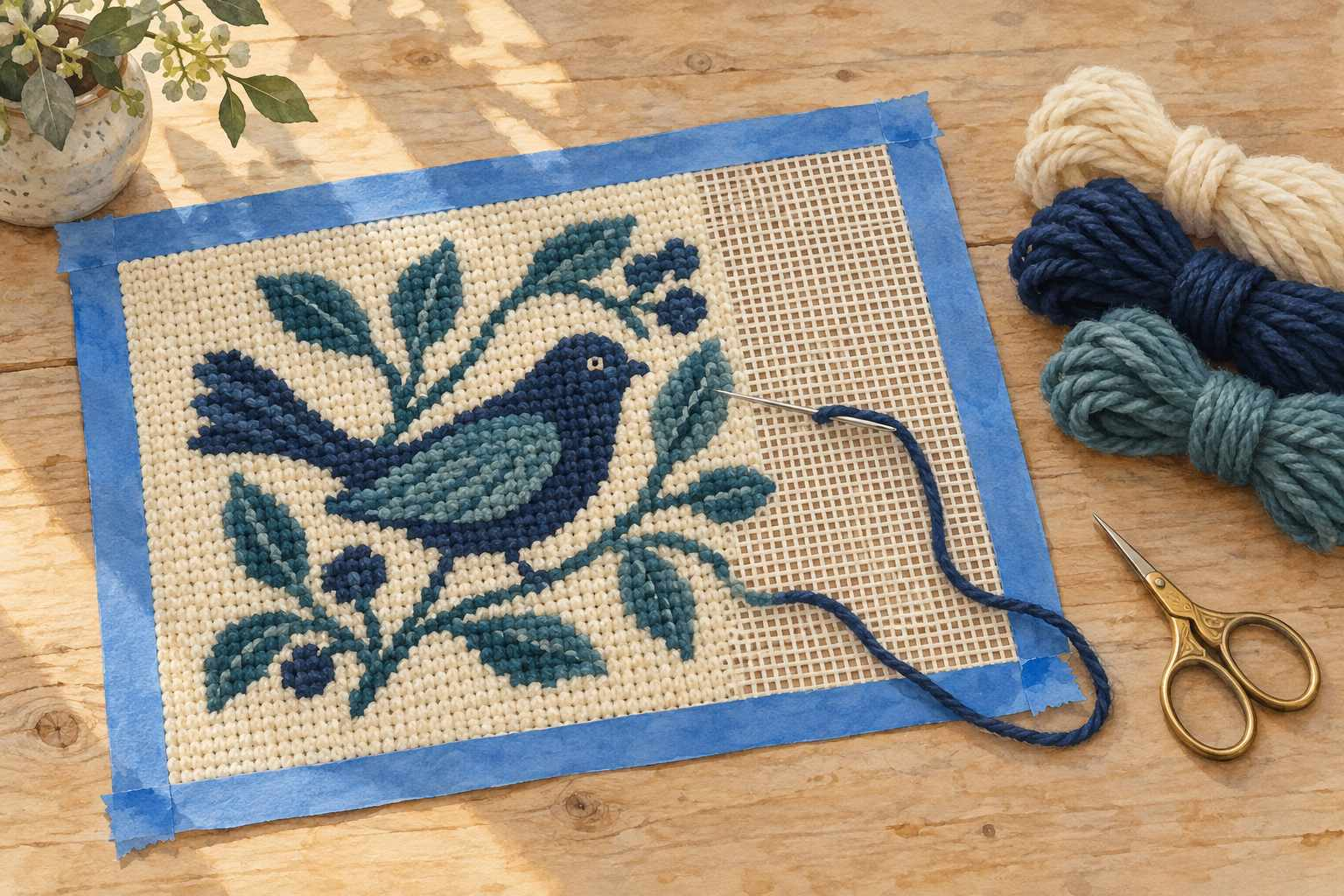
Stitchers argue about whether the background goes first or last, and the people who write about needlepoint do not agree. What they do mostly agree on is why order can matter: dark fibers that get into light stitches, and dark threads that show through from the back. This guide sorts the advice into the cases where order changes the result and the cases where it is taste. Last updated October 28, 2026.
Start here: The Stitch Ladi, Poppy Monk, Abigail Cecile, Benzie Design and Floss Field all say to stitch light colors before dark ones where they touch. Beyond that, The Stitch Ladi says the rules are silent for a plain tent stitch background and order is taste. If your background is white or pale and your design has dark colors next to it, stitch that pale area first. Otherwise pick the order you will actually finish.
Why order matters at all
There are two physical problems. The first is fiber transfer. The Stitch Ladi says dark thread sheds, and that stitching navy before white drags navy fibers into the white through the shared holes, a result stitchers call dandruff that cannot be picked out. Floss Field says the same thing: fibers from a dark thread already in the canvas can be pulled through with a light one stitched beside it. Benzie Design's kit tutorial gives it as the reason to stitch lighter colors first, since several threads come up through the same hole.
The second is shadows from the back. The Stitch Ladi says pale stitches are slightly transparent, so a navy tail carried across the back reads through white as a gray shadow, and that you should end the thread and start fresh on the other side. Floss Field and Abigail Cecile also warn about a dark thread lying on the back of a light area. For ending threads cleanly, see our guide to starting and ending a needlepoint thread and to keeping the back neat.
The rule everyone repeats: light before dark
Poppy Monk says needlepoint experts recommend stitching white or light areas first so you avoid trapping the ends of darker threads beneath lighter ones. Abigail Cecile says you typically want to stitch the light areas first and work toward the darkest, and warns that a dark thread stretched across the back and then stitched over in a lighter color will probably show through on the front.
Two limits on the rule show up in the sources. Poppy Monk says that on a canvas with a lot of colored detail, they recommend stitching the detail first anyway, and then cutting dark thread ends long, a quarter to a half inch, when they sit close to white areas. Their reasoning is that long ends trap fewer fuzzy bits under the light stitches and are easier to pull out if they do get caught. And in a Reddit thread, one commenter said light to dark comes from working in wool or inferior threads and that silks and cottons do not bleed into each other. Others in the same thread said they still go light to dark, and one said dark fuzz has come through the canvas on their finished work. Those are forum comments, not tests.
There is a second, separate reason people save white for last: keeping it clean. Abigail Cecile says that if you toss your needlepoint in a big purse or snack while stitching, leaving white for last may be wise, provided no dark thread is stretched across the back. In a Reddit thread on white backgrounds, one commenter said white goes last, to avoid staining from handling, except when working with threads they know are not colorfast. If you suspect a thread may run, read how to test needlepoint threads for bleeding before you put it next to white.
Painted canvas: background first or last
The case for background first
Jane of Chilly Hollow says she stitches from the background to the foreground, calls it a personal preference, and gives two reasons: it helps keep the background in its proper place as less dominant, and it avoids having tons of background left at the end, which she says can make a canvas drag on. She also says she once stitched a design first because she had not found a good frame and did not know how much background to cover.
Janet Perry of Nuts about Needlepoint says she used to stitch the background last and lists the problems: shadows when dark traveling threads cross unstitched light background, a slight change in the balance of the piece because stitches made last slightly overlap the earlier ones, and boredom that makes people give up projects. The Stitch Ladi also stitches background first, and says that for a repeating decorative background it is easier to set the pattern in open canvas and compensate around the design afterward than to fit a pattern around finished edges. A Reddit commenter who was taught background first said the same, that counting a pattern through an unstitched design is easier.
The case for design first
Abigail Cecile stitches the focal point first because it sets the precedent for decisions about the other elements, then the secondary elements, then the background last, with smaller stitches or a thinner thread so it recedes. She adds that she breaks this order often, and sometimes starts with a plain tent stitch background to get past blank page anxiety. Floss Field calls design first, small details early and background last, the usual order, with one exception covered below. In a Reddit thread on background last, commenters gave practical reasons: compensating around finished details is easier and small details are easier to see. In another thread, a commenter said stitching details first makes them easier to rip out if you make a mistake. Most commenters in that thread said they always do background last, though a thread titled that way attracts that answer.
If a decorative stitch is going in the background, see our guides to needlepoint background stitches and compensation stitches, since fitting a repeat into the space around a finished design is where the order matters most.
The exception both camps mention
Floss Field puts the light-before-dark rule above the usual order: where the background is lighter than the design, stitch the background first. The Stitch Ladi says the same, and several Reddit commenters said they do a white background first for this reason, though others do white last to keep it clean, as noted above. Nuts about Needlepoint adds the reverse, that shadows are not a problem with a dark background, so it can be stitched all at once.
Charted designs
Floss Field says that on a chart the design is counted in first, so the painted-canvas order turns round: a background lighter than the design is left for last, and no dark thread is carried across the back of canvas it will cover. Abigail Cecile tells stitchers to stitch the charted design and leave the background for last, and suggests tent stitch for the design and decorative stitches such as woven, brick or skipped tent for the background, because working decorative stitches while counting a chart can be tricky. For reading the chart itself, see how to read a needlepoint chart.
Stitching the background as you go
Janet Perry's alternative is to stitch the background as you stitch the foreground. In her ornament she worked the background up to a motif, stitched the motif, then continued, which she says kept traveling threads off the canvas and over the background threads on the back. She says the method helps most when the background is light, and that she does not use it on every canvas. She lists cases where she modifies it: backgrounds with dots or small motifs, where she stitches the main background first and then the motifs; a well-contained focal point, where background last is fine; and dark backgrounds.
Reddit commenters describe versions of the same habit. One threads several needles with the background color, stitches until they are empty, then does a colorful section. Another stitches a few rows of light background around dark areas so a dark strand is not caught later. Another said to alternate between design and the background around it. Again, these are forum posts, not tests.
Other order rules
The Stitch Ladi gives three more rules beyond color. Fuzzy threads such as mohair and angora go last because their fibers wander into later stitches. Raised details such as beads and French knots go near the end, because they get snagged and flattened while you work around them. Turkey work goes dead last, because its loops bury the surrounding holes. Layered stitches are built in the order the stitch guide gives, padding first and the covering stitch after. See our guides to adding beads, turkey work and metallic thread.
Needlepoint For Fun makes a different kind of order point, about depth. It says over-decorating background objects confuses the eye, and that on a design with a foreground and a distant scene you should stitch the distant objects first and use fancy fibers and stitches sparingly there, then stitch the fence and flowers in front last, where you can play more. Abigail Cecile makes a related point about thread weight: do not use thin thread for the focal point and a thick thread for the background.
For the stray fibers, Jane of Chilly Hollow says friends have laid large cotton handkerchiefs over canvases to keep dark fuzzies out of other areas, and says she uses tissue paper when cutting turkey work, which she says works great, though she was unsure how well the handkerchief method worked.
Where to put the first stitch
This is a separate question from background order, and the sources give it little weight. Thorn Alexander Style says where you begin is up to you, suggests big blocks of color or the top right corner for the easiest path, and says that on a printed canvas not on a frame, starting in the middle and branching out helps keep the canvas from warping, since the printed canvas may be thinner and less durable. Needlepoint.com says you can start anywhere but that beginners often find it easier to stitch the smallest color areas first. Abigail Cecile suggests starting a chart in the center of the design so the stitching is centered without measuring, and stitching a monogram letter before the florals around it. Floss Field says to start an area at its upper right if you are right-handed when working continental or basketweave, and at its lower left if left-handed. See left-handed needlepoint for more on direction.
A way to decide
This is our synthesis of the advice above, not a rule from any one source.
- Is the background white or pale next to dark design colors? Stitch the pale area first, or the pale rows around the dark areas first (Floss Field, Stitch Ladi, Poppy Monk, Reddit commenters).
- Is the background a dark color? Order is flexible, since Nuts about Needlepoint says shadows are not a concern there.
- Is the background a decorative repeat on a painted canvas? Consider doing it early (Stitch Ladi, Reddit commenter), or finishing the design first and accepting more compensation (Abigail Cecile, Reddit commenters).
- Is it a chart with a decorative background? Design first, background last (Abigail Cecile, Floss Field).
- Is it plain tent stitch in a mid or dark color? Take your pick. The Stitch Ladi says order is taste, and Chilly Hollow says to stick with what works for you unless there is a reason to change.
- Do you lose interest in acres of background? Interleave it, or do some early (Chilly Hollow, Nuts about Needlepoint, Reddit commenters).
Where sources disagree
The default order. Floss Field calls design first and background last the usual order and Abigail Cecile stitches the background last, while The Stitch Ladi, Chilly Hollow and Nuts about Needlepoint each stitch the background first or alongside the design. Jane calls her background-first habit a personal preference.
Whether the light-to-dark rule is firm. Poppy Monk, Abigail Cecile, Floss Field and Benzie Design state it as advice. Poppy Monk then recommends breaking it for detailed canvases and managing thread ends instead, and a Reddit commenter says it only matters for some fibers. Treat it as strongest for wool and other fuzzy threads against white or pale areas, which is where the sources describe the problems.
Is there a right answer? The Stitch Ladi says there is no one right order and that five physical rules matter. Needlepoint For Fun says there is no right answer to any of this, and Abigail Cecile says there are no rules. Floss Field calls one order usual, but its painted canvas guide also says a new stitcher can begin with a patch of background either way.
Evidence. None of these sources reports a controlled comparison. They are teachers, sellers and stitchers describing their own practice, so the strongest claims are the physical ones (fibers and shadows) and the rest is preference.
Common mistakes
- Carrying a dark thread across the back of an unstitched light area (Stitch Ladi, Abigail Cecile, Floss Field).
- Leaving short dark ends beside white areas, when Poppy Monk says to cut them long (a quarter to a half inch) so they are less likely to get trapped.
- Stitching a fuzzy or raised element early and then working around it (Stitch Ladi).
- Choosing a decorative background stitch without looking at how it meets the design, which the compensation guide covers.
FAQ
Should I do the background first or last in needlepoint?
The sources split. Abigail Cecile and Floss Field lean to design first and background last. Jane at Chilly Hollow, Janet Perry and The Stitch Ladi lean to background first or alongside the design. Light before dark where they touch is the point they share.
Do I stitch white first or last?
Floss Field says stitch a lighter background first. Abigail Cecile says some people leave white for last to keep it clean. In Reddit threads, commenters went both ways, and some said it depends on the thread.
Does stitching order matter with silk or cotton threads?
One Reddit commenter said silks and cottons do not bleed into each other, and another said it matters less with pearl cotton. That is opinion and not a test. The Stitch Ladi singles out fuzzy threads such as mohair and angora, which should go last.
Where do I start on a printed canvas?
Thorn Alexander Style says that on a printed canvas that is not on a frame, start in the middle and branch out to help prevent warping.
Does this apply to cross stitch?
These sources are about needlepoint, and we did not use cross stitch advice here.
Sources
- The Stitch Ladi - Is There a Right Order to Stitch a Needlepoint Canvas? (a blog post dated August 11, 2026 from a needlepoint shop site, with five rules and a personal order)
- Poppy Monk Needlepoint - Where To Start Stitching A Needlepoint Canvas (a kit seller, January 31, 2022)
- Abigail Cecile - Learn to Needlepoint Week 2: Planning and Approaching the Canvas (a designer's lesson on painted canvas)
- Abigail Cecile - How to Stitch a Needlepoint Chart (the same designer's guide for charted patterns)
- Chilly Hollow Needlepoint Adventure - Monica's Background Question (a stitcher's blog post, February 2, 2010, with reader comments)
- Nuts about Needlepoint - A Different Approach to Stitching Needlepoint Backgrounds (Janet M Perry, November 19, 2020)
- Floss Field - Painted, printed and charted needlepoint: the difference (a guide with a what-to-stitch-first section for painted and charted canvas)
- Floss Field - How to needlepoint: a beginner's guide (the same site's beginner habits list)
- Needlepoint For Fun - How to Choose Needlepoint Stitches and Plan Your Canvas (a seller, advice on emphasis and foreground and background)
- Benzie Design - Needlepoint Tutorial (a seller's kit tutorial)
- Thorn Alexander Style - How To Needlepoint: A Brief Lesson for Beginners (a beginner lesson)
- Needlepoint.com - Learn How to Needlepoint in 5 Minutes (a seller's beginner page)
- Reddit r/Needlepoint - What order do you stitch your canvases? (a community thread, March 2026, so opinion and not a test)
- Reddit r/Needlepoint - Am I in the one of the few that likes to do the background last? (a community thread, February 2025, so opinion)
- Reddit r/Needlepoint - Order of stitching/Background question (a community thread, April 2024, so opinion)
- Reddit r/Needlepoint - White first or last when background? (a community thread, October 2025, so opinion)