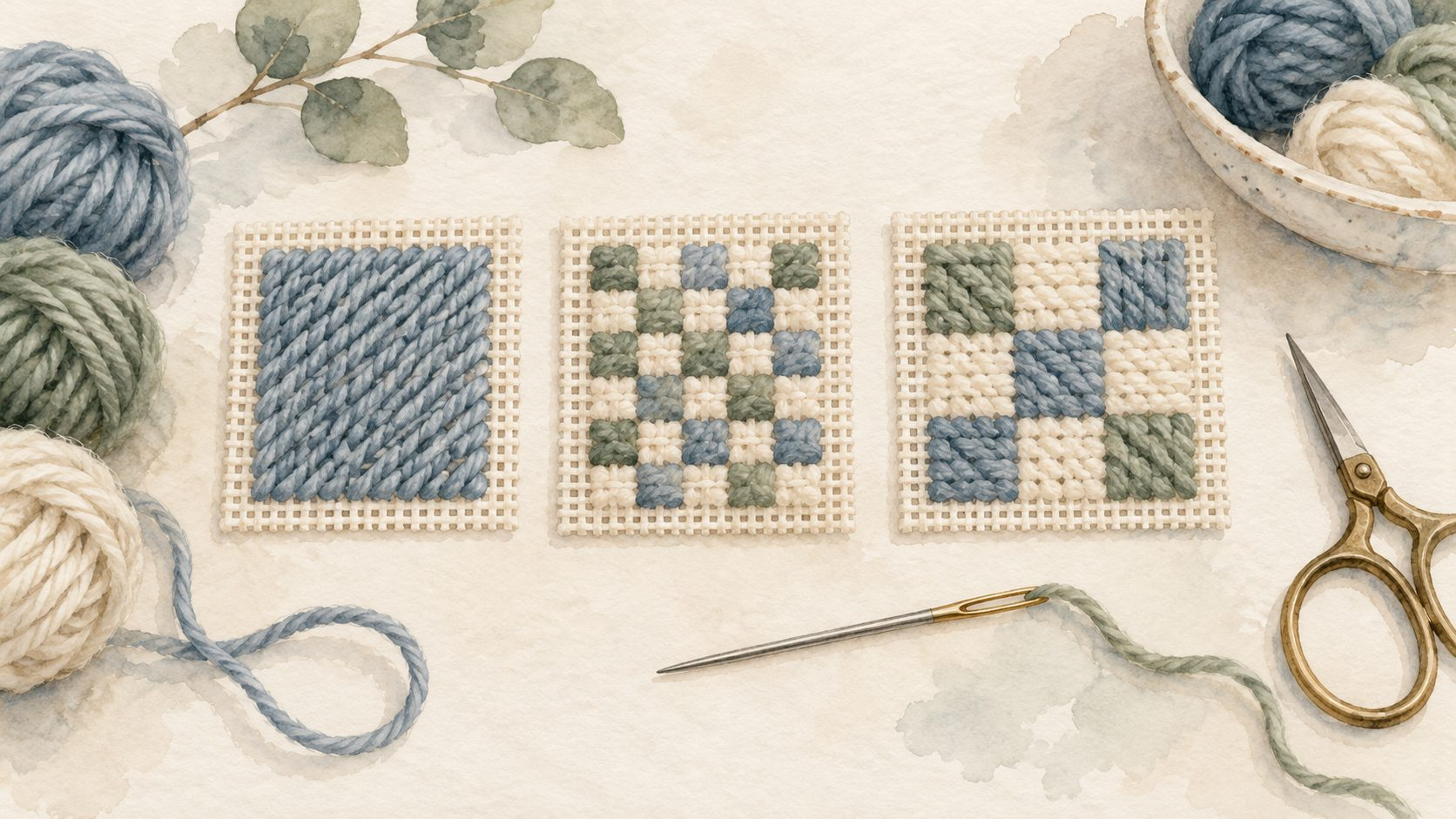
The background is the biggest part of most needlepoint canvases and the part that takes longest. Plain basketweave is the safe answer. A decorative stitch can make the piece more interesting and finish faster, but only if it fits the space, the mesh, and the design.
Measure the narrowest part of the background. If the stitch will not fit two or three full repeats there, pick a smaller stitch. If it is your first canvas, or the piece will be handled a lot, use basketweave. Test any decorative stitch on a patch of spare canvas in the thread you plan to use before you commit the whole area.
Common background stitches compared
These descriptions come from the sources listed below. Speed and look are the sources' own words, so treat them as a guide and not a measurement.
| Stitch | What sources say | Good for |
|---|---|---|
| Basketweave | Slow to work. Full coverage, no distortion, very durable (Unwind Studio). | Large areas, pillows, chair seats, anything handled |
| Mosaic | Small block, fills densely, quiet (AMK Publications). Three stitches making 2 x 2 blocks (Bower Thread). | Broken up, narrow, or curved areas |
| Scotch | Larger block, more dramatic, needs room (AMK Publications). Five stitches making 3 x 3 blocks (Bower Thread). | Generous open areas, borders, geometric designs |
| Brick | Upright stitches over two canvas threads, each row offset by half a stitch (Bower Thread). Beginner friendly (Unwind Studio). | Calm backgrounds, skies, water |
| Nobuko | Alternating long and short diagonal stitches in rows (Unwind Studio). No real direction, so it fits small spaces (Poppy Monk). | Sky, water, snow, fur, awkward shapes |
| Skip tent and T-stitch | Open stitches that let canvas show. The quickest group (Unwind Studio). | Light, airy backgrounds, painted canvases |
How to choose
AMK Publications says to start with the size of the area and not the look of the stitch, and to measure the narrowest part, not the widest. It then says to check mesh count: the same stitch is roughly half the physical size on 18 mesh that it is on 10. So a stitch that is too big on 13 mesh can be comfortable on 18. Our 13 vs 18 mesh guide and canvas types guide help with that choice.
Then decide how much the background should say. AMK Publications splits it into receding, a small dense quiet stitch near the canvas color so the motif does the talking, and participating, a larger geometric stitch that becomes part of the design. Bower Thread puts the rule briefly: the background stitch should never be more interesting than the thing in front of it. Local Needlepoint Shops adds time and wear: for a piece that will be handled, it cites the Royal School of Needlework stitch bank calling basketweave the most hard-wearing way to work tent stitch.
Basketweave: the default
Bower Thread calls basketweave the best background stitch for most people, most of the time, because it looks like the rest of your tent stitching, keeps the canvas straight, and wears longest. Unwind Studio agrees that it covers large areas neatly with no distortion, and names its main drawback: it is slow compared with decorative stitches. We have a full basketweave how-to and a continental vs half cross comparison for the rest of the tent family.
Mosaic, Scotch, and other diagonal blocks
AMK Publications says the difference between mosaic and Scotch comes down to scale. Mosaic is a small block that fills densely and sits close in scale to basketweave, so it slots into awkward spaces. Scotch covers more canvas per repeat, which makes it faster and more dramatic, but it needs room: in a narrow border you would compensate nearly every repeat and the pattern would never appear. Bower Thread says Scotch can shout on a soft romantic floral, so audition it in a corner first, and suggests mosaic for texture with zero new skills. Unwind Studio lists other quick diagonal options too, including corduroy, oatmeal, wicker, and bamboo, and the Point Craft Studio guide recommends cashmere for floral canvases, landscapes, and holiday ornaments when you want subtle interest.
Brick and other upright stitches
Brick is the only non-diagonal stitch in Bower Thread's five. It gives a gentle horizontal rhythm that reads calm and linear, and is "refreshingly mindless" to work. Poppy Monk likes double brick because it is orderly, fills geometric spaces, can be worked over two or four intersections, can run horizontally or vertically, and has a smooth, glossy look from straight stitches. It also suggests upright cross for small awkward spots, and says to thin stranded thread for it because the stitch packs tightly.
Open stitches for light backgrounds
Skip tent is regular tent stitch with intersections deliberately skipped. Bower Thread says it is a style choice, airy and sketch-like, and warns that on a white-ground design it can read as "ran out of thread," so commit to it clearly. AMK Publications makes the related point that on a painted canvas the thread sits close to the shade beneath it, so what peeks through reads as depth, while on a bare white canvas bright thread makes it look stark. Unwind Studio recommends T-stitch and skip tent for skies. Open stitches use less thread, so check quantities with our thread yardage calculator.
Edges, thread, and testing
A background meets the design at every edge, so the stitch gets cut all the way around. Where a whole unit will not fit, fill the gap with shorter stitches running the same way, which stitchers call compensating. AMK Publications says simple stitches shorten cleanly, while complex stitches lose their identity when cut in half, so a motif with lots of curved edge argues for a smaller, simpler stitch. Poppy Monk says Nobuko is one of the easier stitches to compensate because everything flows in one direction.
Thread matters too. AMK Publications says a matte wool fills the canvas and mutes the pattern, while silk or stranded cotton laid flat catches the light and sharpens it. Our thread by mesh count guide covers what suits each canvas. Test first: AMK Publications suggests stitching a small square on scrap of the same mesh, and Local Needlepoint Shops and Unwind Studio both suggest trying a patch in the spare canvas around the design. If you work from a chart, see how to read a needlepoint chart, and for a wider tour of stitches see needlepoint stitches for beginners.
Where sources disagree
The best default. Bower Thread says basketweave. AMK Publications names mosaic as safe and quiet for any area. Bower Thread also says that on a first canvas you should not choose at all and should use plain continental everywhere. Those are different answers for different situations. The difference is whether you value learning one stitch or protecting the canvas shape.
Mixing backgrounds. Bower Thread says one background texture per piece almost always looks better and that mixing reads as indecision. Other sources do not say this, and the Local Needlepoint Shops guide matches different stitches to different parts of a design, such as sky, water, and walls. Both can be true: one texture per area is not the same as one per canvas.
Speed. Unwind Studio puts brick, Nobuko, mosaic, and Scotch together as quick to work. Bower Thread calls Scotch the fastest of its full-coverage stitches and mosaic and brick fast, with skip tent the fastest overall. The ordering inside the quick group is not settled.
Printed canvas. Bower Thread says decorative stitches work in single-color printed regions but that you should stay with tent stitch where printed colors change square by square. AMK Publications says a stitch that looks harsh on a blank sampler can look beautiful on a painted piece. These do not conflict, but they stress different cases.
Questions
What is the easiest background stitch?
Sources name brick (Unwind Studio, Bower Thread) and mosaic (Bower Thread) as easy, and Poppy Monk describes Nobuko as easy because it is worked in rows like continental.
What uses the least thread?
Bower Thread says skip tent by far, then mosaic and Scotch, slightly leaner than basketweave. Basketweave uses the most thread among tent stitches.
How do I stop a background pulling my canvas?
Basketweave distorts the canvas least, per Unwind Studio and Local Needlepoint Shops. Block the piece afterwards if it warps; see our blocking guide.
Can Threaded help me plan a background?
Threaded makes the chart. The stitch you work over a flat color area is your choice. Try the needlepoint chart maker.
Sources
- AMK Publications: Needlepoint background stitch
- AMK Publications: Mosaic vs Scotch stitch
- Local Needlepoint Shops: Needlepoint background stitches
- Bower Thread: The best needlepoint background stitches
- Unwind Studio: Best needlepoint stitches for background areas
- Point Craft Studio: Best stitches for needlepoint backgrounds
- Poppy Monk: Three needlepoint background stitches