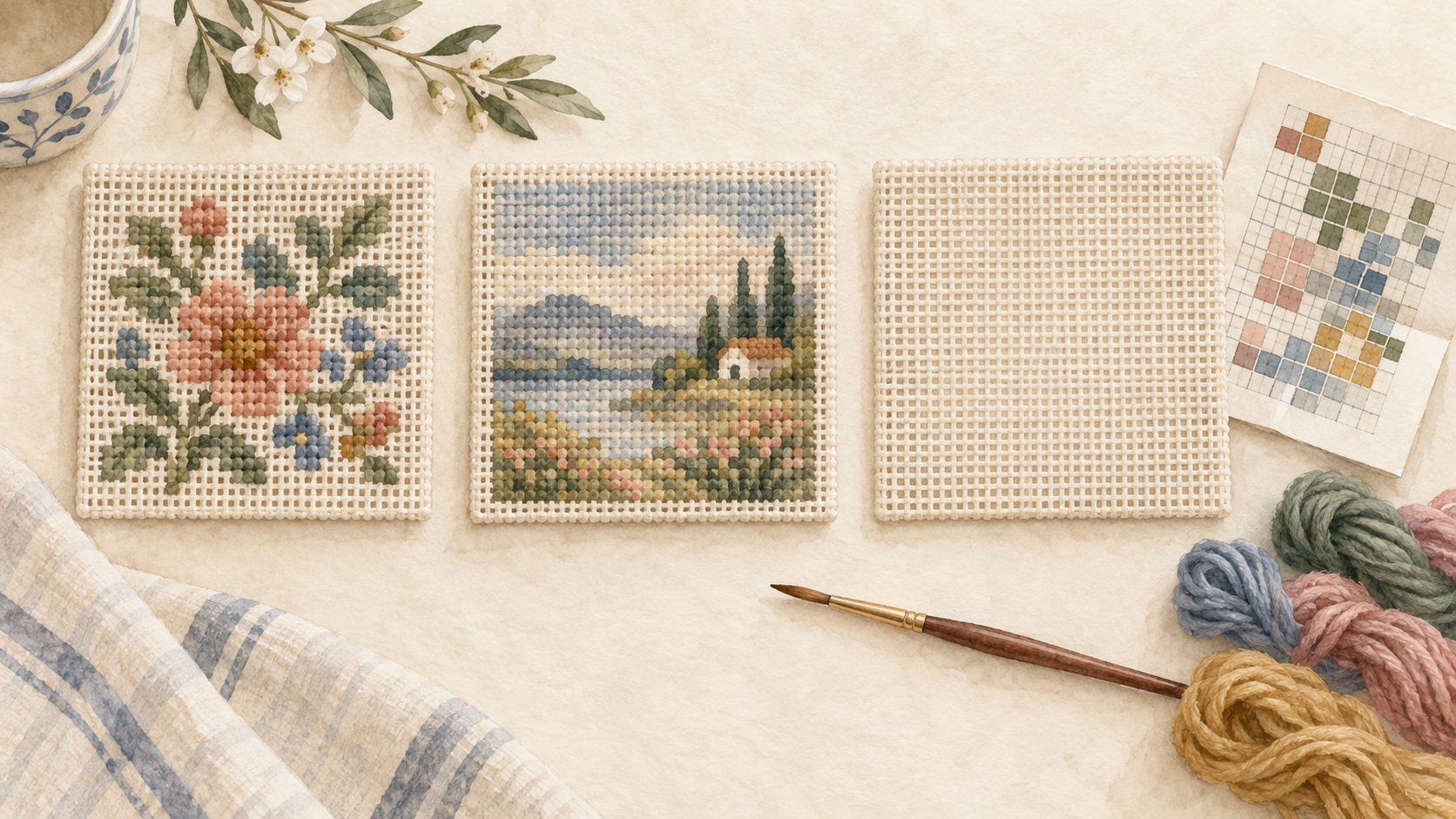
A needlepoint design can reach your canvas in three broad ways: painted by hand, printed by machine, or left off the canvas entirely and supplied as a chart. The choice changes how easy the design is to read, what it costs, and how much you decide as you stitch. This guide compares the three using what shops and makers say, and notes where they disagree.
If you want the least guessing, look for a stitch-painted canvas, where each intersection is one color. If budget matters most, a clearly printed canvas or a charted design works. Whatever you choose, check the mesh and size before buying. Our canvas types guide covers the weave itself, which is a separate choice.
The types compared
| Type | How the design gets there | What sources say |
|---|---|---|
| Stitch-painted | Each intersection painted one color, by hand | Easiest to read, usually the most expensive (Nuts About Needlepoint, Pampered Introvert) |
| Hand-painted | Painted by hand, curves may not follow intersections | Some intersections carry more than one color (Nuts About Needlepoint, DMC) |
| Printed | Ink applied by machine, by screen, roller, or digital printer | Lower cost; quality varies with the process (Nuts About Needlepoint, DMC, Unwind Studio, Saltwater Stitch) |
| Charted | Symbols on paper, stitched on blank canvas | Most affordable; you choose and count (DMC) |
Stitch-painted and hand-painted
Nuts About Needlepoint draws a line between the two. In a stitch-painted canvas a person paints every intersection one color only, so you never decide about colors. A hand-painted canvas differs in that curves and slanted lines are not painted intersection by intersection, so some intersections may have more than one color. It adds that most US hand-painted canvases stitch-paint straight lines and hand-paint curves. DMC makes the same point: on some hand-painted canvases an intersection's color is not clearly stated, and stitchers often enjoy making those calls along with choosing threads and stitches. Ashley Evans Designs, a hand-painted canvas brand, says a painted canvas translates art into the grid, simplifying detail so the design reads clearly, and says that can make a first project smoother. Matilda Stitch Co explains that with stitch painting each intersection is a single color, so the color under your needle tells you which thread goes in that stitch, while freeform painting leaves more of those choices to you.
Printed canvases
Printed is a family of methods. Nuts About Needlepoint separates silk-screened, roller-printed, giclee, and computer-printed canvases. It lists the shared weaknesses of machine methods as more than one color per intersection, colors lost in the holes, and edges that are often not straight to the canvas threads, and says roller-printed canvas is very inexpensive to produce. DMC says printed designs, common in kits, come from silk-screening or heat transfer, cost less than hand-painted, and tend to be simpler because those methods limit the color palette. It also says a color strip on the selvage lists the colors used. The Pampered Introvert says digitally printed canvases are more affordable and faster to produce, easier for complex shading, but ink may not line up with each intersection and colors can look slightly blended. Unwind Studio, which sells printed canvases, argues both types have artistic value and notes some printed canvases use stitch-simulating techniques so that each color lands on a chosen intersection. Saltwater Stitch says traditional screen printing let ink bleed into holes and lines drift off the grid, and claims its process places ink precisely on the mesh.
Charted designs
DMC says charted designs are the most affordable and appear in books and magazines. Each square needing a stitch carries a symbol, and a key links symbols to thread colors. Charts are stitched on blank canvas, so DMC notes it can be harder to cover the surface and that stitches which fully cover the canvas suit charts best. To learn the symbols, read how to read a needlepoint chart. If you want to make your own chart, try the needlepoint chart maker, see photo to needlepoint pattern, and print it with how to print a needlepoint pattern.
Why prices differ
The Pampered Introvert says a 4 by 4 inch canvas on 14 mesh holds 56 by 56 stitches, or 3,136 intersections, and that stitch painting means painting each one by hand, which is why labor, time, and small production runs raise the price. It also notes that printed and stitch-painted canvases both start from a chart. Matilda Stitch Co says a canvas price covers the artwork, the painting time, the canvas, and edge binding, while kits add matched thread and professional finishing is usually separate. Unless a canvas is sold as a kit, it may include no thread, so compare like with like. Our beginner kits guide and supplies guide show what else you need.
Checking a canvas before you buy
A few details from the sources help you judge a listing. DMC says a color strip on the selvage of a printed canvas lists the colors used, which makes the design easier to read. Nuts About Needlepoint says smooth curves point to hand painting, and circles at an edge point to stitch painting. It also says printed edges are often not straight to the canvas threads, and that most hand-painted acrylic is waterproof when dry while some printed inks are not. Matilda Stitch Co says bound edges stop fraying and keep your thread from catching, and that a canvas not sold as a kit usually has no thread in the package. Ask the shop what is included before you order.
How to choose
Match the type to what you want from the project. If you want a clear map and little guessing, choose stitch-painted. If you enjoy choosing colors, threads, and stitches, a hand-painted canvas with some open choices suits that. If cost is the priority and the design is bold and simple, a clean printed canvas works, and a chart is cheaper still. Then check mesh: read 13 vs 18 mesh before you buy, because a design is sized to its mesh. Once you have the canvas, prepare it before the first stitch.
Where sources disagree
Is printed worse? Ashley Evans Designs says printed canvases can feel flatter and less polished and that painted ones are usually the stronger choice for a polished result. Unwind Studio says both are equally valuable and challenges the belief that hand-painted holds more artistic value. Saltwater Stitch says printed canvases got a bad reputation from older screen printing and that modern printing reads as clearly as hand-painted. Nuts About Needlepoint says there are no bad canvases, only ones inappropriate for you right now.
Printed and beginners. The Pampered Introvert calls digital printing great for beginners, partly on price. Ashley Evans Designs says a clear hand-painted canvas gives a smoother first project because the visual cues are clearer. Both can be true: price versus readability.
What hand-painted means. Unwind Studio describes hand-painted canvases as painted at each intersection, then notes some painted canvases are not made that way. Nuts About Needlepoint and DMC separate stitch-painted from hand-painted. Check the listing, and ask the shop if it is unclear.
Questions
What is a stitch-painted canvas?
Nuts About Needlepoint says each intersection is painted one color only. Matilda Stitch Co says the color under your needle tells you which thread to use.
Why are some printed canvases hard to stitch?
Nuts About Needlepoint says machine printing can leave more than one color on an intersection, lose colors in the holes, and run off the canvas threads. The Pampered Introvert adds that digital ink may not align with each intersection.
Are charted designs cheaper?
DMC says charted designs are the most affordable, because the design lives in a book or magazine and you stitch it on blank canvas.
Can I make my own?
Yes. See best needlepoint software and the chart maker. Matilda Stitch Co says its own designs start as sketches turned into charts before they are painted.
Sources
- Nuts About Needlepoint: How Does the Design Get on the Needlepoint Canvas?
- DMC: Tapestry and Needlepoint Designs and Charts
- Ashley Evans Designs: Painted Needlepoint vs Printed
- Unwind Studio: Printed vs Hand Painted
- Saltwater Stitch: Printed vs. Hand-Painted Needlepoint Canvases
- The Pampered Introvert: Digitally Printed vs. Stitch-Painted
- Matilda Stitch Co: Why Is Needlepoint So Expensive?