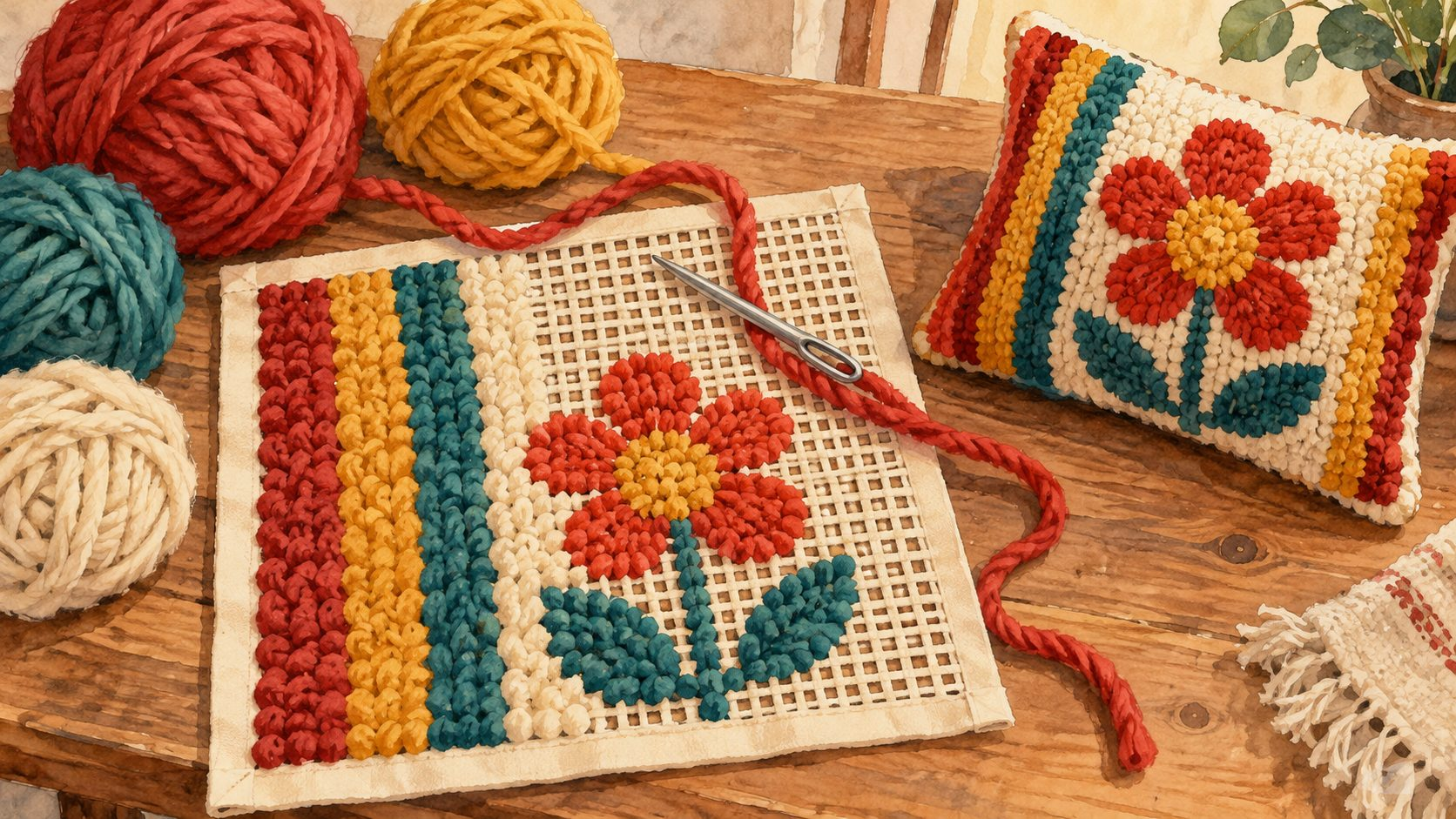
Quickpoint, also written quick point, is ordinary needlepoint stitched large: thick yarn on the coarsest canvas, most often 5 mesh. The stitches are the same. What changes is the scale, and with it the speed. This guide covers the canvas, yarn and needle, the stitches that behave, how to size a project, and the places where the sources give different numbers.
The common recipe across our sources: 5 mesh rug canvas, rug yarn or another thick yarn, a size 13 tapestry needle, and tent stitch (Floss Field, Cozy Stitchery, The Spruce Crafts). Any charted design can be worked this way by changing the canvas and yarn, without changing the chart (Floss Field, The Spruce Crafts). The tradeoff is detail: big stitches show less of it.
What quickpoint is
Floss Field defines quickpoint as needlepoint worked large, and says the name is for the speed. Its sources put quickpoint at the coarse end of three size names for needlepoint: petit point at 16 mesh and finer, gros point in the middle, and quickpoint at roughly 3 to 7 mesh. Floss Field also reports that a 1964 needlework book claims to have coined the name. See our petit point vs gros point guide for the other two terms.
The speed comes from simple arithmetic. Floss Field counts 25 stitches per square inch on 5 mesh, against 169 on 13 mesh and 324 on 18 mesh. The Spruce Crafts says a typical quickpoint project can be finished in half the time of one on smaller canvas, and imagines an ornament or coaster done in one hour instead of three or four. Treat that as a rough claim from one author, not a measurement. Our how long needlepoint takes guide has more on time.
The canvas
The canvas for quickpoint is rug canvas (Floss Field). World of Needlepoint describes rug canvas as very heavyweight, woven with two vertical threads twisted around each other and two horizontal threads lying side by side, with threads that cannot be separated, in gauges from 3 to 5. Floss Field's teacher lists it in 3.3, 3.75, 5, 6 and 7 stitches to the inch and says it is heavily starched.
Cozy Stitchery says 5 mesh canvas comes as rug canvas or Penelope (double) canvas. Floss Field notes that older books call quickpoint canvas Penelope, while its teacher keeps the two apart because Penelope pairs can be split for smaller stitches. See our canvas types guide.
Plastic canvas also works. The Spruce Crafts lists rug or large hole plastic canvas with 3 to 5 mesh, and says that plastic canvas needs only minimal backing and no blocking. Our plastic canvas guide covers sizes.
Annake's Garden, writing about quickpoint for stitchers whose eyes and hands tire, uses two rug canvases: a number 3.75 latch hook canvas that takes uncut rug yarn or thick craft yarn, and a smaller mesh rug canvas. The same author says traditional quickpoint canvas has 4.5 stitches to the inch.
Yarn and needle
Floss Field says quickpoint is worked in rug yarn, and also names worsted weight knitting yarn and thick cotton yarn as options. The Spruce Crafts lists medium or worsted knitting yarn, single ply thick or bulky cotton yarn, and acrylic or Persian rug yarn, which it calls a more expensive approach.
The Spruce Crafts' tapestry yarn article says tapestry yarn is a tightly twisted 4 ply yarn that cannot be separated and, because it is thinner than most rug yarn, is ideal for working on number 5 rug or quickpoint canvas. Cozy Stitchery lists several strands of tapestry or Persian wool as an option for 5 mesh. Our thread amount guide covers yardage.
For the needle, Floss Field and Cozy Stitchery both give a size 13 tapestry needle for 5 mesh. The Spruce Crafts recommends large eye, blunt tip tapestry needles and says the larger the needle and canvas, the quicker the project. See the needle guide.
Stitches that work
The Spruce Crafts says the most commonly used stitches are diagonal tent, continental and basketweave, which show the design detail and prevent distortion from the large holes in rug canvas. Floss Field makes the same point: tent stitch, worked as continental or basketweave, is the most common. Our basketweave guide covers the one that distorts the canvas least.
Straight stitches such as bargello, Gobelin and mosaic are less ideal. Both The Spruce Crafts and Floss Field say to keep them to no more than 4 canvas threads long, because longer stitches show gaps. Annake's Garden adds that quickpoint can be done in counted cross stitch as well as tent stitch, and shows pieces that combine cross stitch, star stitch, tent stitch and backstitch. The Spruce Crafts suggests cross stitches, French knots and bullion knots when you want texture.
Sizing a project
To convert a design, keep the chart and change the canvas. Floss Field's example: moving a design from 10 mesh to 5 mesh makes it twice as wide and twice as high, four times the area. Inches are stitches divided by mesh, so 100 stitches on 5 mesh are 20 inches. Our resize guide and mesh size chart cover the same sums for other counts.
Cozy Stitchery's planner for 5 mesh gives these stitch counts, with 2 inches of spare canvas on every side:
| Project | Design (in) | Stitches | Canvas to buy (in) |
|---|---|---|---|
| Ornament | 3 x 3 | 225 | 7 x 7 |
| Coaster | 4 x 4 | 400 | 8 x 8 |
| Framed picture | 8 x 10 | 2,000 | 12 x 14 |
| Pillow | 14 x 14 | 4,900 | 18 x 18 |
The Spruce Crafts works a conversion example: a design 75 stitches wide by 69 long on 14 mesh canvas (5.36 by 4.93 inches) becomes a piece on 5 mesh rug canvas of about 15 by 10 inches for the design, plus at least 3 inches on every side. Our own arithmetic says 75 by 69 stitches at 5 mesh is 15 by 13.8 inches, so check the height before you cut. See how much extra canvas to buy.
The Spruce Crafts' process for a project: pick a pattern, convert the measurements, choose your yarn and stitch, then center the design on the canvas and draw it with a waterproof marker.
What to make
- Rugs. Floss Field quotes a 1975 needlecraft book that says quickpoint was "once used mostly for rugs".
- Pillows and pictures. Floss Field lists both as classic quickpoint projects, and Cozy Stitchery's planner includes pillows, framed pieces, a stocking, an eyeglass case and small items.
- Bold designs. Floss Field says a 1978 book calls quickpoint canvas best for bold graphic designs, and a seller says the big stitches do not allow as much detail as 10 mesh.
- Beginner and kids' projects. The Spruce Crafts calls quickpoint the easiest way to learn needlepoint and a good craft for kids. See our needlepoint for kids guide.
- Easier on tired eyes and hands. Annake's Garden recommends quickpoint for needlecrafters whose eyes and hands do not respond as well as they used to. See also lighting and magnification.
One caution from Floss Field's quote of a 1964 book: the bulkiness of quickpoint limits its uses slightly. It does not recommend it for chair seats or stool tops that drop into a frame, unless the furniture was built for the extra thickness.
Where sources disagree
What mesh counts as quickpoint. Floss Field reports a spread: 5 mesh is the figure nearly every account names, one teacher says 3 to 7, a 1971 book says 4 or 5, and one writer says 3 to 5 works best. The Spruce Crafts says 3 to 5 works best. Annake's Garden calls 4.5 the traditional count. World of Needlepoint gives rug canvas as 3 to 5. Our advice: treat 5 mesh as the default and 3 to 7 as the range.
How much spare canvas. Cozy Stitchery adds 2 inches on every side. The Spruce Crafts says to add at least 3 inches. The larger margin costs more canvas but gives room to mount the piece. Our extra canvas guide explains the tradeoffs.
Which yarn. Floss Field says rug yarn, with worsted and thick cotton as other options. The Spruce Crafts says rug yarn is the more expensive approach and starts with knitting yarn and cotton. Tapestry yarn is thinner than rug yarn but, per The Spruce Crafts, suits number 5 canvas.
Is it only needlepoint? Floss Field defines quickpoint as needlepoint. Annake's Garden says the word point implies that, but quickpoint is also lovely in counted cross stitch on the same canvas.
Rug canvas or Penelope? Cozy Stitchery lists both for 5 mesh. Floss Field says older books use Penelope for quickpoint, while its teacher distinguishes them because Penelope pairs can be split. World of Needlepoint says rug canvas threads cannot be separated.
Questions
What is quickpoint needlepoint?
Needlepoint on large mesh canvas, usually 5 mesh, with thick yarn (Floss Field). The stitches are the same as in other needlepoint.
What mesh is quickpoint?
Usually 5 mesh, with a range of 3 to 7 depending on the source (Floss Field, The Spruce Crafts, Annake's Garden).
Is quickpoint good for beginners?
Yes, according to The Spruce Crafts and Annake's Garden, because it is easy and finishes fast. Be aware that the big holes show less detail.
What needle and yarn do I use for quickpoint?
A size 13 tapestry needle and rug yarn on 5 mesh (Floss Field, Cozy Stitchery). Worsted knitting yarn and thick cotton also work (Floss Field, The Spruce Crafts).
Can I convert a regular needlepoint chart to quickpoint?
Yes. Keep the chart and change the canvas and yarn (Floss Field, The Spruce Crafts). The piece comes out larger by the ratio of mesh counts.
Do I need to block quickpoint?
The Spruce Crafts says plastic canvas quickpoint needs no blocking. For rug canvas, work with the canvas flat and check for distortion, using basketweave to limit it. Our blocking guide covers the rest.
Sources
- Floss Field, What is quickpoint? Needlepoint on large-mesh canvas
- The Spruce Crafts, Quickpoint: the Fastest Way to Stitch Needlepoint Projects
- The Spruce Crafts, Stitching With Tapestry Yarn in Needlepoint
- Annake's Garden, Quickpoint: Big Stitches for Needle Art Success
- Annake's Garden, Easier on The Eyes: Needlework for Older Needlecrafters
- Cozy Stitchery, 5 Mesh Needlepoint Canvas Guide and Chart
- World of Needlepoint, Guide to Needlepoint Canvas
- NeedlepointTeacher, Determine the Tapestry Wool Coverage