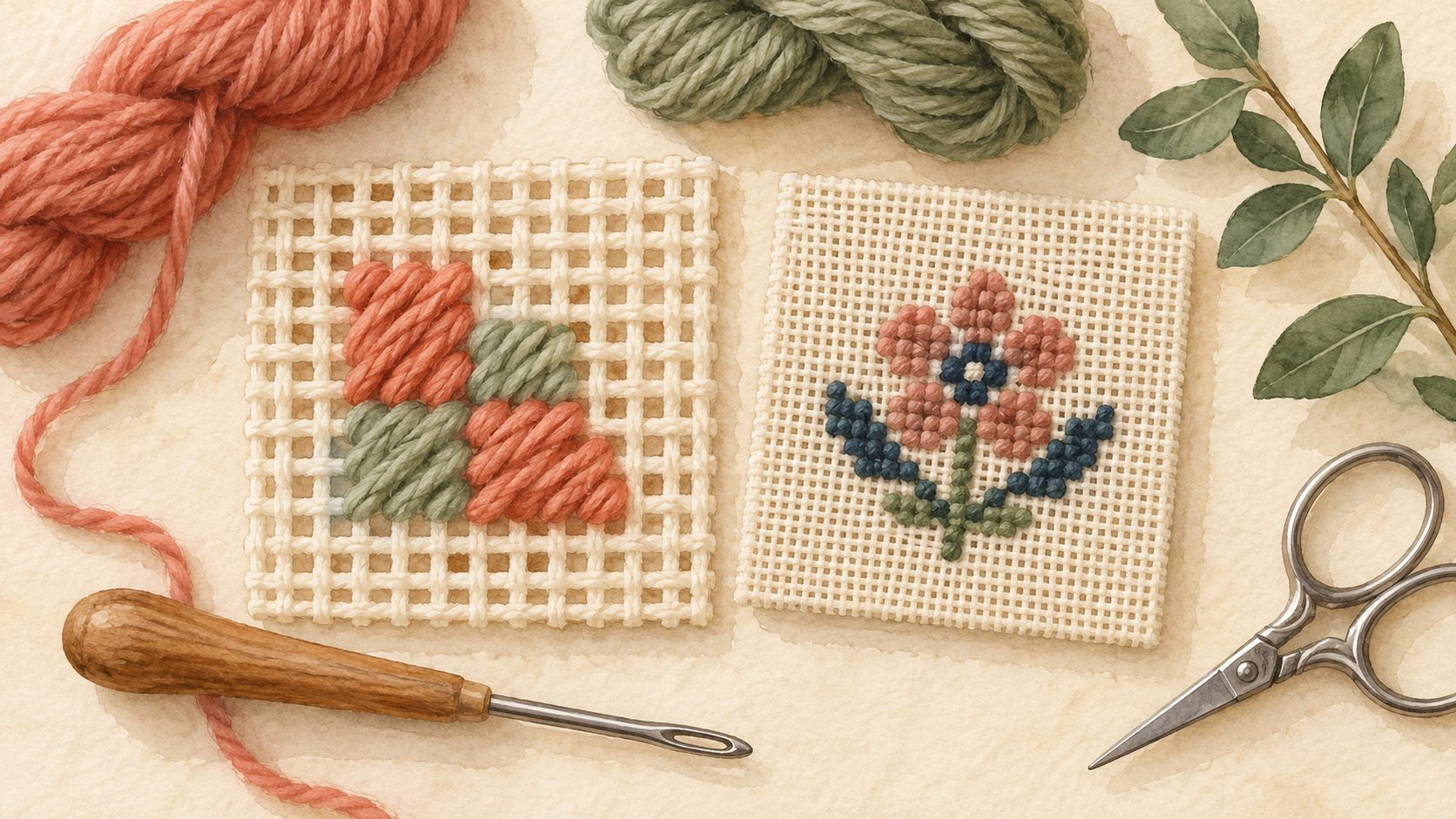
Petit point and gros point are both needlepoint, and the difference is stitch size. Petit point is tiny stitches on fine canvas, gros point is larger stitches on coarser canvas, and the sources do not agree on exactly where one stops and the other starts. This guide lays out what each source says, shows the numbers side by side, and explains what it means when you pick a canvas.
Look at the canvas, not the label. Britannica ties the terms to holes per inch: gros point from 7 or 8 up to 16, petit point from 16 to 20 or more, quick point under 7. If a kit says petit point, check the mesh count and the canvas type before you buy, because The Spruce Crafts warns that a beginner can buy a petit point kit while thinking it is a simple needlepoint design. To work out finished size for any mesh, use the needlepoint canvas size calculator.
The three terms
Gros point. Britannica says needlepoint worked on a canvas with 7 or 8 to 16 squares per linear inch is called gros point, and that it is most often worked in two-ply Persian yarn or four-ply tapestry yarn. Needlepoint Online describes 10 count gros point as larger stitches on a coarser canvas, about 10 stitches per inch, and says the thicker yarn makes durable pillows and faster projects.
Petit point. Britannica says petit point is needlepoint on a canvas with 16 to 20 or more holes per linear inch, worked with finer crewel yarns, and that most needlepoint from the 16th to the 18th century was petit point at 20 to 45 squares per linear inch. The Spruce Crafts, written by needlecraft author Cheryl Fall, says petit point is always tiny stitches worked on individual threads of Penelope canvas or on fine mesh canvas of 22 or more threads to the inch, such as Congress Cloth or silk gauze, and that it lets you create more detail in part of a design. The same article notes the term has also been used for very fine cross stitch.
Quick point. Britannica says that if the mesh openings are fewer than 7 per inch, the work is known as quick point. None of the other sources here define it, so treat the under 7 line as Britannica only.
Side by side
| Source | Gros point | Petit point |
|---|---|---|
| Britannica | 7 or 8 to 16 holes per inch | 16 to 20 or more holes per inch |
| The Spruce Crafts | Regular needlepoint stitches worked alongside petit point on Penelope | Tiny stitches on Penelope threads or on canvas of 22 or more threads per inch |
| Needlepoint Online | 10 count, about 10 stitches per inch | 20 count |
| Serendipity Needleworks | 10 stitches per linear inch on Penelope | A tent stitch across every intersection, 20 stitches per inch |
| NeedlepointTeacher | Can be combined with petit point and trame on Penelope | Made by splitting Penelope intersections, or worked on silk gauze |
Canvas decides
World of Needlepoint says the number of vertical threads per inch of canvas is called the gauge or fabric count. On single mesh canvas such as mono or interlock, the woven grid is formed by one horizontal and one vertical thread meeting at each point. NeedlepointTeacher says that on mono you cannot split the intersections to create petit point, which is why finer count mono is the route to small stitches. It lists mono in sizes from 10 up to 24 stitches per inch.
Penelope, also called double mesh or duo, is different. NeedlepointTeacher describes it as two threads running in each direction to make one intersection, and says ten-twenty count means ten intersections per linear inch that can be divided into twenty stitches per inch. Serendipity Needleworks says the most common size of Penelope is 10/20. The Spruce Crafts adds that one Penelope intersection can hold four smaller petit point stitches. For more on the canvas types themselves, see our guide to mono, interlock, and Penelope canvas, and the mesh size chart for finished sizes.
Mixing both on one canvas
Serendipity Needleworks says the beauty of Penelope is that you can combine gros point (large hole stitching) and petit point (small hole stitching) on the same piece. NeedlepointTeacher agrees that Penelope can be split apart to create combinations of petit point, trame, and gros point. Serendipity Needleworks also says almost all, if not all, of the pre-worked needlepoint designs sold today are on Penelope.
The Spruce Crafts gives practical advice for a mixed piece. Stretch the canvas tautly in a frame so you can separate the intersections without pulling nearby ones out of shape. Choose tapestry needles sized to fit your canvas, and pick threads with multiple plies. To avoid losing your place, work the petit point areas first and then fill the rest with gros point. Needlepoint Online sells a 10 count gros point with 20 count petit point combination and says it gives depth and texture because the two stitch sizes differ. See our guides to choosing a needlepoint needle and thread by mesh count.
Which to choose
- You want a bold design that stitches fast: Needlepoint Online points to 10 count gros point for speed and durability, and Britannica says gros point usually uses Persian or tapestry yarn.
- You want fine detail such as faces or small lettering: The Spruce Crafts says petit point is the way to add more detail in an area, and Britannica pairs it with finer crewel yarns.
- You want both: Use Penelope, as Serendipity Needleworks and The Spruce Crafts describe, and plan which areas get the small stitches before you start.
If you are starting from a photo or a chart, the needlepoint chart maker sizes the chart to the mesh you pick. Our guide to reading a needlepoint chart covers the symbols.
Where sources disagree
- Where petit point starts: Britannica says 16 to 20 or more holes per inch. The Spruce Crafts says fine mesh canvas of 22 or more threads per inch, or Penelope worked on single threads. Serendipity Needleworks and Needlepoint Online both put it at 20 stitches per inch.
- What gros point means: Britannica defines it by canvas, 7 or 8 to 16 holes per inch. The Spruce Crafts uses it for the regular size stitches worked next to petit point on a mixed Penelope piece. Serendipity Needleworks and Needlepoint Online say about 10 stitches per inch.
- Needlepoint Online and itself: its headings say 20 count petit point, but its conclusion mentions 15 count petit point, which does not match the headings or Britannica.
- Quick point: only Britannica defines it, as fewer than 7 openings per inch.
Questions
Is petit point the same as needlepoint?
No. The Spruce Crafts says the two terms are often used interchangeably but are different. Petit point is the fine stitch end of canvas embroidery, and most needlepoint stitchers choose mono canvas for larger stitches and heavier thread.
What mesh count is petit point?
It depends on the source. Britannica says 16 to 20 or more holes per inch, The Spruce Crafts says 22 or more threads per inch for fine canvases, and Serendipity Needleworks says 20 stitches per inch on 10/20 Penelope.
What is gros point?
Britannica says it is canvas with 7 or 8 to 16 holes per inch. Serendipity Needleworks and Needlepoint Online both give about 10 stitches per inch. The Spruce Crafts says it is also what the regular size stitches are called when mixed with petit point.
Can I do both on one canvas?
Yes, on Penelope, according to Serendipity Needleworks, The Spruce Crafts, and NeedlepointTeacher. Mono intersections cannot be split.
Does a higher mesh number mean bigger stitches?
No. Serendipity Needleworks says mesh size is directly related to the number of stitches per linear inch, so a higher number means smaller stitches. Our mesh size chart shows the finished sizes.
Sources
- Britannica Kids: Needlepoint
- Britannica: Gros point
- The Spruce Crafts: Important Facts About Needlepoint and Petit Point
- Needlepoint Online: Pros and Cons of 10 ct Gros Point, 20 ct Petit Point and the Combination
- Serendipity Needleworks: Needlepoint Canvas, A Closer Look
- NeedlepointTeacher: Choosing the Right Canvas
- World of Needlepoint: Guide to Needlepoint Canvas