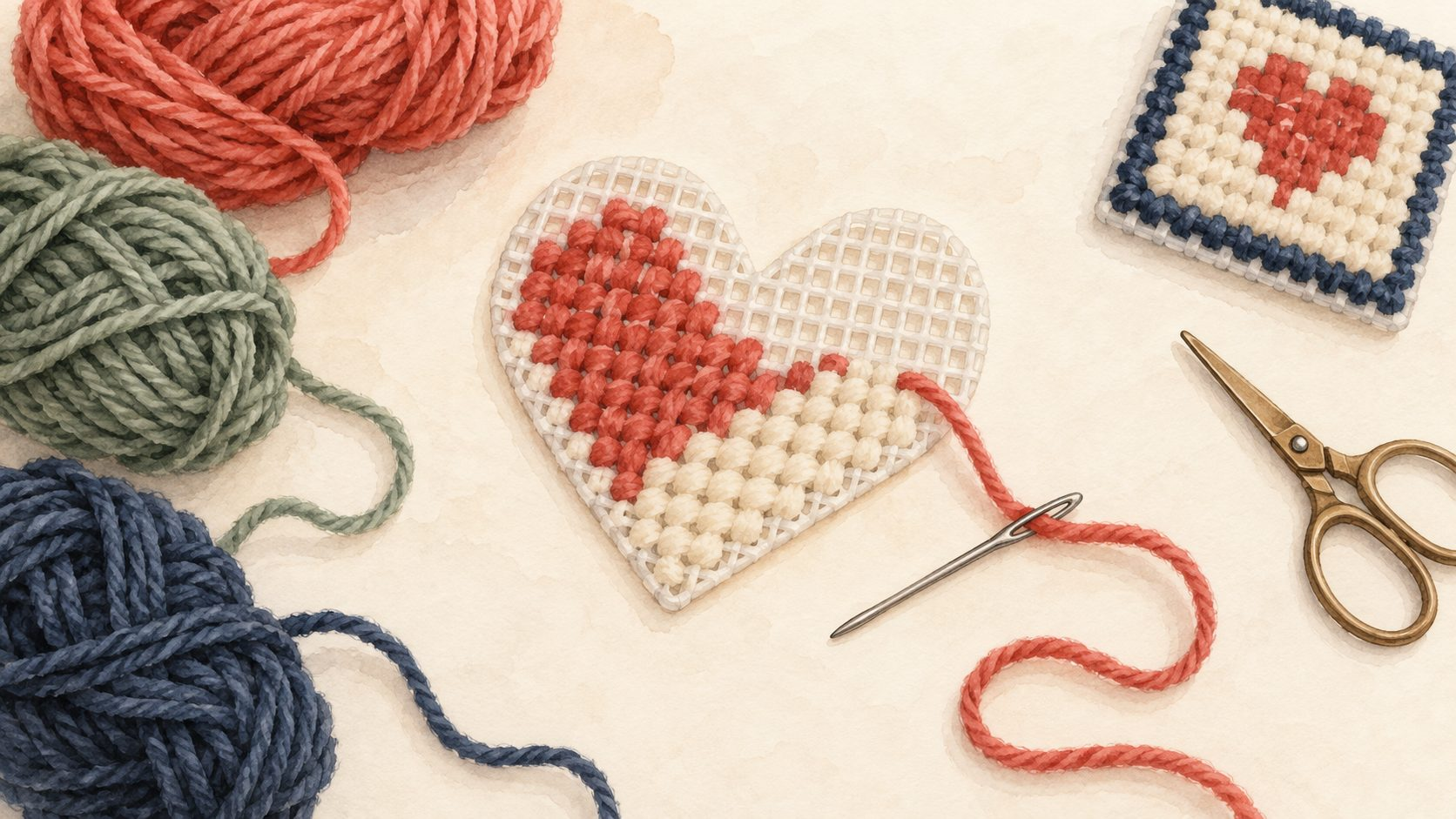
Plastic canvas looks like a cousin of regular needlepoint canvas, and in many ways it is. It is a stiff grid of holes you stitch yarn through. But it behaves differently from fabric canvas, which changes the counts, needles, stitches, and projects that suit it. This guide pulls together what craft and needlework sources say, and notes where they do not agree.
For a first project, the sources lean toward 7-count clear plastic canvas, worsted-weight yarn, and a blunt tapestry needle. Do not pull stitches tight, and finish raw edges with an overcast stitch. If you want to stitch a design that is painted or printed on fabric, that is a different material, so see our guide to needlepoint canvas types.
What plastic canvas is
Needlepointers describes plastic canvas as lightweight plastic with regularly spaced holes that mimics other embroidery cloth, also called vinyl weave. It says acrylic or wool knitting yarn is most often used with a large needle, and that its rigidity makes three-dimensional projects such as tissue box covers, ornaments, and totes possible. It also notes that sheets can be cut to any size or shape, that precut shapes like numbers, letters, circles, and triangles are sold, and that it is a good place to start if you are teaching a child, since there is no hoop and no fabric to maneuver.
Herrschners says plastic canvas suits both two-dimensional pieces like wall hangings and coasters and three-dimensional pieces such as tissue box covers and napkin rings, and that cotton embroidery floss can be used for backstitching and accent details. Mary Maxim says that unlike traditional fabric canvas, plastic canvas will not fray, stretch, or lose its shape, and that it is forgiving because you can remove stitches without damaging the canvas underneath.
Counts and what goes with them
Count works the same way as on fabric canvas: it is the number of holes per inch, so a smaller count means bigger holes. WhyIEnjoy and Wikibooks both list 5, 7, 10, and 14 as the sizes you will meet, while Herrschners names 7, 10, and 14 as the most common. The table below combines what the sources say about each.
| Count | What sources say | Source |
|---|---|---|
| 7 | Largest holes of the common counts, pairs with worsted or bulky yarn, beginner friendly. Size 16 tapestry needle suggested | Mary Maxim, 8bit Craft |
| 10 | Medium holes, still works with worsted yarn, more detail than 7. Some pieces use finer yarn, pearl cotton, or floss | Mary Maxim, 8bit Craft |
| 14 | Smallest holes, sport weight yarn or embroidery floss, small ornaments and detailed work | Mary Maxim, 8bit Craft |
8bit Craft says 7-count is the most common beginner choice for yarn projects, and that 10-count and 14-count make smaller versions of a design but need finer materials such as lighter yarn, pearl cotton, or floss with a smaller tapestry needle. Mary Maxim says many crafters settle on 10-count once they try it. For the same idea on fabric canvas, see our guide to choosing thread by mesh count and the comparison of 13 mesh and 18 mesh.
Plastic canvas vs fabric needlepoint canvas
| Question | Plastic canvas | Fabric canvas |
|---|---|---|
| Edges | Do not fray, so you can cut before stitching (Notorious Needle, Mary Maxim) | Edges can fray, so they are usually taped or bound (see preparing canvas) |
| Shape | Holds its shape, no distortion, supports 3D pieces (Needlepointers, Notorious Needle) | Can distort, so finished pieces are often blocked (how to block needlepoint) |
| Frame or hoop | Cannot be put in a hoop, you stitch in hand (Notorious Needle) | Often stitched on a frame or hoop |
| Joining pieces | Overcast or whipstitch two pieces together (Wikibooks), or use a canvas bridge for larger designs (8bit Craft) | WhyIEnjoy says interlock canvas can be joined by overlapping edges about a half inch and basting or stitching through both layers |
| Fixing mistakes | Stitches come out without damaging the canvas (Mary Maxim) | See fixing mistakes |
Notorious Needle also separates two kinds of plastic. It says mesh plastic canvas, molded with square holes, is the kind made for needlepoint, while perforated plastic has round holes and is the kind for cross stitch, since square holes can leave small gaps between the X shapes. That page is written for cross stitchers, so its needle and thread advice, such as a size 24 needle with 4 floss threads on 14 count perforated plastic, is aimed at floss on perforated plastic and not at yarn on mesh canvas.
Stitches and finishing
Different sources pick different default stitches. Herrschners says to make a half cross-stitch for each symbol on the chart, worked in rows or columns, with specialty stitches such as backstitch, straight stitch, running stitch, and French knots added after the main design. Wikibooks teaches continental stitch, slanted gobelin, and gobelin, plus overcast or whipstitch for the unstitched edge and for joining pieces, and suggests at least three stitches at corners. 8bit Craft teaches Scotch stitch for filling color blocks and says to finish exposed edges with overcast stitch. If you want to understand the first two on fabric canvas, see continental vs half cross stitch and needlepoint stitches for beginners.
For starting and ending yarn, Herrschners and Wikibooks both say to run the needle under 4 or 5 stitches on the back and clip, with no knots, and Herrschners says the tension of the stitches holds the yarn in place. 8bit Craft suggests optional masking tape on rough canvas edges. For care, Needlepointers and Wikibooks both say to soak a dirty piece in warm, not hot, water with a little dish soap, rinse, and air dry. Wikibooks adds not to use a washing machine or dryer.
Mistakes to avoid
8bit Craft lists these beginner problems: starting with the bridge before learning the basic stitch, leaving gaps between neighboring Scotch stitches, pulling yarn so tight the canvas bends, using thick yarn on higher-count canvas with small holes, and forgetting to finish exposed edges with overcast stitch. Needlepointers and Wikibooks both say not to use colored canvas unless the pattern calls for it, because the plastic can show through. Needlepointers adds that if you design your own piece, colored plastic is fine.
Where sources disagree
- Which yarn: Needlepointers says acrylic or wool knitting yarn, Mary Maxim says worsted acrylic is the beginner favorite, and 8bit Craft says worsted-weight or plastic canvas yarn. Wikibooks goes further and says it never uses the small skeins sold just for plastic canvas, calling them expensive and not necessary.
- Which count to start on: 8bit Craft, Wikibooks, and Mary Maxim all point beginners at 7-count, but Mary Maxim says many crafters end up preferring 10-count.
- Which main stitch: Herrschners uses half cross-stitch, Wikibooks uses continental, and 8bit Craft uses Scotch stitch, so check what your pattern says.
- Hiding thread ends: Herrschners and Wikibooks say to run ends under stitches on the back. Notorious Needle, writing about floss on perforated plastic, says burying thread under the front stitches can raise them and show, and that pin stitch is not possible on plastic.
- Cross stitch on plastic: Notorious Needle says mesh canvas is not ideal for cross stitch, while WhyIEnjoy says cross stitch charts can be adapted for plastic canvas.
Questions
Is plastic canvas the same as needlepoint canvas?
Needlepointers describes plastic canvas as being most often used in needlepoint or other embroidery, and Wikibooks calls it a variation of regular needlepoint. The material, though, is a stiff molded grid rather than woven fabric.
Do I need a hoop?
Notorious Needle says plastic canvas cannot go in a hoop or frame and is stitched in hand.
Can I cut it before I stitch?
Notorious Needle and Mary Maxim both say it does not fray, and Notorious Needle says you can cut it before stitching. Needlepointers says sheets are cut to any size or shape the pattern calls for.
What needle should I use?
8bit Craft says a blunt tapestry needle that fits your count and yarn. Mary Maxim suggests size 16 for 7-count with worsted yarn.
Is it good for kids?
Needlepointers says it is a great place to begin when teaching a child.
Where do I start next?
See needlepoint supplies for beginners if you want to move on to fabric canvas.
Sources
- 8bit Craft: Plastic Canvas Guide
- Needlepointers: Learn to Craft with Plastic Canvas
- Herrschners: Plastic Canvas 101
- Wikibooks: Plastic Canvas Stitching Guide
- Mary Maxim: Getting Started with Plastic Canvas
- Notorious Needle: Guide to Cross Stitch on Plastic Canvas
- WhyIEnjoy: How To Needlepoint On Plastic Canvas