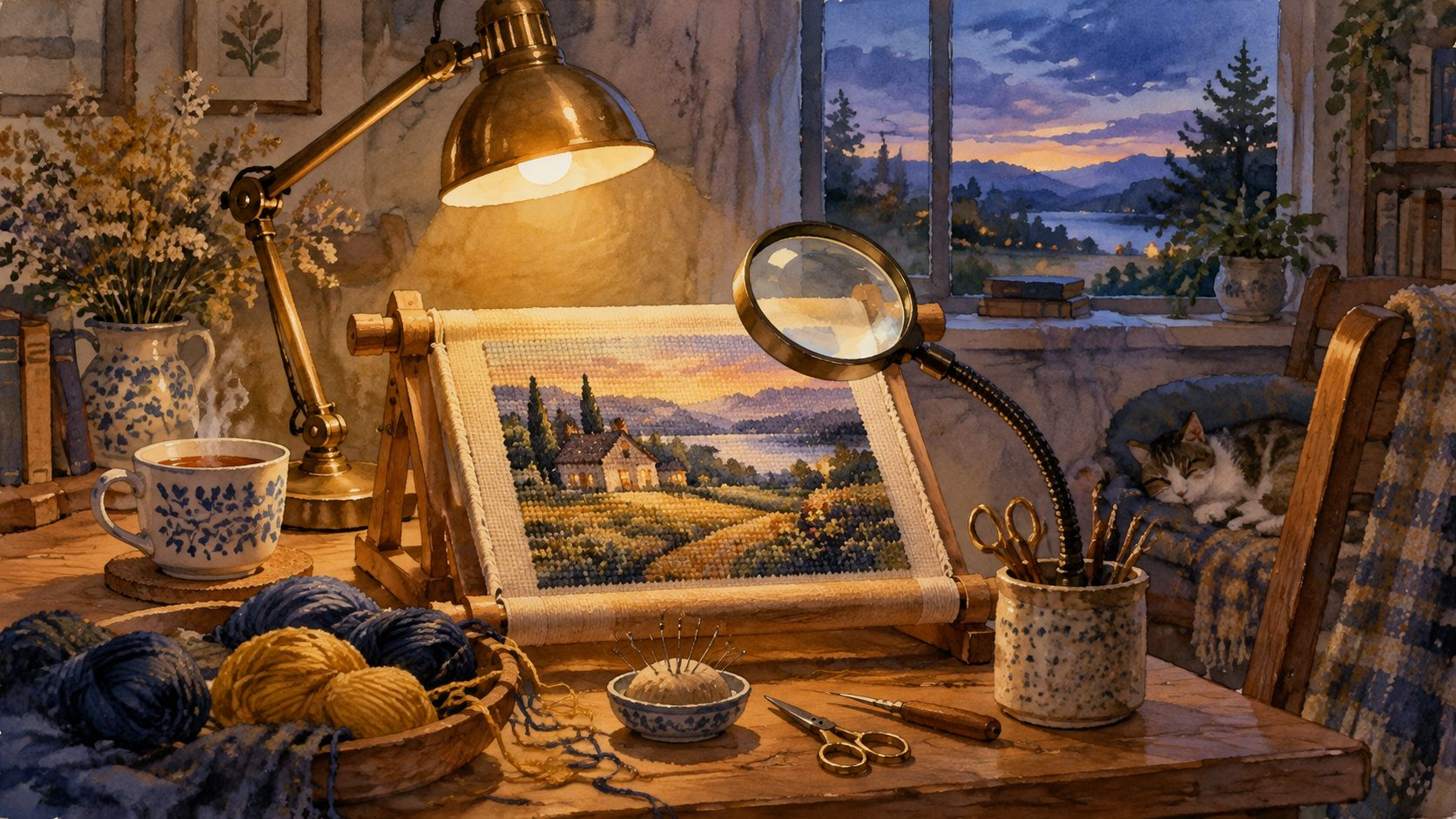
If you cannot see the holes in your canvas, fix the light before you buy a magnifier. Stitchers and needlework shops agree on that order: daylight or a strong lamp first, then magnification if you still need it, and regular breaks either way. They differ on lamp type, how bright is bright enough, and whether a separate magnifier is worth it.
Flossfield says that if you struggle to see the holes, better light is the first thing to try, before a magnifier. It says daylight is best and otherwise to use a lamp close to the work, falling on it from above. Needle in a Haystack puts the share even higher: its author says lighting is about 80 percent of the problem when stitchers cannot see their work well. If you get aching eyes or headaches after close work, the Cross Stitch Guild says to have your eyes tested.
Light comes first
Needle in a Haystack, a needlework retailer's newsletter, says one thing that fades with age is the contrast between light and dark, and that contrast is what helps you see the holes in the fabric. Brighter light helps make up for the loss. The author says she stitches very fine linen without extra magnification mostly because she stitches in very strong light. Dr Christine Hamilton, writing for the Cross Stitch Guild, says the first step is good light: daylight by a window is probably best, and otherwise use a proper lamp close to the work. Needlework Tips and Techniques agrees that natural light is ideal and suggests a table beside a sunny window when you can, and says an ordinary desk lamp can be harsh and may not give a good color balance for matching threads.
Where to put the lamp
Nuts About Needlepoint says that at a table or desk the lamp typically goes in front of you, placed so your hands do not break the pool of light, because shadows make seeing harder even with a lamp. For a floor lamp with an incandescent bulb, it says to put it on the side opposite your dominant stitching hand. The author is right-handed, so hers sits on her left. It says the lamp should be about 12 inches above the work for most lamps, and up to 18 inches for brighter lamps or a 200 watt incandescent bulb. Flossfield, writing about cross stitch, says light should fall on the work from above, and that a small clip-on light can travel with the work on the hoop, the frame or the table.
Poppy Monk Needlepoint recommends having at least two lights: one for home and a portable one for travel. Its picks include a clip-on daylight lamp with three brightness levels that charges by USB. See also our guide to taking needlepoint on a plane for travel kits.
Lamp types and what the specs mean
| Type | What sources say |
|---|---|
| Incandescent or halogen | Needle in a Haystack says the best needlework lamp used to be a dimmable halogen, and that its author still uses a 50/200/250 watt bulb on the 200 or 250 setting when stitching |
| LED task lamps | Needle in a Haystack says LED technology now matches or beats incandescent in power and color. Nuts About Needlepoint says LEDs fade over 35,000 to 50,000 hours rather than blowing out |
| Daylight lamps | The Cross Stitch Guild says daylight lamps are good but can run hot when used close and have a slight blue cast that can distort some colors, though still better than an ordinary bulb for telling colors apart |
| Fluorescent | Nuts About Needlepoint says many fluorescent lamps are being phased out because of the gases in the bulbs and the lower cost of LEDs. Needlery says colors can look distorted under fluorescent light |
Specs are hard to compare. Nuts About Needlepoint says it is rare to find technical specs for LED lamps. It reports the Stella lamp as 127 to 1,410 lumens depending on setting and a lux rating of 900 and 930 for two Daylight models, and says it could not convert between lux and lumens. Needlery says to look for lumens, which measure illumination, not watts, and describes the Color Rendering Index, a 0 to 100 scale where natural daylight and incandescent light both score 100, noting that high CRI makes objects look truer to life. Nuts About Needlepoint's advice is to try a lamp before you buy it.
Magnification
Needle in a Haystack says most craft magnifiers are made of polycarbonate, not glass, and that most range from 1.75x to 3x. It warns that focal length shortens as power rises, so you hold the work closer, and not to choose too strong a clip-on. It also says its author does not use a separate magnifier because they made her queasy over long sessions, and that she uses reading glasses tuned with her eye doctor instead.
Three sources give the same diopter conversion: Needle in a Haystack, Flossfield and MagneticHoop all say to divide the diopters by 4 and add 1 to get the power. A 4 diopter lens is 2x, and 5 diopters is 2.25x. Flossfield lists the kinds from simplest: magnifying glasses worn like reading glasses, a small lens that clips on your own glasses, a lens that hangs round the neck, and a lens on a stand or bendy arm, often with a lamp built in. The Cross Stitch Guild notes that switching your eyes between a magnifier and the chart takes some adjusting.
Resting your eyes
Flossfield suggests short breaks often, a few minutes every hour, and the 20-20-20 rule used for screen work: every 20 minutes, look at something about 20 feet away for 20 seconds. The Cross Stitch Guild also covers distance: hold the work at arm's length and bring it in until it looks clear, and stay between that point and the point where it blurs again. Both say to have your eyes tested if you often get aching eyes or headaches.
Make the canvas easier to see
The Cross Stitch Guild says canvas is easier to work on than blockweave because the stiff threads guide the needle. KC Needlepoint, in its travel advice, likes 13 count canvas because the bigger holes are easier to see in poor light. Our 13 mesh vs 18 mesh guide and mesh size chart compare counts, and our guide to finding a canvas mesh count helps if the label is gone. Good light also helps with even tension: Elizabeth Bradley says that straining to see makes you more likely to tug too hard.
Where sources disagree
- Lamp type: Needle in a Haystack favors strong LED or incandescent light. The Cross Stitch Guild likes daylight lamps but notes heat and a blue cast. Needlery warns about color distortion under fluorescent light.
- How bright: Needle in a Haystack uses very strong light, up to a 200 or 250 watt bulb. Nuts About Needlepoint says lamp distance runs 12 to 18 inches depending on brightness. None of the sources gives one right number.
- Separate magnifier: Flossfield and the Cross Stitch Guild list magnifiers as an option. Needle in a Haystack says its author avoids them and prefers glasses tuned by an eye doctor.
- Cross stitch versus needlepoint: Flossfield's comfort guide, the Cross Stitch Guild and Needlework Tips and Techniques are written for cross stitch or embroidery. The light and eye advice carries over, but the cloth is different.
Questions
What is the best light for needlepoint?
Daylight when you can get it. Otherwise a strong lamp close to the work, per Flossfield and the Cross Stitch Guild.
Where should the lamp go?
Nuts About Needlepoint says in front of you at a desk, or on the side opposite your stitching hand, about 12 to 18 inches above the work.
Do I need a magnifier?
Flossfield says try better light first. Needle in a Haystack says most craft magnifiers are 1.75x to 3x.
How do I convert diopters to power?
Divide by 4 and add 1, according to three sources above.
Which canvas is easiest to see?
KC Needlepoint likes 13 count for poor light. Higher counts have smaller holes.
Sources
- Needle in a Haystack: The Importance of Good Lighting
- Needle in a Haystack: Magnification
- Nuts About Needlepoint: The Importance of Good Lighting, Part 2
- Nuts About Needlepoint: The Importance of Good Lighting, Part 3
- Poppy Monk Needlepoint: Best Lamps and Lights for Needlepoint and Cross Stitching
- MagneticHoop: Ultimate Guide to Needlepoint Magnifiers
- Floss Field: Cross stitch light and magnifier, hands, neck and eyes
- Needlework Tips and Techniques: Magnification for Embroidery
- Cross Stitch Guild: Care of Your Eyesight by Dr Christine Hamilton
- Needlery: Lights
- KC Needlepoint: travel like a pro with your stitching
- Elizabeth Bradley: Tips on Tension