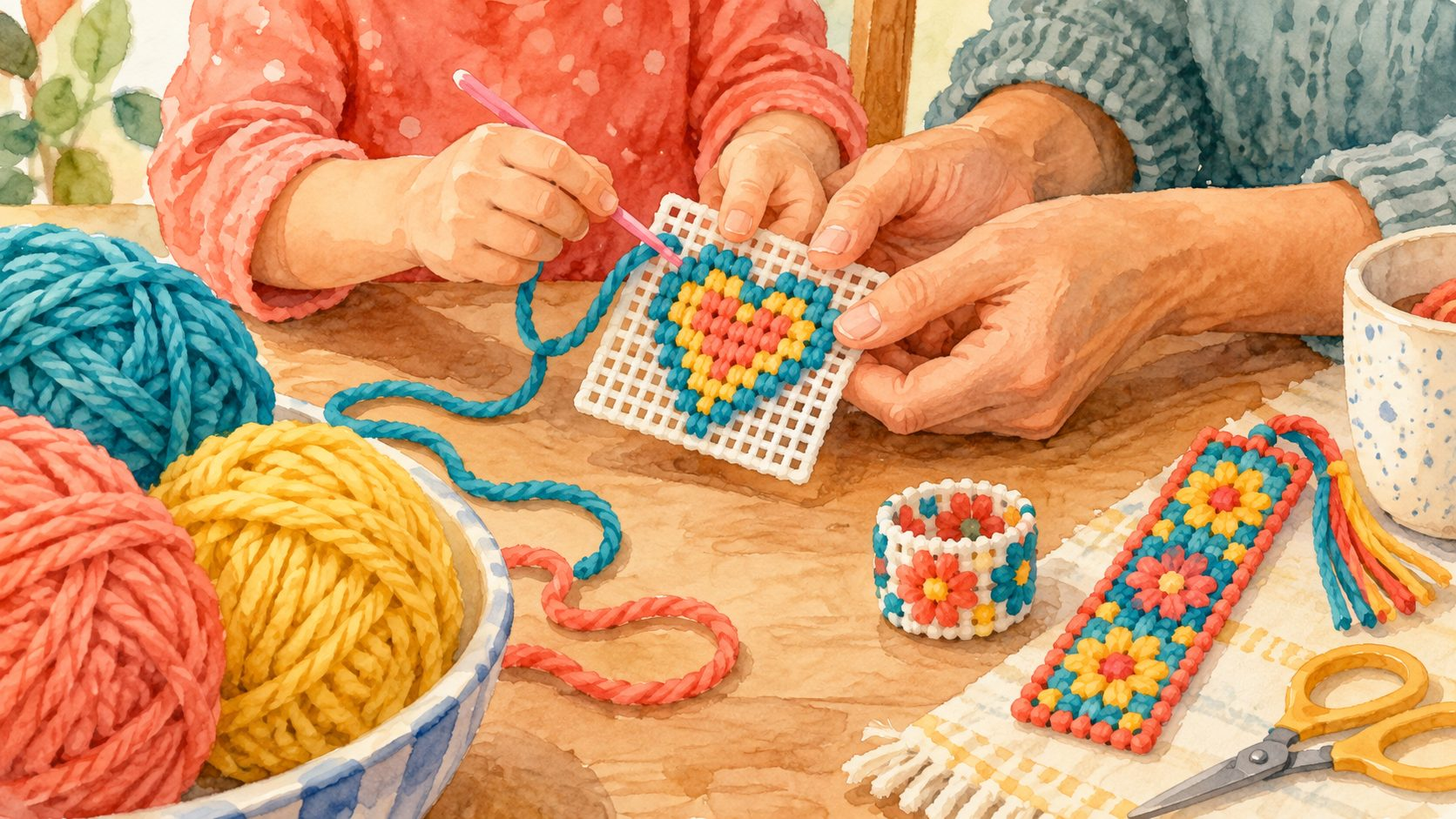
Kids can learn needlepoint earlier than most adults expect, as long as the materials are big and the first project is small. The sources we read agree on that much and differ on almost everything else: the right age, canvas, thread and even the first stitch. This guide sets out what each source says, where they split, and a sensible first lesson.
Floss Field's short version: start a child on plastic canvas with 7 holes to the inch, a blunt size 16 tapestry needle and worsted weight knitting yarn. Make the first piece small enough to finish in one sitting. Do the cutting and, at first, the threading yourself, show the stitch on a scrap, then sit alongside while the child works. Most of the other sources say the same in different words.
What age to start
Nobody gives one number. Floss Field says there is no set age and to go by the child's hands and patience. It sorts the ages that its own sources give into stages: before canvas, threading beads and lacing cards; about 3 to 5, going in and out of holes of plastic canvas, which is not yet a needlepoint stitch; about 5 to 7, the first tent stitches with an adult alongside; and about 7 and up, tent stitch with less help.
Rooted Childhood, writing about a plastic canvas rainbow craft, says to try it with kids 3 and up, that most 4 year olds can finish with some help, and that most 5 year olds can do it mostly alone. Teach Kids How says readiness depends on small motor skill and on the child's wish to learn, and that a child who has watched someone stitch already has an idea of the technique. It places "young school age" children in grades K to 6 and says children under 8 will probably need a kit designed for younger children.
A practical reading: before 5, treat it as threading and lacing play. From about 5 to 7, expect to be sitting beside them. From 8, many children can stitch with a kit and less help. That summary is ours.
Canvas, needle and yarn
Canvas
Floss Field starts children on 7 mesh plastic canvas. It is stiff, so it needs no frame; it does not fray; the needle passes easily through the open grid; and a wrong stitch can be taken out without harming it. Rooted Childhood also recommends 7 point (7 openings per inch) plastic canvas for children and says to use smaller pieces for younger children. Our plastic canvas guide covers sizes and joining.
Needlepoint.com takes a different route: a kids kit on a 7 or 10 mesh canvas, hand painted, with yarn, a needle, a threader and instructions, and large areas of a single color. Floss Field notes that kits for children are sometimes on 7 or 10 mesh woven canvas. Woven canvas is harder for an adult to prepare: Floss Field says its cut edges unravel and need to be bound with masking tape, and the canvas bends, which is why a frame helps. See our canvas prep guide and mesh count guide.
Needle
All the sources want a blunt tip and a large eye. Floss Field specifies a size 16 tapestry needle for 7 mesh plastic canvas. Tapestry needle sizes run backward, so a smaller number is a bigger needle (Floss Field). Rooted Childhood suggests a plastic canvas needle, with an extra large eye and a blunt tip, and says a tapestry needle also works. Teach Kids How says younger children will need a blunt plastic needle. Our needle guide has the size chart.
Threading is the first hurdle. Needlepoint.com suggests a needle threader from the kit, or folding the yarn in half and pushing the fold through the eye. Spiegato also recommends needle threaders because hand threading can be frustrating for younger kids.
Yarn
Floss Field recommends worsted weight knitting yarn on 7 mesh plastic canvas. Teach Kids How says younger children need yarn or thread of medium weight, and that yarn is easier to learn with though many children handle thread. Use short lengths: Teach Kids How cuts about 18 inches, and Floss Field's cross stitch guide gives the same length, since longer thread tangles.
A first project
Floss Field wants something the child can use or give away, finished in one sitting: a finger ring, with a bracelet, bookmark or coaster as the next step. Its rules for a first design are few colors (one to five, in large areas), nothing to read, and small size. It also warns that too much choice can stall a child, so lay out a few colors to pick from. Teach Kids How agrees that the child should choose the colors, and suggests a simple design that uses one type of stitch.
Spiegato points to everyday items such as bookmarks and coasters, and gifts for a birthday or holiday. Needlepointers.com lists coasters, bookmarks and ornaments among typical plastic canvas projects and calls the material forgiving for beginners. If the child wants a keepsake, our keychain finishing guide is a good next step.
A sizing example from Floss Field: a square of 10 stitches each way is cut 12 bars each way, because the piece needs one bar outside its stitches on every side. At 7 holes to the inch that is about 1 3/4 inches across and 100 stitches. A square of 20 stitches is cut 22 bars each way, a little over 3 inches across, and takes 400 stitches. Floss Field says a 72 stitch square chart, at 5,184 stitches, is a long project for an older child or a teenager.
How to teach the stitch
Floss Field teaches tent stitch worked in rows as continental stitch: bring the needle up, go down one row up and one hole to the right, come up to the left of where the first stitch began, and repeat. Needlepoint.com says kids can learn tent stitch using either continental or basketweave, especially on larger mesh. Teach Kids How lists basketweave, continental and half-cross as the basic stitches to practice first. Unwind Studio's kids videos teach tent stitch and long stitch. See our continental vs half cross comparison and basketweave guide if you need a refresher yourself.
A lesson plan that combines the sources:
- Set up first: cut the canvas, cut the yarn into lengths, thread the needles (Floss Field).
- Show one stitch slowly on a scrap of the same canvas (Floss Field).
- Let the child try it on the scrap with your help until the movement comes easily (Floss Field).
- Start the yarn on the real piece yourself. On plastic canvas, leave a tail an inch or two long on the back and stitch over it. On woven canvas, use a waste knot (Floss Field, Needlepoint.com). Our start and end guide has the steps.
- Sit alongside with your own stitching. Floss Field warns that a child who is corrected at every stitch can stop enjoying it.
- Stop when interest goes. Teach Kids How says to keep sessions short because frustration comes early and often.
Spiegato says teachers should not worry too much about perfect stitches: the key is to get children going with a needle and thread first. Floss Field lists three common slips. The child carries yarn over the edge, the yarn twists, or the stitches are pulled unevenly. It says to expect all three, and that trying matters more than a perfect piece. For a left-handed child, Floss Field says the stitch has the same slant but begins at the lower left, working the first row left to right. See also our left-handed guide.
What the adult does
Every source gives the adult the setup work. Floss Field has the adult do the cutting, the first threading, and the start of each length. It suggests that the adult end each length until the child can run the needle under the stitches while watched, explaining why each time. On woven canvas, the adult binds the edges and, for larger pieces, mounts the canvas on a frame. Teach Kids How says small projects will not need a frame but larger ones will. See our stretcher bar guide.
Spiegato says adult supervision is imperative with a sharp needle. Floss Field notes that a tapestry needle is blunt and that a metal one does not bend in a child's hand. Needlepoint.com says its kids kit needles have a bigger eye to suit the yarn. Store work in progress safely: Teach Kids How suggests a ziplock bag for small pieces and a pillow case for larger ones.
Where sources disagree
First canvas: plastic or woven? Floss Field and Rooted Childhood start with 7 mesh plastic canvas. Needlepoint.com sells kids kits on 7 and 10 mesh painted canvas. Teach Kids How says to start with a kit on plastic or coarse canvas. Plastic canvas is simpler for the adult to prepare, which is the reason Floss Field gives for starting there. A painted kit gives the child a design with nothing to count, which suits Floss Field's rule of nothing to read. Either works; the deciding factor is how much setup you want to do.
When can they stitch for real? Rooted Childhood says 3 and up for a plastic canvas craft. Floss Field says 3 to 5 is only in and out of holes, and the first tent stitches come at about 5 to 7. Teach Kids How says children under 8 will probably need a kit for younger children. The sources are describing different tasks, so the ages do not conflict as much as they appear to.
Yarn or thread? Floss Field and Rooted Childhood use yarn. Teach Kids How says yarn is easier to learn with but many children can work with thread, and that older children can move to finer thread as they progress.
Which stitch first? Floss Field and Needlepoint.com teach tent stitch, with Needlepoint.com naming continental or basketweave. Teach Kids How adds half cross. Unwind Studio's videos pair tent stitch with long stitch. Floss Field chooses continental because it is worked in rows and rows are the way to teach it.
Needle type. Floss Field says a metal tapestry needle does not bend and plastic needles also work. Teach Kids How says younger children need plastic. Rooted Childhood says a plastic canvas needle is best but a tapestry needle will do.
Questions
What is the best age to start needlepoint?
There is no fixed age (Floss Field). Many 3 to 5 year olds can sew in and out of plastic canvas holes with help (Floss Field, Rooted Childhood). The first real tent stitches come at about 5 to 7 with an adult nearby (Floss Field).
What should a child's first needlepoint project be?
Something small that finishes in one sitting, in one to five colors (Floss Field). A ring, bookmark or coaster fits that. A kit with a painted canvas works if you want no counting (Needlepoint.com).
Is plastic canvas better than regular canvas for kids?
For the first piece, Floss Field says yes: it is stiff, it does not fray and mistakes are easy to remove. Our kits guide covers what to check in a kit if you prefer woven canvas.
Do kids need a frame?
Not for plastic canvas or small pieces (Floss Field, Teach Kids How). For larger woven canvas, a frame or stretcher bars keep it flat and steady (Floss Field, Teach Kids How).
How do I stop a child getting frustrated?
Do the setup yourself, keep the first piece small, teach one or two things per sitting, and stop when interest goes (Floss Field, Teach Kids How). Spiegato adds that perfect stitches can wait.
Should a child learn needlepoint or cross stitch first?
Floss Field has a section on this question in its kids guide, and a separate cross stitch guide for children that suggests plastic canvas with yarn as a way to practice before cloth. Both are on our sources list. Our beginner stitch guide covers the stitches you will want to know first.
Sources
- Floss Field, Needlepoint for kids: how to teach a child to stitch
- Needlepoint.com, Needlepoint for Kids: Showing Your Kids How To Needlepoint
- Teach Kids How, Teach Your Child How to Do Needlepoint
- Needlepointers.com, Plastic Canvas Tips and Tricks
- Unwind Studio, Needlepoint for Kids: Basic Stitching
- Rooted Childhood, Plastic Canvas Rainbow
- Spiegato, What are the Best Tips About Needlepoint for Kids?
- Floss Field, How to teach a child to cross stitch