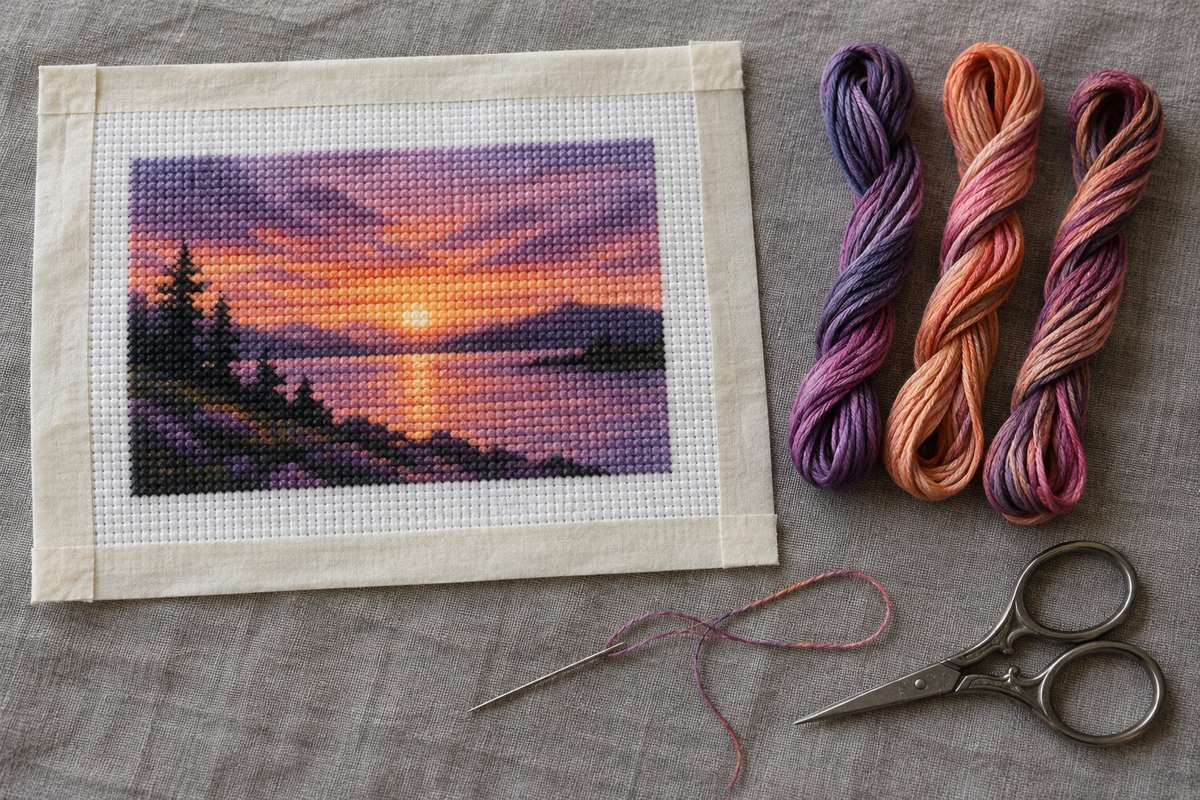
Variegated floss, also sold as overdyed, multicolor or gradient thread, changes color along its length, so a single strand can shade from light to dark or run through several hues. Used well it adds depth to text, borders, silhouettes and small motifs without a thread change. Used carelessly it can look striped or random. This guide covers the main product lines, which patterns suit them, how stitching method and stitch order change the result, and the cost, dye lot and colorfastness cautions. Last updated November 13, 2026.
Start here: Test the thread on scrap fabric first. Stitch each cross completely (the English method) rather than rows of half stitches, plan where you cut the thread so the colors flow, and use the floss on larger blocks, text, borders or silhouettes where the gradient can show. Test for bleeding before you wash or iron.
What variegated thread is
Siri of Sirious Stitches, a stitching blogger, defines variegated as exhibiting different colors, especially as irregular patches or streaks. In floss terms she means thread dyed with more than one plain color, which can range from a lighter and darker shade of one color to a whole rainbow. Overdyed and hand-dyed threads belong to the same family, usually sold by smaller dyers. Kate Anderson of Two Little Kits, a retailer, uses variegated to cover DMC Coloris, Variations and other gradient-style threads.
Variegated floss seems like a special-occasion thread, but Siri says you can use it on any pattern you like. The goal is the overall effect, not each individual stitch.
The main product lines
Siri's overview, which is a few years old and mixes her opinions with facts, names these lines. Check current availability with a shop before you plan a project around any of them.
- DMC. The original variegated range, numbered 48 to 125, which is mostly three or four shades of one color from light to dark. Siri believes it was discontinued but says it can still be found at some shops. The Color Variations line in the 4000s stays in one color family with some hue shift, for example a blue-green to a yellow-green. The Coloris line typically has four quite different colors, for example yellow to pink to brown to green.
- Cosmo Seasons (Lecien). Three styles: the 5000s change color every 8 cm (about 3 inches), the 8000s change more slowly, about every 30 cm (about 12 inches), and the 9000s make quick, short changes of random lengths across a wide range of colors. Siri finds the Cosmo colors more saturated than comparable DMC ones.
- Anchor. Siri lists an ombre line, numbered 1201 to 1220, and a multicolor line, numbered 1300 to 1390, and says they have apparently been discontinued after DMC bought Anchor. She notes that packs of Anchor threads made in India are sold online and may differ slightly in dye lot.
- Sulky. The 12 weight Cotton Blendables, which Siri says are about as thick as two strands of DMC and suit 16-count and finer fabric, so you do not have to split strands.
- Hand-dyed brands. She names ThreadWorx, Weeks Dye Works, The Gentle Art, Classic Colorworks and The Caron Collection, plus many independent dyers on Etsy and in local shops.
Which patterns suit it
Two Little Kits says variegated floss generally works best in larger blocks of color where the gradient can show, and that scattered stitches can make the color changes look abrupt or random. It suggests lettering, decorative borders and floral designs.
Siri's list of what works is similar and a little wider:
- Text. Probably the most common use she has seen, especially bold fonts where you can see the color change inside each letter. Swap a colorful thread for plain black.
- Silhouettes. Patterns made of one or two colors that form the shape of a symbol or character work well with subtle or bright variegation.
- Blackwork. Not strictly cross stitch, but she says it can look striking in variegated thread, and that a bright variegated thread stood out on black fabric.
- Borders. Repeating borders suit subtle variegation, since you do not want to pull attention from the focal point.
- Small motifs. An iridescent shell, a patterned dress or a variegated liquid in a potion bottle. You do not have to use it for the whole pattern, only the parts that would benefit from texture.
Our bead guide and metallic floss guide cover other ways to add texture, and the same idea in canvas work is in our needlepoint variegated thread guide.
Stitching method and stitch order
Both sources recommend the English method for variegated floss, meaning you complete each cross before moving to the next. Two Little Kits warns that the Danish method, working a row of half stitches and then crossing back over them, can give a stripey or uneven look. Siri explains why: with the Danish method the top of a stitch is more likely to be a different color from the bottom leg, which may or may not be what you want. Our English vs Danish guide compares the two.
Stitch order is the second control. Siri stitched the same pattern in five ways, with similar lengths of the same thread: diagonally, in horizontal rows, in a spiral and in columns using the English method, and in rows using the Danish method. She reports that they all came out very different, even with the same colors in the thread. On a big silhouette area, the path you take changes the look. She also says you do not have to stitch everything in the same direction: stitching sections at different angles draws the eye to different parts of the pattern.
Two Little Kits adds practical points:
- Plan where you cut. Look at the color changes along the floss. Where you cut decides where a color starts in your stitches, and a new length should match the color where you left off.
- Test first. Stitch a small swatch on scrap fabric to see how the shades blend.
- Blend with a solid. If stitches feel choppy, a solid color that matches part of the variegated thread can smooth the transitions.
- Watch for twisting. Some variegated floss twists more than usual. Let the needle dangle now and then to untwist it.
Our strands guide and thread conditioner guide can help with handling.
Cost, dye lots and colorfastness
Siri raises three cautions.
- Cost. She says variegated floss is likely to cost more, especially hand-dyed. When she wrote, she put mass-produced DMC variegated lines at about $1.54 per skein against $0.99 for standard cotton. Those are dated figures from her post, so check current prices.
- Dye lots. Dye lot variation is a known issue with solid colors and more so with multicolor thread. It is greater for small dyers whose lots are smaller. If you need a lot of thread for a big pattern, order it at once and ask for the same dye lot if possible. Our dye lots guide covers the same issue for canvas work.
- Colorfastness. Major brands are likely colorfast, she says, but independent dyers may not be, and overdyed thread can react differently. Test your thread before washing or ironing, and be careful. She also reports a red DMC variegated thread bled in her own wash. If you rarely wash or iron your finished stitching, the risk is lower. Our guide to washing finished cross stitch covers the washing side.
Siri also notes that when you stitch with variegated thread an exact color match matters less than usual, since the variation is the point. That relaxed view does not apply to dye lots when two areas that should match are stitched months apart.
Where sources disagree
English or any method. Two Little Kits recommends the English method for smoother, more natural color transitions. Siri says most people recommend English to show off the color changes, but frames the Danish method as a choice that gives a different look, not a mistake. If you want the gradient to read as in the skein, use English. If you want a different texture, test the Danish method on a swatch.
Where to use it. Two Little Kits points to larger blocks and says scattered stitches can look random. Siri says you can use variegated thread on any pattern, and also suggests small motifs and subtle variegation. Both agree it works best when the stitched areas are big enough to show the shift.
Precision. Two Little Kits expects "unpredictable" results and tells you to embrace the organic look. Siri shows you can steer the result with stitch order. These are compatible: you cannot control the thread exactly, but you can shape the effect.
FAQ
What does variegated mean for floss? Floss dyed with more than one color, so the color changes along the strand. It covers products sold as overdyed, multicolor, color variations or Coloris.
Should I use the English or Danish method? Both sources recommend the English method for variegated thread, completing each cross as you go.
Will variegated thread bleed? It can. Siri says major brands are likely colorfast but independents may not be, and she had a red DMC variegated thread bleed. Test before washing or ironing.
What patterns work best? Larger blocks of color, text, borders, silhouettes and small motifs, according to Two Little Kits and Siri.
Do I need to split the strands? Handle it as you would any floss. Sulky Cotton Blendables, per Siri, are about two strands thick so you need not split them.
Is it more expensive? Siri says usually yes, especially hand-dyed, though her price figures are dated.
Sources
This guide draws on the following sources. Where their advice differs, it says so above rather than blending them.
- Sirious Stitches, stitching blog by Siri: Variegated Thread - Tips for Cross Stitching with Multicolor Floss, sirithre.com, first posted in 2021 and marked as updated. Source for the product lines, pattern types, stitch order experiment and the cost, dye lot and colorfastness cautions. Product lines and prices may have changed since.
- Two Little Kits, floss and kit retailer: Mastering Variegated Floss: Tips for Stunning Colour Transitions, twolittlekits.com, March 2025. Source for the seven tips on method, cutting, testing, pattern choice, blending and twisting. Two Little Kits sells floss.