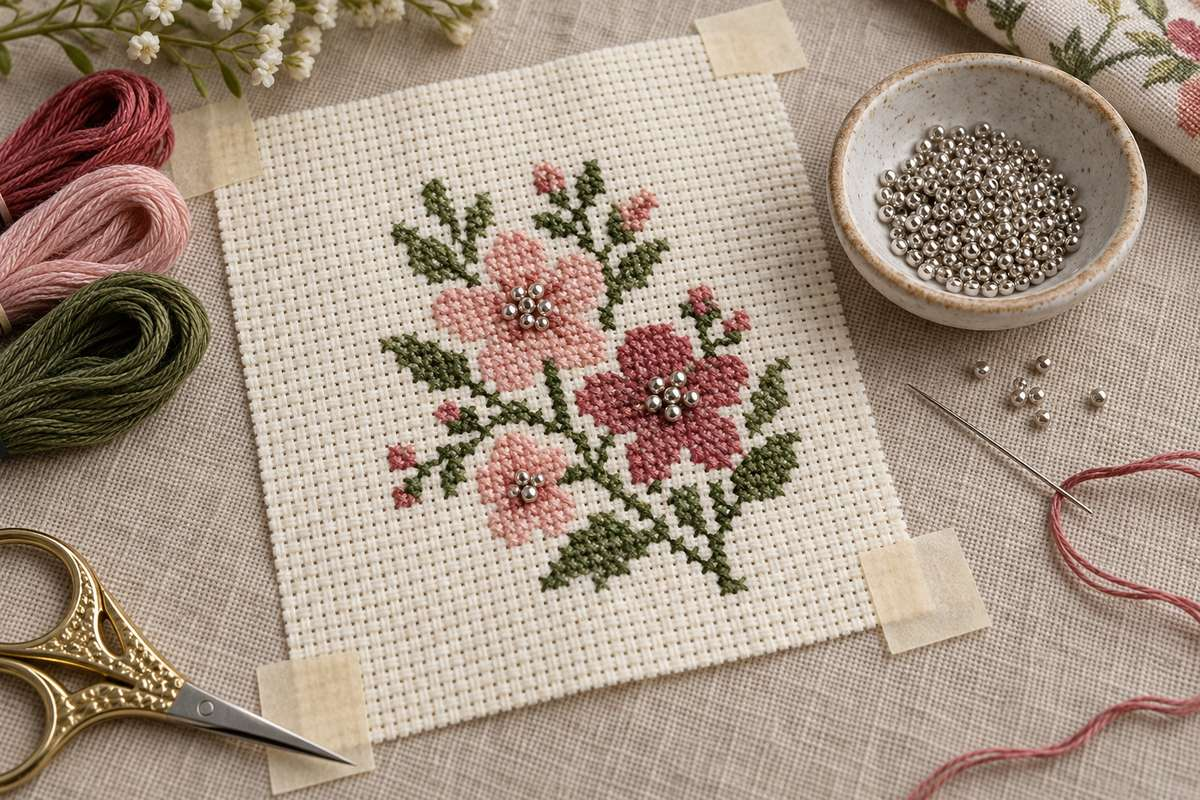
Beads give cross stitch a raised highlight that thread cannot imitate. In most charts, one seed bead replaces one stitch. You attach it with a diagonal half stitch, then add the second leg when you want the bead locked upright. The work is simple, but the needle, thread and bead size have to match. Last updated November 5, 2026.
Start here: Use the bead size named in the chart, usually 11/0 seed beads. Test a size 28 tapestry needle; switch to a beading needle if the bead will not pass over the eye. Add beads after the cross stitch and backstitch, using one or two strands of floss.
Beads, needles and thread
Seed beads are the small round glass beads most cross stitch charts call for. Floss Field explains that the size numbers run backward: 15/0 is smaller than 11/0, and 8/0 is larger. Peacock and Fig identifies 11/0 Mill Hill seed beads as a common chart bead and describes them as about 2.5 mm.
The needle must pass through the bead, including its eye and thread. Little Lion Stitchery says a size 28 tapestry needle works for 11/0 and larger beads, while 15/0 petite beads need a #10 beading needle. Clouds Factory gives the same split: a beading needle is best, but a size 28 tapestry needle may work. Test one bead before threading the whole project.
Ordinary floss is the easiest thread. Floss Field suggests one or two strands matched to the bead, or matched to the fabric when many bead colors appear together. Nylon beading thread is another option, but it is slippery and needs especially secure fastening.
Read the chart first
Peacock and Fig warns that charts place beads in different ways. Some put a full cross stitch under the bead. Some put the bead directly on the fabric. The key or symbol legend tells you which bead to use and where it belongs.
Do not substitute sizes casually. A bead should fill its square without crowding neighboring stitches. Little Lion Stitchery notes that 11/0 beads can look crowded on dense 32-count-over-two work and that stitchers using 36-count or 18-count fabric often move down to 15/0 petite beads. Use the chart designer's bead unless you have stitched a sample.
Sew on one bead
Floss Field and Clouds Factory describe the standard attachment as a half stitch:
- Fasten the thread under existing stitches on the back.
- Bring the needle up at the bottom-left corner of the bead square.
- Slide one bead down to the fabric.
- Go down at the top-right corner.
The bead now lies along the diagonal. Work every bead half stitch in the same direction so the beads tilt alike. Little Lion Stitchery shows that starting bottom left to top right tilts the bead one way; starting bottom right to top left tilts it the other way. Consistency matters more than the direction you choose.
Lock the bead upright
A bead on one half stitch can rock. To lock it, add the second diagonal. With two strands, Floss Field and Clouds Factory say to part the strands so one passes on each side of the bead, then finish the opposite diagonal. With one strand, pass through the bead a second time.
The locked bead sits upright in the center of its square. Little Lion Stitchery calls this the official secure method for 11/0 and larger beads, while also noting that half stitches alone are a valid faster finish. Use the full lock where the piece will be handled, framed close to glass or worn.
Pull each stitch snug, but do not crush the bead into the fabric. If a bead still wobbles, the thread is slack or the second leg was not placed around it cleanly.
When to add beads
Most sources recommend adding beads last, after cross stitch, backstitch and French knots are complete. Floss Field says this keeps beads out of the way of working thread and lets you wash and press the piece first. The Art of Stitch gives the same advice because beads can snag later stitching.
Peacock and Fig also tells stitchers to bead last and to loosen hoop tension around heavy beading. If you prefer to bead as you go, keep the hoop away from finished beads or work in hand.
A bead mat, shallow dish or segmented tray keeps beads from rolling. Little Lion Stitchery and Peacock and Fig both suggest using a stocking over a vacuum nozzle to recover spilled beads.
Washing and pressing
Wash and press before beading when you can. Floss Field says never to put an iron directly on beads; press before they go on or iron around them afterward. Peacock and Fig adds that some bead finishes are sensitive to detergent and some nylon threads are heat sensitive, so test the exact supplies.
Little Lion Stitchery has seen beads bleed and usually washes and blocks before beading. Other stitchers wash afterward. If the beads must be washed, test a few for colorfastness first. Our washing and care guide covers the fabric side.
Where sources disagree
Should the thread match the bead or the fabric?Little Lion Stitchery says matching the bead hides the attachment when only one or two bead colors are used. Matching the fabric is faster when a design uses many bead colors. Floss Field gives the same practical choice. Neither is universally better.
Is one half stitch enough? Floss Field and Clouds Factory recommend the second leg to lock the bead upright. Little Lion Stitchery says the lock is the secure official method but half stitches work when you want a faster finish. Handling and visibility decide.
Should you bead before or after washing? Floss Field favors washing and pressing first. Little Lion Stitchery usually does the same because beads can bleed, while noting that some stitchers wash after. Peacock and Fig says to check the bead manufacturer and test the supplies.
Which needle is correct? Clouds Factory prefers a beading needle. Little Lion Stitchery says a size 28 tapestry needle is enough for 11/0 and larger beads. The bead hole and thread decide the answer; always test the combination.
FAQ
What does 11/0 mean on seed beads? It is a bead size. The numbers run backward: 15/0 is smaller than 11/0, and 8/0 is larger. Many cross stitch charts use 11/0 seed beads.
Can you use a regular cross stitch needle for beads?Sometimes. A size 28 tapestry needle may fit 11/0 beads. Smaller 15/0 beads usually need a fine beading needle.
Does one bead replace a cross stitch? Usually. Floss Field describes a bead as taking the place of one stitch, but the chart controls the placement. Some designs stitch a full cross underneath.
How do you keep beads from tilting? Make every half stitch in the same diagonal direction and add the second leg when you want the bead locked upright.
Should you use beading thread? You can, but ordinary floss is easier and less slippery. Nylon beading thread is nearly invisible, but it needs extra-secure fastening and may be less heat resistant.
Can you iron over beads? No. Press before beading or iron around them afterward. Direct heat can damage bead finishes and synthetic beading thread.
Sources
- Floss Field - How to Add Beads to Cross Stitch (a cross-stitch educational reference; bead sizes, needles, half stitch, locking leg and care)
- Little Lion Stitchery - Adding Seed Beads to Cross Stitch (a cross-stitch teaching site; needle and thread choices, bead directions, fabric-count notes and troubleshooting)
- Clouds Factory - Adding Seed Beads (a cross-stitch pattern designer's PDF; diagonal and straight bead attachment)
- Peacock and Fig - Beading Embroidery and Cross Stitch (a cross-stitch designer and tutorial site, June 2017; chart symbols, bead sizes, thread, handling and washing)
- The Art of Stitch - Beading in Cross Stitch (a needlework shop and teaching site; placement, timing, consistency and practice advice)