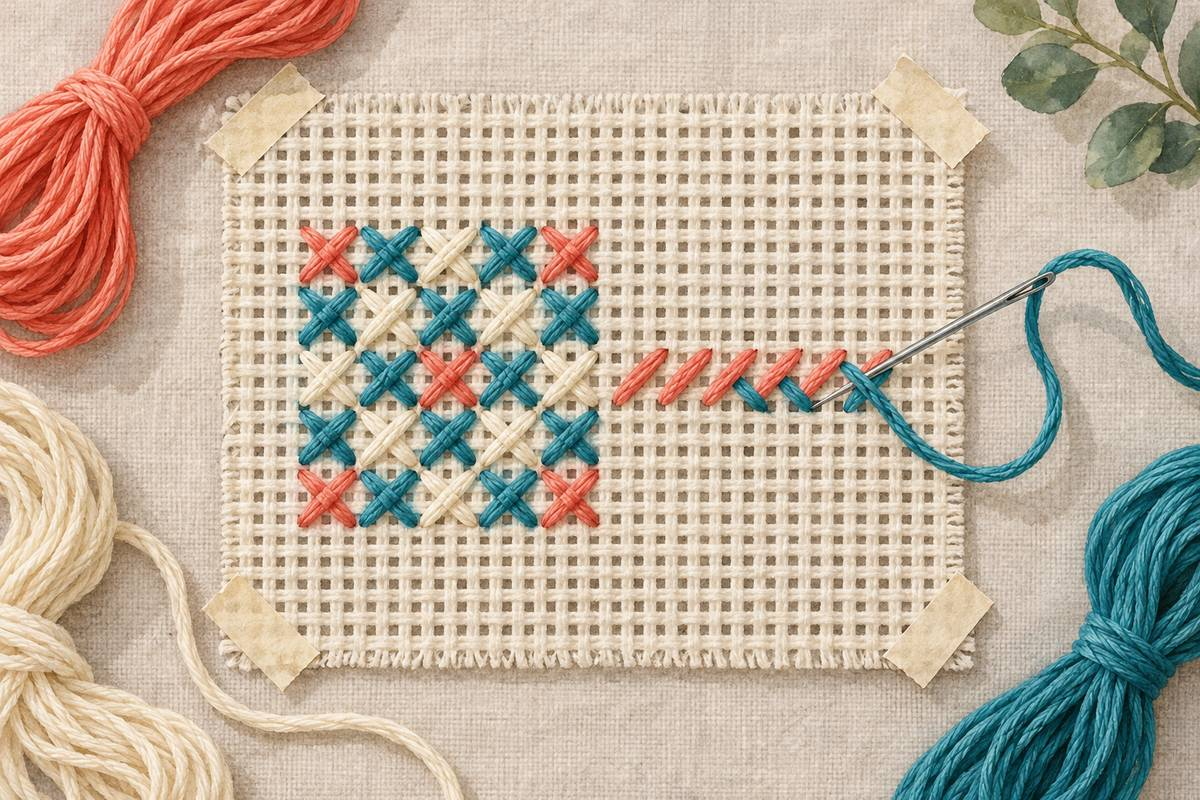
English and Danish cross stitch produce the same X on the front, but they get there in different orders. English completes one whole cross before starting the next. Danish works a row of half crosses in one direction, then returns to cross them. Neither is the correct method for every situation. The better choice depends on whether you are stitching confetti or a solid block, moving horizontally or vertically, and how you want variegated thread to behave. Last updated November 4, 2026.
Start here: Use English for isolated stitches, confetti, vertical single columns, parking and variegated thread when you want each cross to hold one clear color. Use Danish for horizontal rows and big blocks of one color. Test both in your own hand; the neater method is the one that keeps your thread direction consistent.
What the names mean
DMC defines the English method as completing each cross before the next one begins, and the Danish method as making a row of half crosses before completing them on the return. The Royal School of Needlework Stitch Bank describes the finished stitch itself as two straight diagonal stitches of equal length crossing into an X. The finished X is the same either way; the route your needle takes is what changes.
Peacock and Fig gives the same split: English completes each cross at once, while Danish lays one half of the stitch across a row and comes back with the second half. Catkin and Lillie adds that many stitchers already use both without knowing the names. If you sometimes finish each X and sometimes travel back across a row, you have already used both.
When English works best
English is the natural choice for confetti. Peacock and Fig calls it easier for random scattered stitches of one color and ideal when using the parking method, because each stitch is closed before the thread moves on. Our parking method guide relies on that same idea of keeping active threads organized. Catkin and Lillie adds vertical one-stitch columns to the English list, and her stitched samples looked neater that way.
English also helps when you need to travel around a pattern. You can complete individual crosses to move across a design without carrying a line of half stitches back and forth. It is not always the neatest option in a block, but it is the most flexible when stitches are isolated or the route matters more than the row.
When Danish works best
Danish shines in horizontal rows and big blocks of color. Peacock and Fig recommends it there because you can work in one direction and return at the start of the next row or column. Catkin and Lillie describes it as batching the work: all the bottom arms first, then all the top arms. In her samples, horizontal Danish rows looked neater than horizontal English rows.
The advantage is rhythm. Once the first leg is established, the return trip becomes automatic, and counting a filled block is easier than repeatedly checking isolated crosses. If you work vertically, though, do not assume the same result. Catkin and Lillie saw recommendations against Danish for vertical columns, and her own sample agreed: English looked neater there.
Why one looks neater
Neatness is not inherent to the name. Catkin and Lillie traces it to the direction the thread is pulled on the back. In her horizontal Danish sample, every stitch was pulled the same way, so the fronts looked consistent. In horizontal English, she worked one row left to right and the next right to left, which subtly changed the backs and the impression on the front.
That result belongs to her hand, not to every stitcher. She explicitly cautions that another person's thread path may differ, so the neatest method for you may be the opposite. The transferable rule is consistency: whichever method makes your stitches repeat the same tension and direction is the neat one. Our even tension guide covers the broader habit.
Thread use, speed and the back
The back of English work usually shows a mixture of vertical and diagonal stitches, while Danish rows show vertical stitches. Catkin and Lillie notes that English is often considered more durable because that combination holds the fabric together with less stress in one direction. She also explains why English is said to use more thread: the diagonal on the back is longer than the side of a square.
Her samples complicate the rule. For horizontal blocks, English and Danish used exactly the same amount because the English method's extra diagonal was canceled by a shorter transition to the next row. In vertical columns, English used 34 cm against 30 cm for Danish because the thread traveled farther on the back. She also found no meaningful time difference in simple blocks; Danish feels faster mainly because it is easier to count and follow, not because each stitch physically takes less time.
Variegated thread changes the answer
Stitchonomy's variegated-thread comparison gives English the clearer result. Because each cross is completed with the same section of thread, the top and bottom of the cross share a color and the gradient appears as defined pixels. With Danish, the thread can change color between the first pass and the return, producing crosses with different colors in the lower and upper halves.
That does not make Danish wrong. Stitchonomy recommends English for highly contrasting gradient thread and scattered crosses, but Danish when you want a soft watercolor-like blend across a large area. Its practical advice is to stitch a small sample first, keep all crosses in the same direction, and mix methods if the design calls for it. Our variegated thread guide applies the same sampling principle to needlepoint.
Where sources disagree
Is Danish faster? Peacock and Fig calls it ideal for big blocks, and Catkin and Lillie says it feels quicker because the work is batched. But her timed samples showed no real difference. Treat Danish as easier to count, not automatically faster.
Does English always use more thread? The back of an English stitch can include a longer diagonal, but Catkin and Lillie found horizontal English and Danish blocks used the same amount. Her vertical English sample used more. The pattern shape and travel path decide the answer.
Which method is neater? Catkin and Lillie's samples favored Danish in horizontal rows and English in vertical columns. Peacock and Fig presents both as valid and advises experimenting, including vertical work. DMC and the RSN describe both without ranking them. There is no universal winner.
Why are they called English and Danish? Catkin and Lillie could not verify a historical reason. Cross stitch spread across Europe in the early 1500s, so the names may reflect regional habits, but the origin is not established. Do not repeat a tidy origin story as fact.
FAQ
What is the English method in cross stitch? You complete one full X before starting the next. DMC and Peacock and Fig both define it that way.
What is the Danish method in cross stitch? You stitch a row of half crosses in one direction, then return across the row and add the second diagonal to complete each X.
Should beginners use English or Danish? Either. English is easier to understand stitch by stitch and works well for confetti. Danish is comfortable for rows and blocks. Peacock and Fig recommends trying both and using the one that suits the pattern and your hand.
Which method is best for confetti? English. Peacock and Fig and Catkin and Lillie both prefer it because the thread does not need to travel back and forth across the back for scattered stitches.
Which method is best for variegated floss?Stitchonomy usually recommends English when you want each cross to show one clear color. Use Danish deliberately when you want the two halves of the cross to blend into different colors.
Does it matter which diagonal goes on top? Yes, consistency matters more than which one you choose. The RSN defines the stitch as two equal diagonals crossing into an X; Stitchonomy emphasizes keeping every cross in the same direction, especially with gradient thread.
Sources
- Peacock and Fig - Cross Stitch Techniques: English Method and Danish Method (a cross-stitch teaching site, April 2017; definitions, confetti, parking and blocks of color)
- Catkin and Lillie - English vs Danish Method for Cross Stitch (a cross-stitch designer's tested comparison, July 2023; horizontal and vertical samples, thread use, speed and backs)
- DMC - Step by Step Cross Stitch Guide (a thread manufacturer reference; official stitch order for the English and Danish methods)
- Stitchonomy - English vs Danish Cross Stitch for Variegated Thread (a cross-stitch teaching site, updated August 2026; gradient-thread behavior and sampling advice)
- Royal School of Needlework Stitch Bank - Cross Stitch (a needlework school reference; stitch structure, reverse side and historical references)