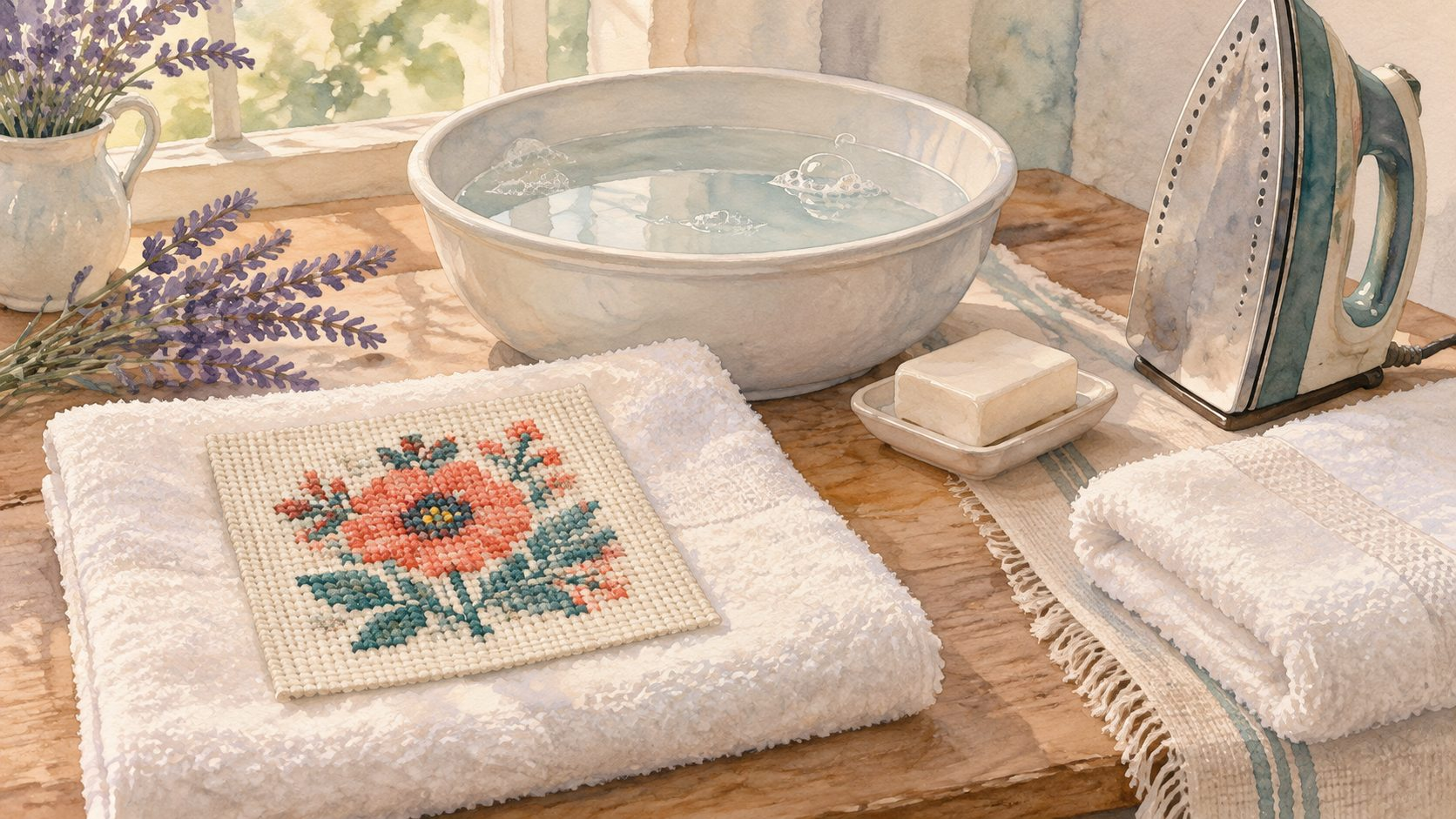
Most finished cross stitch looks clean, and most of it is not. Hand oils, dust, hoop rings, and leftover pen marks all sit in the fabric, and some of them turn yellow over the years. A gentle soak, a careful dry, and a face-down press fix nearly all of it. The risks are specific and easy to test for, so this guide covers when to wash, when to skip it, and how to do it without bleeding colors or crushed stitches.
Check your thread first. Major-brand cotton floss on plain cotton or linen fabric is usually safe to wash. Hand-dyed floss, beads, metallics, printed fabric, and unknown kit materials are not safe to assume. Run the colorfast test below, then soak in cool or lukewarm water with a tiny drop of mild soap for 10 to 15 minutes, rinse until the water runs clear, roll in a white towel, dry flat, and press face down on a thick towel.
Why wash at all
Cross Stitch Academy puts it plainly: no matter how carefully you handled the fabric, a finished project holds residual oils from your hands and some dust. You may not see stains today, but they can develop with time. Stitch Squad describes the same process in more detail. Skin oils transfer to the fabric and thread over weeks or months of stitching, and they oxidize into yellowish stains that are very hard to remove once they set.
Washing also removes things that are visible right now:
- Hoop marks. The ring pressed into the fabric by your hoop or frame.
- Water-soluble marker lines. Grid lines and pattern marks drawn on the fabric. Notorious Needle notes that soaking also removes ink left from gridding or from a stamped design. If you drew a grid, our guide to gridding cross stitch fabric covers marking it in the first place.
- Fabric tension. My Cozy Cross Stitch points out that a soak relaxes the fabric, evens out stitches, and makes creases disappear in a way ironing alone does not manage.
Catkin and Lillie sums up her own habit as washing and pressing anything meant for display, framing, or a gift that will be kept, every time. She will sometimes skip the wash for a tiny gift tag or card, but she still presses it, because it simply looks better.
When not to wash
DMC makes an honest point that gets lost in most how-to posts: many needlework projects never need washing. If you stitch with clean hands, cover the project between sessions, and keep pets and food away, there may be nothing to wash out. DMC also says to take the care instructions of your fabric, patches, and embellishments into account, and that it may not always be possible to wash a piece at all.
Skip or modify the wash in these cases:
| Situation | Why it is risky | What to do instead |
|---|---|---|
| Hand-dyed or overdyed floss | Small-batch dyers do not always set color the way large brands do. My Cozy Cross Stitch describes a variegated red running into cream aida in seconds. | Test first. If any color transfers, skip the soak. |
| Unknown kit or unbranded thread | You cannot assume it is colorfast. | Check the kit care notes, ask the seller, and run the test. |
| Pre-printed fabric | DMC advises against washing embroidery where the design is printed on the fabric. | Spot clean only, by blotting with a clean cloth and mild soap. |
| Beads and embellishments | Some painted or dyed beads lose their finish, some metallic braids tarnish, and vintage buttons can rust. | Wash before adding beads if you can, as Catkin and Lillie does. |
| Wool or silk thread | These need a wool-specific wash and cool water. | Use a wool wash at cool temperature, not the routine below. |
| Antique or heirloom linen | Unknown fibers and age make results unpredictable. | Consider a textile conservator. |
The colorfast test
This is the two-minute step that prevents the worst outcome. Quality threads from major brands are generally colorfast, and Stitch Squad says DMC and Anchor shouldn't bleed. The risk sits with hand-dyed thread, small-brand variegated floss, and strongly saturated colors, especially reds and deep darks. Cross Stitch Academy also flags bright colors like red as the most common bleeding risk.
Pick the darkest or most saturated color in the piece. Press a damp white paper towel, a white cotton cloth, or a damp cotton swab firmly against it, ideally on the back of the work. Hold for about ten seconds and look. If any color comes off, do not soak the piece. A quick cool rinse or spot clean is the safer route, or you can frame it as it is.
What you need
- A clean basin or sink with no cleaner residue.
- Cool or lukewarm water (see the disagreement section below on temperature).
- A very small amount of mild, clear soap. Stitch Squad suggests a pea-sized drop of clear dish soap or a textile wash. DMC specifies a non-biological detergent and says to avoid biological powders, harsh detergents, and chlorine bleach.
- Two or three clean white or light towels. Both My Cozy Cross Stitch and Catkin and Lillie warn that a new dark towel can dye damp fabric. An older, lint-free towel is best.
- A thick, soft towel or two for pressing, and an iron.
Step by step
- Prep the piece. Take it out of the hoop or frame. Check the back, trim any long tails, and make sure your starts and ends are secure. If the raw edge is fraying, My Cozy Cross Stitch suggests a line of zigzag stitching or masking tape along it. For help securing threads, see our guide to starting and ending cross stitch thread.
- Rinse briefly. DMC and Cross Stitch Academy both begin by running the piece under cool water. If the water turns colored, stop washing at once and go to the bleeding section.
- Soak. Fill the basin, add the small drop of soap, and swirl. Lay the piece in flat and press it down gently. Do not crumple or wring. Leave it for 10 to 15 minutes.
- Swish gently. Move the fabric through the water to carry loosened oils away. Rub a stubborn mark very gently with a fingertip on the fabric, not directly on the stitches. Cross Stitch Academy warns that stitches that are firm can loosen under intense scrubbing.
- Rinse until clear. Drain, refill with clean cool water, press gently, and repeat. My Cozy Cross Stitch says this usually takes two to four changes. Leftover soap attracts dirt and can yellow over time, so rinse longer than feels necessary.
- Lift with support. Wet linen is heavy. Support the whole piece with both hands, or slide it onto a flat plate, so the grain does not get pulled crooked.
Drying
Do not wring or squeeze hard. Every source agrees on this. Squeezing adds creases and can distort the stitches and fabric.
- Lay the piece on a clean dry towel.
- Roll the towel up with the stitching inside and press gently along the roll. Do not twist.
- Unroll, move the piece to a dry part of the towel, and smooth it with your hands without pulling on the edges.
- Leave it flat, face up, in a ventilated spot away from direct sun. Stitch Squad says drying typically takes a few hours.
Notorious Needle adds that if the piece is only mildly creased, smoothing it by hand while damp may let you skip the iron.
Pressing
Pressing is different from ironing a shirt. The goal is to flatten the fabric while keeping the stitches raised and textured.
- Lay a soft, thick towel on the ironing surface. A bath towel works well, and a thicker layer helps if the piece has beads or other raised parts.
- Place the stitching face down on the towel. Pressing from the front flattens the stitches.
- Use a medium or warm setting. DMC says to press lightly with a warm iron, never a hot one, and to use the steam setting for creases and fold lines. Use low heat on synthetic blend fabric, per Stitch Squad.
- Lift and place the iron rather than dragging it. Give hoop marks and fold lines a little extra time.
- Let the piece cool and finish drying flat before you frame or store it.
A thin clean cloth, such as a tea towel or pillowcase, between the iron and the back of the work helps if you are nervous. Catkin and Lillie notes that metallic threads can usually be pressed, but she uses less heat and extra care on them. Stubborn creases, says My Cozy Cross Stitch, usually need a second dampening rather than more heat.
When things go wrong
Colors start to bleed
Act immediately and do not let the piece dry, because drying can set the dye. Keep rinsing in cool water. Stitch Squad adds that a color catcher sheet in the rinse water can help, and that most bleeding can be reversed when you move quickly. My Cozy Cross Stitch is blunt that hot water and extra soap make it worse. Cross Stitch Academy also notes that colors that look like they are changing can simply be the wet fabric turning more transparent so the back shows through, so check before you panic.
Marker lines will not come out
Follow the pen manufacturer's instructions. My Cozy Cross Stitch warns that some markers need a plain cool rinse with no soap first, and that soap or heat on certain pens can set the line. Ordinary pencil lines usually lift in the soak. Do not iron until you are sure the marks are gone, because heat can set them.
Yellowed or stained fabric
Treat aged yellowing gently. A longer cool soak with mild soap may give a partial improvement. Do not use chlorine bleach. For a valued heirloom with unknown fibers, a conservator is worth calling. For a fresh spot on a piece you cannot immerse, DMC suggests blotting with a clean cloth and mild non-biological soap, and says not to dry clean.
Dust only
If the piece is just dusty, DMC offers a way to avoid the water entirely. Stretch a piece of nylon stocking or mesh over a vacuum nozzle, keep the nozzle just above the stitching, and vacuum lightly.
Storing finished pieces
Wash and press before storing, as Catkin and Lillie recommends, so oils do not age in the fabric. For storage she layers the piece between acid-free tissue paper, rolls it around a cardboard tube, and keeps it in a dry cupboard or drawer. Avoid folding, which creates new creases, and avoid damp places. If you are heading for a frame next, our guide to finishing and framing cross stitch picks up where this one stops.
Where sources disagree
These are small differences, but they are real. Here is how they split.
| Question | What the sources say |
|---|---|
| Water temperature | Cross Stitch Academy and DMC say cold. Stitch Squad says lukewarm and warns heat can cause bleeding. My Cozy Cross Stitch says cool. Cool, not hot, is the safe overlap. |
| Soaking time | Notorious Needle says 10 to 15 minutes, Stitch Squad 15 to 20, Catkin and Lillie says 15 and that a few extra minutes will not matter but not hours. Fifteen is a fair middle. |
| Pressing damp or dry | Stitch Squad presses while slightly damp. Catkin and Lillie says it works either way, though she has heard damp pressing can make colors run and has never had a problem. If you doubt the thread, press once fully dry. |
| Soaking versus a quick rinse | DMC rinses and hand washes briefly. Others soak. Doubtful thread points toward the short rinse. |
Questions
Do I always have to wash a finished cross stitch?
No. DMC notes many projects never need it, and a tiny gift piece may only need pressing. For anything that will be framed or kept for years, washing is cheap insurance.
Can I use regular laundry detergent?
Avoid it. DMC says no biological powders or harsh detergents. A tiny amount of mild clear dish soap or a textile wash is enough.
Can I put cross stitch in the washing machine?
None of the sources used here recommend it, and DMC says not to wash a piece with other laundry. Hand washing keeps the stitches and fabric from stretching and snagging.
Should I wash before or after framing?
Before. Once it is framed you cannot reach the fabric to wash or press it, so do both first.
Does it matter what fabric I stitched on?
Cotton and linen handle gentle soaking well. If you are choosing between fabrics, our evenweave versus aida guide covers how they differ.
Why did my fabric look darker or different when wet?
Cross Stitch Academy notes wet fabric can become more transparent, so back colors show through. It usually clears as the piece dries.
Sources
- DMC: when washing is needed, non-biological detergent, warm iron limits, vacuum cleaning, and printed fabric warning.
- Cross Stitch Academy: why wash, cold rinse, gentle handling, and bleeding risk.
- Stitch Squad: step-by-step soak, swab test, color catcher, and pressing method.
- Notorious Needle: soak time, towel choice, and drying flat.
- Catkin and Lillie: when to wash, pressing metallics, beads, and storage.
- My Cozy Cross Stitch: hand-dyed floss, rinsing, lifting, marker lines, and problems.