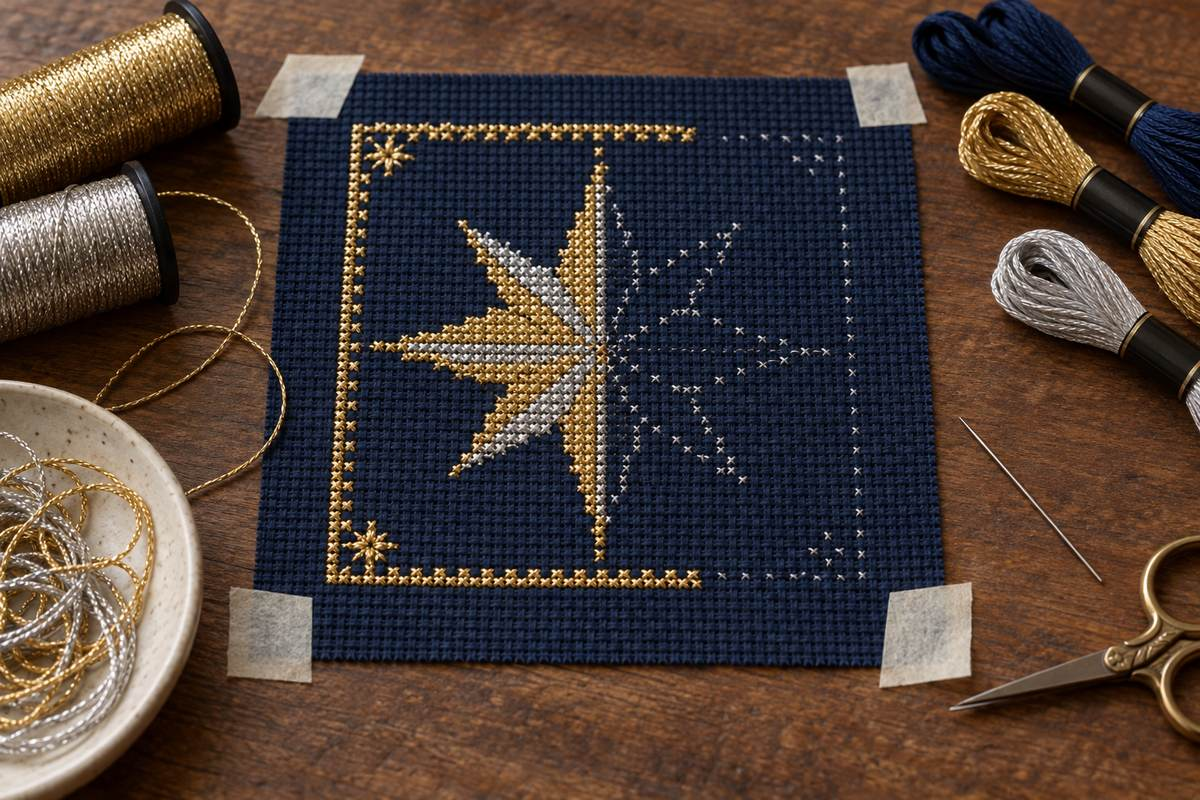
Metallic cross stitch thread adds real sparkle, but it frays, twists and slips out of the needle more easily than cotton floss. The fix is not one magic product. Cut shorter lengths, use a needle with a little more room, stitch slowly and choose the right metallic form for the coverage you want. Stranded metallic floss, braided metallic and blending filament all behave differently. Last updated November 5, 2026.
Start here: For a first metallic accent, use a fine braided metallic rather than stranded metallic floss or blending filament. Cut about 12 to 18 inches, use it as a single strand without separating it, and let the needle dangle every few stitches to release twist.
Know the thread types
The Spruce Crafts separates metallic threads into three common forms. Stranded metallic floss looks like cotton floss and can be divided; DMC Light Effects is the common example. Braided or woven metallic thread cannot be separated; Kreinik Braid is the common example. Blending filament is a very fine thread meant to be combined with cotton floss or laid over finished stitches.
XStitch Magazine recommends braid as the easiest starting point because it is used as it comes. Peacock and Fig makes the same distinction: do not try to separate a braid. Floss Field notes that metallic floss has six strands like cotton floss, while a metallic braid is one round thread used as a single strand.
The choice affects the finished look. Floss gives a familiar floss-like stitch but can shred. Braid gives a rounder, smoother stitch. Filament gives a subtle shimmer rather than full metallic coverage.
Set up the thread
Short lengths matter because every pass through fabric wears the metallic surface. Floss Field and The Spruce Crafts both suggest about 12 inches, or 30 cm, for stranded metallic floss. The Spruce Crafts allows up to 18 inches for braided metallic. Replace a length as soon as it looks worn instead of trying to finish it.
Use a needle one size larger than you would choose for cotton floss. Floss Field says the larger hole and eye are kinder to the thread. For stranded metallic, The Spruce Crafts recommends a cow hitch at the needle eye: fold the strand, pass the fold through the eye, then pull the ends through the loop. Floss Field gives the same knot for two strands that slip from the eye.
Thread conditioner helps many stitchers, but it is not required. A light pass over the thread can reduce static and tangling. Peacock and Fig also suggests running braid over a slightly damp cosmetic sponge if it comes off the spool curled.
Stitch without knots
Slow down and pull gently. Peacock and Fig warns that the sewing method can twist metallic thread faster; the stab method gives you more control. Whichever method you use, let the needle hang every few stitches so the thread can unwind. XStitch Magazine gives the same advice for braid.
Lay each leg before pulling it snug. Metallic stitches look thin and wiry when they twist around themselves. Our railroading guide explains how to keep strands side by side. Keep all top legs in the same direction; sparkle is more noticeable when the surface is consistent.
Secure isolated stitches without carrying metallic thread a long way across the back. Peacock and Fig's reader guidance allows a small, tight knot when there are no nearby stitches to bury under, but knots should be sparse and kept away from crowded holes.
Blending filament
Blending filament is almost as fine as tinsel. It is normally threaded together with cotton floss to add a light shimmer. Floss Field recommends short lengths and knotting the filament to the needle eye so it does not slip away from the cotton.
If the two threads fight each other, use two passes. Stitch the area in cotton first, then go over the finished crosses with filament alone. Peacock and Fig recommends doing the main color first so the shine is not buried under the floss. The Spruce Crafts suggests adjusting the filament's position before pulling the stitch tight so it wraps visibly over the cotton.
Do not remove the stabilizing core from Kreinik blending filament. Peacock and Fig says the core gives the thread stability and strength.
Choose the right coverage
Coverage depends on fabric count and the metallic's thickness. XStitch Magazine describes Kreinik Very Fine #4 Braid as half the size of Fine #8 Braid. It says #8 was designed for 14-count Aida, while #4 is suited to 16-count, 18-count, or over-two work on 32-count and 36-count fabric.
Peacock and Fig describes #4 Braid as roughly equivalent in coverage to two strands of cotton floss, and says #4 can look a little thinner than surrounding cotton on 14 count. That is why a sample matters. If one strand looks sparse, move up a braid size rather than doubling the braid in the needle.
Use metallic for accents that benefit from light: stars, snow, water, jewelry, lettering, halos and small borders. Large fills can become stiff and tiring to stitch. For a needlepoint-specific approach, our metallic thread guide covers canvas and thread choices.
Fix common problems
- Shredding or snapping: shorten the length, enlarge the needle, pull more gently and replace worn thread sooner.
- Slipping out of the needle: knot the thread to the eye with a cow hitch or use a bigger needle eye.
- Twisting and knots: let the needle hang, stitch more slowly, use the stab method and try a damp sponge or light conditioner.
- Thin, wiry stitches: lay each leg flat before tightening and avoid pulling the metallic into a tight twist.
- Uneven sparkle: keep all top legs in the same direction and use the same metallic form throughout the accent.
Where sources disagree
Should you use a bigger needle? Floss Field and The Spruce Crafts recommend going up a size to reduce wear. Some stitchers prefer a smaller needle for neat holes. A larger needle is the safer default for fragile stranded metallic; test it on a scrap and switch if the fabric holes stay visible.
Is #4 or #8 braid right for 14 count? XStitch Magazine says Fine #8 Braid was designed for 14-count Aida. Peacock and Fig says #4 is roughly two strands of cotton and can work with two-strand cotton areas, though it may look slightly thinner. The sources are using different coverage preferences. Sample both if coverage matters.
Should filament be stitched with floss or over it?Floss Field allows both and suggests the second pass when the threads fight. Peacock and Fig also recommends the main color first for stitchers who find the mix slippery. The goal is the same: keep the filament visible instead of trapped under cotton.
Is thread conditioner necessary? Floss Field and The Spruce Crafts say it helps many stitchers. XStitch Magazine focuses on braid, dangling the needle and a damp sponge instead. Conditioner is a tool, not a requirement.
FAQ
Why does metallic floss fray? Stranded metallic floss is made from twisted fine pieces. Repeated passes through the fabric and needle eye wear those pieces. Shorter lengths and a larger needle reduce the friction.
Should you separate metallic braid? No. Kreinik braid is already a complete thread. Use one strand as it comes and move to a thicker braid if you need more coverage.
How long should metallic thread be? About 12 inches for stranded metallic floss and no more than about 18 inches for braid. Fresh thread looks better than a long, worn length.
Can metallic thread go in the wash? XStitch Magazine describes modern synthetic metallic threads as washable, but finishes vary. Test your exact thread and beads or specialty fibers before washing the full piece, and avoid direct high heat.
Can you use metallic thread for a whole design?You can, but small accents are easier and usually more effective. Large metallic fills take longer, show tension problems and can feel stiff.
What is the easiest metallic for beginners? A fine braid. It does not need separating, covers evenly and is easier to control than stranded metallic floss or blending filament.
Sources
- Floss Field - Metallic, Variegated and Specialty Threads in Cross Stitch (a cross-stitch educational reference; lengths, needle size, needle knot, braid vs floss and troubleshooting)
- XStitch Magazine - How to Use Metallic Thread for Cross Stitch (a needlework magazine tutorial, November 2023; Kreinik braid sizes, fabric counts and beginner handling)
- The Spruce Crafts - Working With Metallic Embroidery Threads (a craft education site; stranded floss, woven thread and blending filament techniques)
- Kreinik - Metallic Thread Selection Guide (a thread manufacturer reference; product forms and cross-stitch thread selection)
- Peacock and Fig - Kreinik Metallic Threads for Cross Stitch and Embroidery (a cross-stitch designer and tutorial site, February 2017; braid handling, coverage and reader troubleshooting)