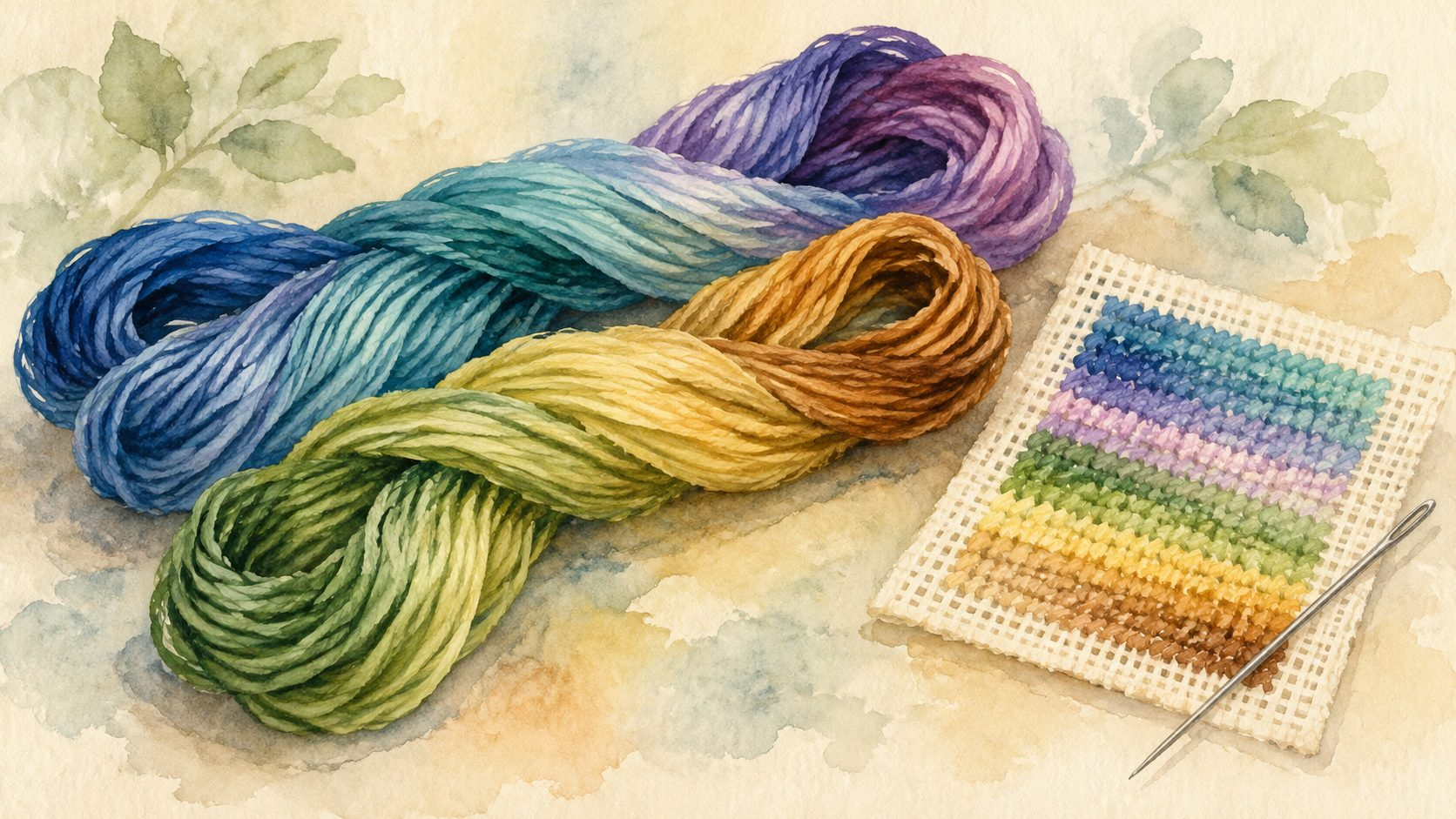
Variegated thread changes color along its length, so a single strand can shade a sky or a tree trunk. The risk is stripes. The sources we read agree that the stitch path decides what you get, and that you should plan where the thread goes. They disagree on which stitch is best and on how much to fuss over color placement.
Needlepoint For Fun says that if you stitch in a straight line, variegated and overdyed threads form stripes. Lycette Designs prefers the continental stitch for variegated thread because the colors fade gently from one to the next, and says basketweave makes the colors jump around. Poppy Monk says to use variegated thread sparingly, in a single focal point or a few balanced places. Test on a scrap before you commit the thread to a big area.
Variegated vs overdyed
The sources do not all use these words the same way. Needlepoint For Fun says a variegated thread is factory-dyed in varied tones of one color, in even repeating bands, while an overdyed thread is dyed over an existing color, usually by hand, with random and uneven color changes that need not stay in one color family. It says DMC has 18 variegated and 36 overdyed cottons, the overdyed ones called Color Variations. Hannah Hand Makes describes the same split: variegated is one color in many shades, and Variations has more than one color in the skein. It says the variegated numbers are two or three digits, such as 93, and the Variations numbers are four digits starting with 4, such as 4077. HiFi Makes says the two terms are often used interchangeably but are different, and defines variegated as multiple colors or shades along a strand with a gradual, repeating pattern. Colour Complements, which dyes thread, says most commercial makers use machines that make evenly spaced stripes, and that its hand-dyed threads use varying, shorter color runs that blend. That is a claim from a seller about its own product.
How the stitch changes the color
- Continental. Lycette Designs says colors fade gently. Poppy Monk says continental gives a more subtle effect than basketweave. Needlepoint For Fun says to stitch sea or sky in horizontal lines with continental, not basketweave.
- Basketweave. Poppy Monk says it makes diagonal stripes of color. Needlepoint For Fun says it gives diagonal bands. Lycette Designs likes it when the thread is meant to be the star of the show, with many colors in it. See our continental vs half cross guide and basketweave guide.
- Diagonal decorative stitches. Lycette Designs says Nobuko makes random bursts of color, much like basketweave, and says diagonal mosaic should do the same. Poppy Monk shows subtle blue thread in slanted Victorian step for water or sky, and a bolder tan, gray and terra cotta thread in horizontal cashmere for stone or pavement.
- Vertical columns. Needlepoint For Fun says a tree trunk looks organic with vertical bands, but horizontal bands would look odd, so stitch in vertical columns.
- Random or clumped stitches. Needlepoint For Fun says placing stitches randomly, every 3 to 5 holes and then filling in, gives a mottled look that suits fur or grassy hills, and clumping gives tweed or groves of trees. It admits the back gets messy.
- French knots and leaf stitch. Poppy Monk says French knots in a tone-on-tone silk make shrubs look three-dimensional, and a leaf stitch looks almost real.
Where to use it
Poppy Monk lists sky, grass, foliage, tree trunks, dirt, sand, stone, pavement, fur and clothing, anywhere you want shading in a color range. It says wool has loft and less sheen, so it suits trunks, sand and rocks, while silk has luster and suits sea and sky. It says subtle color shifts suit sky and water, and bolder ones suit flowers and foliage. Lycette Designs uses blue variegated thread as a background for shell and ocean canvases, and also for trees, sand and loafers. HiFi Makes says variegated thread looks best in larger areas, where it has room to develop. For sky and water stitch ideas, see our sky and water guide, and for fur see our fur guide.
Controlling the color
- Do not start with the loop method. Hannah Hand Makes says folding one strand in half puts two different colors side by side, so start with a waste knot or by catching the thread on the back. See our starting and ending thread guide.
- Match where you stop and start. Hannah Hand Makes says one end of a cut length is usually darker than the other, so when you rethread, start with the end that matches where you left off, so the shade carries on. It says not to stress over exact matching.
- Complete each stitch before the next. Hannah Hand Makes says rows of half stitches followed by a return row can spoil subtle shifts, since the bottom row may be a different color from the row that crosses it. Needlepoint For Fun says the same effect is a choice for cross stitch: finishing both arms of each cross gives stripes, and the traditional half-row then return method gives a mottled look.
- Reverse a strand. NeedlenThread, writing about surface embroidery with six-strand floss, offsets the color runs by reversing one of three strands, and says it can also cut and thread the floss so a dark shade always falls at the base of a petal. It says this may mean ending a thread mid-petal. That is embroidery, not canvas, but the idea of offsetting runs carries to pliable floss.
- Add a solid. NeedlenThread also stitches one strand of a matching solid with two strands of variegated, one reversed, for a heathered look.
- Plan symmetrical pieces. Creative Stitch says counted needlepoint relies on symmetry, so color changes should be planned, and it says to cut lengths so matching parts get the same color changes. It also says never to change thread color in the middle of a stitch such as Scotch stitch, and to avoid drastic color changes between neighboring stitches.
Making your own
Needlepoint.com says you can make variegated thread by combining strands. Use pliable thread such as DMC floss, cut equal lengths of each color, separate them, and use the number of plies your mesh needs. Its example for 18 count with DMC floss is 4 ply, using 2 ply of each of two colors. Line the strands up, twist them gently, hold them against the canvas to judge the effect, and adjust. It says to write down the combination and to start with two or three colors. For strand counts by mesh see our thread by mesh count guide.
Quick comparison
| Goal | What sources suggest | Source |
|---|---|---|
| Soft, gradual fade | Continental, horizontal rows | Lycette Designs, Poppy Monk, Needlepoint For Fun |
| Diagonal stripes or color jumps | Basketweave, Nobuko, diagonal mosaic | Poppy Monk, Lycette Designs |
| Tree trunk | Vertical columns | Needlepoint For Fun |
| Fur, grass, hills | Random or clumped stitches | Needlepoint For Fun |
| Heathered look | Add a solid strand, reverse one strand | NeedlenThread |
| Custom blend | Twist strands of two or three colors | Needlepoint.com |
Where sources disagree
- Basketweave: Poppy Monk and Needlepoint For Fun treat its diagonal banding as something to avoid for sky and water. Lycette Designs likes it for multicolor thread that should be the star.
- Machine or hand-dyed: Colour Complements says machine-dyed runs stack into blocks and hand-dyed blends better. Needlepoint For Fun describes factory variegated as even bands and overdyed as random, and does not say one is better. We did not test either.
- Terms: HiFi Makes and Needlepoint For Fun both separate variegated from overdyed. Poppy Monk, Lycette Designs and Colour Complements use the words loosely or together.
- Back of the work: Needlepoint For Fun says random stitch placement leaves a messy back and accepts that for a better front. Our neat back guide covers the opposing habits, and the sources here do not weigh the trade-off.
- Embroidery sources: NeedlenThread and Hannah Hand Makes write about floss on fabric, so strand tricks may behave differently on canvas.
- Prices: Several sources sell thread. We did not check prices or availability.
Questions
How do I avoid stripes?
Needlepoint For Fun says stripes form when you stitch in a straight line, and suggests random or clumped placement for a mottled look. Poppy Monk suggests choosing a stitch that suits the thread.
Which stitch is best for variegated thread?
Lycette Designs prefers continental. Poppy Monk and Needlepoint For Fun say it depends on the effect you want.
Can I use it for the whole background?
Lycette Designs does so on ocean and shell canvases. Poppy Monk says use it sparingly.
What is the difference between variegated and Color Variations?
Hannah Hand Makes says variegated is one color in many shades, and Variations is more than one color.
Can I make my own?
Needlepoint.com says yes, by twisting together strands of two or three colors.
Does it work on 13 and 18 mesh?
It depends on the thread. Poppy Monk says some are single strand and some are multi-strand, and it gives one sashiko thread as working on 13 to 18 mesh.
Sources
- Poppy Monk Needlepoint: Needlepoint Variegated Thread Tips
- Needlepoint For Fun: Using Variegated and Overdyed Needlepoint Threads
- Lycette Designs: Needlepointing with Variegated Threads
- HiFi Makes: Using Variegated Threads for Needlepoint (preview only, the rest is paid)
- Hannah Hand Makes: 3 Tips for Stitching With DMC Variations and Variegated Thread
- NeedlenThread: Stitching with Variegated Threads, Part II
- Creative Stitch: The Hows and Whys of Variegated Threads
- Needlepoint.com: How to Make Your Own Variegated Threads
- Colour Complements: How to Use Variegated Thread