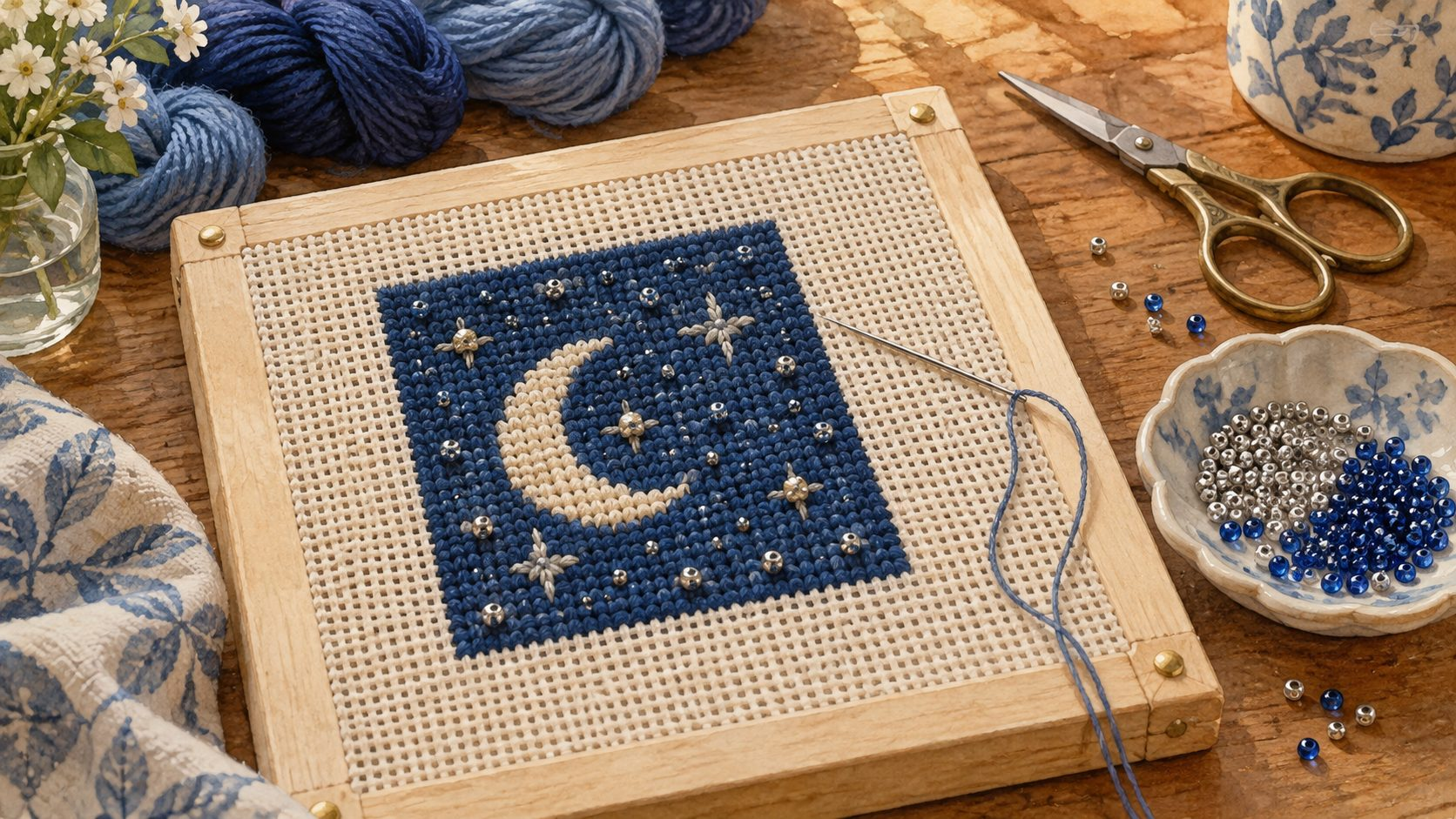
Beads go onto needlepoint one at a time, after all the other stitching, with a beading needle and fine beading thread. Each bead takes the place of one tent stitch, so if you can work a tent stitch you can sew on a bead: only the needle and thread change. The two decisions that matter are picking a bead size that fits your canvas mesh and choosing an attachment stitch that holds each bead at the angle you want.
Use size 11 seed beads on 13 or 14 mesh canvas and size 14 or 15 on 18 mesh, per Floss Field and Serendipity Needleworks. Bead last, after every other stitch is done, on stretcher bars rather than a scroll frame, per Floss Field. Sew each bead on like a tent stitch, then take a second stitch in the same two holes beside the bead, splitting the two strands around it to lock it: the lasso method. A beading needle is not optional; a tapestry needle is too thick to pass through a seed bead.
When to bead
Add beads after the rest of the stitching is finished, per Floss Field. There is a structural reason: a scroll frame rolls the unworked canvas, and the rolled layers press on any beads inside, so padding the roll to protect them leaves it uneven and can pull the canvas out of shape. Work a piece you plan to bead on stretcher bars, which hold the whole canvas flat and roll none of it. Our stretcher bars guide covers sizing and mounting.
Two exceptions. A decorative stitch with beads diagrammed into the pattern may be worked beads-first, and if your canvas came with a stitch guide, follow its order. And while you stitch the rest of the piece, leave empty every intersection marked for a bead, since each bead takes the place of one tent stitch.
Bead sizes and mesh
Seed beads are the standard needlepoint bead: small glass beads, usually round. They carry a size number that runs backward, so a bigger number means a smaller bead: size 14 is smaller than size 11. The core pairings, per Floss Field, Serendipity Needleworks, and Needlepoint.com:
| Canvas mesh | Hole spacing | Bead size | Bead diameter |
|---|---|---|---|
| 13 mesh | 1/13 inch, just under 2 mm | Size 11 | About 2.0 to 2.2 mm |
| 14 mesh | 1/14 inch, 1.8 mm | Size 11 | About 2.0 to 2.2 mm |
| 18 mesh | 1/18 inch, 1.4 mm | Size 14 or 15 | About 1.5 mm |
In each pairing the bead is about as wide as the step from one hole to the next, so beads on neighboring intersections sit close together. Not sure of your mesh? Our mesh count guide shows how to check. An older table from Fireside Stitchery, preserved by the Chilly Hollow blog, extends the range: size 10/0 for 12 count, size 8/0 or 6/0 for 10 count, and size 5/0 for 7 count plastic canvas. It also notes Mill Hill's line by name: Magnifica beads are 12/0, Frosted, Seed, and Antique Seed are 11/0, and Petite Seed are 15/0.
A larger bead than the table suggests can work where beads stand alone among stitches, per Floss Field: size 11 on 18 mesh, or size 8 on 13 or 14 mesh. Keep to the table sizes where beads fill a large area, because oversized beads crowd. Size numbers vary a little from maker to maker, so when the fit matters, go by the diameter in millimeters.
Bead shapes and quality
Serendipity Needleworks names the three shapes you will actually meet. Round beads, also called rocailles, are the fat little doughnuts used most. Cylinder beads, sold under Miyuki's Delica brand, are cut from tubes of glass: more uniform, a little smaller than a round bead of the same size number, and more expensive. Hex beads are six-sided tubes whose edges catch the light. Bugle beads are long narrow tubes; Floss Field notes a stitch guide may call for them by name, and needlery warns their cut ends can be sharp enough to fray thread, so cushion each end with a seed bead if the design allows.
On quality, Serendipity Needleworks is blunt: Japanese beads, Miyuki above all, are uniform in size and hole diameter, while cheaper Czech beads can include many that no needle will pass. Shop brands like The Collection and Sundance Designs advertise Japanese beads; big-box craft store seed beads are usually Czech. Whatever you buy, expect to set aside the occasional bead that no needle will fit through, per Floss Field.
Needles, thread, and holding beads
Needles. A tapestry needle is too thick for a seed bead: Floss Field measures a size 22 tapestry needle at about 0.94 mm, against a hole of about 0.8 mm in a size 11 bead. Beading needles are slender with an eye barely wider than the shaft. Sizes 10 and 12 are the workhorses, with the higher number the finer needle: about 0.46 mm and 0.36 to 0.4 mm respectively, per Floss Field. Start with a 10 and drop to a 12 if it sticks. Alice Hall's beading lesson notes needles come short, about 1 1/4 inches, and long, 2 1/4 to 3 inches: short suits single beads, long suits stringing a row. Bead holes vary, so buy a mixed pack. Our needle guide covers the tapestry side of the family.
Thread. Beading thread is strong, smooth, and thin enough to pass through a bead more than once. Waxed nylon beading thread (Nymo is the usual brand name) is the standard pick across the sources: give each cut length a firm tug before threading to relax the kinks so beads lie smoothly. One strand of silk or one strand of stranded cotton floss also works, though neither is as strong; draw cotton across a cake of beeswax first to protect it from rough glass inside the bead and to make it easier to handle. Alice Hall prefers natural beeswax over synthetic conditioners. Match thread color to the bead or to the canvas underneath, and remember thread shows through a translucent bead and changes its color, per Floss Field: test the pairing first.
Doubled thread. The lasso method uses the thread double. Floss Field's setup: cut about 36 inches, pass one end through the eye and bring the ends together so only one thickness sits in the eye, giving a working length of about 18 inches. Longer threads tangle.
Keeping beads under control. Beads roll. Pour a few onto felt, or into a shallow sticky-lined case, and pick each one up with the needle point. Alice Hall likes the Tacky Bob, a small box with sticky surfaces; Needlepoint.com calls a bead case essential if you do not want to chase beads around the floor.
The lasso method
The standard attachment, per Floss Field: a tent stitch with a bead on it, then a second stitch in the same two holes that goes around the bead instead of through it.
- Double the thread in the beading needle and knot the ends together. This knot stays on the back; ordinary stitching leaves no knot, but beading allows it.
- Anchor on the back by running the needle under a few existing stitches, then back under them the other way, because beading thread is slippery.
- Come up at the lower left of the empty intersection, slide one bead down to the canvas, and go down at the upper right, exactly like a tent stitch. The bead is on but loose.
- Come up again in the first hole and go down again in the second, this time beside the bead, not through it.
- Just before the stitch tightens, part the two strands and lay one along each side of the bead. Pull snug. The bead is now trapped between the strands and cannot flop.
- Moving to a distant bead? Run the needle under a stitch or two on the back first. A long thread run across the back works loose, and the last bead loosens with it. On pieces that will be handled a lot, anchor after every bead so one snagged bead cannot undo its neighbors.
- End threads the same way you started: under a few stitches on the back, then back the other way, and trim close. Our thread starting guide covers anchoring generally.
Which way beads lie
A bead's hole runs along the stitch holding it, and a round seed bead is wider across than it is long, so a bead sewn like a normal tent stitch appears to lean the opposite way from the tent stitches around it, per Floss Field. To make beads lean the same way as your tent stitching, sew them from lower right to upper left, a reverse tent stitch; stitch guides sometimes specify this. To seat a bead upright with its hole vertical, use a cross stitch with a single thread: sew the bead on from lower left to upper right, then come up at the lower right, pass through the bead again, and go down at the upper left. The bead settles centered on the intersection and needs no lasso.
Whichever you choose, test first: sew three or four beads each way on a scrap of the same canvas or on the bare margin, and compare them against your stitching. Then keep one direction for the whole area, because beads sewn in two directions lie at two angles, and spaced beads can read as diagonal stripes instead of separate dots.
Lines and whole areas
Beads draw the eye, so most beading is accents: an eye, a star, a berry, a flower center, per Needlepoint.com. A bead can go anywhere the design has a tent stitch, no special pattern needed.
For a line of beads, Nuts about Needlepoint's easier way is couching: string the whole line of beads on one thread with the beading needle, lay it along the line, then use a second needle with a strand of matching floss to couch over the thread between beads, snuggling each stitch down between two beads without puckering the line. Put a couching stitch at both ends of every line, space stitches closer on curves, and couch at any crossing point where lines meet. Floss Field's alternative for steadying a row of individually sewn beads: after every three to five beads, pass the needle back through the group to align them.
A whole area can be beaded with a lassoed bead on every intersection. Floss Field's figures: 169 beads per square inch on 13 mesh, 324 on 18 mesh; with about 110 size 11 beads to the gram and about 250 size 15 beads to the gram, that works out to roughly 1.5 grams of size 11 beads per square inch on 13 mesh and 1.3 grams of size 15 on 18 mesh. Beads can also fill the empty intersections of an open stitch like skip tent, an easy way to bead a large area.
Named variations you will see in stitch guides
- Brick beading: one bead per brick stitch (the upright stitch over two canvas threads, stepped half a stitch each time). Use a bead slightly large for the mesh, size 11 on 18 mesh, so each bead sits over a canvas hole.
- Stitching twice: the attaching stitch is simply repeated through the bead, used in place of the lasso.
- Messy beading: several beads piled on one stitch in no set order, such as three size 11 beads forming a raised ring at a flower center.
- Piggyback and stacked beads: a small bead riding on a larger one, like a size 11 on a size 6. For a stack, come up, thread the beads, skip the top one, and pass back down through the rest so the stack stands.
- Basketweave beading: each bead gets a second pass that turns it horizontal or vertical, alternating for a woven look. Floss Field's spacing note: on 14 mesh, work every sixth row in a smaller tube bead to leave room.
Sequins, buttons, and charms
Sequins go on with a beading needle too, per Floss Field. On 18 mesh allow about four stitches of width for a 4 mm sequin and five for a 6 mm one; on 13 mesh they cover about two and about three stitches. For an overlapping row, start at the bottom and sew each sequin with two stitches making a V over its top edge, then lay the next sequin over that V. A bead can hold a sequin down instead: a size 14 bead holds a 2 mm sequin, and a size 11 hides it. Buttons and charms sew on after stitching through their own holes or loops; a shank button takes four stitches slanting different ways, and a hanging charm can be steadied with a stitch across another part of it in matching thread.
What goes wrong
- A bead flops or leans out of line: the thread holding it is slack. Pull every stitch snug and anchor the thread on the back before carrying it anywhere, per Floss Field.
- Rows look uneven: usually uneven tension. Working on a frame helps.
- Thread frays or breaks: a sharp edge inside the bead hole is cutting it. Throw that bead out.
- Needle will not pass: bead holes vary, even in one tube. Set the bead aside rather than forcing it.
Finishing and care
Keep beads off the outermost rows of a design, per Floss Field: at the edge of an ornament, stitching wraps around the board inside and the edging cord can hide the outer stitches. If your design wants beads right at the edge, ask the finisher first; finishers generally want one to a few rows of plain background beyond the beads to work with. A beaded piece that has pulled out of square goes to a finisher or needlework shop for blocking; our blocking guide explains what that involves, and finishing basics covers the handoff generally.
Never wash a beaded piece or put it in water or cleaning solution. Dust it only after checking every bead is secure, vacuuming at low suction through a piece of window screen laid over the work, the same method as in our cleaning guide. Anything more than dusting is a job for a conservator. Some bead colors can fade in sun or shift with bleach or detergent over time, per Floss Field, so check the maker's color notes before beading something that will be handled heavily or sit in a window.
Where sources disagree
- Bead size for 18 mesh: Floss Field, Serendipity Needleworks, and Needlepoint.com all say size 14 or 15 for 18 mesh. Alice Hall's beading lesson says size 11 works well for most areas on 18 count, with petite size 14 reserved for beading large areas or the whole canvas. Her logic matches Floss Field's note that a larger bead works when beads stand alone; the table sizes matter when beads fill an area.
- Bead size for 13 and 14 mesh: most sources say size 11. Alice Hall suggests size 8 for 13/14 count alongside size 11, and the Fireside Stitchery table adds size 10/0 for 12 count. Size numbers vary by maker, so treat millimeters as the real spec.
- Knots on the back: ordinary needlepoint forbids knots, but Floss Field's lasso method starts with a knot that stays on the back, secured with a second pass under stitches. Other anchoring traditions avoid knots entirely.
- Thread: Alice Hall calls Nymo the strongest option but notes it is thicker and harder to thread; she also rates silk over cotton for strength. The other sources present waxed nylon, silk, and waxed cotton as near-equivalent choices.
Questions
What size beads do I use on 18 mesh needlepoint?
Size 14 or 15 seed beads for areas of beading, per Floss Field and Serendipity Needleworks. For single scattered beads, size 11 can also work, per Floss Field and Alice Hall.
Do I really need a special beading needle?
Yes. A size 22 tapestry needle is about 0.94 mm thick and the hole in a size 11 bead is about 0.8 mm, per Floss Field's measurements. Beading needles in sizes 10 and 12 are about half that thickness.
When in the project should I add beads?
Last, after all other stitching, per Floss Field, unless a stitch guide diagrams beads as part of a decorative stitch. Work beaded pieces on stretcher bars, not a scroll frame.
How do I keep beads from flopping around?
Use the lasso: a second stitch in the same two holes, with the two strands parted around the bead. Pull snug, and anchor the thread on the back before moving any distance.
How many beads do I need for a fully beaded area?
Floss Field's figures: about 169 beads per square inch on 13 mesh and 324 on 18 mesh, which is roughly 1.5 grams of size 11 beads and 1.3 grams of size 15 beads per square inch respectively.
Can I wash a beaded needlepoint piece?
No. Never put beadwork in water or cleaning solution, per Floss Field. Dust through window screen at low vacuum suction, and take anything worse than dust to a conservator.
Sources
- Floss Field, How to add beads to needlepoint: sizes, thread and the stitch
- Serendipity Needleworks, Bring on the Beads! (using beads on needlepoint)
- Serendipity Needleworks, To Bead Or Not To Bead (bead shapes)
- Needlepoint.com, Learn How To Bead
- Nuts about Needlepoint, An Easy Way to Make a Line of Beads
- Chilly Hollow Needlepoint Adventure, Bead Sizes for Needlepoint (Fireside Stitchery table and Mill Hill sizes)
- BeStitched Needlepoint, Beading Lesson from Alice Hall
- needlery, Beading (needles, threads and attachment techniques)