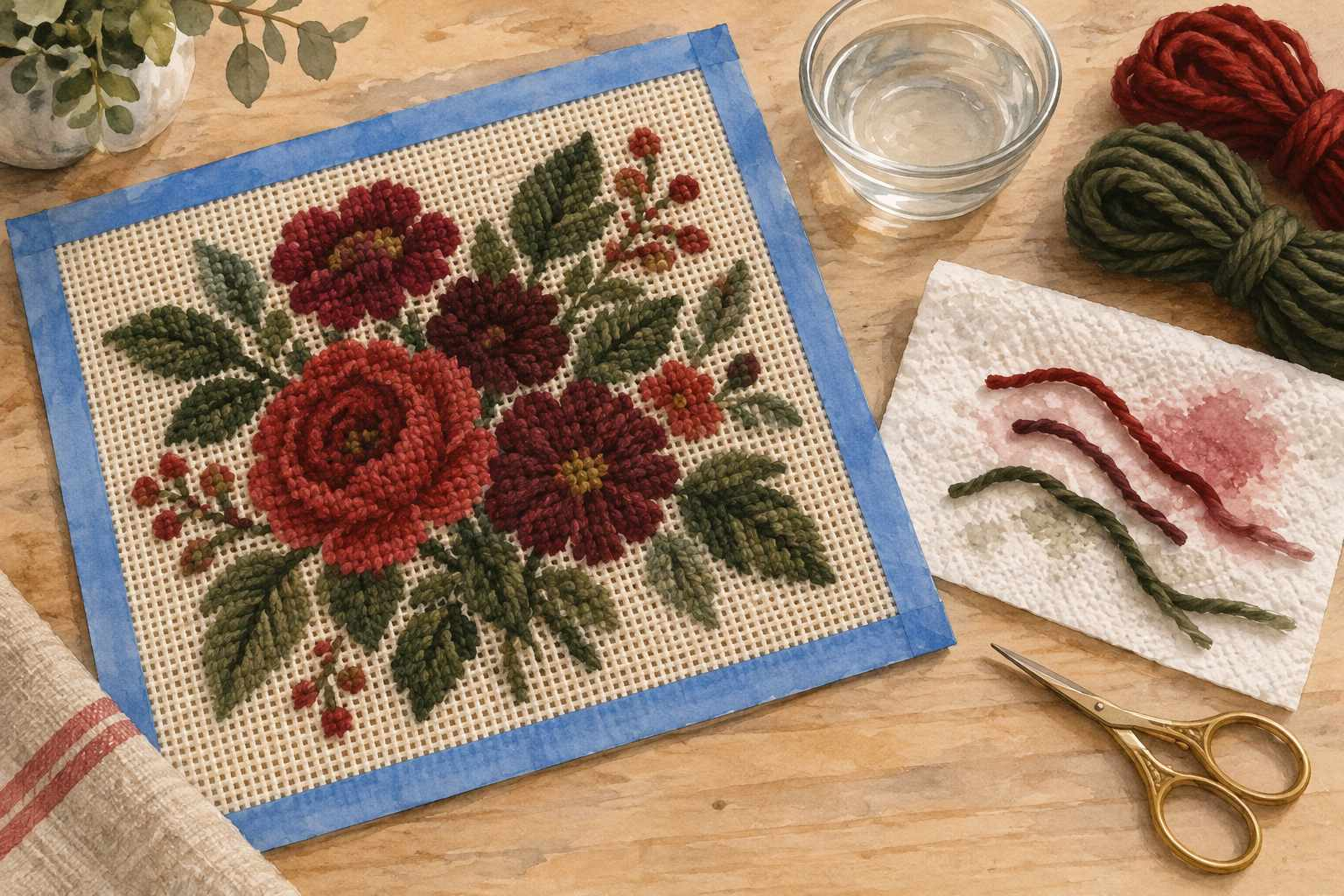
Needlepoint gets wet at the end: blocking, spot cleaning, a spilled glass. If a thread or a painted line on the canvas runs, the color goes into the wool next to it, and needlepoint writers say that often cannot be undone. This guide collects the tests those writers give for threads, finished pieces and canvas markings, what to do when something fails, and where they disagree. Last updated October 28, 2026.
Start here: before any water touches the piece, wet a short length of each thread (or dab a damp white cloth on each color) and look for color on the white. Serendipity Needleworks, Floss Field and Craft Studio all describe this test. If anything transfers, do not wet or steam the piece, and tell your finisher.
Why bleeding matters
Serendipity Needleworks defines color fastness as a thread's ability to resist fading or bleeding when exposed to water or light, and treats water here. It lists what it considers normal conditions: wet blocking, spot cleaning, overall cleaning, perspiration and overturned water glasses. It says color fastness matters most for items that get handling or wear, such as a belt, purse, napkin rings or a tray.
NeedlepointTeacher.com says before you block with the wet method to make sure your threads can get wet, and warns that many times damage cannot be reversed. The steam method does not remove the risk: NeedlepointTeacher.com offers it for silk, overdyed or other threads that may run, but still says to test all questionable fibers, and Craft Studio says steam is still water. For the blocking steps themselves, see our guide to blocking needlepoint at home.
Which threads are the risk
A label is not proof. Poppy Monk Needlepoint says that even if the label says a thread is color fast, some colors have a habit of bleeding, and singles out red. A finisher quoted on Chilly Hollow Needlepoint, Margi of Sandy's Finishing Touches, says red is not the number one color to bleed: in her experience green and burgundy are more problematic, certain overdyed jewel-toned threads bleed the worst, and she has seen red thread run orange, brown thread run red and, once, black thread run. She says silk is no more likely to bleed than other fibers, so every thread needs testing.
Pat Mazu, a finisher and author of Finishing 101, in the same post, adds deep-colored metallics and overdyed metallics, and says navy, burgundy and forest green can be real problems in any thread, even embroidery floss or yarn. She adds that some threads are color fast to dry cleaning but not to water. Stitchmate calls hand-dyed and overdyed threads the usual suspects and red the usual culprit. For overdyed threads in general, see using variegated thread.
Janet Perry of Nuts about Needlepoint explains why dye can come out at all. She says a dye works by penetrating the fiber, unlike paint or ink, that it must then be made permanent with a fixative such as heat or vinegar, and that the thread is rinsed until the water is clear, which can take repeated rinsings. If a thread is sold as colorfast, she says, that does not mean the color cannot change at all. Her post is about how dyeing works and is not a test method.
Test a thread
The best time is before you stitch, and the sources agree on the shape of the test: wet the thread, press it on something white and look.
- Cut a length of each thread. Serendipity Needleworks says at least 2 inches; Margi on Chilly Hollow says 6 to 12 inches of a skein.
- Wet it. Serendipity Needleworks lays the thread on a paper towel moistened with warm water, folds the towel over, presses firmly and leaves it at least 10 minutes. Poppy Monk dampens leftover pieces and blots them firmly with a paper towel. Margi swishes the length in cool water.
- Look at the white. Any dye on the paper towel means the thread is not color fast, Serendipity Needleworks says. Margi also checks for color transfer by blotting a dry-looking thread with a white cloth or paper towel.
- Repeat for every thread. Serendipity Needleworks and Craft Studio both say color fastness can vary between threads and even between dye lots of the same color.
Serendipity Needleworks also describes a longer test in its cleaning post: soak a piece at least 2 inches long for at least eight hours in lukewarm water, so any dye releases. As an extra step it presses the wet thread between two white paper towels with a steam iron, to make any bleed show. Its quick version for a finished piece is below.
Test a finished piece
If you have no leftover thread, test on the piece. Floss Field puts a drop of water on an out-of-the-way spot of each color, presses white blotting paper or a white cloth on it, and looks for color on the white, then looks again after a few minutes. Serendipity Needleworks dabs a damp cotton swab on a single color and checks the swab, and says to repeat for every color on the piece. Floss Field says to test the sewing thread and backing as well as the stitching, and to test again with the detergent mix if you plan to use one.
Floss Field adds a caution: a clean test is not a guarantee, because dyes sometimes run anyway. For the cleaning side, see how to clean needlepoint. Serendipity Needleworks says for spot cleaning you need only test the threads in the area you will clean, and for an overall clean, every thread used. It also says not to rub or scrub, which can make colors bleed or threads loosen.
Test the canvas markings
Thread is not the only color that can move. Floss Field's guide to painting your own canvas says a label is no proof either: a marker sold as permanent can bleed, an acrylic paint can fail to set, and a marker can hold on one canvas and run on another, because canvases differ in the kind and amount of sizing. Its advice is to wet a scrap of the same canvas. It says to let ink dry 10 to 15 minutes and paint a few days before any test.
Stitchmate agrees on the principle: paint that is waterproof when dry is the one non-negotiable, since blocking dampens the stitching and any water-soluble pigment migrates into the wool. It says acrylics pass and watercolors, washable markers and most inkjet inks fail, and suggests painting a scrap, drying it overnight, soaking it and pressing it against a paper towel. Serendipity Needleworks names Sakura Pigma Micron pens as pens it has never had bleed or smear, unlike others that claim to be permanent. For marking pens, see best pens for marking needlepoint canvas.
Floss Field's comparison guide relays a designer's warning that a marker sold as permanent can still bleed when soaked, reds and pinks especially, and her way to find out: draw a line in each color on a scrap of canvas, let it dry, spray the scrap until thoroughly wet and see. For printed canvases, Floss Field says dye ink, one of two kinds in inkjet printers, can bleed in water, while pigment ink resists it, and says to wet a printed scrap of the same canvas before stitching. A poster in a Reddit thread on a printed canvas worried about smudging while stitching and when blocking, and in another thread, commenters said Sharpies can bleed through when water is used to block and can transfer onto the thread, and suggested acrylic paint markers or Micron pens instead. These are forum comments, not tests. For how to tell the canvas types apart, see hand-painted vs printed vs charted needlepoint.
What to do if something bleeds
Do not wet the piece. Floss Field says if any color transfers, do not wet it, and to ask a finisher. Craft Studio says if something bleeds, or you cannot test it because you ran out, do not wet block or steam block, and tell your finisher before they start. Serendipity Needleworks says you do not want a finisher to use wet blocking, including steam, if your threads are not color fast or were untested.
Dry block. Poppy Monk says if the color comes off on the towel you should consider dry blocking. Stitchmate describes a dry-block variant as pinning hard, skipping the water and accepting slower results, or handing the piece to a professional. For the wider choices, see needlepoint finishing basics.
Rinse before stitching. If a thread bleeds, Margi on Chilly Hollow recommends flushing out the excess dye, then if the thread does not bleed, checking for transfer. If it still transfers, she would not stitch a project at risk of coming into contact with liquids, only projects to be framed or made into ornaments. Serendipity Needleworks gives the options as using a different thread or rinsing the one you have, and notes that rinsing may leave the color less vibrant.
Use the piece for what it can take. Pat Mazu's advice in the same post is to think about the final purpose before you start, test threads for anything that may need cleaning, such as a pillow, and always use a frame and clean hands, which reduces the need to clean or block at all.
Already bled. The sources here give no tested fix. In a Reddit thread about a vintage piece with bleeding, one commenter said they washed vintage wool needlepoint in a cold water soak, swished and rinsed until it ran clear, then rolled it in a towel and air dried, and another said that for other fiber crafts they used Synthrapol and a color catcher sheet and it worked well. Neither commenter was describing a tested needlepoint fix for a bleeding piece, so for anything valuable, ask a finisher.
Where sources disagree
Which color is worst. Poppy Monk and Stitchmate point at red. Margi on Chilly Hollow says red is not the number one bleeder and names green, burgundy and overdyed jewel tones, and Pat Mazu names navy, burgundy and forest green. The safe reading is that no color is exempt.
Setting dye with vinegar or salt. Serendipity Needleworks says neither salt nor vinegar is a dye fixative, and that what happens is the excess dye leaches into the water as the thread soaks, so it does not recommend relying on that. Margi on Chilly Hollow recommends flushing out excess dye before setting any threads with a vinegar rinse, and the question she answered was about a cold water and vinegar prewash. Nuts about Needlepoint lists vinegar as a common fixative in dyeing itself.
How long to test. Serendipity Needleworks gives 10 minutes on a wet towel for a thread, and eight hours of soaking in its cleaning post. Floss Field says to look again after a few minutes. Margi and Poppy Monk give no time.
Steam as the safe method. NeedlepointTeacher.com calls steam the safest way to square a canvas and suitable for threads that may run, but also says to test questionable fibers. Craft Studio says the colorfastness test applies to steam too.
Whether to skip the test. Serendipity Needleworks says that if the finished project will not get much wear or handling, color fastness is not a game-changer, but you should still ask your finisher which blocking method they will use. Floss Field and Craft Studio say to test before wetting at all.
Common mistakes
- Trusting a label that says permanent or colorfast. Poppy Monk and Floss Field both say it is not proof.
- Testing one thread and assuming the rest are fine. Serendipity Needleworks says to test each thread, and dye lots can differ.
- Testing the canvas ink but not the thread, or the thread but not the canvas ink. Floss Field says to test paint on the canvas as well.
- Rubbing at a stain. Serendipity Needleworks says rubbing can make colors bleed; see fixing needlepoint mistakes for stitching problems.
- Drying in the sun. NeedlepointTeacher.com says sun can fade threads, and says to dry flat for at least 24 hours so the thread colors do not run down to one side.
FAQ
Do I have to test every thread?
Serendipity Needleworks says yes, because color fastness can vary from thread to thread and between dye lots. Margi on Chilly Hollow says to test all threads before stitching.
Is red the thread most likely to bleed?
Poppy Monk and Stitchmate single out red. A finisher on Chilly Hollow says green and burgundy give her more trouble. Test them all.
Can I block if a thread fails?
Not with water, say Floss Field and Craft Studio. Poppy Monk suggests dry blocking and Stitchmate says to dry block or hand the piece to a professional.
Can I test after I have stitched the piece?
Yes. Floss Field and Serendipity Needleworks both give a spot test on the finished piece, with a drop of water or a damp swab on each color.
Does a pass guarantee safety?
No. Floss Field says a clean test is not a guarantee, so go carefully.
How do I handle a framed piece?
Local Needlepoint Shops says to test the threads before you block, whichever method you use, and says NeedlepointTeacher.com warns the damage often cannot be undone. See how to frame needlepoint.
Sources
- Serendipity Needleworks - Color Fastness in Needlepoint Thread (a needlepoint shop blog post dated June 18, 2023, so a seller)
- Serendipity Needleworks - Cleaning Your Needlepoint, Part 1 (the same shop, dated May 21, 2023, with the long soak and swab tests)
- Serendipity Needleworks - Painting Needlepoint Canvases (a guide to painting canvases, with a pen recommendation)
- Chilly Hollow Needlepoint Adventure - Should I Prewash My Red Threads? (a February 12, 2018 post repeating advice from two finishers)
- Floss Field - How to block needlepoint (a needlepoint guide with a pre-wet test)
- Floss Field - How to clean needlepoint safely (the same site's cleaning guide with the colorfastness step)
- Floss Field - How to paint your own needlepoint canvas (covers permanence of markers, paints and printer inks)
- Floss Field - Painted, printed and charted needlepoint: the difference (notes on ink that can bleed and the marker test)
- NeedlepointTeacher.com - Blocking Needlepoint Using Wet Method (a needlepoint teacher and author's tutorial)
- NeedlepointTeacher.com - Blocking Needlepoint Using Steam Method (the steam alternative for threads that may run)
- Craft Studio - How to Block and Finish Needlepoint (an app maker's guide that repeats a shop's bleed test)
- Stitchmate - How to Finish Needlepoint: Block, Frame and Make Ornaments (an app maker's guide with a dry-block variant)
- Stitchmate - Paint Your Own Needlepoint Canvas (an app maker's guide on waterproof paint)
- Poppy Monk Needlepoint - Needlepoint Blocking Board Recommendations and Tips (a kit seller, so a seller)
- Local Needlepoint Shops - How to Block and Frame Needlepoint (a directory guide that relays NeedlepointTeacher.com's warning)
- Nuts about Needlepoint - How Did that Thread Get Dyed? (a December 8, 2020 explainer on dyes and fixatives, not a test)
- Reddit r/Needlepoint - Canvases with Sharpie? (a community thread, February 2025, so opinion and not a test)
- Reddit r/Needlepoint - Have you used Synthapol in a wash and wet block? (a community thread, August 2026, so opinion and not a test)
- Reddit r/Needlepoint - Non waterproof printing on canvases (a community thread, 2026, so opinion and not a test)