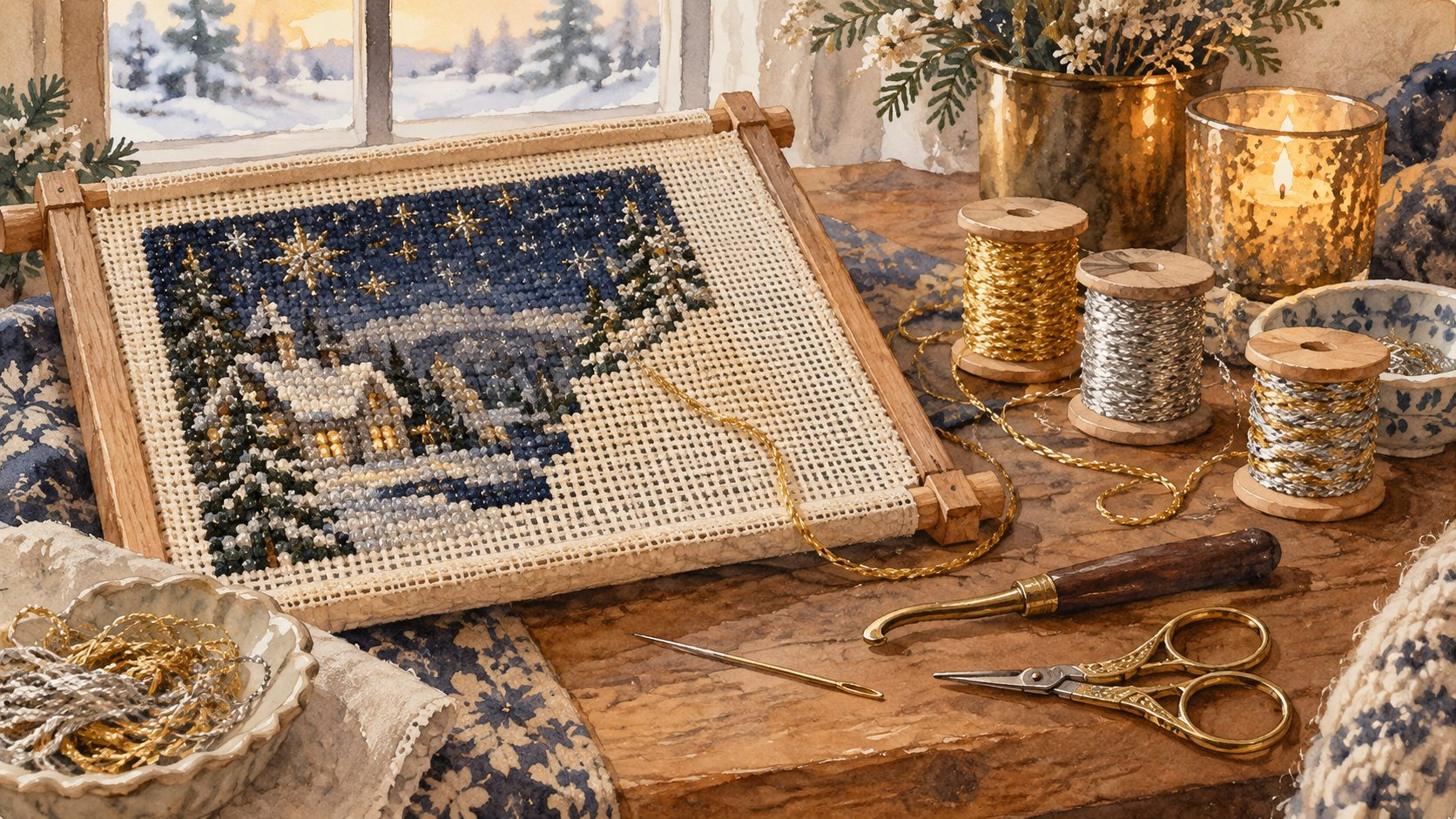
Metallic thread frays, kinks and slips out of the needle. Stitchers and needlepoint shops give nearly the same fixes: cut shorter lengths, use a needle one size bigger, stitch with an up and down motion, and work slowly. They differ on exactly how short, whether you need a laying tool, and whether metallics really dull your scissors.
Needlepoint.com says to work with lengths of about 10 inches, because metallics are synthetic and fray as they are pulled through the canvas. NeedlepointTeacher says to use a slightly larger needle than the canvas needs, and to stab the needle up and down instead of sewing it through. Serendipity Needleworks says to stitch more slowly than usual. If you only change one thing, cut the thread shorter.
Cut it short
Every source that gives a number says to cut metallics shorter than you would cut wool or floss, but the numbers differ. Needlepoint.com says about 10 inches. Floss Field says about 12 inches, and Serendipity Needleworks says no longer than 14 inches, with 12 even better. NeedlepointTeacher says to use shorter lengths in general, and 18 inches for Kreinik filament, the very fine metallic that is made to be blended. Purple Rose Embroidery explains the reason: the more times metallic thread goes through the cloth, the more likely it is to break, so short strands are dragged through fewer times.
Purple Rose Embroidery adds a second habit: keep the needle near the very end of the thread, a couple of inches from the end, and leave it there for that whole length. Metallic thread frays around the eye, so this keeps the damaged part to a short stretch and the rest of the length stitches normally.
Use a bigger needle
Three sources say to go up one needle size. Serendipity Needleworks says the larger needle opens the canvas hole a little more so the thread glides through instead of dragging. Its example: on 18 mesh canvas, if you normally use a size 24 tapestry needle, use a 22. It also reminds you that a higher needle number is a finer needle. NeedlepointTeacher gives the same advice, and Stitch NZ says a slightly bigger needle is easier to thread and pushes the fabric threads apart so the thread slides through. Our guide to choosing a needlepoint needle has the size chart for each mesh count.
How to stitch it
- Stab, do not sew. Serendipity Needleworks says to put the needle straight down into the canvas from the top or the back and pull it all the way through, instead of using a sewing motion. It says this helps prevent fraying. NeedlepointTeacher says the same, and describes the motion as "like a sewing machine" for Tiara and filament.
- Let the needle hang. Serendipity Needleworks and Stitch NZ both say to let the needle dangle every few stitches so the thread can unwind. Floss Field says the same and suggests waiting until the thread stops turning.
- Go slowly. Serendipity Needleworks says working more slowly is essential. Stitch NZ says it lets you watch the thread and see that your stitches are neat.
- Use a single strand. Stitch NZ says to use one strand and, if you need more coverage, move to a thicker thread. Its example is a Kreinik #8 instead of a #4.
- Do not drag it tight. Floss Field recommends a gentler pull, and says to start a fresh length as soon as one looks worn. Our even tension guide covers the same habit for any thread.
Starting and ending
NeedlepointTeacher says never to start a metal thread with a large permanent knot. The ball on the back makes a bulge on the front, so use an away knot, a waste knot, or pass the end through neighboring stitches, and remove the knot after stitching. Stitch NZ, which writes for fabric and not canvas, says to leave a longer tail at the back and stitch the first few stitches over it, then finish by running the tail under more stitches. See also our guide to starting and ending thread.
If the thread keeps slipping out of the needle, Stitch NZ and Floss Field both say to knot it to the eye. Stitch NZ describes two ways: tie a knot with the long thread and the tail, or loop the tail back through the eye and pass both ends through the loop. Floss Field's method for a doubled thread is to cut it twice as long, fold it in half, push the fold through the eye, pass the two ends through the loop and pull snug. The Stitch NZ tied knot will need tightening from time to time, according to that source.
For ends that fray before you start, NeedlepointTeacher says to put a dab of Fray Check by Dritz or clear nail polish on the ends and let it dry. Serendipity Needleworks agrees and suggests pre-cutting your lengths and treating both ends at once.
Kinds of metallic thread
| Type | What sources say |
|---|---|
| Braids | Serendipity Needleworks says braids are the most commonly used metallic in needlepoint, run from size 4 up to size 32, and cannot be divided. It uses sizes 8, 12 and 16 most on 13 and 18 mesh. NeedlepointTeacher says to lay a braid flat and use a larger needle. |
| Flat ribbons | Needlepoint.com names Neon Rays, Neon Rays Plus and Fyre Werks as flat threads and says to use a laying tool. NeedlepointTeacher says Fyre Werks ends will fray. Needlery says Neon Rays can kink and may be dampened or "popped". |
| Twisted threads | NeedlepointTeacher says Tiara is softer and easier to stitch on canvas because of its twist, but the ends fray. Needlery says to use short lengths. |
| Blending filament | NeedlepointTeacher says it is very fine and can go in the needle with other threads or over stitch on top. It gives 18 inches for filament. |
| Metallic floss and pearl | NeedlepointTeacher says DMC metallic embroidery thread is 3-ply, divisible, washable and resistant to tarnish. It says DMC metallic pearl cotton is size 5 and comes in gold or silver only. |
Serendipity Needleworks says you can use metallic thread anywhere a part of the design is naturally light-reflective, and gives snow, stars, candlelight and shimmering wings as examples. Needlepoint.com likes metallics for open stitches in large spaces, for small areas of sparkle, for eyes and for snow. Our guide to needlepoint thread types and thread by mesh count chart cover the other fibers and which mesh each suits.
Laying tool, conditioner and scissors
Laying tool. Needlepoint.com says to use one for flat threads so they lie smooth and even. NeedlepointTeacher says to consider one for braid. NeedlenThread lists "Use a laying tool!" among the standard tips, then says it did not need one with a particular braid.
Thread conditioner. Purple Rose Embroidery says a conditioner such as beeswax cuts friction, since the rough surface is part of why metallics fray. Stitch NZ says a conditioner like Thread Magic is not essential, but some stitchers use it to smooth the thread and prevent fraying. Serendipity Needleworks says a damp cosmetic sponge folded around the thread and pulled down its length takes the curl out of kinked braid, and that sliding your thumb and finger down the thread 10 or so times also helps.
Scissors. Needlepoint.com says metallics will dull your embroidery scissors over time, so cut them with a separate pair. The Chilly Hollow Needlepoint blog disagrees in part: it says real metal threads may call for their own scissors, but doubts that synthetic metallics like Kreinik do more damage than other thread. If you want a separate pair, it suggests serrated blades.
Care and finishing
NeedlepointTeacher says that metal sometimes tarnishes and suggests treating it as patina, or picking another thread if you do not like it. It says to avoid chlorine and other bleaches, clean with caution, block if needed, and use stretcher bars while stitching to keep dirt off. Floss Field, writing about cross stitch, says metallic thread does not like heat, and says to press from the back with a cool iron or let the piece dry flat and skip the iron. See our guide to blocking needlepoint and guide to cleaning needlepoint before you press a piece with metallics in it.
Where sources disagree
- Length: Needlepoint.com says about 10 inches, Floss Field about 12, Serendipity Needleworks 12 to 14. NeedlenThread, writing about hand embroidery, says folks advise 12 inches or shorter, and says it cut one brand of braid at 18 inches with no breakage.
- Whether metallics always fray: Serendipity Needleworks says they will fray, with no way around it. NeedlenThread says some braids, in its test, did not twist, snag or break.
- Laying tool: Needlepoint.com says to use one for flat threads. NeedlenThread says it did not need one, and did not use a conditioner either, for the braids it tested.
- Scissors: Needlepoint.com says metallics dull scissors. Chilly Hollow doubts it for synthetic metallics.
- Real metal versus synthetic: Chilly Hollow says real metal threads may call for their own scissors but doubts that synthetic metallics do the same harm. Check which kind is on your spool before you pick a method.
- Cross stitch and embroidery sources: Floss Field, Stitch NZ, Purple Rose Embroidery and NeedlenThread are not about needlepoint canvas. The habits carry over but the fabric is different, and Purple Rose says Aida with open holes is lower risk than closely woven cloth.
Questions
How long should I cut metallic thread for needlepoint?
Sources say 10 to 14 inches for most metallics. Needlepoint.com says 10, Floss Field 12, Serendipity Needleworks 12 to 14, and NeedlepointTeacher 18 for fine filament.
What needle size should I use?
One size bigger than the canvas calls for, per Serendipity Needleworks, NeedlepointTeacher and Stitch NZ. On 18 mesh that means a 22 instead of a 24.
Why does metallic thread keep coming out of the needle?
It is slippery. Floss Field and Stitch NZ both say to knot it to the eye of the needle.
Can I start with a knot?
NeedlepointTeacher says not to use a large permanent knot. An away knot or a waste knot that you cut off later is the safer way.
Do I need a laying tool?
Needlepoint.com says yes for flat ribbons like Neon Rays and Fyre Werks. NeedlepointTeacher says to consider one for braid.
Can I iron a piece with metallic thread?
Floss Field says metallic thread does not like heat and to use a cool iron from the back, or skip it. Check the thread's own label too.
Sources
- Needlepoint.Com: Tips For Stitching With Metallic Needlepoint Threads
- NeedlepointTeacher: Metallic Threads
- Serendipity Needleworks: 8 Tips for Working with Metallic Threads
- Chilly Hollow Needlepoint Adventure: Tips for Stitching with Metallics
- Stitch NZ: Using Metallic Threads
- Purple Rose Embroidery: Top tips for stitching with metallic threads
- NeedlenThread: Thread Talk, The Metallics You Want to Use
- Needlery: Metallic and Synthetic Fibers
- Floss Field: Metallic, variegated and specialty threads in cross stitch