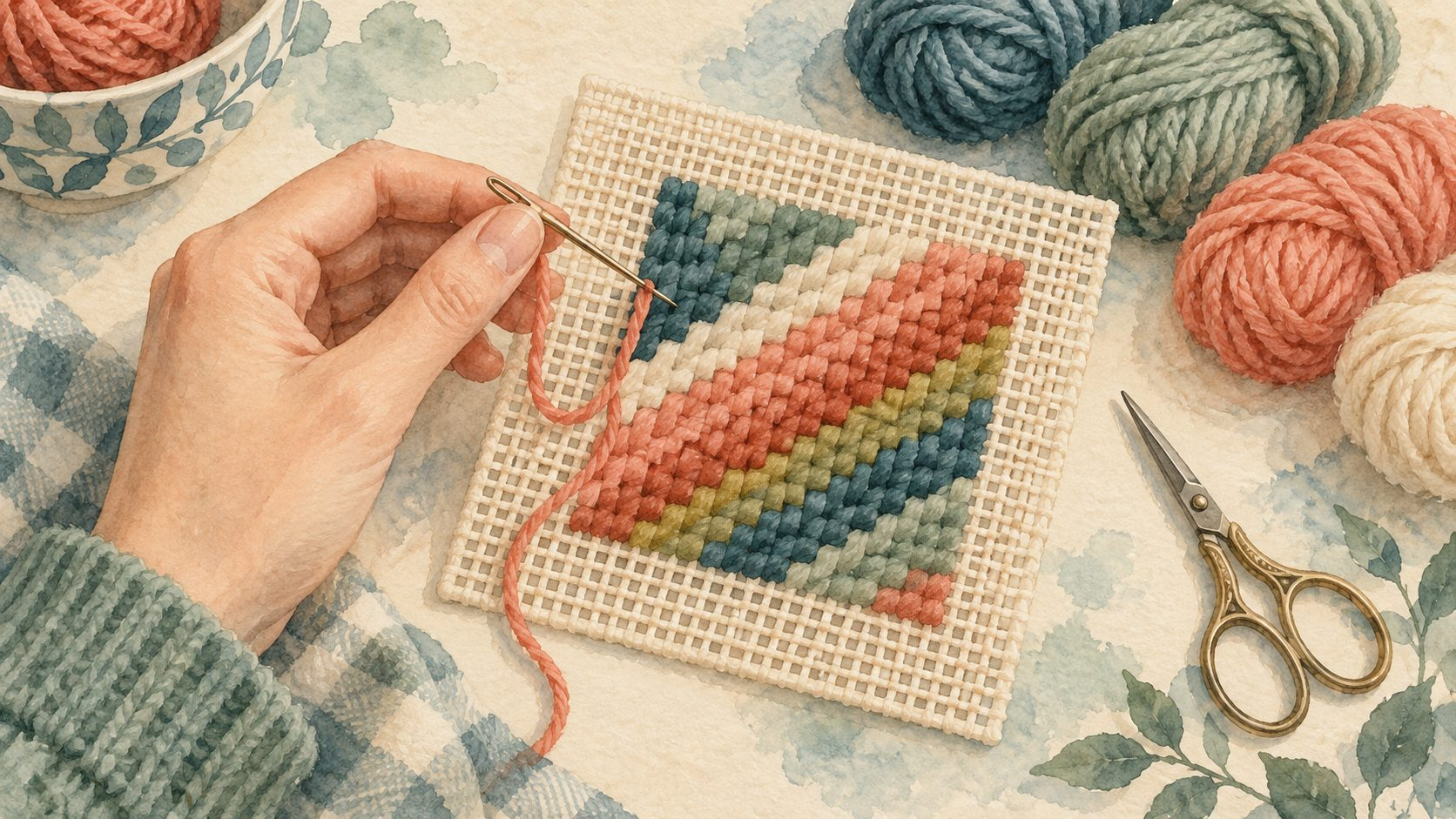
Most needlepoint diagrams are drawn for right-handed stitchers. The sources we read agree that left-handers can still stitch every stitch, and that all the stitches on one canvas must slope the same way. They differ on whether to mirror the diagrams, start in a different corner, or simply stitch the standard way.
Greystone Needlepoint says left-handers begin basketweave in the lower left corner of the canvas, where right-handers begin in the upper right. Modern Mesh and Poppy Monk both say to start continental stitch in the upper left corner if you are left-handed. One Off Needlework says the only real rule is that every stitch on a canvas slopes the same way. Pick one method, test it on a scrap of canvas, and keep the slant consistent.
Three ways to approach it
- Mirror the diagrams. One Off Needlework says its left-handed diagrams are a mirror image of right-handed ones, and that the only difference is that stitches slope in the opposite direction. It also says it was told by an American left-hander that US needlepoint exhibitions have a rule about slant, and that stitches sloping the wrong way would not win prizes. We did not find that rule in any other source we read, so treat it as one person's report.
- Change where you start and which way you travel. Needlepoint.com says left-handers may find it easier to work left to right and to experiment with directions until one feels comfortable. It says most stitch patterns can be mirrored or adjusted.
- Stitch it the usual way. A commenter on the Greystone post, who says she is left-handed, recommends learning to stitch as a right-hander would, so she can see her work as she goes. The commenter says stitching left-handed meant she could not see her work and dragged her hand over finished stitches. This is a reader comment, not the shop's advice.
Continental stitch
The Spruce Crafts describes the right-handed method. The first row runs from right to left, each stitch slants from the bottom diagonally up over one canvas intersection, and you start in the upper right area of the design. Because the stitch is always worked right to left, it says you either turn the canvas around for each new row, or, on a frame, turn the frame upside down or work the next rows left to right with stitches going down diagonally.
For left-handers, Modern Mesh says to start in the upper left corner instead of the upper right. Poppy Monk says the same, and adds that the first thread goes downwards in its left-handed version of the diagram. Greystone says left-handers should come up on the odd numbers of the diagram and go diagonally down on the even numbers.
Needlepointers, in a plastic canvas tutorial, says you can make the continental stitch from left to right or right to left. Its author, who says she is left-handed, prefers to start on the left side and work towards the right, which means starting each stitch on the top right and going down at the bottom left. This is plastic canvas, not fabric canvas, but the stitch path is the same idea. Our continental vs half cross guide compares the tent stitch versions.
Basketweave
The Spruce Crafts says that with many needlepoint stitches left-handers can reverse the right-handed directions, but that this is difficult to do with basketweave. Its tip is to remember that all the stitches slant in the same direction and the rows are worked on the diagonal only. It says to make the first stitch in the lower left corner, move two canvas mesh to the right for the second, set up the corner, and then work diagonal rows up and down. It says that to tell which way to go, look at the back: if the last row you stitched is horizontal on the back, the next row goes downward, and if it is vertical, the next row goes upward.
HiFi Makes has a longer left-handed basketweave guide. It says to always start in the bottom left of the canvas and work up toward the top right, and to cover each intersection by stitching from top right to bottom left. It teaches "steps" and "poles": an intersection where the top canvas thread is horizontal is a step, worked diagonally upward, and one where the top thread is vertical is a pole, worked diagonally downward. Rows alternate between steps and poles as you cross the canvas. Its advice for an irregular shape is to look for the lowest left row, find out whether it is a step or a pole, and start there. For stitching the same stitch right-handed, see our basketweave how-to and basketweave for beginners.
Habits that help
- Stop in the middle of a row. HiFi Makes says this reminds you which direction to work when you come back. The Spruce Crafts says to leave the needle pointing in the direction you were working, and to finish a row and place the first stitch of the next one before stopping if you can.
- Keep threads short. HiFi Makes says 18 to 20 inches for basketweave. Greystone says about the length from your fingertip to your elbow.
- Bury ends horizontally or vertically. HiFi Makes says burying a basketweave thread diagonally can disturb tension and leave ridges. See our starting and ending thread guide.
- Mind tension. HiFi Makes says it is easy to pull too tightly on diagonal stitches, and to stop pulling once you feel resistance. See even tension.
- Check the back. HiFi Makes says a true basketweave shows threads moving horizontally and vertically in alternating rows. A Greystone commenter reported that her back looked like parallel slanted lines when she followed a left-handed guide. The post does not answer her.
- Tools. Needlepoint.com says left-handed scissors and ergonomic tools can make a difference.
Quick comparison
| Stitch | Where a left-hander starts, per source | Source |
|---|---|---|
| Continental | Upper left corner | Modern Mesh, Poppy Monk |
| Continental (plastic canvas) | Left side, working left to right | Needlepointers |
| Basketweave | Lower left corner | Greystone, The Spruce Crafts, HiFi Makes |
| Any stitch | Mirror the diagram, slant the opposite way | One Off Needlework |
Where sources disagree
- Mirror, change start, or do it the standard way: One Off Needlework says to mirror the diagrams. Needlepoint.com says to adapt and experiment. A reader on Greystone says to stitch right-handed. None of them compare the results.
- Slant direction: One Off Needlework says mirrored diagrams slope the opposite way from right-handed ones and that this is fine as long as the slant is consistent. HiFi Makes describes a left-handed basketweave where each stitch goes from top right to bottom left. The Spruce Crafts and Greystone say all stitches should slant the same way. We could not confirm from the text alone how every source draws the slant, so check the diagram you follow before you start.
- Can you reverse basketweave: The Spruce Crafts says reversing right-handed directions works for many stitches but is difficult for basketweave. One Off Needlework says mirror diagrams work for tent stitch in general.
- Competition rule: One Off Needlework passes along a report that exhibitions in the US require a particular slant. No other source we read mentions it. If you plan to enter one, ask the organizer.
- Kits and pricing: Several of these sources sell kits or canvases. We did not check prices.
Questions
Is needlepoint harder for left-handers?
One Off Needlework says wool, canvas and needles have no right or left side, so it should not be, and suggests left-handers try stitching their own way. Greystone says it can feel intimidating when diagrams are for right-handers.
Where do I start on the canvas?
Lower left for basketweave according to Greystone and HiFi Makes. Upper left for continental according to Modern Mesh and Poppy Monk.
Do my stitches have to slope a certain way?
One Off Needlework says the only rule is that they all slope the same way on one canvas.
Which stitch should I learn first?
Modern Mesh says continental is the one it recommends learning first. Greystone suggests starting with a background in basketweave. See needlepoint stitches for beginners and kits for beginners.
What do I do if I stop mid-row?
The Spruce Crafts says to leave the needle pointing the way you were working. HiFi Makes says to stop in the middle of a row as a reminder.
Sources
- Greystone Needlepoint: A Left-Handed Beginners Guide to Needlepoint
- Needlepoint.com: Stitching for Left-Handers, Tips, Tricks and Techniques
- HiFi Makes: Basketweave for Left-Handed Needlepointers
- One Off Needlework: Left Handed Stitchers
- The Spruce Crafts: Continental Tent Stitch for Right- and Left-Handers
- The Spruce Crafts: Basketweave Needlepoint Stitch Tutorial
- Modern Mesh: Beginner's Guide to Needlepoint
- Poppy Monk Needlepoint: Learn How to Needlepoint
- Needlepointers: How to Continental Stitch on Plastic Canvas