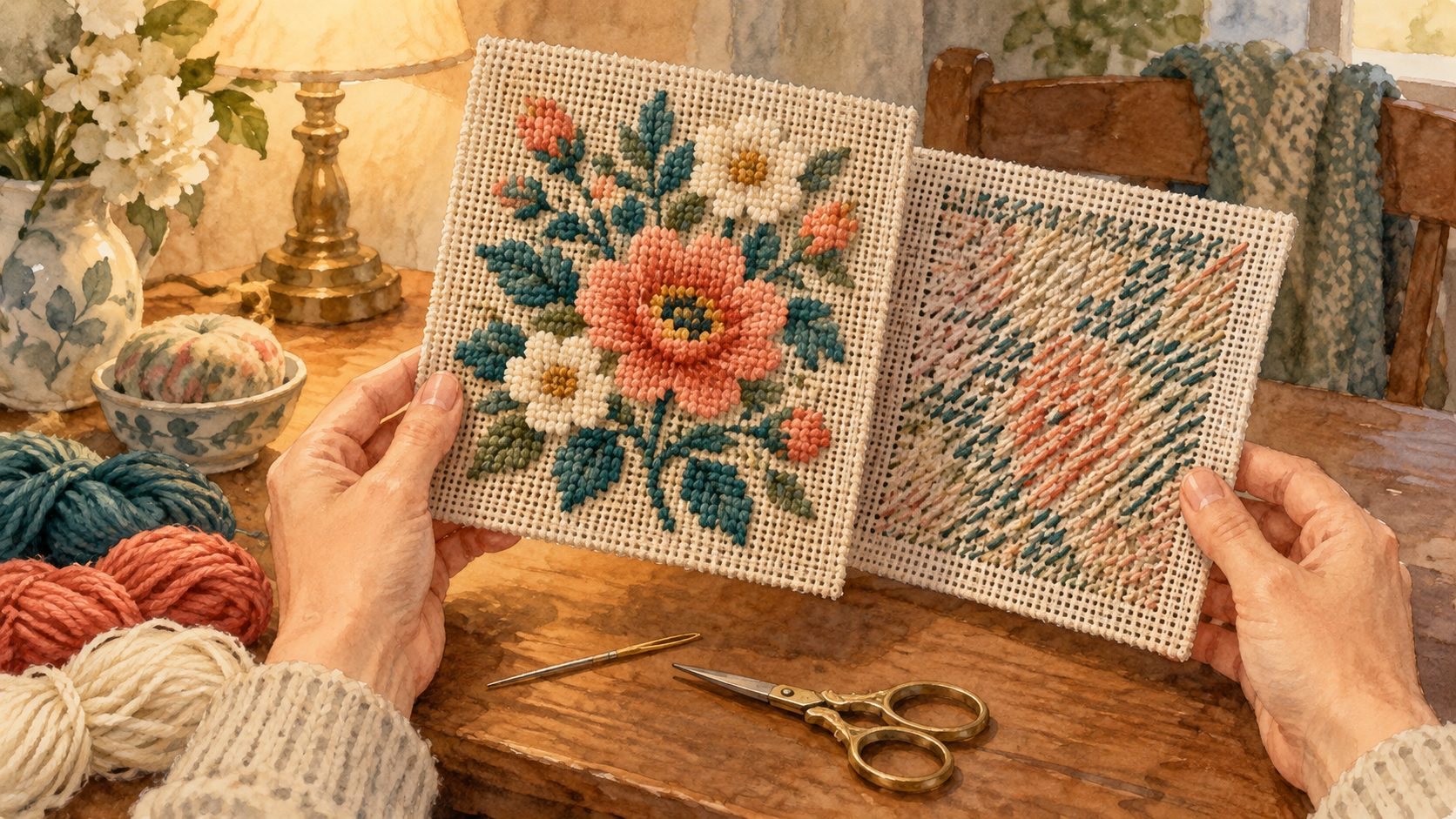
The back of a needlepoint canvas shows how you stitched. Needlepoint writers give a short list of habits for a neat back: stitch light colors before dark, do not drag thread far, cover the canvas well, and secure the ends. They differ on knots, how far is too far to carry a thread, and whether parking works on canvas at all.
Nuts About Needlepoint says to stitch from light to dark, not to drag your thread more than half an inch to a new area, to make stitches with good coverage on the back, and to cut off thread tails as you go. Floss Field puts the travel rule in one line: do not carry a thread far across the back, end it and start again. If you do those four things, most of the mess goes away.
Rules for a neat back
- Light before dark. Nuts About Needlepoint says stitching light after dark can mix dark fibers into the light thread. It also says that when a light thread passes behind an area where a darker thread is carried across the back, it makes a shadow on the front of the canvas. Stitching light to dark avoids that.
- Do not drag more than half an inch. Nuts About Needlepoint says moving thread across stitched or unstitched canvas for more than half an inch looks messy and can change the tension of your stitches. It says it is better to end the thread and start again in the new area.
- Good coverage on the back. Nuts About Needlepoint says taking the longest way from the end of one stitch to the start of the next gives good coverage. The check is bare canvas on the back where the front is covered. The result is a fuller piece that wears better, according to that source.
- Pierce your starting tails. If you start with a waste knot or away knot, Nuts About Needlepoint says later stitches should pierce the thread coming from the knot, holding it from the back if it keeps moving away.
- Cut off tails as you go. Nuts About Needlepoint says loose ends get caught in new stitches and can pull out and show on the front.
Carrying and traveling thread
Serendipity Needleworks separates two ideas that sound alike. A stitch pathway is the order in which you do the parts of a stitch. "Traveling" is how the thread lies on the back of the canvas as you stitch. Its author says to keep canvas holes clear of travel threads where you can, and if you cannot, to be consistent by repeating the travel in the same way so it makes a duplicate pattern in that area.
NeedlenThread, writing about hand embroidery on fabric and not canvas, describes a different way to move across a gap: "travel" the thread by whipping it through the backs of existing stitches to the new starting point, or work little backstitches from the front through an area that will be covered later. It says this avoids long threads across the back that can knot or tangle. That method suits a surface stitched fabric. On canvas, Nuts About Needlepoint and Floss Field both say to end the thread instead of carrying it far.
The cost of finishing a thread and starting a new one is small. Our guide to starting and ending thread walks through the methods.
Starting and ending without bulk
NeedlepointTeacher says thread should be no longer than 18 to 20 inches, and describes three starts. A waste knot: knot the end, come up about an inch and a half from your first stitch, and stitch toward the knot so the stitches cover the thread on the back, then snip the knot. An anchoring "L": make an L shape of stitches four or five intersections away from where you start, so no knot is needed. An away knot: for stitches where the back is not covered enough, such as Belgium Cross, start with the knot away from the work area and tack the thread down as you come to it. To end, it says to run the needle under a few stitches on the back and cut off the rest, with a longer tail or a second pass if the thread is slippery. It adds that anchoring in the same color avoids ghosting and that you should never leave knots on the back.
Needlepoint For Fun says that when the stitches are secure, you slide the needle under three or four nearby stitches, and that the direction matters for the tension on the front. For basketweave, which has horizontal and vertical threads on the back, it says to slide the needle diagonally under them, because that gives the least distortion. Where the stitches do not give secure cover, it recommends a Bargello tuck: weave the end through several stitches and back through again in the opposite direction, under at least an inch of stitches, without pulling too tightly. Nuts About Needlepoint describes the same tuck and adds that the thread must go over at least one stitch before it goes back under, or the tail pulls out. See also our basketweave guide and continental versus half cross stitch for how each stitch lies on the back.
Stitch pathways
| Pathway | What Serendipity Needleworks says |
|---|---|
| Satin | As much thread on the back as on the front. The thread circles the canvas threads as you work across a row, with stitches side by side. Upright Gobelin is the example. |
| Running | An up and down forward motion, as in a darning pattern. |
| Double running | One row in two passes, across and back. |
| Backstitch | Circles the canvas threads like satin, but stitches lie end to end. |
| Run and back | A composite of running and backstitch. Use a chenille needle so you can pierce the working thread and keep it in line. |
| Conservative | Leaves very little thread on the back. The half-cross variation of tent stitch is its example. |
The same author says to keep one pathway for a whole stitch pattern, because switching midway can make the work lumpy, and to work from a "clean" hole, with no thread in it, to a "dirty" hole that already holds thread. For layered stitches like Smyrna cross, keep the top legs all in one direction. Our stitches for beginners guide has the common stitches to practice this on.
Parking threads
Parking means leaving a thread waiting on the front of the work instead of ending it. Floss Field describes it for cross stitch: you work a small block, bring each color up at the square where it is needed next, and let it hang. NeedlenThread says parking saves time because you are not ending threads every few minutes, and says to bring parked threads up in an area you will stitch later, so the holes are covered. Peacock and Fig compares parking with cross country stitching, and says parking is easier to follow but leaves many needles and threads hanging.
All three sources are about cross stitch or embroidery on fabric, not needlepoint canvas. We found no needlepoint source that recommends parking on canvas, and Nuts About Needlepoint and Floss Field both advise ending the thread when you move far. Treat parking as an idea to test on a doodle canvas, not a rule.
Where sources disagree
- Knots: NeedlepointTeacher says never to leave knots on the back. Needlepoint For Fun says a slippery thread may need a small knot, because a thread that comes loose and pulls through to the front after framing is worse than a knot that cannot be seen.
- How far to carry: Nuts About Needlepoint gives half an inch. Floss Field says not far and gives no number. NeedlenThread, for embroidery, says to travel the thread along stitches to a new spot, not to carry a loose thread across.
- Tail security: NeedlepointTeacher uses waste knots, L stitches and away knots. Nuts About Needlepoint and Needlepoint For Fun add the Bargello tuck for stitches with little back cover.
- Cross stitch and embroidery sources: Floss Field's parking guide, Peacock and Fig and NeedlenThread are not about canvas. Their habits may not carry over.
Questions
Does the back of my needlepoint need to be neat?
Nuts About Needlepoint says it affects the front too, through shadows from dark thread behind light areas, and through wear if coverage is poor. A neat back also helps whoever frames or finishes the piece, see our framing guide.
How far can I carry a thread?
Nuts About Needlepoint says no more than half an inch. Floss Field says not far.
Should I use knots?
NeedlepointTeacher says never leave them on the back. Needlepoint For Fun says slippery threads may need one.
Which stitch leaves the least thread on the back?
Serendipity Needleworks says half-cross tent stitch, a conservative pathway.
Is a thicker back worse?
Nuts About Needlepoint says good coverage on the back makes the piece fuller and wear better, so a fuller back is not a fault.
Sources
- Nuts About Needlepoint: Keys to a Neater Back
- Serendipity Needleworks: Needlepoint Stitch Pathways
- Serendipity Needleworks: Revisiting Needlepoint Stitch Pathways
- NeedlepointTeacher: Start and End a Thread
- Needlepoint For Fun: How To Start and End A Needlepoint Thread
- Floss Field: How to needlepoint, a beginner's guide
- Floss Field: Cross stitch parking method, cross country and confetti
- NeedlenThread: Starting and Traveling, Stitching Efficiency
- NeedlenThread: Parking Embroidery Threads
- Peacock and Fig: Parking versus cross-country stitching