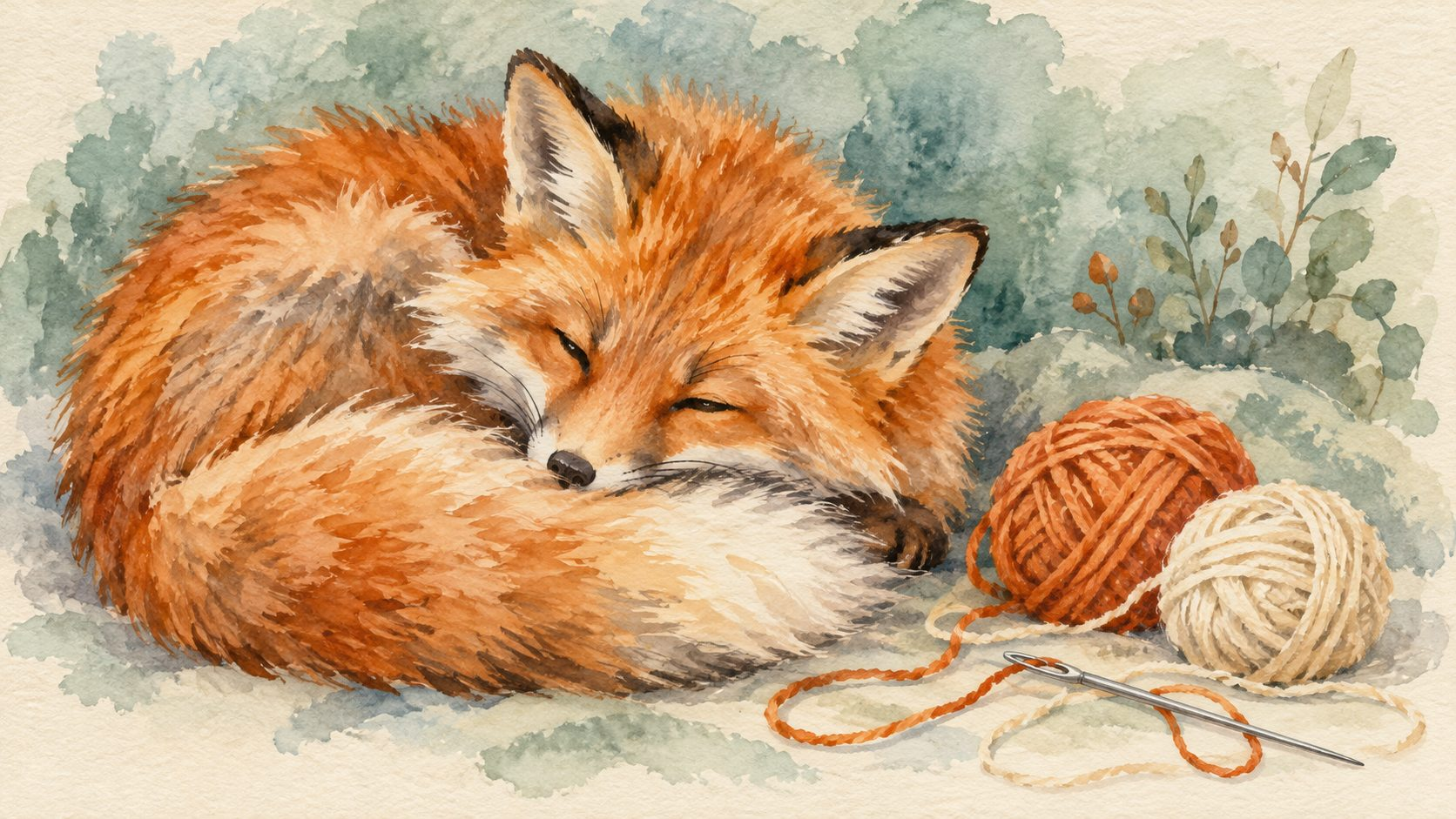
Animal fur on a needlepoint canvas is mostly a matter of stitch direction and thread choice. The sources we read agree that long, slightly irregular stitches that follow the way the fur grows look best, and that fuzzy or loopy threads and stitches are the shortcut for fluffy areas. They differ on which stitch is the best one, and some of the best fur advice comes from embroidery, not canvas.
Unwind Studio calls the long stitch the star for fur and feathers, and says encroaching gobelin is a go-to for realistic, layered fur on animals such as wolves, bears and cats. Serendipity Needleworks says to study photos of the animal first and draw arrows for the direction the fur grows, then work in the long and short stitch with random lengths. If the fur is fluffy, such as a bunny tail, Needlepoint.com suggests turkey work.
Stitches for fur
- Long stitch. Unwind Studio says its length and direction can imitate soft tufts of fur, manes and tails, and suggests layering long stitches or mixing short and long ones for depth. Its own stitch page says to keep a single long stitch under 20 canvas holes, and to break bigger areas into several groups of stitches.
- Encroaching gobelin, also called interlocking gobelin. Unwind Studio says each row slightly overlaps the one before, which mimics how fur lies, and that changing shades and stitch lengths adds depth. KC Needlepoint says the two names are the same stitch and lists it, in several sizes, among its favorites for animals. Serendipity Needleworks says it is easy to work and easy to compensate, and that it is slightly directional.
- Long and short stitch. Serendipity Needleworks uses it for realistic, painterly fur with randomly placed stitches. Its author says there is no single right way when you work it randomly for fur, hair, feathers or petals.
- Cashmere stitch. Unwind Studio recommends it for smooth, short-haired animals and for small areas such as ears and noses, because it has a tidy, woven look.
- Kenan stitch. KC Needlepoint says it loves this one for animal fur and that it works in small spaces.
- Tressed stitch and half ray. Unwind Studio recommends the tressed stitch for feathers, tails or a stylized mane. KC Needlepoint says half ray is designed to look like feathers. These are for birds more than fur.
Plan before you stitch
Serendipity Needleworks gives a process for the long and short stitch on a painted canvas. Photocopy the canvas, trace the main shapes and lines onto tracing paper, and find several photos of the animal. Look at how the fur grows on the ears, around the muzzle, and where the direction changes, then take notes. Draw arrows on the traced design to show the growth direction. Start at the top and work one row at a time. The author usually works the background first when the long and short stitch is used on the focal point.
The same source says stitches should be irregular in length, staggered across the area, and that the angle can change from stitch to stitch. Its example mixes a stitch over 1 vertical and 4 horizontal canvas threads with one over 2 vertical and 7 horizontal. It says it is fine to stitch a little outside the painted area, because fur sticks out.
Crewel Ghoul is about embroidery on fabric, not canvas, but its advice carries over in spirit. It says to use a reference photo that shows the real colors and the direction the fur lies, to choose similar colors for smooth blending and contrasting colors for sharp changes, and to avoid a regular long, short, long, short pattern because the eye picks up patterns. It also says to use a smooth, uniform direction where colors blend gradually, and to let stitches overlap where the fur changes direction. For a pet portrait, our pet photo to needlepoint pattern guide covers the pattern side.
Threads that look like fur
Serendipity Needleworks uses Alpaca 18 for interlocking gobelin. It describes the thread as 100% alpaca, comparable in size to DMC number 5 pearl cotton, best on 14 to 18 mesh, in 17 natural colors, and very soft, so it says to use shorter pieces of about 16 inches and to move the needle along the length of the thread as you stitch. Its sample uses one strand on 13 mesh with a number 22 tapestry needle. It says Bella Lusso also works for this stitch, at 4 to 5 strands on 13 mesh and 2 to 3 strands on 18 mesh. For the long and short stitch, the same author likes Bella Lusso crewel wool, starting at two strands on 18 mesh and three or four on 13 or 14 mesh, then adding or removing one strand at a time. It also says to practice on a doodle canvas first.
Stitch Style has a list of fuzzy threads and the mesh each suits. It says Alpaca 18 is one of the least fuzzy of the ones it lists, with shorter, more natural filaments, and good for animals. It lists Fuzzy Stuff for 18 and 13 mesh (doubled on 13), Very Velvet for both, and Wisper for 18 mesh, doubled for coverage. Its tips for fuzzy threads are to use shorter strands, since pulling through the canvas wears off the fluff, and to stitch fuzzy threads last, after the surrounding area, so the fibers do not get pulled into stitched areas nearby. For thread basics see our thread types guide and thread by mesh count.
Loops, curls and pile
- Turkey work. Needlepoint.com says it works for fur, beards and fringe. You do not use a waste knot, you leave the tail on the front, and you tack loops down by coming up in the center hole and pulling taut. The loops can be left loopy or trimmed short, and it likes curved scissors for shaping. For a fuller look, such as a bunny tail, it says to put several threads in the needle. Bella Lusso and Vineyard Merino Wool are its favorite threads for it.
- Gathered stitch. Needlepoint For Fun says it suits curly hair, animal fur and wool. It says to use a sharp chenille needle and a twisted thread, because a single ply thread will not curl well. You pierce the thread at three points about 1/8 to 1/4 inch apart, then go down in a neighboring hole so a curl forms on top.
- Velvet stitch and other pile stitches. The Needlework Tips and Techniques stitch guide lists velvet stitch and turkey work as plush effects for fur, hair or soft surfaces, which can be trimmed or left looped.
Quick comparison
| Stitch | Source says it suits | Source |
|---|---|---|
| Long stitch | Fur, feathers, manes, tails | Unwind Studio |
| Encroaching gobelin | Thick or layered realistic fur | Unwind Studio, KC Needlepoint |
| Long and short | Realistic, painterly shading | Serendipity Needleworks |
| Cashmere | Smooth short hair, ears, noses | Unwind Studio |
| Kenan | Fur in small spaces | KC Needlepoint |
| Turkey work | Fluffy fur, beards, fringe | Needlepoint.com |
| Gathered stitch | Curly hair, fur, wool | Needlepoint For Fun |
Where sources disagree
- Which stitch is best: Unwind Studio names long stitch the star and encroaching gobelin the go-to for realism. Serendipity Needleworks uses long and short for the most lifelike, painterly fur. KC Needlepoint singles out Kenan for fur. None of them test the stitches against each other.
- Random or regular: Serendipity Needleworks says to place long and short stitches randomly for fur and not to follow a diagram. Its gobelin post says gobelin stitches are worked in a set order from bottom to top. The first is a freeform technique and the second is a counted stitch, so the advice depends on the stitch.
- Stitch length: Unwind Studio says to keep a long stitch under 20 canvas holes. Serendipity Needleworks gives stitches of roughly 3/8 to 1/4 inch for random fur. The units differ and the sources do not compare them. We did not convert them, because mesh count changes the answer.
- Embroidery sources: Crewel Ghoul is about thread painting on fabric with six-strand floss, so the colors, strands and stitch sizes do not apply directly to canvas.
- Pricing and availability: We did not check thread prices or whether any named thread is in stock.
Questions
What is the best stitch for animal fur in needlepoint?
Unwind Studio says long stitch and encroaching gobelin. Serendipity Needleworks says long and short stitch. Pick by how realistic you want it to look and how big the area is.
Are encroaching and interlocking gobelin different?
KC Needlepoint says they are the same stitch.
How do I stop fuzzy thread from wearing out?
Stitch Style says to use shorter strands. Serendipity Needleworks says to use about 16 inches of Alpaca 18 and to move the needle along the thread.
Do I need a special needle for loops or curls?
Needlepoint For Fun says a sharp chenille needle for the gathered stitch. See our needle guide for needle sizes in general.
Should I stitch the fur or the background first?
Serendipity Needleworks says it usually works the background first when using long and short stitch on the focal point. Stitch Style says to stitch fuzzy threads last.
Where do I start and end the thread?
See our starting and ending thread guide. Needlepoint.com says turkey work is the exception, with no waste knot.
Sources
- Unwind Studio: Best Needlepoint Stitches for Animals
- Unwind Studio: Long Stitch / Satin Stitch
- Serendipity Needleworks: All About the Long and Short Stitch, Part 2
- Serendipity Needleworks: Winter Threadventure Week 4, Jokkmokk Winter Market
- KC Needlepoint: The Stitch Vault, Stitches for Animals
- Stitch Style: Jinny's Stitching Tips, Stitching with Fuzzy Threads
- Needlepoint.com: What's the Stitch, Turkey Work
- Needlepoint For Fun: Stitch Curly Hair With a Needlepoint Gathered Stitch
- Needlework Tips and Techniques: Needlepoint Stitches
- Crewel Ghoul: How To Embroider Animal Fur