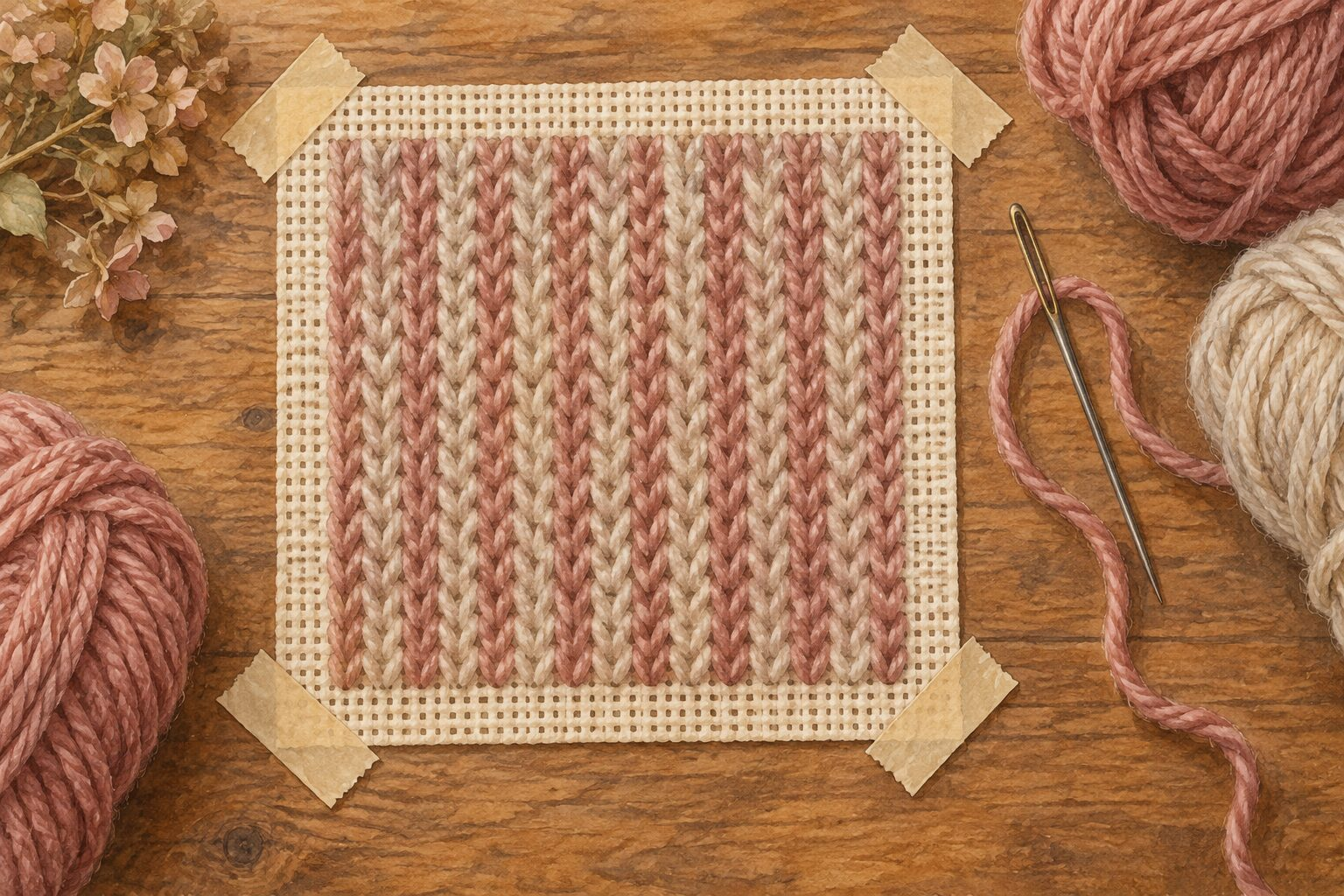
Kalem stitch is the needlepoint stitch that looks like knitting. Columns of steep slanted stitches lean one way, then the other, and each pair of columns closes into a row of tiny Vs, like the ribs of a sweater. It is also called knitting stitch, kelim or kilim. Here is how to work it, how to finish the edges, and the points where the sources genuinely disagree. Last updated October 25, 2026.
Start here: work a column of stitches that each go one canvas thread across and two up, one starting a hole above the last. At the top, start a second column that leans the other way and comes down into the holes where the first column began, closing a row of Vs (Floss Field). Repeat, a column down and then a column up.
What Kalem stitch is
Floss Field describes Kalem as columns of steep slanted stitches, one canvas thread across and two up, that lean one way and then the other, so that each pair of columns looks like a rib of knitting. PieceWork, in a stitch tutorial by Deanna Hall West, defines the knitting stitch as a double row of straight stitches slanting in opposite directions that forms a solidly stitched, braidlike pattern and resembles true knitting. KC Needlepoint, a shop, points out that the stitches do not fall on a true diagonal: they are steeper, and it suggests thinking of tiny points that come together.
The names are a tangle. PieceWork lists kalem, kelim, kilim, knit, knitting gobelin and tapestry, and explains that kelim is the Turkish word for a prayer rug, with kalem and kilim as spelling variants. The thin, soft kelim rugs of Persia were woven in the tapestry style rather than knotted, which PieceWork gives as the reason for the tapestry nickname when the stitch is worked closely in a fine thread. Floss Field lists knitting stitch, kelim stitch and kilim stitch. Unwind Studio, a designer and shop, files it as Kalem Stitch/Knitting Stitch and names fern stitch and herringbone stitch as related. Poppy Monk, a kit maker, says it looks a lot like a knitting stockinette stitch.
One historical note, attributed to its source: PieceWork cites designer Eileen Bennett's A Note Book of Sampler Stitches for the idea that the knitting stitch, which appears on some samplers, may have been an exercise for teaching schoolgirls to repair fabrics. PieceWork also says the stitch gives excellent coverage on the back of the canvas and a hardwearing surface, and that it has sometimes been used for floor rugs.
How to stitch it
These steps follow Floss Field, which gives the most complete sequence. The slant and starting corner can be mirrored without changing the result (see the disagreements section).
1. Make the first slanted stitch. Bring the needle up in the bottom row of the area, one hole in from its right edge. Take it down one hole to the right and two holes up (Floss Field).
2. Start the next one hole higher. Come up in the hole straight above the start of the first stitch and go down in the hole straight above its end (Floss Field).
3. Work up to the top of the area. Continue up the column, one stitch for every canvas thread, until one ends in the top row (Floss Field). Unwind Studio puts the same rule in different words: each stitch sits immediately below the next one, jumping two threads up and one across.
4. Begin the second column at the top. Bring the needle up in the top row, two holes to the left of where the last stitch went down. Take it down one hole to the right and two holes down, in the hole where the top stitch of the first column began, to close a V (Floss Field).
5. Work down the second column. Continue down to the bottom row, coming up one hole below the start of the last stitch and going down in a hole where a stitch of the first column began (Floss Field). Unwind Studio and Morgan Julia Designs, a designer, both describe this as mirroring the first column, with the bottom stitches of each pair sharing the same canvas hole.
6. Turn and repeat. Start in the bottom row, two holes to the left of where the last stitch went down, and work up as before. Each stitch goes down where a stitch of the previous column began. Continue across the area, a column down and then a column up (Floss Field). Floss Field adds that a shape can just as well be started at the top or from its left side: make each stitch the way its column is going, up or down, and the stitches on the back stay short.
PieceWork charts four common starting sequences: at the top of the row on the left, at the top on the right, and at the bottom on the left or right. It notes the stitch needs two separate trips, one for each lean. Art Needlepoint, a shop, suggests stroking the needle in and out with one thrust and stitching as you would a continental stitch, turning the canvas as you go.
Edges and compensation
Because the stitches lean, the top and bottom of an area end in points and gaps. Sources handle them differently, and this is the part of Kalem where they disagree most (details below). Floss Field fills the gap in the open top of each V, and the gap under each peak along the bottom, with an upright compensating stitch over one canvas thread, placed as soon as the columns on both sides are worked. PieceWork says you may add short compensating stitches between the top two and bottom two stitches to fill the small gaps, depending on how you want it to look in the design. Art Needlepoint works a half cross stitch at the beginning and end of each row, slanting in the opposite direction from the row, for a clean edge.
For irregular shapes, the general compensation advice applies: Brooke Thorn McGowan, a needlepoint designer writing on Substack, recommends placing the established pattern in the largest part of the area first and then compensating, keeping the overall flow of the stitch, and using tent stitches in the right orientation when in doubt. Our compensation stitches guide covers that process in detail.
Where to use it
Clothing in a design is the use every source agrees on. Floss Field lists sweaters, scarves, mittens and hats, plus borders, bands, baskets and braids. KC Needlepoint calls it a staff favorite for clothing because of the knitted look. BeStitched Needlepoint, a shop, used it to make a woven-looking stocking cap on a skeleton in a canvas for a class, and calls it wonderful for anything you want to look woven. Morgan Julia Designs suggests knitted sweaters, wings and floral elements, and notes the stitch has a raised, dimensional effect that suits small details such as bird wings or flower petals. PieceWork adds borders, bands, stripes, and braided rug or hair-braid motifs.
Poppy Monk, a kit maker, uses it for the mauve sweater on one of its kits. A single rib of Kalem makes a narrow border or band, as Floss Field notes, which pairs with the options in our border stitches guide. For a broader look at when to choose which texture, see our stitches for beginners guide.
On whether Kalem works as a background, sources split; that is covered below.
Threads, mesh and stitch size
The stitch is worked over one canvas thread across and two up in the usual version (Floss Field, KC Needlepoint, Poppy Monk's chart over two). PieceWork says it can be one or two threads wide and one to four high, with one wide and two to four high the usual setup. Floss Field gives a taller Kalem, one across and four up, beginning two threads past the last stitch, for a bigger sweater or basket. Morgan Julia Designs says it can be adapted to different thread counts and cover more than two threads.
The Needlepointer, a shop, lists a Kalem variation as an intermediate stitch suited to silk, wool and cotton on 13, 14 and 18 mesh, with tips to keep tension and counting consistent. Our mesh count guide and thread types guide help match thread to canvas.
Thread choice changes how knitted it looks. Floss Field says a fuzzy thread, or one made of many strands, blurs the two slants, and suggests a smooth thread used as a single strand, such as pearl cotton, to show the Vs. PieceWork agrees a fuzzy or multistranded thread is more likely to obscure the pattern, but adds that this may be what you want to convey the texture of knitted motifs. Art Needlepoint says the stitch takes a little less thread. Even tension matters either way; PieceWork says to keep it even to avoid an untidy look, and our even tension guide explains how.
Direction is flexible. KC Needlepoint and Floss Field both say the stitch can be turned a quarter turn and worked in horizontal rows, Art Needlepoint says the texture can run vertically, horizontally or diagonally, and PieceWork shows diagonal work as well. For shading, Floss Field suggests a second color or shade for the second column of each rib, and PieceWork suggests working the two trips in different colors or interspersing shades within one trip.
Where sources disagree
How to finish the edges. Floss Field uses upright compensating stitches over one thread in the gaps at the top and bottom. PieceWork uses short compensating stitches between the top two and bottom two stitches, and says to add them depending on the look you want. Art Needlepoint instead starts and ends each row with a half cross stitch slanting the opposite way. All three produce a straight edge; they differ in how many extra stitches you work and how visible they are.
Backgrounds. Art Needlepoint calls Kalem one of the best background stitches there is. PieceWork says it suits fillings for small or large shapes and even entire backgrounds, and Unwind Studio tags it for small and large areas. Floss Field disagrees for large backgrounds: the texture is strong and comes forward instead of sitting back, so it keeps Kalem for a sweater, a basket or a band within the design. Our background stitches guide compares calmer options.
Stitch height. Floss Field, KC Needlepoint and Poppy Monk's chart show one across and two up. PieceWork allows one or two across and one to four high, with two to four high as the usual height. Floss Field treats the four-high stitch as a variation rather than the standard.
Which way the first column leans. Floss Field starts at the bottom right and leans up to the right. Unwind Studio and Morgan Julia Designs describe the first run as stitches stepping up or down to the left, then mirrored to the right. PieceWork charts all four starting corners. These are mirror images of one another: pick one corner, work it consistently, and mirror it when your shape needs it.
Fuzzy thread. Floss Field recommends a smooth single strand so the Vs show, and lists fuzzy thread as a cause of a hard-to-see pattern. PieceWork says fuzzy or multistrand thread obscures the pattern but may be desirable for knitted texture, and Morgan Julia Designs praises the raised look of the stitch. Your goal for the area decides which advice applies.
Common mistakes
Counting like tent stitch. Floss Field says to count one hole across and two up or down; a stitch that looks like a tent stitch is one thread too short.
The columns do not close into Vs. One column has slipped a hole up or down against the other. Rework the second so that each stitch ends in a hole where a stitch of the first began (Floss Field).
A thin place partway up a column. A canvas thread was skipped. Go back and work the missing stitch (Floss Field).
Uneven tension or lost alignment. The Needlepointer names uneven tension and losing stitch alignment as the common mistakes, and PieceWork asks for even tension for a tidy result. If a section looks off, our guide to fixing mistakes covers unpicking cleanly.
FAQ
What is Kalem stitch in needlepoint?
A canvas stitch worked in columns of steep slanted stitches that lean one way and then the other, so the finished area looks like knitting (Floss Field; PieceWork).
Is Kalem the same as knitting stitch?
Yes. Floss Field, PieceWork and Unwind Studio treat knitting stitch, kalem, kelim and kilim as names for the same stitch; PieceWork explains kelim and kilim as spellings of the same Turkish word.
Is Kalem a good background stitch?
Sources disagree. Art Needlepoint and PieceWork recommend it for backgrounds, while Floss Field says the strong texture comes forward and keeps it for clothing, baskets and bands. See the disagreements section.
Can I work Kalem horizontally?
Yes. Turn the stitch a quarter turn and work it in rows (KC Needlepoint; Floss Field). PieceWork also shows a diagonal version.
How do I make the edges straight?
Use upright compensating stitches over one thread (Floss Field), short compensating stitches between the top two and bottom two stitches (PieceWork), or opposite-slanting half cross stitches at the ends of rows (Art Needlepoint).
What thread gives the best knitted look?
A smooth single strand such as pearl cotton shows the Vs most clearly (Floss Field). A fuzzier thread softens them, which PieceWork says may suit knitted motifs.
Sources
- Floss Field - Kalem stitch in needlepoint: how to work it (step sequence, names, edge fills, troubleshooting, taller and horizontal variations, background caution)
- PieceWork - A Stitch in Time: The Knitting Stitch (Deanna Hall West; names and etymology, sampler note, stitch sizes, four starting sequences, compensating stitches, thread advice, uses)
- Unwind Studio - Kalem Stitch - Needlepoint Tutorial (a needlepoint designer and shop; related stitches, mirrored instructions, small and large area tags)
- KC Needlepoint - Kalem Stitch- Vertical (a needlepoint shop; steep diagonal over one across and two up, clothing uses, rotating to horizontal)
- KC Needlepoint - Tiny Stitches for Tiny Canvases (a needlepoint shop; steeper than a true diagonal, tiny points that come together)
- Art Needlepoint - Stitch Course Lesson 6 (a needlepoint shop; background and outline uses, directions, opposite-slant half cross at row ends, thread use)
- Morgan Julia Designs - Stitch of the Month: Kalem Stitch (a needlepoint designer; mirrored instructions, raised texture, wings and petals, adapting thread counts)
- BeStitched Needlepoint - Learn the Kalem Stitch (a needlepoint shop; woven look, stocking cap example)
- Poppy Monk - Needlepoint Stitch Library (a kit maker; stockinette comparison, worked in columns, chart over two, sweater example)
- The Needlepointer - Kalem variation (a needlepoint shop; intermediate level, silk, wool and cotton, 13, 14 and 18 mesh, common mistakes)
- Brooke Thorn McGowan - How To Compensate Your Decorative Needlepoint Stitches (general compensation method)