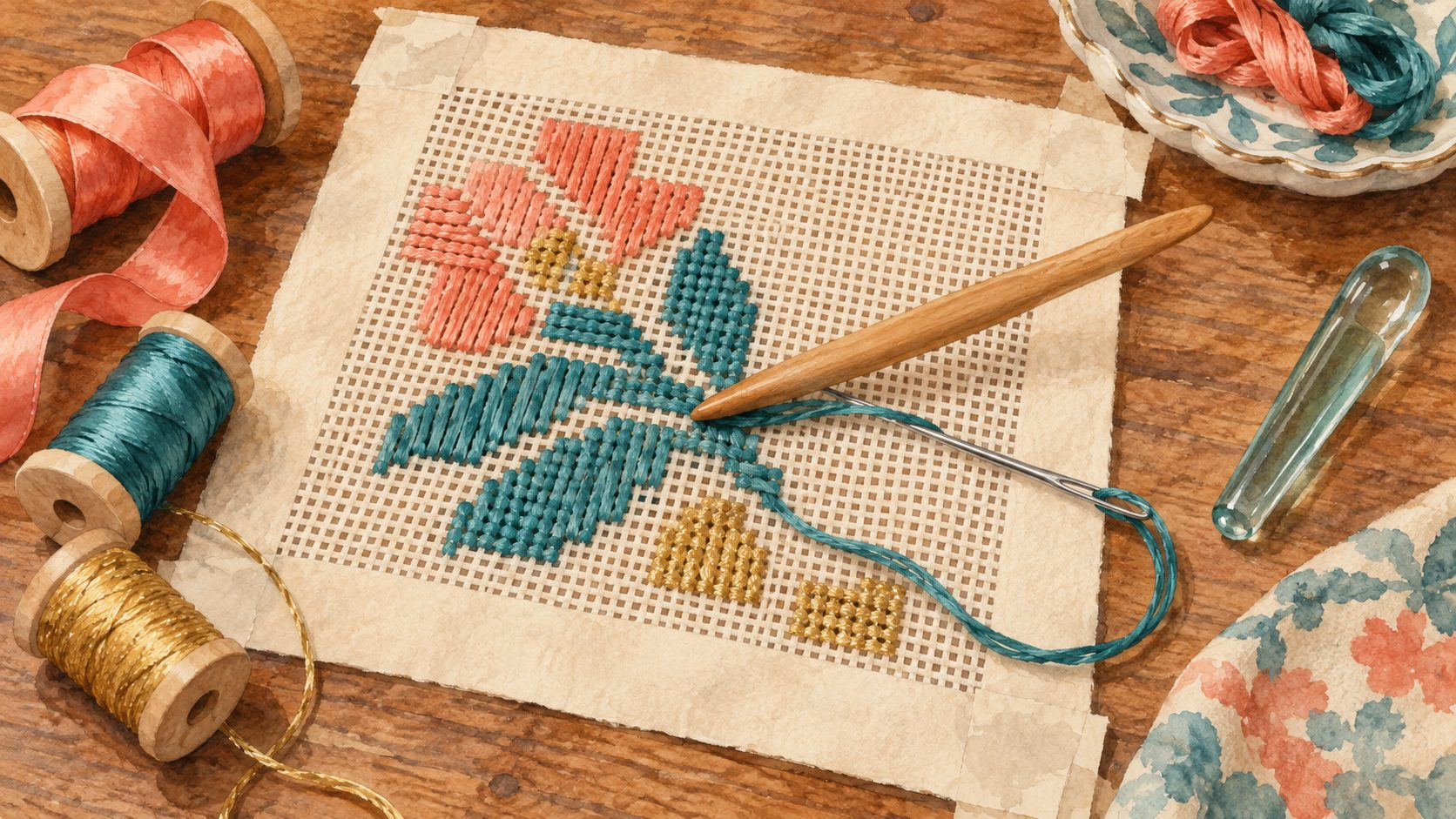
A laying tool is a smooth stick that helps threads lie flat. It is one of the cheapest ways to make ribbon, silk and multi-strand threads look neat in needlepoint, and it costs nothing to try: a large tapestry needle will do. This guide pulls together nine sources on when to use one, how it is held, what to buy and where the sources split.
Bring the needle up as usual, but do not finish the stitch. Hold the laying tool in your non-dominant hand, press it on the thread and slide it along the thread so the strands lie flat and parallel. Finish the stitch while the tool guides the thread, then slip the tool out at the last moment (Serendipity Needleworks). Use it for flat or strandable threads, ribbons and long stitches (Needlepoint.com, Martha Beth, KC Needlepoint).
What a laying tool does
Needlepoint.com says laying tools keep stitches even when working with strandable or flat threads. Serendipity Needleworks calls them, basically, sticks, and says stroking the thread flat also spreads the plies so they cover better. NeedlenThread describes the tool as used to stroke threads, keep them flat, and tension them as you take a stitch so they stay smoothly parallel instead of twisting.
Needlery reports that Kreinik recommends one for its silk thread, because laying silk straight gives the most uniform light reflection, which is what makes silk shine. Needlery and BeStitched both note that neat, well laid threads matter if you enter a piece in competition.
When to use one
- Flat and ribbon threads. Needlepoint.com and KC Needlepoint name flat or ribbon threads (KC lists Neon Rays and Sparkle Rays) and strandable threads (KC lists Splendor). Serendipity Needleworks adds silk ribbon and several ribbon-type threads. Our metallic thread guide covers a related thread type.
- Multiple strands. Serendipity Needleworks says laying tools are especially helpful with multiple strands of thread. See our Persian yarn guide for separating plies first.
- Long and decorative stitches. Martha Beth lists bargello, duplicate stitch, satin or other long stitches, wide flat threads and low count fabric such as 6 count. KC Needlepoint recommends one for decorative stitches. Try it on bargello.
- Any stitch. Island House shows the technique with a first stitch that could be tent, continental or another stitch. In plain wool tent stitch you can skip it. That last judgment is ours.
Types and materials
Serendipity Needleworks says laying tools can be wood, metal, bone, glass, plastic, even porcupine quills, and that the key is a very smooth surface so threads do not snag. NeedlenThread and Needlery say the same: the material matters less than a smooth shaft.
- Wood. Very popular (Serendipity Needleworks, BeStitched). BeStitched says a sharp wooden tool can also work as an awl to enlarge a hole, while silk ribbon calls for a rounder tip. Serendipity Needleworks says pointed tips help adjust threads after a stitch, and blunt tips are less likely to pierce ribbon.
- Metal. BeStitched says metal is usually smoother than wood and effective with silk. Serendipity Needleworks describes the BLT (Best Laying Tool) as incredibly sharp with four sides so it does not roll, and good with multiple plies of silk. NeedlenThread names the BLT as a favorite.
- Glass and bone. BeStitched says glass tools are very smooth and that its writer's go-to tool is glass. Needlery says glass works wonderfully with silk.
- Plastic. BeStitched says plastic tools often have a molding seam but work with most threads, and a blunt plastic one is handy for travel.
- Trolley needle. A tapestry needle without an eye welded to a finger guard, worn on the non-dominant hand (Serendipity Needleworks). More on this under safety.
How to use it
Every source agrees you need both hands, one for the needle and one for the tool. Mount the canvas on a scroll frame or stretcher bars on a stand first (Serendipity Needleworks). See our stretcher bar guide. The sources describe the motion in three slightly different ways:
- Stroke and guide (Serendipity Needleworks, Xs and Ohs). Bring the needle to the front as usual. Hold the tool in the non-dominant hand and press the thread down. Slide the tool along the thread so it lies straight and the plies spread. Keep the tool on the thread as you finish the stitch, then slip it out at the last moment. Xs and Ohs describes using the side of the tool to stroke the thread away from the starting hole.
- Trap and lift (Martha Beth). Pull the thread up so it lies on the surface, lay the tool flat across it (perpendicular to the thread) and hold it down with your thumb. Send the needle to the back while the tool holds the thread, then, as the thread pulls through, let the tool rise and move toward the hole, keeping it parallel to the canvas to maintain tension. Pull the tool out at the end.
- Under the stitch (Island House). Make your first stitch, slide the tool under it near where the needle emerges, push it in the direction you want the stitch to lie, and pull the needle through while holding the tool in place.
NeedlenThread says it feels awkward at first, then becomes second nature, and that progress is quick once you have a rhythm. Island House says to practice. You do not have to use the tool on every stitch (NeedlenThread).
Ribbon. Xs and Ohs suggests inserting the tool into the loop formed by the two ends of a ribbon stitch and stroking underneath, which keeps the ribbon from curling. It also notes the tool can slightly open the hole the ribbon passes through to cut wear on the edges. Serendipity Needleworks says to use the tool the same way with ribbon as with multiple plies, with one strand to manage.
Tension matters too. Our even tension guide and thread types guide pair well with this one.
What to use instead
NeedlenThread says a large needle works as well as a laying tool when you do not have one. Martha Beth gives a longer list: a size 13 tapestry needle, a trolley needle, a toothpick, a plastic hair roller pick, a pick up sticks stick, a small knitting needle or a skewer from a turkey trussing set. BeStitched adds a second needle, a stitch holder, a quill and even a dental tool.
Xs and Ohs and Needlery both caution: the substitute must be sturdy enough to press with and smooth enough not to snag. Needlery says plastic pick up sticks work in a pinch but recommends paying a little more for a sturdy tool. Our needle size guide explains the size 13.
Care and safety
Needlery says to keep tapered tools in a case or with a point protector, and that burrs on bone or wood tools can be smoothed with an emery board or very fine sandpaper. If the tool still catches threads after buffing, replace it.
Several sources warn about sharp tools. Serendipity Needleworks says the BLT can be dangerous if not handled carefully, and that the trolley needle is easy to forget you are wearing, so take care not to poke yourself in the eye. Martha Beth finds a trolley needle's spike dangerous and says one teacher wears hers on her thumb. Needlery also suggests wearing it on the thumb. Keep sharp tools away from children and out of reach of pets (this last point is ours).
BeStitched says to keep the tool's tip protected and notes a blunt plastic tool is easy to take through airport security. Our needlepoint on a plane guide has the wider picture.
Where sources disagree
Which material is best? Serendipity Needleworks prefers wood, NeedlenThread prefers stainless steel, and BeStitched's writer favors glass. NeedlenThread says a decorative painted wood tool was not smooth enough for silk. The shared point is smoothness, not the material.
Sharp or blunt? Serendipity Needleworks says pointed tips help adjust threads after a stitch and blunt tips suit ribbon. BeStitched says a sharp wood tool can double as an awl and rounded tips suit silk ribbon. Martha Beth and Serendipity both treat very sharp tools as hazards.
How the motion works. Serendipity Needleworks slides the tool along the thread and guides it through the stitch. Martha Beth traps the thread under the tool and lets it rise as you pull through. Island House places the tool under a finished first stitch. These are different techniques for different threads, and the sources do not compare them. Try each on a scrap.
Are substitutes fine? NeedlenThread and Martha Beth say a big needle or household stick works. Xs and Ohs and Needlery say a proper sturdy tool is worth buying. Both can be true: a needle is fine to start, a tool is nicer for long sessions.
Where to wear a trolley needle. Serendipity Needleworks says it goes on the index finger or thumb of the non-dominant hand. Martha Beth and Needlery point to the thumb as safer. Martha Beth personally avoids the trolley needle altogether.
Questions
What is a laying tool in needlepoint?
A smooth stick used to lay threads flat and keep them parallel while stitching (NeedlenThread, Serendipity Needleworks).
Do I need a laying tool for needlepoint?
No. Needlepoint.com says they are commonly used with strandable or flat threads. Plain wool in tent stitch will not benefit as much (our reading of the sources).
What can I use as a laying tool?
A large tapestry needle, a small knitting needle or a toothpick, among many others (NeedlenThread, Martha Beth, BeStitched). Make sure it is smooth and sturdy (Xs and Ohs, Needlery).
Which threads need a laying tool most?
Ribbon, silk and multi-strand threads, plus long stitches such as bargello (Serendipity Needleworks, Martha Beth, KC Needlepoint).
Is a trolley needle safe?
It can be dangerous, since the spike is easy to forget about (Serendipity Needleworks, Martha Beth). Wearing it on the thumb is the common advice (Martha Beth, Needlery).
Does a laying tool help with tension?
Yes, NeedlenThread describes keeping threads in tension and parallel as the stitch is pulled through. Martha Beth says keeping the tool parallel to the canvas holds tension as you pull the thread to the back. Our beginner stitch guide is a good place to practice.
Sources
- Needlepoint.com, How To Use A Needlepoint Laying Tool
- Serendipity Needleworks, A Guide to Using Laying Tools in Needlepoint
- Island House Needlepoint, A Step-by-Step Guide on How to Use a Laying Tool
- Martha Beth, How to Use a Laying Tool
- Xs and Ohs, Tip: Laying Tools
- KC Needlepoint, Learn to use a laying tool
- Needlery, Laying Tools
- NeedlenThread, What's a Laying Tool?
- BeStitched Needlepoint, Now I Lay My Threads and Ribbons