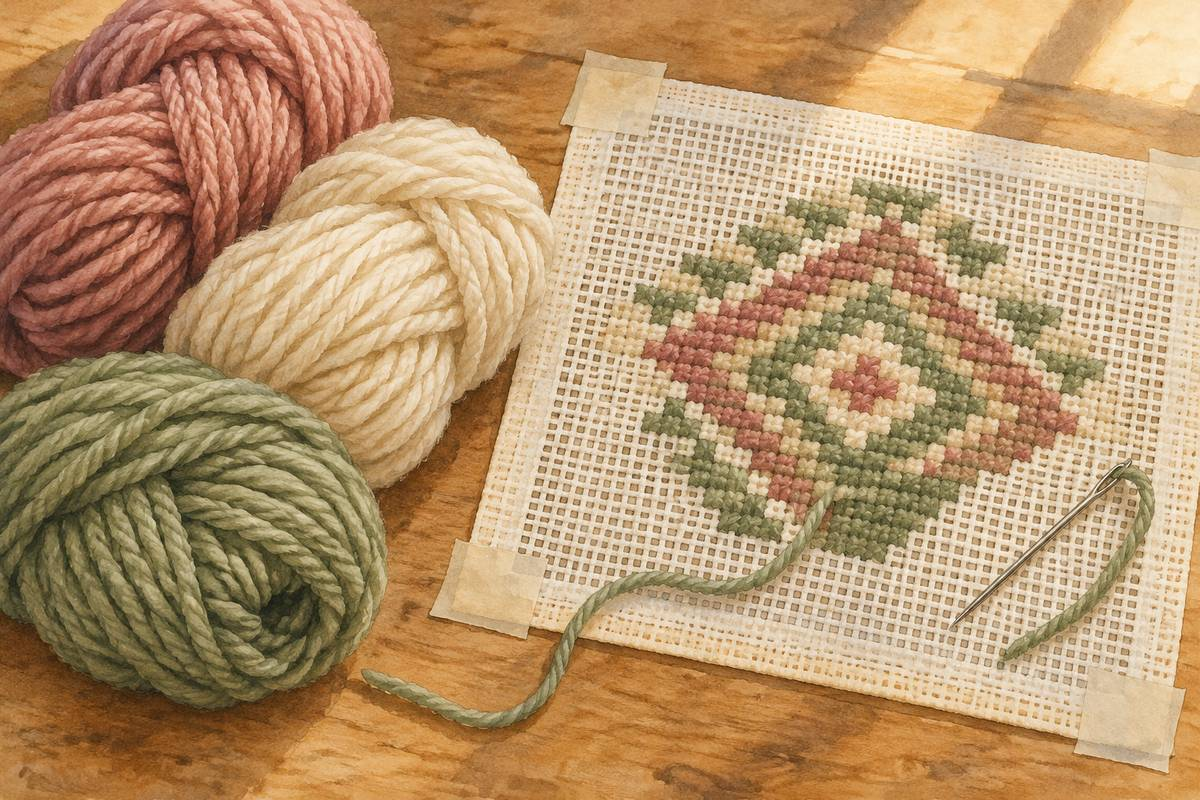
Wool is the original needlepoint thread, and the wool wall at a needlepoint shop divides into three yarns that look similar on the skein but behave very differently in the needle: Persian, tapestry and crewel. The names describe how the yarn is built, not where the wool comes from, and the build decides everything - how many strands you can peel off, which canvas mesh each one covers, and which projects each suits. This guide sorts out the three, with the numbers shops and teachers actually use. Last updated November 2, 2026.
Start here: Persian wool is a bundle of three separable strands, so one skein covers almost any mesh - it is the most versatile and the most popular. Tapestry wool is a single thick strand that cannot be split, made for 10 to 14 mesh. Crewel wool is a fine two-ply strand you use in multiples, made for detail, blending and 18 mesh and up. Whatever you buy, stitch a small test patch on your own canvas before committing.
Why wool is the classic needlepoint thread
The Spruce Crafts calls wool the most popular yarn for needlepoint: the natural fiber is long-lasting, colorfast and wears well, which extends the life of the finished piece. World of Needlepoint adds the practical side - wool's durability makes it the choice for projects that will get heavy use, like chair seats and sofa cushions, and a shop guide at Local Needlepoint Shops quotes the Royal School of Needlework on the same traditional use for seat covers and rugs. Needlepoint.com, cited in the same guide, says wool tends to be more forgiving to stitch with than silk or metallics, which is why it suits first projects.
One warning the sources repeat: yarn made for knitting is not a substitute. World of Needlepoint explains that knitting yarns are spun with shorter, softer fibers that make them less durable, DMC says a knitting yarn is likely to stretch and fray as you stitch, and The Spruce Crafts notes needlepoint threads need long, strong fibers to survive being pulled through stiff canvas hundreds of times. Tapestry wool may look like a double-knit knitting yarn on the shelf, but it is spun for the canvas.
A naming note from Janet Perry of Nuts about Needlepoint before the details: words like lambswool, merino, mohair and cashmere name the animal the wool came from, not the structure of the yarn. The three yarn structures below are what actually change how you stitch.
The three wool yarns
Every source divides the wool shelf the same way: by structure. Persian wool is three two-ply strands twisted together, made to be separated. Tapestry wool is one thick strand, usually four plies, that stays whole. Crewel wool is a fine two-ply strand sold as single strands, used alone for embroidery and in multiples for canvas. Once you see the three as thick-bundle, thick-single and fine-single, every shop recommendation about strands and mesh becomes arithmetic.
Persian wool
Persian yarn is the all-rounder. The Spruce Crafts calls it by far the most popular needlepoint yarn: spun as a single three-ply thread, it can be separated into individual strands for fine stitching or used all together on larger mesh - and used as one, it has the same thickness as tapestry wool. Janet Perry gives one strand's range as 13 to 18 mesh. That one skein, in other words, covers nearly every canvas you are likely to meet, which is why shops so often reach for it first. Our guide to separating Persian yarn shows the technique for splitting the strands cleanly.
The name is literal history. Colonial Needle, which sells a Persian yarn, recounts that brothers Harry and Karnick Paternayan immigrated to America from Turkey in 1916 and developed their wool while repairing genuine Persian carpets - Janet Perry confirms the yarn was originally made by the Paternayan Brothers for Persian rug repair, hence the name. The Paternayan brand itself passed through JCA Crafts and Saco River Dyehouse before closing in 2018, per Colonial Needle, and Rittenhouse Needlepoint's listings now describe Colonial Persian as comparable to the discontinued Paternayan wool.
Tapestry wool
Tapestry wool is the thick single strand. The Spruce Crafts describes it as one strand that cannot be separated, thick enough to cover 10-mesh mono canvas without doubling, usually sold in 8.8-yard skeins. DMC, which makes it, describes its tapestry wool (also known as Colbert wool) as a gently twisted four-ply thread of combed virgin wool: hard-wearing, colorfast and treated to be moth-proof, with the even texture that made tapestry cushions last for generations. Appletons, the British maker, sells it as 4ply tapestry wool for canvas of 12 holes per inch or less, and points it at textured, bold and hard-wearing projects.
Because it cannot be split, tapestry wool is a what-you-see yarn: Floss Field's thread table puts one strand on 10 to 14 mesh and calls it unsuitable for 18 mesh, where you switch to a finer thread. Its strength is simplicity and speed on bigger canvases - no stripping, no strand counting, and a plump stitch that fills a background fast.
Crewel wool
Crewel wool is the fine one. Floss Field's crewel guide describes it as a fine wool of two plies, loosely twisted, sold as single strands - much finer than tapestry wool, with about three strands of crewel equaling one strand of tapestry in thickness. Janet Perry puts one strand at roughly the thickness of two strands of embroidery floss, and The Spruce Crafts compares it to a single ply of Persian yarn. It is famous for crewel embroidery on fabric, but on canvas it earns its place three ways: detailed work on 18 to 22 mesh (Spruce), petit point (Floss Field), and blending - two colors in the needle at once to shade one into another, a trick both Floss Field and Appletons mention for the fine strands.
On canvas you thread several strands at once. Floss Field's starting numbers: two strands on 18 mesh (three if two leave canvas showing), three or four on 13 and 14 mesh, and four on 12 mesh for a background that will get hard wear, like a chair seat. One more handling rule from the same guide: cut separate lengths rather than folding one length double in the needle, which makes fuzzier stitches.
Matching wool to your mesh
Mesh count is the holes-per-inch of your canvas, and every shop table works the same way: the lower the mesh number, the bigger the holes and the heavier the yarn you need. World of Needlepoint states the rule of thumb - the yarn should slip through the holes without catching, yet be thick enough that canvas does not show through the stitches. For the specific pairings, Floss Field's thread table and the shop listings behind Local Needlepoint Shops' guide largely agree:
- Tapestry wool: one strand on 10 to 14 mesh (Floss Field notes one shop uses two strands on 10 mesh; Local Needlepoint Shops cites listings that use it as it comes on 13 mesh). Not for 18 mesh.
- Persian wool: three strands on 10 mesh, two on 12 to 14, one on 18 (Floss Field's table; Rittenhouse listings give the same three-two-one progression for Colonial Persian).
- Crewel wool: one or two strands on 18 mesh (Rittenhouse listings via Local Needlepoint Shops), three to four on 13 and 14 mesh (Floss Field).
Treat all of these as starting points, not law. Floss Field warns that published charts do not all agree and that everyone stitches at a different tension, so the universal advice is to stitch a dozen tent stitches in a corner of the margin and look: if canvas shows between stitches, add a strand; if the yarn barely fits through the holes, drop one. The Spruce Crafts suggests the same one-inch sample on scrap canvas of the same mesh. Upright stitches like bargello cover less than slanted ones and may need an extra strand. Our thread-by-mesh-count guide covers the full table beyond wool, and petit point vs gros point explains the fine end of the canvas scale.
Buying: skeins, hanks and dye lots
Two buying details save real frustration. First, format: Appletons sells wool as skeins (short lengths for multicolor work and detail) and hanks (long lengths with fewer joins, for backgrounds and large areas) - its crewel skein is 25 meters against a 180-meter hank, and tapestry runs 10 meters a skein against 55 meters a hank, which also tells you how much farther fine yarn goes. Second, dye lots: The Spruce Crafts and Floss Field both say to buy all of a background color at once from a single dye lot, because lots vary. If you run short later, our guide to dye lots and running out of thread is the rescue plan.
On brands: Appletons offers about 430 shades and publishes conversion charts to DMC, Anchor and Paterna colors; DMC's tapestry wool comes in 390 colors. But Floss Field warns that each maker uses a different numbering system for wool, so for matching, take the chart or a printed photo to the shop and match by eye - screen colors are approximate at best. Our thread brand conversion table covers the cotton floss side of conversions.
Stitching with wool
Wool has a nap. Floss Field's handling notes say to stroke the strand: one direction feels smooth, the other fuzzy, and you thread the needle so the yarn travels through the canvas in its smooth direction. Cut working lengths around 18 inches (both Floss Field and the shops behind Local Needlepoint Shops give that figure), because every pass through the canvas wears the fiber a little. And when a project calls for two strands, use two separate strands - never one folded double.
Where sources disagree
Is tapestry yarn thicker or finer than Persian? World of Needlepoint calls tapestry yarn slightly finer than Persian yarn. The Spruce Crafts says the opposite in effect: all three Persian strands used together equal one strand of tapestry wool. Janet Perry and Floss Field side with thickness - tapestry is the yarn for 10 to 12 mesh while a single Persian strand serves 13 to 18. The confusion dissolves once you ask thicker than what: than the whole three-strand Persian bundle, tapestry wool is about equal; than one Persian strand, it is much thicker. Read worldofneedlepoint's line as a comparison to the separated strand, not the bundle.
Does one Persian strand really cover 13 mesh? Janet Perry writes that one strand works 13 to 18 mesh, while the shop tables (Floss Field, Rittenhouse via Local Needlepoint Shops) call for two strands on 13 and 14 mesh. The difference is coverage philosophy: a lighter, quicker stitch versus a fuller cover. The sources all converge on the same resolution - stitch a test patch on your own canvas, at your own tension, and let your eyes settle it.
How fine can crewel go on 14 mesh? Floss Field gives three or four strands on 13 and 14 mesh but notes that on 14 mesh, two strands are enough for some stitchers. Again, tension and taste decide.
FAQ
Which wool should a beginner buy? Persian wool, if the shop has it. It is the most popular needlepoint yarn (The Spruce Crafts), the most forgiving fiber to learn on (Needlepoint.com, via Local Needlepoint Shops), and its three separable strands let one skein adapt to almost any canvas. Our beginner supplies guide has the rest of a first kit.
Can I use knitting wool for needlepoint? The sources say no for anything meant to last: knitting yarns are spun with shorter, softer fibers (World of Needlepoint) that stretch and fray as you stitch (DMC), unlike the long-fibered yarns made to survive canvas (The Spruce Crafts).
What is the difference between Persian and tapestry wool? Structure. Persian is three separable two-ply strands; tapestry is one thick four-ply strand that does not separate. All three Persian strands together equal tapestry wool's thickness (The Spruce Crafts), so Persian adjusts to your mesh while tapestry comes ready for 10 to 14 mesh.
Is crewel wool only for crewel embroidery? No - Floss Field calls it a needlepoint thread too. On canvas you simply use several strands at once, and its fineness makes it the wool for 18 mesh, petit point, detail and color blending.
How do I blend colors with wool? With crewel wool: the strands are thin enough that two colors can go in the same needle at once, shading one into the other (Floss Field; Appletons recommends the yarn for blending two colours).
Does wool hold up better than other fibers? For pieces that take wear, yes - that is why wool is the traditional choice for chair seats, cushions and rugs (World of Needlepoint; Royal School of Needlework via Local Needlepoint Shops), and DMC credits wool for the longevity of tapestry cushions. For a broad fiber comparison, see needlepoint thread types: wool, cotton and silk.
Sources
- Nuts about Needlepoint - Talking Wool Threads (Janet Perry, needlepoint teacher, November 2014; the three wool structures, Paternayan origin, one Persian strand on 13-18 mesh)
- The Spruce Crafts - Basic Threads and Yarns for Needlepoint (a craft reference site, updated 2019; Persian most popular, three strands together equal tapestry wool, sample-first advice)
- Floss Field - Needlepoint and Crewel: The Difference (a needlework guide site; crewel wool on canvas, strand counts by mesh, blending, no folded strands)
- Floss Field - Needlepoint Thread Guide (a needlework guide site; the mesh table, wool nap, 18-inch lengths, test-patch advice)
- World of Needlepoint - Guide to Needlepoint Yarns and Threads (a needlepoint reference site; match yarn weight to gauge, wool for heavy-use projects, knitting yarn warning)
- Local Needlepoint Shops - Needlepoint Thread Types (a shop-directory guide drawing on shop listings; Rittenhouse strand counts, wool as the forgiving beginner fiber)
- Appletons - Buy Wool (a wool maker and seller; crewel 2ply vs tapestry 4ply, skein and hank lengths, 430 shades)
- DMC - Which Thread Is Best for Tapestry and Needlepoint? (a thread maker and seller; what tapestry wool is, why knitting yarn fails on canvas)
- Colonial Needle - Persian Yarn (a needlework manufacturer and seller; the Paternayan history behind the name)