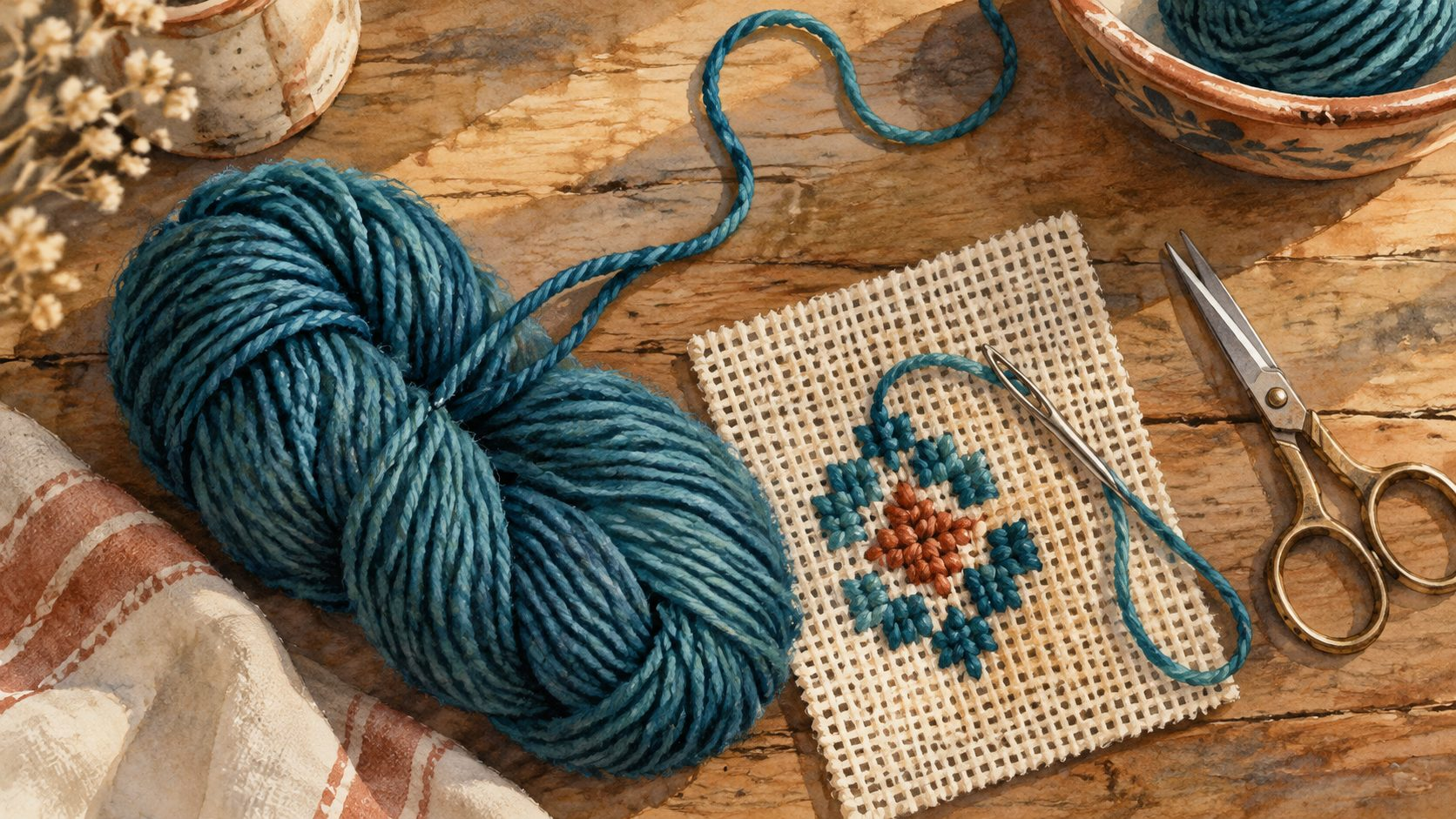
Persian yarn comes as one three-part yarn, and you are meant to pull the parts apart before you stitch, even if you end up using all three. The sources agree on that and on the basic move: pull each strand out from the top, one at a time. They differ on what to call the parts and on how many to put back for a given canvas.
Cut a length, pinch the top, pull one strand straight up and out, smooth the rest, and repeat. Poppy Monk Needlepoint says to draw each strand straight out from the top and warns that separating from the middle usually ends in a tangle. Colonial Needle says separating is always needed, even when you use all three strands, so the yarn lies smoothly on the canvas.
Why separate at all
Colonial Needle says plying, its word for separating the three strands, is always necessary before stitching. Even when three strands are used, plying is still needed so the yarn will lie smooth on the canvas. A reader answer on Needlework Tips and Techniques, written about six-strand floss, gives a second reason: fibers are packed tight in the packaging, and a little fluffing gives much better coverage. That answer is about floss, not Persian wool, but the logic carries over to any thread sold as a bundle of strands.
Separating also lets you change thickness. World of Needlepoint says the strands of Persian yarn can be separated to make a thinner yarn, and that you can add more strands to make a thicker one. Mirrix Looms says Paternayan yarn is three ply, but the plies are not twisted together, which it calls strandable, so they are easily separated. It also says the yarn does not get fuzzy and does not fray. Judy Moore Pullen of Colonial Needle used the same trait for wool applique: she split the three strands of Colonial Persian and stitched with one.
How to separate a strand
- Cut a working length. Our guide to starting and ending thread covers length and waste.
- Pinch the top of the cut length between your fingers.
- Take one strand and draw it straight up and out of the others. Poppy Monk Needlepoint describes drawing each strand or ply up and out from the top.
- Let the remaining strands gather, then run your fingers down them to straighten them. The Needlework Tips reader answer says that if you do not straighten them, they will tangle.
- Repeat until every strand is free, then put back the number you want, laid side by side and not twisted.
Poppy Monk Needlepoint also shows what not to do. Trying to separate from the middle of the length is likely to leave a tangled mess.
How many strands to put back
The number you put back depends on the mesh. Two shops publish figures for Persian wool, and they agree on the order of magnitude.
| Mesh | Flossfield | Colonial Needle (basketweave chart) |
|---|---|---|
| 10 | 3 strands | 3 strands |
| 12 | 2 strands | 2 strands |
| 13 to 14 | 2 strands | 2 strands on 14 |
| 18 | 1 strand | 1 strand |
Flossfield groups its row as 10 to 12 mesh, 13 to 14 mesh and 18 mesh. It adds that these are starting points, that everyone stitches at a different tension, and that upright stitches such as bargello and brick cover less well than slanted ones and may need more strands. Add or remove a strand until the canvas is covered. Our thread by mesh count guide and mesh size chart go deeper, and the thread yardage calculator turns strands into yardage. For the amount to buy, see how much thread you need.
Florilegium makes a related point about buying: it says to calculate the proper number of strands or yardage for each color using the correct number of plies, because each Persian strand holds 3 plies of wool.
Uneven strands in older yarn
Nuts About Needlepoint says modern Persian wool, including Waverly and Paternayan, has three strands of even width, so it does not matter which ones you combine. Older Paternayan, and probably other older Persian wools, did not. The author says its three strands came in three different sizes, which she calls Papa, Mama and Baby Bear. For two strands she suggests pairing Papa with Baby or two Mamas, since other mixes give an uneven thickness. She says you can see the difference by untwisting an inch of two of the strands, and that if you cannot see one, it is probably newer yarn. For one strand she would not recommend Persian at all, but says to use all Mamas if you do.
Other threads that do and do not separate
| Thread | Separable? | Source |
|---|---|---|
| Persian yarn | Yes, three strands | World of Needlepoint, The Spruce Crafts |
| Tapestry yarn | Single strand, difficult or not meant to be separated | World of Needlepoint, The Spruce Crafts |
| Embroidery floss | Yes | World of Needlepoint |
| Cotton thread sold in groups of 4 to 12 | Yes, strip and put back | The Spruce Crafts |
| Pearl cotton | No | World of Needlepoint, The Spruce Crafts |
The Spruce Crafts says cotton threads are stripped and put back together with the number of strands needed, and that the stripping is critical for smooth, even stitches. It says silk strands tend to cling or stick out, so a laying tool or trolley needle is needed. Our guide to wool, cotton and silk compares the fibers.
Where sources disagree
- Ply or strand: Mirrix Looms and The Spruce Crafts call Persian yarn three ply. Florilegium says each strand contains 3 plies. Nuts About Needlepoint says Colonial Persian and Waverly Wool have three two-ply strands. The words are not used the same way, so count the pieces you can pull free, not the label.
- Which strands to combine: Nuts About Needlepoint says it does not matter for modern yarn and does matter for old Paternayan. Other sources do not raise the issue.
- Strands per mesh: Flossfield puts 3 strands on 10 mesh and 2 on 12 mesh. Colonial Needle puts 2 on both 12 and 14 mesh. Treat both as starting points.
- Separating floss versus wool: the Needlework Tips advice is for floss, and Poppy Monk Needlepoint writes for needlepoint thread in general. Both say pull from the top.
Questions
Do I have to separate Persian yarn if I use all three strands?
Yes, according to Colonial Needle. It says plying is needed so the yarn lies smoothly, even with three strands.
How do I stop strands from tangling?
Pull them out from the top, one at a time, and straighten the rest between pulls. Poppy Monk Needlepoint and the Needlework Tips reader answer both say this.
How many strands go on 18 mesh?
Flossfield and Colonial Needle both say one strand of Persian. Nuts About Needlepoint would not recommend Persian for one strand, so check a sample.
Can I separate tapestry yarn?
World of Needlepoint says separating it is difficult, and The Spruce Crafts says it cannot be separated for fine stitching.
Why does my yarn look uneven?
Nuts About Needlepoint says older Paternayan has strands of three sizes, so a mix of sizes can show. Pair matching strands.
Sources
- Colonial Needle: Persian Yarn
- Colonial Needle Creative Ideas Blog: Playing with Yarn
- Florilegium: Paternayan / Colonial Persian Yarn
- Mirrix Looms: Persian Yarn, a Gift from the Needlepoint World
- Nuts About Needlepoint: Paternayan Persian Wool, Old and New
- Poppy Monk Needlepoint: How to Separate Strands of Needlepoint Thread
- Needlework Tips and Techniques: How do I separate my strands?
- World of Needlepoint: Guide to Needlepoint Yarns and Threads
- The Spruce Crafts: Basic Threads and Yarns for Needlepoint
- Floss Field: Needlepoint thread guide