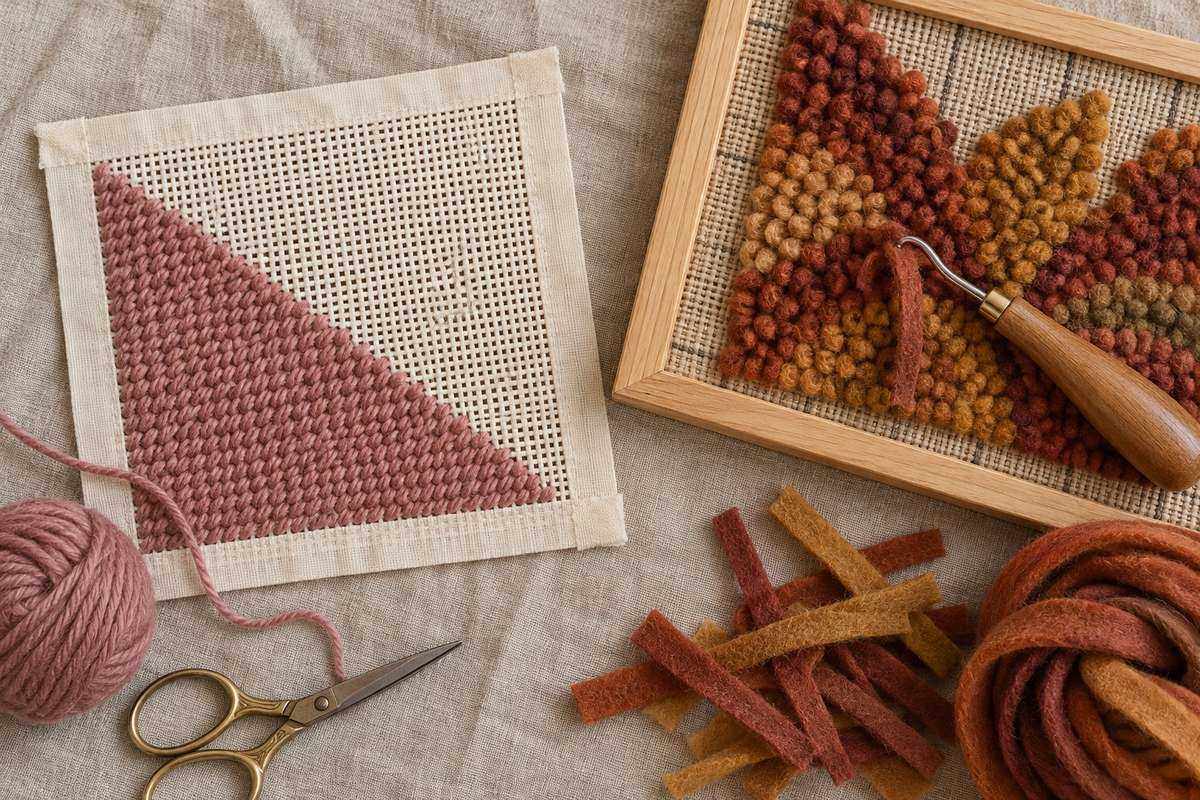
Needlepoint and rug hooking meet at the same destination - a handmade cushion, a wall hanging, even a rug - by completely different roads. Needlepoint is counted embroidery: a blunt tapestry needle carries thread through a stiff open canvas, one stitch per intersection, until the canvas disappears under a flat woven surface. Rug hooking pulls loops of yarn or wool strips up through a woven backing cloth with a hook, building a soft, textured pile. The tools, materials, pace and finished feel are different enough that choosing between them is really choosing what you want to make. This guide lays the two side by side. Last updated November 3, 2026.
Start here: If you want crisp detail, exact color placement and pieces that finish into pillows, belts, ornaments or framed work, that is needlepoint. If you want a plush, forgiving surface - especially a rug or anything meant to read as cozy folk texture - that is rug hooking. Needlepoint is precise and slow; hooking is looser and covers ground faster.
Flat stitches vs a looped pile
Floss Field's definition pins needlepoint down: embroidery stitched by hand on stiff, open canvas, in stitches that nearly always cover the canvas whole, with the humble tent stitch - one small slanted stitch over one intersection - as the foundation. Because every stitch sits exactly on the canvas grid, needlepoint is counted-thread work: the weave decides where the needle goes, and the design builds out of small squares of color, crisp at the edges.
Rug hooking makes the opposite texture. Punch and Canvas, a kit shop that works in both worlds, describes the motion: a hook pulls loops up through the backing from underneath, and the finished surface is raised, sturdy loops - closer in spirit to punch needle than to any flat stitch. We Like Rug Hooking, a magazine for the craft, calls the basic unit the running loop stitch and notes the quiet marvel of it: nothing is knotted, and simple tension in the woven backing is what holds every loop in place.
How each one is worked
In needlepoint you see every stitch land. The design is painted or printed on the canvas, or counted from a chart, and the needle passes fully through, front and back, exactly where the grid says. Work is usually done from the front, so what you see is what you get, stitch by stitch.
In rug hooking the loop is formed from the top but the material comes from below: We Like Rug Hooking describes the hook reaching through the foundation cloth to catch a strip of wool fabric or a strand of yarn held underneath, then pulling it up into a loop - which makes hooking a two-handed craft, one hand feeding material below the frame while the other works the hook above. The reward for that coordination is control: unlike punch needle, where you work from the back and flip the piece to see the loops, a hooker watches every loop appear exactly where it was placed. We Like Rug Hooking notes that many stitchers who dislike punch needle's blind side choose the hook for precisely that reason.
Canvas, backing and thread
Needlepoint's foundation is its namesake: an open-grid canvas - mono, interlock or double-thread Penelope, in Floss Field's taxonomy - measured in mesh, the holes per inch. Thread is usually wool (tapestry or Persian), cotton or silk, chosen to cover the mesh. Our canvas types guide and wool guide cover those choices.
Rug hooking skips the grid entirely. The foundation is a woven backing cloth - the tradition grew up alongside the burlap and linen backings of the mid-1800s, per We Like Rug Hooking - and the material that goes through it is different too: strips of wool fabric, often recycled and hand-dyed, are the most recognized material, with yarn as the other standard. Cut width matters in the hooking world the way mesh count matters in needlepoint: the magazine's example piece was hooked with #4- to #6-cut strips, and finer cuts give finer detail. Because nothing is counted, a hooked design is drawn on the backing and filled in freehand - curves come naturally, where needlepoint's grid steps every curve into pixels.
What each craft makes
Punch and Canvas's choosing advice is the shortest honest answer: you want something tough for a cushion - needlepoint; you want a rug - rug hooking. Needlepoint's dense stitched cloth wears hard, which is why it finishes into pillows, chair seats, belts, stockings and ornaments; Floss Field's list runs from pillows to purses to stand-ups, with rugs and furniture as the large end.
Needlepoint does have a genuine rug tradition of its own, though. Rugsonnet, a rug seller, documents the needlepoint carpet: a flat, stitched floor covering with no pile, from the embroidered "Turkey work" of 16th- and 17th-century England to the Arraiolos wool-on-linen rugs of Portugal, still made today. A needlepoint rug is a durable flat cloth of stitches; a hooked rug is a cushioned pile underfoot. They answer the same room with different textures - and the same is true at cushion scale, where needlepoint reads tailored and hooking reads rustic.
A short history
Rug hooking is the younger folk craft. We Like Rug Hooking puts its accepted origins in the mid-1800s, when the foundation cloths and dated hooks of the era appear - a thrift craft, worked with whatever wool and backing a household had. Its sibling, punch needle, is barely younger than people assume: the first punch patents date to the early 1880s. Needlepoint on canvas is centuries older: Floss Field records canvas work as the craft's name until the early nineteenth century, and Rugsonnet traces stitched carpets to 16th- and 17th-century Europe, with earlier canvas work older still. Our history of needlepoint tells the long version.
Which one to start
Both are beginner-accessible, but they teach different hands. Needlepoint's on-ramp is a painted canvas and one stitch - Floss Field notes that a painted canvas in tent stitch asks for one stitch and no counting, which is why it suits a first project - and our beginner supplies guide lists the small toolkit. Rug hooking's on-ramp is a small kit with a hook and pre-cut strips; the motion is one loop, repeated, but We Like Rug Hooking's own story warns that tension matters - a teacher in the piece gave up on a kit that had her tuck the backing under her leg instead of stretching it on a hoop or frame. Choose needlepoint if you like precision, charts and finishes with crisp edges; choose hooking if you like texture, freehand drawing and visible progress, or if the thing you actually want to own is a rug.
Where sources disagree
Is hooking slow? Punch and Canvas groups rug hooking with punch needle as faster-filling loop crafts, but We Like Rug Hooking draws a line between the two: the punch covers large areas faster, and the author reaches for the hook on smaller, detailed pieces and the punch on anything larger than about 2 by 3 feet. Hooking sits between needlepoint's deliberateness and punching's speed.
Can a needlepoint be a rug? Yes, depending on what you mean by rug. Rugsonnet's whole catalog rests on flat stitched needlepoint carpets with centuries of precedent. But in the craft-shop sense - a thick, soft, looped rug - that is the hooked (or punched) article, and needlepoint's closest relative there is quick point, the coarse-canvas scale Floss Field places at 3 to 7 holes per inch on what is literally sold as rug canvas.
Is rug hooking a kind of needlepoint? No - and Floss Field's neighboring-crafts list makes the clean division: needlepoint's surface is stitches that cover a canvas; hooking and punching build a surface of loops through a backing. Same family of handmade floor and cushion textiles, different mechanics, materials and feel.
FAQ
What is the main difference between needlepoint and rug hooking? Stitch vs loop. Needlepoint stitches thread fully through an open canvas into a flat surface (Floss Field); rug hooking pulls loops up through a woven backing with a hook into a raised pile (Punch and Canvas; We Like Rug Hooking).
Which is easier for a beginner? Both start simply. Needlepoint's painted canvas teaches one stitch with no counting (Floss Field); hooking is one repeated loop but asks for a well-stretched frame and two-handed coordination (We Like Rug Hooking).
Can I use yarn for rug hooking? Yes - wool strips are the most recognized material, but yarn and other materials have been used all along, varying by region and what was at hand (We Like Rug Hooking).
Which lasts longer? Both are built for floors and furniture. Needlepoint's wool-on-canvas cloth is famously hard-wearing (Floss Field), and hooked rugs have survived since the 1800s; hooking's loops hold by tension in the backing, so a well-packed backing is what keeps them snug (We Like Rug Hooking).
Is punch needle the same as rug hooking? They are the two halves of the same loop: hooking pulls loops up from below, punching pushes them down from above (Punch and Canvas; We Like Rug Hooking). Our needlepoint vs punch needle guide compares the flat craft with the pushed-loop one.
What about latch hook? Different again: pre-cut yarn lengths knotted one by one onto mesh - a shaggy, knotted pile rather than continuous loops (Punch and Canvas; Floss Field).
Sources
- Punch and Canvas - Punch Needle vs Embroidery, Needlepoint and Rug Hooking (a punch needle kit shop, October 2026; hooking pulls loops from below, wool strips and yarn, the choosing advice)
- Floss Field - What Is Needlepoint? (a needlework guide site; canvas-work definition, tent stitch, canvas kinds, quick point and rug canvas, neighboring crafts)
- We Like Rug Hooking - To Punch or to Hook? (a rug hooking magazine, April 2025; the running loop stitch, hooking's mid-1800s origins, two-handed hooking vs one-handed punching)
- Rugsonnet - Needlepoint: Technique, History, Beauty and Style (a rug seller, September 2025; needlepoint rugs as flat stitched carpets, Arraiolos tradition, wool for floor wear)
- Floss Field - Needlepoint vs Embroidery (a needlework guide site; where needlepoint sits among the counted-thread crafts)