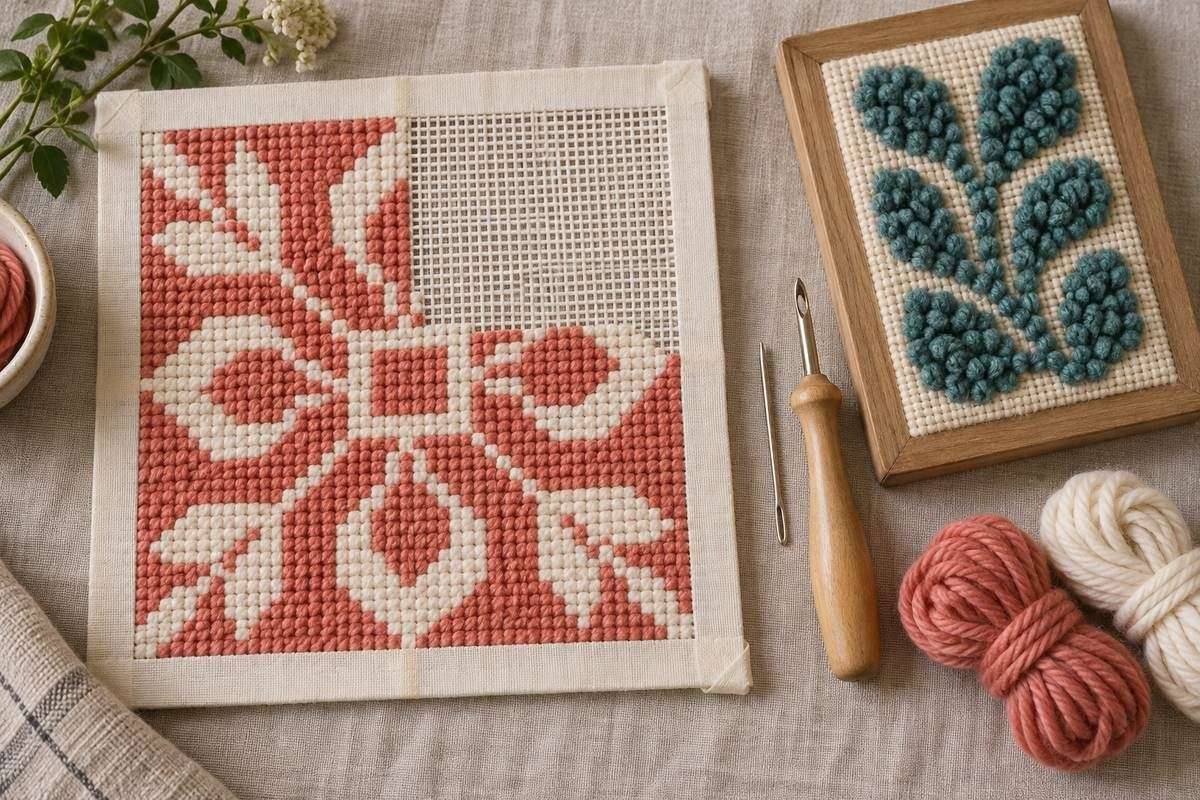
Needlepoint and punch needle share a word and a look on social feeds, so they get treated as cousins. Mechanically they are almost opposites: needlepoint pulls thread all the way through a stiff open canvas, one stitch at a time, and builds a flat woven surface, while punch needle pushes loops of yarn partway into a stretched cloth with a hollow pen-shaped tool and builds a plush pile. The difference decides your tools, your pace, your texture and how the finished piece holds up. This guide sorts the two so you can pick the right one before you buy a kit. Last updated November 3, 2026.
Start here: Want a flat, tailored piece with crisp color edges that can live as a pillow, belt or ornament for decades? That is needlepoint. Want a soft, raised, rug-like texture and fast visible progress? That is punch needle. Neither is a stepping stone to the other - the skills barely transfer - so choose by the surface you want to live with, not by which one looks easier.
Why the two get mixed up
Bower Thread, a needlepoint kit shop, blames the feed: both crafts photograph as colorful fiber art in progress, both use the word needle, and both are marketed to beginners. Punch and Canvas, a punch needle kit shop, makes the same point from the other side - they all involve thread, fabric and something pointy, so it is fair to wonder what the difference is. The Fresh Cross Stitch adds that all three of needlepoint, punch needle and cross stitch count as forms of embroidery in the broad sense, which is true but hides everything that matters when you are choosing one.
The confusion costs real money. A beginner who buys a punch needle kit expecting needlepoint gets a tool that cannot stitch canvas, and a beginner who buys printed needlepoint canvas for punching gets a fabric that cannot hold a loop. The fabrics and tools are not interchangeable in either direction.
Two crafts, two motions
Needlepoint is canvas work. A blunt tapestry needle carries wool, cotton or silk thread fully through the holes of a stiff open-grid canvas, out the back and up again, and every stitch locks into the weave. The Fresh Cross Stitch notes the classics here - tent, continental and basketweave stitches - and that the stitches cover the canvas completely, which is what makes the finished fabric so dense. You work from the front, watching the design appear exactly where it will stay. Our needlepoint vs cross stitch guide covers where that motion sits among the other counted crafts.
Punch needle never passes anything through. The Spruce Crafts describes the motion: instead of stitching through fabric, you push thread or yarn into the cloth while the tool stays on the surface, then withdraw it, leaving a loop behind. Punch and Canvas explains what holds it - nothing is knotted; the tight weave of the foundation cloth grips each loop and its neighbors hold it in place. Because the loops form on the far side, Needlepointers.com points out that the working side is usually the back of the project: you punch along the drawn lines, then turn the piece over to see the plush right side.
The surface each one makes
Needlepoint produces a flat, dense, woven-looking surface with crisp boundaries between colors. Punch and Canvas calls it flat, dense and hard-wearing, which is why you see it on cushions and chair seats, and The Fresh Cross Stitch lists pillows, wall hangings, upholstery, belts and handbags as its natural homes - functional pieces, not just framed ones.
Punch needle produces a raised pile of loops, or a sheared velvety surface if you clip them. The Spruce Crafts describes the result as a highly textured design that shows off the craft's connection to rug making, and Bower Thread calls the look plush and casual against needlepoint's tailored one. The tradeoff for that softness is detail: Bower Thread notes that loops are chunky, so fine lines and lettering are limited, where needlepoint's grid resolves detail stitch by stitch.
Side by side
The two kit shops' comparison tables agree on the essentials:
- Tool: needlepoint uses a blunt tapestry needle (Bower Thread suggests size 20 to 22 for beginner 13-mesh canvas); punch needle uses a hollow tool with the thread running through a channel in its shaft (The Spruce Crafts).
- Base: needlepoint works on stiff open-grid canvas, often needing no hoop at all; punch needle needs a tightly woven foundation cloth - monk's cloth is the most common, per The Spruce Crafts - stretched drum-tight in a hoop or on a frame.
- Working side: needlepoint is worked from the front; punch needle is usually worked from the back, with the loops forming on the far side (Needlepointers.com).
- Speed: punch needle covers ground much faster - The Spruce Crafts says that once you find the rhythm, you can fill a large area in a jiffy, and Punch and Canvas calls loops faster than flat stitches. Needlepoint is slower by design: Bower Thread counts a 5-inch square of 13-mesh canvas at 4,225 stitches, roughly six to ten unhurried hours.
- Fixing mistakes: punch needle loops pull out with a single tug to redo an area (Punch and Canvas); needlepoint stitches have to be unpicked one at a time. Our guide to fixing needlepoint mistakes shows that slower rescue.
Which one lasts
Needlepoint wins this one clearly, and both shop blogs agree. Bower Thread gives the reason: needlepoint stitches are locked into the canvas weave, which is why needlepoint pillows and ornaments survive decades of handling, while punch needle loops hold only by fabric friction and usually need a glued or sewn backing to resist snags - especially on anything touched often. Punch and Canvas confirms the flip side from its own craft: loops can pull out in a single tug, which is wonderful for fixing mistakes and less wonderful on a chair seat. If the piece will be sat on, stepped on or handed down, that is a needlepoint's job; our pillow finishing guide shows what a hard-wearing finish looks like.
Which is easier to start
Both are genuinely beginner crafts; they just fail differently. Bower Thread frames it well: punch needle's failure mode is setup - if the foundation cloth is not drum-tight or the loop depth is set wrong, loops pull straight back out and beginners assume the motion is wrong - while needlepoint's failure mode is patience, since nothing goes wrong mechanically but the finish arrives hour by hour. The Spruce Crafts adds the setup detail that makes punch needle picky: standard hoops work if they hold the fabric tight, but frequent punchers invest in frames with gripper strips or carpet tacks. Punch and Canvas gives punch needle one of the shortest learning curves in the fiber crafts - a single movement - and Bower Thread puts needlepoint's first stitch at about fifteen minutes of learning. If you are setup-averse, needlepoint's printed canvas is the smoother on-ramp; if you want fast visible progress, punching delivers it. Our beginner kits guide covers the needlepoint starting kit.
What a start costs
The two crafts are close. Bower Thread's figures: a complete needlepoint kit runs about $30 to $80, while a punch needle start - tool, cloth and yarn, or a kit - runs about $20 to $50. The long-run costs behave differently, though. Needlepoint's main expense is the hand-painted canvases and threads for each new project, while punch needle's is yarn by the bag for bigger pieces; neither requires the other's tools, so switching later means starting the toolkit over. For the needlepoint side of that budget, why needlepoint is expensive breaks down where the money goes.
Where sources disagree
Is punch needle a kind of embroidery? The Fresh Cross Stitch groups needlepoint, punch needle and cross stitch together as forms of embroidery, and Punch and Canvas concedes that punch needle is, strictly speaking, a kind of embroidery - the relaxed cousin. The Spruce Crafts and Needlepointers.com instead emphasize punch needle's kinship with rug hooking, since it builds loops rather than passing stitches. Both framings are right at different levels: by umbrella category it sits under embroidery, but by mechanism and result it belongs with rug making.
Which is truly easier? Punch and Canvas says punch needle and latch hook have the shortest learning curves because each has a single movement. Bower Thread warns that the simplicity is real only after the setup clicks - tension and loop depth decide whether the loops stay at all - and gives needlepoint the smoother first hour for the setup-averse. The honest answer is that punch needle is easier to do and needlepoint is easier to start.
Can you punch on needlepoint canvas? No, and the sources are not really divided so much as absolute: Bower Thread states that open-grid canvas cannot hold loops, because punch needle needs tightly woven foundation cloth to grip the yarn. If a tutorial suggests otherwise, it is describing rug-hooking mesh, which is a different material again.
FAQ
Is punch needle the same as needlepoint? No. Needlepoint stitches thread fully through a stiff open canvas into a flat woven surface; punch needle pushes loops partway into stretched cloth into a raised pile. Different tools, different fabrics, different textures (Bower Thread).
Which is faster? Punch needle, by a lot - Bower Thread puts a small hoop piece at an afternoon against six to ten hours for a five-inch beginner needlepoint canvas, and The Spruce Crafts says punching fills large areas quickly once the rhythm clicks. Whether faster is better depends on whether you stitch to finish or stitch to unwind.
Which lasts longer? Needlepoint. Its stitches lock into the canvas; punch needle loops rely on fabric tension and usually want a sealed backing to be snag-proof on anything handled often (Bower Thread; Punch and Canvas).
Do I need a hoop for either? Punch needle, yes - the cloth must be drum-tight in a hoop or on a gripper frame (The Spruce Crafts). Needlepoint's stiff canvas can be worked in the hand, though many stitchers like a frame; see do you need a frame for needlepoint.
Can I learn one as training for the other? There is little point - Bower Thread notes the skills barely transfer, so pick the surface you actually want rather than the one that looks like practice.
What about rug hooking and latch hook? They are the next relatives over: rug hooking pulls loops up from below with a hook, and latch hook knots pre-cut yarn onto mesh (Punch and Canvas). Our needlepoint vs rug hooking guide takes that pair apart.
Sources
- Bower Thread - Needlepoint vs. Punch Needle: What's Actually the Difference? (a needlepoint kit shop, September 2026; opposite mechanics, locked stitches vs friction loops, stitch counts, starter costs)
- Punch and Canvas - Punch Needle vs Embroidery, Needlepoint and Rug Hooking (a punch needle kit shop, October 2026; loop mechanics with no knots, one-movement learning curve, the neighboring crafts)
- The Fresh Cross Stitch - Punch Needle vs Needlepoint vs Cross Stitch (a cross stitch shop blog, August 2023; the three crafts as embroidery types, tool lists, needlepoint's classic stitches)
- The Spruce Crafts - What Is Punch Needle Embroidery? (a craft reference site, updated August 2024; monk's cloth and gripper frames, tool sizes, the rug-hooking connection)
- Needlepointers.com - How to Punch Needle Embroidery (a needlework reference site, updated July 2025; the punching motion step by step, working from the back, Bunka embroidery)