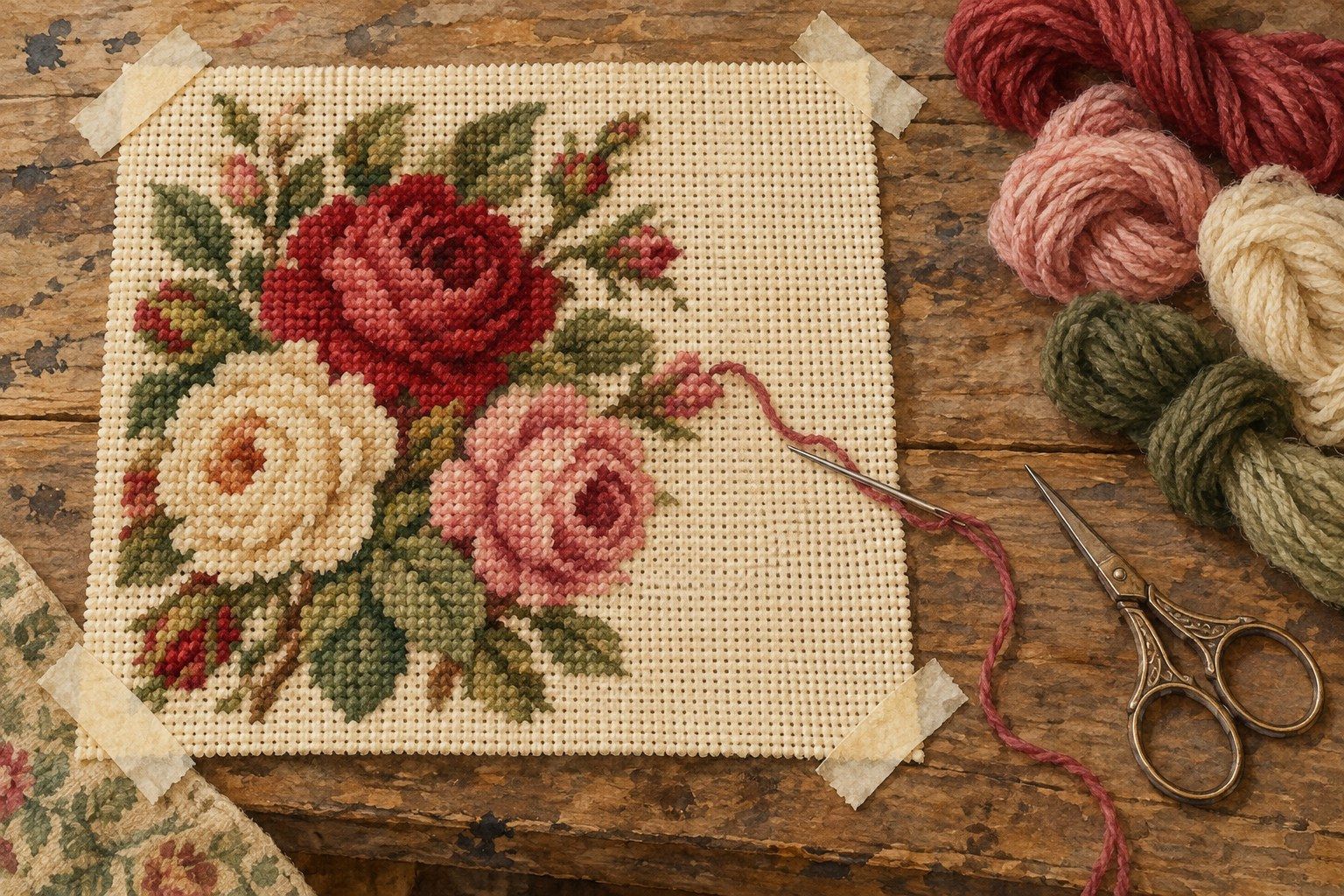
Needlepoint has been a craft of the home since the 16th century: cushions and hangings first, furniture from the 17th, Berlin woolwork stitched from printed charts in the 19th, a 1970s peak and a pandemic revival. Tent stitch on canvas is older still, and the sources argue about exactly how old. Here is the whole arc, century by century, with the dates where eight sources genuinely disagree. Last updated October 25, 2026.
Start here: needlepoint is embroidery stitched over the threads of an open canvas, and its basic stitch is the tent stitch. The oldest surviving tent stitch on canvas is an English church burse from between 1290 and 1340 (Floss Field); the craft became a popular domestic art in the 1500s and a mass craze with Berlin woolwork in the 1800s.
What needlepoint is, and what it was called
Needlepoint is a type of canvas work: yarn stitched through a stiff, open weave canvas so that the design completely covers the ground (Wikipedia). Because it builds a new fabric on an open grid rather than embellishing an existing one, its stitches must be sturdier than most embroidery stitches (Wikipedia).
Names are a tangle. Canvas work was the name until the early 19th century, and canvaswork is still used in Britain (Floss Field). In Britain needlepoint is also often called tapestry, although a true tapestry is woven on a loom; the name passed to canvas work that copied the woven tapestries of palaces and great houses (Floss Field, Wikipedia). Our needlepoint vs tapestry guide unpacks that confusion. The word needlepoint first meant the point of a needle and later a lace made with a needle; sources put that lace usage at 1865 or 1869 (Floss Field, Wikipedia).
The oldest survivors
Tent stitch survives from the Middle Ages. A burse, a flat case for a cloth used at mass, was made in England between 1290 and 1340: canvas embroidered in colored silks in tent stitch and a crossed stitch. A German linen cover for a crozier from the 1400s carries two bands of silk tent stitch (Floss Field), and the V&A holds a tent-stitched purse from about 1450 (West Kingdom).
On fabric rather than canvas, the trail runs further back. The RSN StitchBank dates the earliest evidence of tent stitch to a late 4th or early 5th century tunic excavated at Dush, Egypt. Popular accounts go further still, but Floss Field cautions that histories beginning in ancient Egypt, about 1500 BC, are speaking of a slanted stitch used to decorate clothing and religious objects, not canvas work as we know it.
The 16th to 18th centuries
As a craft of the home, needlepoint became popular in Europe in the 16th century; in the 17th, embroidered furniture came into fashion, and canvas, durable enough for a seat, was the cloth that covered it (Floss Field). Especially in Elizabethan England, canvaswork was extremely popular, imitating the expensive Flemish woven tapestries that were admired and coveted, an affordable homemade version (West Kingdom Needleworkers Guild). Canvas was woven of linen then and is usually a stiff cotton now, and most needlepoint from the 16th to the 18th century was petit point, fine tent stitch on canvas of 20 to 45 holes to the inch (Floss Field).
Much of the work furnished the house: cushion covers, table carpets, hangings, chair covers, and "slips", small motifs stitched, cut out and sewn to velvet or satin (Floss Field; West Kingdom). One table carpet of 1600 to 1615 runs about 400 stitches to the square inch, and the pull of its stitches has drawn the canvas from a rectangle into a leaning parallelogram; a new piece that leans is pulled square by blocking, an old one is not blocked without a conservator's advice (Floss Field). Amateurs drew their own designs, often from the printed pattern books Europe had from the 16th century on; otherwise a professional drew the design (Floss Field). Since that century three stitches have been the most used: tent stitch, cross stitch and Florentine stitch, the upright zigzag also called flame stitch or bargello (Floss Field).
The era's most famous stitcher was Mary Queen of Scots. One set of hangings was worked between 1569 and about 1585 by the captive Scottish queen and the countess whose husband had charge of her, mostly tent stitch and cross stitch copied from woodcuts in printed books (Floss Field). The V&A notes she used petit point to pass the time during her long imprisonment.
In the 1700s tent stitch covered furniture: chair seats, armchairs, stools and screens. By the middle of the century professional embroiderers in Europe were so numerous that a number of them opened shops, selling supplies and kits: a canvas with the design on it and all the materials to finish it (Floss Field). The kit, in other words, is older than the sewing machine.
The 19th century: Berlin woolwork
Berlin woolwork was the craze of Victorian Britain: wool stitched on canvas from a colored chart, usually in one stitch throughout, cross stitch or tent stitch. The chart was printed on squared paper, each square standing for one stitch on the canvas, which is how a needlepoint chart still works (Floss Field). The V&A describes patterns printed on "point" paper, sold as affordable single sheets and creating a craze in Victorian Britain: by 1840 more than 14,000 had been imported into the country, a figure Floss Field matches, adding that charts had pushed aside nearly every other kind of embroidery pattern in England and the United States.
The charts began in Berlin. The first was issued in 1804 (Floss Field); early charts were printed in black and white and colored by hand, later ones by machine, and before them a pattern rarely said which colors or threads to use. The Smithsonian, quoting Miss Lambert's 1846 Handbook of Needlework, gives a more granular account: a Mr Phillipson introduced hand-painted patterns on point paper in 1805, and in 1810 a Madame Wittich prevailed on her husband, a Berlin printseller, to publish a series of them. Wikipedia dates the style's popularity to 1804 to 1875, notes the charts were used sparsely in the United States until they appeared in women's magazines in the 1840s, and credits the Great Exhibition of 1851 with a further boost in Britain.
The materials made the look. Berlin wool came from Merino sheep in Saxony, spun in Gotha and dyed in Berlin; aniline dyes arrived in the mid-1850s and the wool took them well, soon selling in bright colors not to be had before (Floss Field, Wikipedia). Penelope canvas, woven with its threads in pairs, became available mid century (Floss Field; see our canvas types guide). Stitchers made chair seats and backs, cushions, footstools, fire screens, pictures, bags, belts, caps, purses and slippers, and women handed stitched slipper uppers to a shoemaker to make up, much as a stitched canvas now goes to a finisher (Floss Field).
The backlash made history of its own. A leading designer of the day blamed Berlin woolwork for a falling-off in skill with the needle, and in 1872 a school of needlework was founded in Britain to bring ornamental needlework back to its old standing (Floss Field). The V&A names both: William Morris championed art needlework against the Berlin craze, and the Royal School of Needlework was established in 1872 to restore ornamental needlework "to the high place it once held amongst decorative arts". Demand fell in the 1880s; the wool itself was made until the 1930s (Floss Field).
The 20th century to today
British needlework magazines carried needlepoint under the name tapestry from the 1920s to the 1970s; in 1939 one offered a tapestry for the long evenings of the blackout on a coarse canvas so dim light would not tire the eyes, and in 1943 a relief charity asked for half-done embroidery to give wounded prisoners of war as occupational therapy (Floss Field). Suppliers sold part-worked canvases in 1955 and again in the 1960s, the central flowers already stitched and the buyer filling in the background (Floss Field).
The craft's own tools kept evolving. Basketweave, tent stitch worked in diagonal rows, became widely popular in the 20th century, and interlock canvas, whose threads are twisted together where they cross, is an invention of the same century (Floss Field; our basketweave guide teaches the stitch). Interest peaked in the 1970s; afterward many stitchers turned to quilting and knitting (Floss Field). And in the 2020s a revival began in the lockdowns of the Covid-19 pandemic, among younger stitchers, in the United States and beyond (Floss Field).
Needlepoint in America
In the mid-1700s, well-off Connecticut families sent their daughters to school in Boston or Newport, where needlework was taught; a Newport teacher's 1758 newspaper notice offered reading, writing, plain sewing, embroidery, tent stitch and samplers. Boston needlework pictures copied European prints, and in 18th century America needlepoint served as a preparatory skill to train young women to sew their own clothing (Floss Field, Wikipedia).
By the middle of the 19th century Berlin patterns were exported across North America; a large Berlin woolwork picture of 1871 was stitched in Baltimore by a pupil who studied canvas work at an academy there (Floss Field). The guild century followed: an embroiderers' guild started in New York in 1958 as the American branch of a London guild, became independent in 1970 and grew to 92 chapters and 11,000 members by 1975; a guild for needlepoint alone was founded in 1972 (Floss Field).
Who stitched it
Women stitched canvas work at home from the 16th century on; in 18th century America a finished picture hung in the parlor showed its maker's skill and the family's standing (Floss Field). Men stitched too: between 1920 and 1970 British men were generally taken to be non-stitchers, yet sailors, and men recovering from wartime injuries in both world wars, were often given needlepoint, and in 1973 a former professional football player published a book of needlepoint for men (Floss Field).
Tent stitch is not only European. A Chinese official's badge of rank of about 1800 and a 19th century Chinese robe are worked in silk tent stitch on silk gauze in place of canvas (Floss Field). The RSN StitchBank traces the stitch further, from Chefchaouen in Morocco to 19th century Kerman and Arras work and 20th century Aleppo, where women used it on their future bridegrooms' apparel.
Where sources disagree
How old the craft is. The RSN StitchBank gives the earliest evidence of tent stitch as a late 4th or early 5th century tunic from Dush, Egypt. Floss Field starts the canvas-work record with the English burse of 1290 to 1340 and warns that histories beginning around 1500 BC describe a slanted stitch on clothing and religious objects, not canvas work. Wikipedia repeats the 1500 BC Howard Carter claim while flagging its own need for more citations.
When Berlin charts began. Floss Field dates the first Berlin chart to 1804. The Smithsonian, quoting an 1846 needlework handbook, records hand-painted patterns on point paper from 1805 and a printseller's published series from 1810, with the Berlin woolwork name arriving in 1820. Wikipedia dates the fashion itself to 1804 to 1875.
When Berlin work ruled. Floss Field says no embroidery technique was more popular in Britain from 1830 to the 1870s, with demand falling in the 1880s. Wikipedia gives the whole arc 1804 to 1875 and ties the decline to both changing taste and publishers failing to follow it, as art needlework and the Arts and Crafts movement rose.
When "needlepoint" meant lace. Floss Field records the word for a needle-made lace from 1865; Wikipedia's first recorded use as a synonym for point-lace is 1869.
FAQ
How old is needlepoint?
Tent stitch, its basic stitch, survives on canvas from between 1290 and 1340 (Floss Field), and on fabric from a 4th or 5th century Egyptian tunic (RSN StitchBank). As a popular home craft it dates to the 16th century (Floss Field).
What was Berlin woolwork?
Wool stitched on canvas from a colored chart printed on squared paper, usually in one stitch throughout: the Victorian craze that made charted stitching a mass hobby (Floss Field, V&A).
Did Mary Queen of Scots really do needlepoint?
Yes. Panels worked between 1569 and about 1585 by the captive queen and the Countess of Shrewsbury's household survive, mostly tent stitch and cross stitch copied from printed woodcuts (Floss Field); the V&A notes she used petit point during her imprisonment.
When was needlepoint most popular in America?
Interest was at its height in the 1970s, when the US guild grew to 92 chapters and 11,000 members in 1975; afterward many stitchers turned to quilting and knitting (Floss Field).
Is needlepoint popular again?
A revival began in the Covid-19 lockdowns of the 2020s, among younger stitchers in the United States and beyond (Floss Field).
Sources
- Floss Field - The history of needlepoint, century by century (oldest survivors, names, 16th to 18th century furniture and shops, Berlin woolwork detail, 20th century, America, who stitched, Egypt caution)
- Wikipedia - Needlepoint (definitions, tapestry and petit point terminology, 1869 point-lace citation, Beeton 1870, Egypt 1500 BC claim with its own citation flag, post-war gender history)
- Wikipedia - Berlin wool work (1804 to 1875 dating, chart economics, aniline dyes 1856, Great Exhibition 1851, US magazine spread, decline causes)
- V&A - Embroidery styles: an illustrated guide (canvas work and petit point definitions, Mary Queen of Scots, Berlin woolwork craze and the 14,000 figure, William Morris and the 1872 Royal School of Needlework)
- RSN StitchBank - Tent stitch (Dush tunic dating, name origin, world traditions from Morocco to Aleppo, Opus Anglicanum, Hardwick Hall findings, trammed and Penelope notes)
- West Kingdom Needleworkers Guild - Canvaswork (Elizabethan canvaswork culture, tapestry imitation, slips, V&A purse of about 1450, German altar frontals, stitches and materials)
- National Museum of American History - Berlin Wool Work Pattern (Smithsonian; the Phillipson 1805 and Wittich 1810 account from Miss Lambert's 1846 handbook, copperplate printing and hand-coloring, 1820 naming)
- TRC Leiden - Berlin Wool Work Charts (textile research center; Berlin work chart scholarship and digital exhibition)