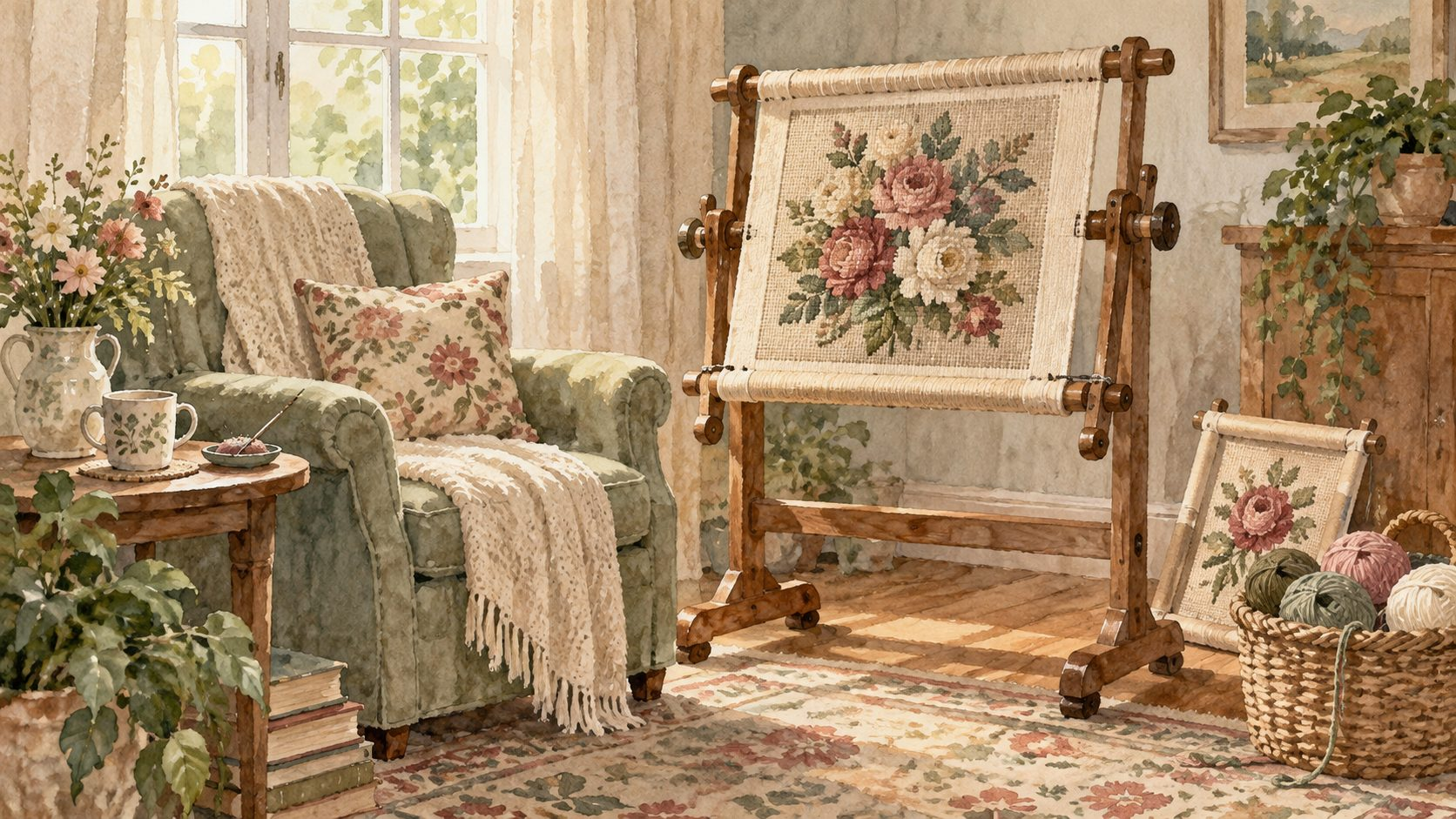
No, you do not need a frame to do needlepoint. Shops and stitchers say the same, and plenty of experienced stitchers work in hand. A frame does help in specific ways: it keeps the canvas square, evens out tension and leaves both hands free. Sources differ on which frame is best, whether a hoop ever makes sense, and how much a stand is worth.
The Needlepoint Shoppe puts stretcher bars firmly in the "nice to have" column and says you can add them once you know how you like to work. Floss Field says a frame is not required, but that it keeps the canvas flat and square, so a piece worked on one often needs little or no blocking. If you are new, begin without one, and try stretcher bars on your second or third canvas.
Why stitchers use a frame
Several sources list the same benefits. Floss Field says a frame keeps tension more even and makes the canvas threads easier to count. World of Needlepoint says a taut canvas makes stitches easier to see and count, and that both hands are free to guide the needle and yarn. Poppy Monk Needlepoint says a frame prevents the canvas from distorting into a parallelogram, so you will not have to block it as hard, and that you handle the canvas less, which keeps it cleaner. Our guide to blocking needlepoint covers what to do if it still comes off crooked.
Nuts About Needlepoint adds two reasons that matter for fancier work. It says some techniques, including pulled thread and beading, need a flat tight base, and that textured stitches look better on a frame because the thread sits flat on a flat canvas. DebBee's Designs agrees for counted canvas work: it says most of the stitches it uses need a tightly stretched canvas and will not lay properly in hand. Our even tension guide has more on that side of it.
Stitching in hand
Floss Field says that if you have no frame, you roll the canvas up to the area you are working on and hold the roll in your other hand, with clips to keep it rolled. It says to use basketweave where it fits and to expect to block at the end. It says continental and half cross stitch rows can pull a canvas out of square, and that basketweave is less likely to warp it. See our basketweave guide.
Unwind Studio prefers in hand stitching because it is the easiest to carry and store, and says it allows "scooping", where you take several stitches in one motion with stitches such as tent stitch or long stitch. Needle in a Haystack, a needlework shop, says it stitches in hand for about 80 percent of its projects, likes to roll or scrunch the fabric, and often uses a sewing motion that needs a flexible canvas. Poppy Monk Needlepoint makes the same point about technique: if you weave the needle across the top of the canvas, a frame holds it too tight.
Stretcher bars, scroll frames and hoops
| Type | What sources say |
|---|---|
| Stretcher bars | Nuts About Needlepoint calls them the most common. Floss Field says they are light wooden bars that slot together at the corners and suit smaller pieces, since the middle of a large frame gets hard to reach. Poppy Monk Needlepoint calls them inexpensive and reusable, and Mr X Stitch says they are generally inexpensive. |
| Scroll frames | Floss Field says two rods are joined by two side bars and the spare canvas rolls up, so they suit long or large pieces. Mr X Stitch says they hold the canvas taut only top and bottom, so the sides stay loose. World of Needlepoint lists widths from 6 to 34 inches. |
| Ratchet frames | World of Needlepoint describes a ratchet frame as a newer variety of scroll frame, with end rails that lock the canvas between them and rollers that move both ways. It lists 12, 18 and 24 inch sizes. |
| Hoops | Floss Field says a hoop is a poor match for canvas because the canvas is thick and stiff, and that the rings mash what lies between them. Nuts About Needlepoint gives two reasons: the wide margins needed would cost too much canvas, and moving a hoop would crush even tent stitches. World of Needlepoint says soft flexible canvas can go in a hoop but that hooping can leave permanent marks in heavier canvas. |
For sizing and mounting, Floss Field says to measure the whole canvas from edge to edge, bare margin included, and gives the example of an 8 by 10 inch canvas taking a pair of 8 inch bars and a pair of 10 inch bars. It says to leave at least 2 inches of bare canvas around the design. World of Needlepoint says the inside of the frame should measure about an inch larger than the canvas all around, which is a different approach. Our stretcher bar size and mounting guide goes through it in detail.
Needle in a Haystack says regular bars from any vendor go together, mini bars from any vendor go together, and Evertites go with Evertites, but you cannot mix types. Nuts About Needlepoint says the same about specialized bars like Evertite and Edmunds adjustable bars. Mr X Stitch says Evertite bars have a tightening mechanism so you can adjust tension without removing the canvas, and that they cost more.
For beads and raised stitches on a scroll frame, Mr X Stitch says to lay felt or towelling over the finished area before rolling. Needle in a Haystack says the same with strips of batting between the layers.
Stands and clamps
Mr X Stitch and DebBee's Designs both say a stand frees a hand. DebBee's Designs describes one hand above the canvas and one below, and says that eases shoulder strain from reaching over and under. World of Needlepoint says lap stands are made for sitting, and floor stands can be used sitting or standing. Floss Field adds that a sit-on stand tucks under your thigh, and that many stands are made for hoops and will not take a heavier frame, so check yours fits before you buy.
DebBee's Designs says to start by looking at how you stitch. Its author stitches in a recliner, where most floor stands will not work because the base of the stand needs to go under the chair, so she measured one in a showroom. For a table, it names the cheapest option as quick release clamps from a hardware store, about $15 to $20 each, with two being best, or a frame weight of 1 to 2 pounds. It also says a table stand can be uncomfortable for shorter people and that System 4 stands are very expensive. We have not checked current prices. A light attached to the stand can help too, see our lighting and magnification guide.
How to choose
- Small canvas, first project: try it in hand, or on stretcher bars if you want a flat canvas. The Needlepoint Shoppe says in hand is fine.
- Counted or decorative stitches, beads: a frame. Nuts About Needlepoint and DebBee's Designs both say the stitches sit better on taut canvas.
- Large or long piece: a scroll frame, per Floss Field, Unwind Studio and Mr X Stitch. Protect beads when rolling.
- Hand pain or fatigue: a frame plus a lap or floor stand, per Mr X Stitch and needlery, which says frames are especially useful for reducing pain when used with a stand.
- Travel: in hand, per Unwind Studio. DebBee's Designs says that if you travel a lot, a table top or lap stand may be the most economical option.
See our beginner supplies guide for the rest of the kit.
Where sources disagree
- Frame or no frame: Nuts About Needlepoint says shops recommend stretcher bars and that it rarely does a piece off them. Needle in a Haystack and Unwind Studio stitch mostly in hand. The Needlepoint Shoppe says frames are optional.
- Scroll frames: Floss Field and Mr X Stitch list them for large canvases. Nuts About Needlepoint says the biggest problem is that the canvas is often not as tight as on stretcher bars.
- Bar size: Floss Field says to take the size down if a canvas falls between sizes, so the bars are smaller than the canvas. World of Needlepoint says the whole canvas should fit inside the frame. Mr X Stitch says the bars should be smaller than the canvas. Check which method your bars and canvas margin allow.
- Hoops: Needle in a Haystack uses hoops for some fabric and for silk gauze, but its page is about cross stitch and fabric. Sources written for needlepoint advise against them on canvas.
- Cross stitch sources: needlery and Needle in a Haystack cover several crafts. Their frame advice applies to canvas only where they say so.
Questions
Do I need stretcher bars for needlepoint?
No. The Needlepoint Shoppe says they are a nice-to-have, and many stitchers work in hand.
What is the best frame for needlepoint?
Mr X Stitch says the best are scroll frames and stretcher bars. Floss Field suits stretcher bars to small pieces and scroll frames to long ones.
Can I use an embroidery hoop on canvas?
Most needlepoint sources say not to. Floss Field says canvas is too stiff for a hoop, and Nuts About Needlepoint says a hoop would crush stitches.
Will a frame stop me needing to block?
It reduces it. Floss Field says a piece worked on a frame often needs little or no blocking. Poppy Monk Needlepoint says a professional finisher will always block.
Do I need a stand?
Only if holding the frame tires your hands. Mr X Stitch and DebBee's Designs say a stand leaves both hands free.
Sources
- Floss Field: Needlepoint frames and stretcher bars, which to use
- Mr X Stitch: Needlepoint Frames and Stands, Quick Guide For Achy Stitchers
- World of Needlepoint: Guide to Needlepoint Frames and Hoops
- DebBee's Designs: Stitching stands, and how to choose one
- Needle in a Haystack: Stitching Frames
- Nuts About Needlepoint: Why Use a Frame?
- Needlery: Hoops, Frames, and Stretcher Bars
- Unwind Studio: How to do Needlepoint with or without a frame
- The Needlepoint Shoppe: Ask the Shoppe, Do I Need Stretcher Bars?
- Poppy Monk Needlepoint: Needlepoint Stretcher Bars, Do I Need Them?